
Electrician Marketing Agency: How to Choose One in 2026

When an electrician asks whether the marketing is working, the answer usually comes back as a cost per lead. That number tells you what an inquiry cost. It says nothing about whether the job got done, what it billed, or whether the caller was even inside your service area.
That gap is where contractors get hurt. A campaign can produce cheap calls all month and still leave the schedule thin, because price shoppers, out-of-area homeowners and people who never call back aren't work. The agency worth hiring is the one that can follow a lead from the search query all the way to the invoice.
Silva Marketing is a Prescott Valley digital marketing agency working with electrical contractors in Prescott, Prescott Valley, Chino Valley, Dewey-Humboldt and the surrounding Northern Arizona communities. We build the local visibility, website and paid campaign systems that put a licensed electrician in front of a homeowner when the panel fails, the EV charger needs installing, or a commercial tenant improvement needs a bid. The goal isn't traffic. It's booked work you can trace.
Table of Contents
What an Electrician Marketing Agency Does for Local Electrical Businesses
Electrician Marketing Services and What They Cost - How to compare a monthly retainer with a one-time build - What to get in writing before you sign
Local SEO and Google Business Profile for Electricians - How the three factors play out in Northern Arizona - Service-area rules that keep listings clean - Does adding city names to a page help
Website and Lead Response That Turn Visits Into Booked Jobs - Five steps to close the speed gap - Why the website has to carry its share
Google Ads and Measuring Profitable Electrician Leads - Referrals belong in the same picture
AI Recommendations Alongside Map Pack Visibility - What AI recommendations actually pull from
Frequently Asked Questions About Electrician Marketing Agencies - Do I need both local SEO and Google Ads - Can an agency guarantee first place in Google Maps - Does the monthly management fee include ad spend - How do I know if a marketing report is useful
Choosing an Electrician Marketing Agency and Your Next Step - How much does an electrician marketing agency cost - How long do results take
What an Electrician Marketing Agency Does for Local Electrical Businesses
An electrician marketing agency builds the systems that bring homeowners and commercial clients to a licensed electrician, then keeps those systems honest about which inquiries turned into jobs. Four pieces have to work together: local search visibility, a website built to turn a worried homeowner into a phone call, Google Ads on the specific job types worth paying for, and follow-up fast enough to beat the next contractor on the list.
Picture a Tuesday evening. At 6:40, half a house goes dark and the homeowner searches on a phone, taps the first listing with a phone number and a licensed badge, and expects an answer. The contractor who shows up in the map pack, has a page about emergency electrical repair, and picks up on the second ring gets the work. The one with a polished brochure site and a contact form nobody monitors gets a submission that goes stale overnight.
We serve residential electricians handling repairs, panel upgrades, EV charger and generator installs, plus commercial crews who want steady project inquiries rather than emergency-only volume. Demand isn't the constraint. The U.S. Bureau of Labor Statistics counted about 821,000 electrician jobs in 2025 and projects roughly 896,900 by 2035, a 9% increase it describes as much faster than average (BLS Occupational Outlook Handbook). More licensed electricians will compete for the same neighborhood searches.
The trade also carries real money. In the 2022 Economic Census, electrical and wiring contractors with paid employees reported about $249.2 billion in combined annual receipts across 81,249 employer establishments (businessnes), roughly $3.07 million per establishment on average. These are firms with budgets, not hobby operations. What each service costs is where most owners want to start, so that comes next.
Electrician Marketing Services and What They Cost
Here's the published list for electricians, so you can price the work before a sales call instead of after one.
Service | What it includes | Listed price | Billing |
|---|---|---|---|
Local SEO | Setup, blog content, technical SEO, backlinks, YouTube content | $1,649 | Per month |
Google Ads management | Full-funnel campaigns, daily optimization, ROI tracking | $1,600 | Per month, one-time setup fee may apply |
Custom website design | Conversion-focused, mobile-ready, SEO-friendly build | From $3,998 | One-time project fee |
Website redesign | Custom layouts around your goals and audience, persuasive copy, SEO-ready structure | No published figure, scoped after a consult | One-time project fee |
AI SEO | Campaigns on AI platforms, ranking work, continuous optimization | Free consult listed | Scope and fee set after the consult |
Logo design | Distinctive branding for the business | Free consult listed | Scope and fee set after the consult |
How to compare a monthly retainer with a one-time build
A retainer and a build are different budgets, and comparing headline numbers hides that. Multiply the monthly lines by twelve. Local SEO at $1,649 a month is $19,788 in year one. Google Ads management at $1,600 a month is $19,200. A custom website starting at $3,998 is paid once. Twelve months of SEO plus a new site lands near $23,800, and that's the figure to hold next to any other proposal you receive.
Then ask whether the ad budget paid to Google is billed separately from the management fee. In most proposals it is, and a $1,600 management line can sit beside an ad budget of the same size or larger. Two agencies quoting the same retainer can differ by thousands a year in total outlay.
Practical rule: Judge every proposal on its first-year total, then judge that total against the gross profit of the jobs it should produce.
If you want a second opinion on how pay-per-call local service ads differ from keyword campaigns before committing a budget, this explanation of how to win more calls from local searches is worth twenty minutes.
What to get in writing before you sign
Ask for an itemized proposal, not a package name. The scope should state which services, which locations, how many pages or campaigns, and which metrics the monthly fee covers. Website redesign, AI SEO and logo design are quoted after a consult because scope drives the price, so get the scope in writing first and the number second.
Local SEO and Google Business Profile for Electricians
Google's own documentation reduces local rankings to three factors: relevance, distance and prominence (Google Business Profile Help). Relevance is how closely your profile matches what someone typed, whether that's "licensed electrician," "panel upgrade" or "emergency electrical repair." Distance is how far you sit from the searcher or from the area named in the query. Prominence is how well known and well reviewed you are, and links, review volume and ratings all feed it.
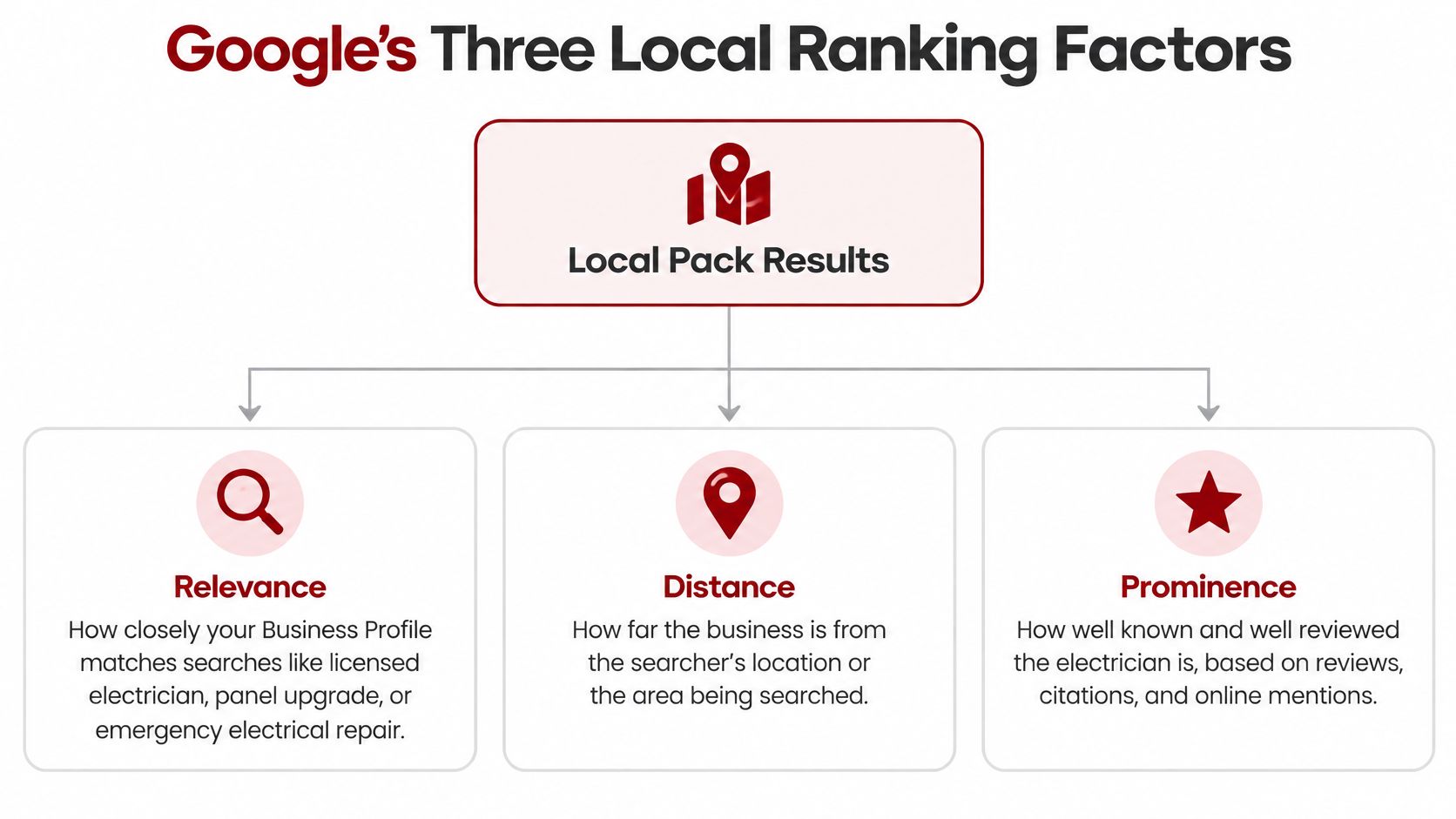
How the three factors play out in Northern Arizona
The model explains something owners find maddening. A nearby, tightly relevant electrician can outrank a bigger company with a stronger brand, because the bigger firm's shop is forty minutes away and its profile is thin on the specific service being searched. That's an opening for a well-built local presence in Prescott, Prescott Valley, Chino Valley and Dewey-Humboldt.
Relevance is the factor you control most directly. Each priority service deserves its own crawlable page with real detail: emergency electrical repair, panel upgrades, EV charger installation, generator installation, commercial electrical work. Distance you can't change, but you can define it accurately.
Service-area rules that keep listings clean
Google asks service-area businesses to keep one profile for the central office and to designate the areas they serve, with the overall territory generally within about two hours of driving from that base (Google Business Profile guidelines). Building a separate profile for every town creates duplicates and misleading listings. An excessively broad footprint misrepresents what you cover, and customers notice when the truck never arrives.
Our own office at 8101 E Pecos Dr., Prescott Valley, AZ 86314 follows the same rules, and so should yours: one address, one set of service areas, the same name and phone everywhere.
Does adding city names to a page help
Not on its own. Swapping town names into the same paragraph is the oldest doorway-page trick in local search, and it doesn't build relevance. Pages need accurate service descriptions, genuine proof, a complete profile and real local authority behind them. For the deeper technical structure, our guide to SEO for electrical contractors covers page hierarchy and internal linking.
Run a consistency check on name, address, phone, hours and service areas across your site and every directory that lists you. Mismatches cost you prominence.
Reviews and Reputation That Build Local Trust
Reviews do two jobs at once. Volume and positive ratings can help local ranking, and reviews that name the actual work, a panel replacement, a rewire, an EV charger install, give both customers and search engines a clearer picture of what you do.
Electricians collect strong review moments naturally. An emergency repair at 9 pm, a rewire on a 1950s house, a service upgrade that finally stopped the nuisance trips. Those experiences shape the next call, which is why the review process deserves a system rather than an occasional ask.
The policy line is firm. BrightLocal's 2025 Local Consumer Review Survey warns that most official review platforms prohibit incentivizing customers to write reviews and may penalize businesses that do so (BrightLocal). A discount or a gift card in exchange for a positive review is off the table, and so is writing reviews yourself or buying them.
Can you offer a discount for a review? No. The gain is small and the platform risk lands on your profile, not on the person who suggested it.
A compliant workflow is unglamorous and effective. Ask genuine customers for honest feedback after the work is complete, make the ask easy with a direct link, and never filter who gets asked. Respond to praise briefly and to complaints calmly, with facts: what happened, what you did about it, and an invitation to call.
Read the complaints as operations data. Late arrivals, estimates that changed, weak communication, debris left in a yard. Fix the cause and the ratings follow. If you want the full workflow, our review management strategy covers the timing of the ask and how to route negative feedback internally before it goes public. We help Prescott-area electricians build that process so it stays inside platform rules.
Website and Lead Response That Turn Visits Into Booked Jobs
Speed is the part of the funnel most contractors never measure. A Harvard Business Review audit of 2,241 U.S. companies found that only 37% responded to web-generated leads within one hour, while the average response time among companies that eventually did reply was 42 hours (Harvard Business Review). A separate analysis of 1.25 million leads showed the payoff: contacting within an hour made a company nearly seven times more likely to qualify the lead than waiting one more hour, and more than 60 times more likely than waiting a day or longer.
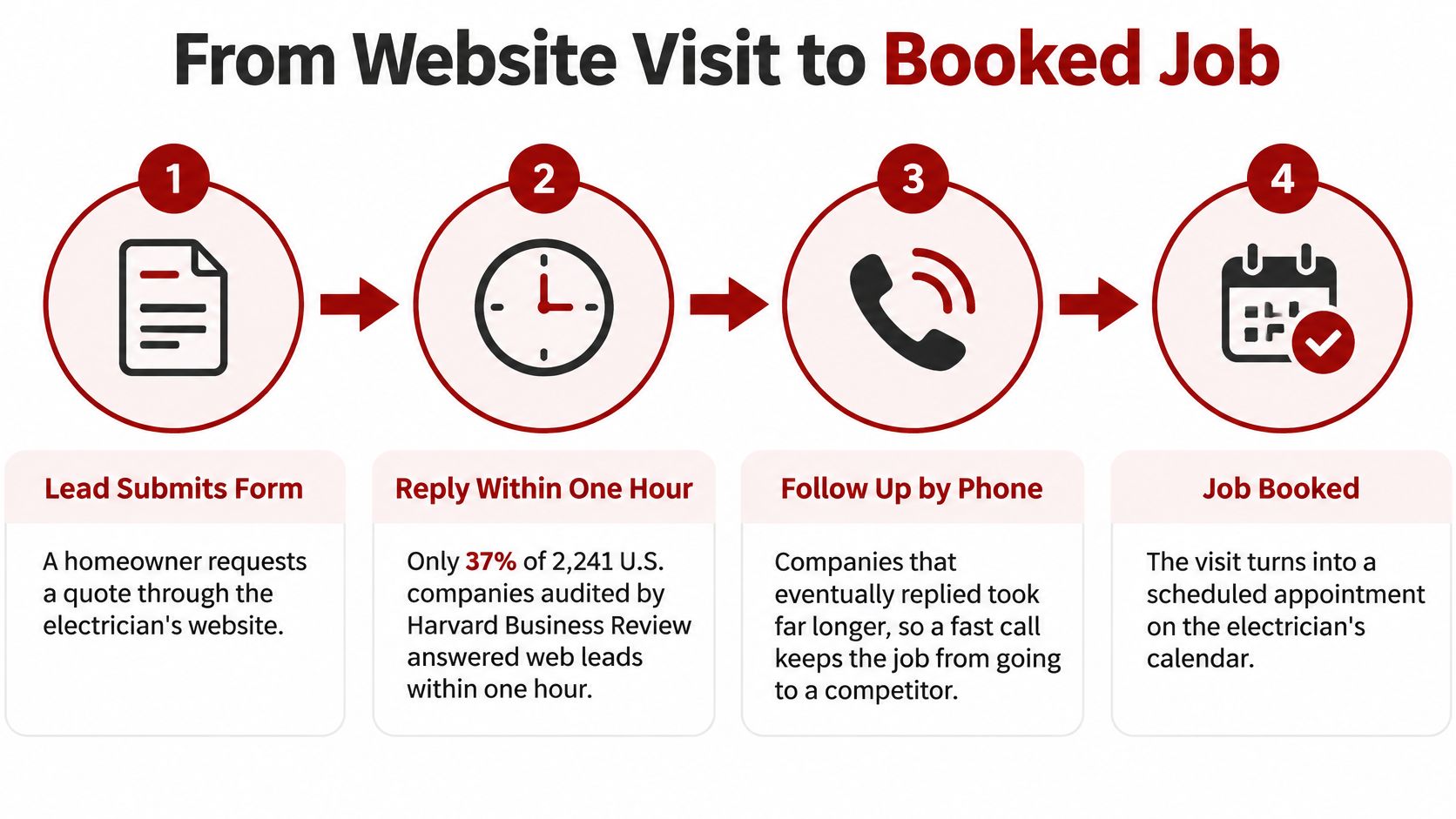
Response window | Qualification likelihood | Internal target |
|---|---|---|
Within one hour | Benchmark with the highest qualification rate | Five-minute first contact |
After one additional hour | Nearly 7 times less likely to qualify than a one-hour response | Five-minute first contact |
24 hours or more | More than 60 times less likely to qualify than a one-hour response | Five-minute first contact |
Five steps to close the speed gap
Route every inquiry to one place. Website forms and Google Ads calls should land in a shared inbox with an immediate SMS or email alert, not a portal someone checks when the van stops moving.
Give calls a human destination. Call-routing rules should send calls to a person or a mobile answering service, including after hours and during job-site hours when nobody can pick up.
Timestamp every lead in the CRM. The arrival time is the only way to prove later whether you hit your own standard.
Set a five-minute internal target for first contact. The published benchmark tops out at one hour, and a five-minute goal keeps you well inside it.
Log the outcome, not just the contact. Was the lead qualified? Did it book? Without those two fields, your reporting can't separate volume from value.
The mechanism is stronger for electrical work than for most trades. People search while facing an outage, a hazard, an inspection deadline or a property closing, so the first credible contractor to make contact often takes the job before competing bids are requested.
Why the website has to carry its share
Google-derived consumer research summarized by Local Catalyst reports that 76% of people conducting a nearby search on a smartphone visit a related business within a day, and 28% of local searches result in a purchase (Local Catalyst). Click-to-call buttons, service pages that load fast on a phone, and a form that takes thirty seconds are not decoration. Our website design for electricians work is built around conversion-focused, mobile-ready, SEO-friendly sites designed for speed and trust.
Test your own site tonight: call the number on the page from a phone, submit the contact form, and time how long until someone responds.
Google Ads and Measuring Profitable Electrician Leads
Google Ads for electricians bids on search terms like "emergency electrician," "panel upgrade" and "EV charger installation," with geographic targeting matched to the service area you defined in your Business Profile. Platform spend is billed separately from the management fee, so a proposal should show both lines. The setup we run includes precision targeting, ad copy written for the job type, lead generation and continuous optimization.
The measurement question that matters isn't what a click cost. It's which campaign, service line, geography and call-handling process produced completed, profitable work.
Metric | What it reveals | Common trap | Where the data comes from |
|---|---|---|---|
Cost per lead | Entry cost of an inquiry | Cheap calls that are unqualified or outside the service area | Google Ads and call tracking |
Qualified call rate | Whether calls fit the service area and can be scheduled | Counting every call as a lead | Call tracking tied to CRM outcomes |
Booked estimate rate | How many qualified calls become scheduled visits | Booking without follow-up | CRM pipeline |
Close rate | How many estimates become signed jobs | Ignoring job type | CRM and invoices |
Margin-adjusted return on ad spend | Gross profit earned per ad dollar | Revenue reported without margin | Offline conversion imports with job margin |
A low cost per lead misleads whenever the calls are outside your area, price shopping, or impossible to schedule. Those inquiries look like a bargain on a dashboard and produce nothing in the calendar.
Referrals belong in the same picture
A 2026 homeowner survey reported that the professional hired was most often someone the customer had used before (31%) or a friend or family referral (31%) (Enrich Labs). Search and reviews carry the moment when no referral exists, and they should be read alongside your referral volume rather than in isolation.
Set up offline conversion imports so each lead's source can be followed to its completed job. Call tracking tied to CRM outcomes is what makes that possible. Then resist the urge to celebrate a falling cost per lead. Cutting it can shift budget toward low-value emergency inquiries while starving the higher-margin work: panel upgrades, EV charging, generators, commercial service.
Each month, clients get a performance dashboard and report, a next-step roadmap, direct communication with their marketer, and clear measurable KPIs. For the campaign structure itself, see our notes on Google Ads for electricians.
AI Recommendations Alongside Map Pack Visibility
AI search is growing, but map pack visibility still carries more local buying intent for electrical work right now. A 2026 local-business survey found that 45% of consumers used AI tools for local recommendations, up from 6% the year before, while a separate 2025 survey cited in industry coverage found AI chatbots were the starting point for only 7% of homeowner service searches (Licheo). The practical read is simple: map pack appearances remain far more common than AI chatbot recommendations, so AI deserves a separate workstream, not first claim on the budget.

The order of work matters. Fix the map pack, reviews and website before expanding into AI platforms, because those assets serve the homeowner who is ready to call now. AI SEO works as an added discovery layer that supports future demand. It should feed the same service pages, location signals and proof points that already make local search clear.
The bigger mistake is measuring AI visibility by mentions alone. A mention can appear in an answer that never produces a call, while a lower-volume AI referral can become a panel upgrade, EV charger install or service call that gets booked. For an electrical business, the useful question is not whether a chatbot said the company name. It is whether that discovery path produced a qualified call, a scheduled appointment and a profitable completed job.
What AI recommendations actually pull from
Models assemble answers from pages that describe a job clearly, from consistent business identity data, from reviews that name real services, and from authoritative third-party references. A page that explains what a panel upgrade involves, when a service change is required, and what the customer should expect gives an answer engine something to quote. A page that only says "we do electrical work" gives it little to use.
Specificity beats broad claims here. Service pages should state the electrical problem, the service area, the booking path and the proof that the work was completed professionally. Business details need to match across the website and local profiles, including the office address at 8101 E Pecos Dr., Prescott Valley, AZ 86314, USA. Reviews help more when customers mention the work performed, such as troubleshooting, replacements or installation, because those details connect naturally to the questions homeowners ask.
Silva Marketing's AI SEO runs strategic campaigns on AI platforms to expand audience, build brand awareness and generate leads. The listed features include ranking on top AI platforms, strategic growth and continuous optimization. That work sits on top of local SEO and should be judged against the same commercial outcome as any other channel: qualified jobs, not vague visibility.
AI SEO should also stay separate from Google Maps in reporting and in execution. Google Maps depends heavily on relevance, distance and prominence, which is why map pack work centers on accurate business data, reviews, service relevance and localPages that match the search. AI platforms pull from a wider mix of sources and may surface a business without sending a click. Treat them as connected systems, but keep the scoreboard separate.
When you report on AI visibility, keep the lines clear: branded AI referrals, assisted conversions, direct traffic, phone calls and qualified jobs. Until those numbers show revenue, AI visibility is an experiment with a budget, not a proven channel. For Prescott-area electricians, I would keep AI spend modest until it can be tied to completed work and margin, while maintaining the map pack, review and website work that supports near-term demand.
Frequently Asked Questions About Electrician Marketing Agencies
Do I need both local SEO and Google Ads
Not always. Local SEO builds durable visibility in the map pack and compounds over time, while Google Ads produces leads quickly for specific services. Many electricians run both and set the split by service mix: ads carrying emergency and seasonal demand, SEO carrying panel upgrades, EV chargers and commercial work.
Can an agency guarantee first place in Google Maps
No honest agency can. Google weighs relevance, distance and prominence, and the competitive picture shifts as nearby contractors publish pages and collect reviews. What a good agency commits to is a documented plan and reporting you can audit.
Does the monthly management fee include ad spend
Usually not. Platform spend is typically billed separately from the fee, so check the itemized proposal for both numbers before signing. The same applies to setup fees, which can appear when SEO or Google Ads is bought on its own.
How do I know if a marketing report is useful
Look for qualified calls, booked jobs and revenue, not clicks and impressions. If the report can't show which campaign produced which completed job, it's describing activity rather than results, and the measurement table earlier in this guide is the standard to hold it to.
Choosing an Electrician Marketing Agency and Your Next Step
Choose an agency only after you can name three things: your service area, the services that matter most to your revenue, and the metrics you'll judge the work by. Without those, every proposal looks reasonable and none can be compared. We meet with clients to align on goals and budget before any proposal is written, because a plan built on guesses wastes the first three months.
Here's the checklist I'd run in order.
Confirm the service area. Ask whether the agency will set up one Business Profile for your office and designate the towns you reach, rather than spinning up a listing per town.
Request an itemized proposal. New clients receive one within 48 hours, and any agency worth comparing should put line items in writing.
Ask about setup fees. SEO or Google Ads bought on their own may carry a one-time setup charge. Get it stated.
Ask what the monthly report shows. Qualified calls and booked jobs, or clicks and impressions?
Ask how reviews get requested. If the answer involves an incentive, walk away.
Ask how AI visibility will be measured. It should appear as separate reporting lines, not folded into organic traffic.
Confirm who your marketer is and how often you'll speak with them directly.
How much does an electrician marketing agency cost
It depends on which pieces you buy. The published list earlier in this article runs $1,649 a month for local SEO and $1,600 a month for Google Ads management, with a custom website starting at $3,998 as a one-time build. Compare first-year totals rather than monthly headlines.
How long do results take
Timing depends on your starting point and how competitive your service area is, so the proposal should state a timeline instead of implying one. Paid campaigns typically move faster than organic visibility, which is why the two are usually run together early and rebalanced later.
When you're ready to talk it through, we offer a free 30-minute call to review your goals and current marketing. No pressure, no obligation, and you'll leave with a clearer picture of what's worth doing next.
Silva Marketing builds the local search, website and Google Ads systems that turn electrical inquiries into completed, profitable jobs, and reports on them that way every month. If you'd rather see the plan on paper before committing to anything, book a free 30-minute call and we'll walk through your service area, your best job types and the metrics worth tracking. You can find the details and start the conversation at Silva Marketing.
Comments