
SEO for Home Services: A Local Playbook for More Calls

98% of consumers had used the internet to find a local business in the previous year, according to the 2024 BrightLocal local consumer review survey, which polled 1,141 U.S. consumers. For a plumber in Prescott Valley or a roofer in Chino Valley, that number settles an old argument. Online discovery isn't a supplement to the truck wrap and the referral list. It's the front door.
Silva Marketing is a Prescott-based digital marketing agency that works with home service companies across Prescott, Prescott Valley, Chino Valley and the rest of Northern Arizona. The problem we solve is narrow: turning local search visibility into answered calls and booked jobs, not just impressions in a monthly report.
Most advice on SEO for home services stops at the ranking. This playbook doesn't. It treats the booked job as the finish line and shows where local search leaks revenue after a homeowner finds you, and why an AI recommendation is not the same thing as a phone that rings.
Table of Contents
What Decides Whether Your Business Shows Up in Local Results - Relevance Is Mostly a Completeness Problem - Distance Is Geography You Can't Argue With - Prominence Builds Slowly and Honestly
How Do You Set Up Google Business Profile for a Service Area - Storefront, Service Area or Several Locations - Three Checks You Can Run Today
Which Service Area Pages Help Homeowners and Google - The Page Map for a Contractor Site - Why Swapped Town Names Fail
How Do You Fix Technical SEO and Local Business Schema - Five Steps in the Order That Matters
How Do You Get Reviews Without Breaking Google's Rules - The Routine That Survives a Busy Week - What Unnatural Looks Like
Why Good Local Rankings Still Miss Calls - The Search Intent Decides the First Screen - Fixes That Work for a Two-Truck Shop
Which Local SEO Numbers Matter Beyond Rankings - Why AI Visibility Needs Its Own Metrics
Questions Home Service Owners Ask Next - Where Do Homeowners Actually Look for a Contractor - Which Listings Should Match First - Will AI Answers Replace the Map Pack This Year
What Decides Whether Your Business Shows Up in Local Results
Google answers this with three factors, and none of them can be bought. Its guidance on how local results are determined states that local search results are primarily based on relevance, distance and prominence, and it says directly that businesses cannot request or pay for a better organic local ranking.
Take a homeowner in Prescott whose air conditioner dies in July. They type "AC repair near me." Google weighs which profiles describe that service, how far each business sits from the phone in their hand, and how well known each one is. On that first screen, your website barely registers. Your Business Profile does the work.
A contractor can influence all three factors. The effort each one requires is wildly different.
Relevance Is Mostly a Completeness Problem
Relevance measures how closely a Business Profile matches the search. Google recommends complete and detailed business information so it can better understand what you offer, which translates into a short list: every service you sell, the most specific primary category you qualify for, secondary categories for the rest, and a description written for a homeowner rather than a keyword tool.
Distance Is Geography You Can't Argue With
Distance is calculated between the searcher and the business, using the searcher's known location when they haven't specified one. A Prescott shop sits close to Prescott Valley and farther from Flagstaff, and no amount of content changes that arithmetic. What you control is whether the towns listed on your profile are the towns your crews drive to.
Prominence Builds Slowly and Honestly
Prominence reflects how well known a business is. Google names links from other websites, review quantity and positive ratings as signals that can influence it. This is the slow factor, and it's the one that compounds, which is why a contractor earning steady local links and reviews in year one is hard to displace in year three.
Factor | What Google Means | What to Do First |
|---|---|---|
Relevance | How closely the profile matches the search | Complete services, categories and description text |
Distance | Distance between the searcher and the business | Service areas that match real drive times |
Prominence | How well known the business is | Links from other sites, review count and rating |
Silva Marketing works with home service companies across Prescott, Prescott Valley, Chino Valley and the wider Northern Arizona region, and the pattern repeats. The businesses that struggle aren't the ones with the worst website. They're the ones whose primary category says "contractor" when they're plumbers, whose services list is half empty, and whose service area covers four counties they've never driven to.
Fix relevance and accuracy first, because those are edits you can make this week. Prominence is earned across seasons. Distance is set by the map.
How Do You Set Up Google Business Profile for a Service Area
Profile setup isn't one procedure. It's several, and choosing the wrong one is how a contractor loses eligibility before writing a single page. Google's guidelines for service-area businesses separate a storefront that welcomes customers from a business that drives to them, and the rules aren't interchangeable. The question to settle first is simple. Do customers come to you, or do you go to them?
Storefront, Service Area or Several Locations
A shop with posted hours uses one profile at its address. A contractor with no public counter uses one service-area profile and hides the address, because customers aren't served there. A company running two staffed offices, each with its own crews, needs one profile per location.
Business Model | Profile Setup | Key Rule |
|---|---|---|
Storefront with customers visiting | One profile at the real address | Show the address and hours |
Service-area business with no public storefront | One profile covering the service area | Name areas by city or postal code, up to 20, no radius, about two hours of driving from base, hide the address |
Multiple staffed locations | One profile per location | Each location gets its own service areas |
The service-area rules are tighter than most owners expect. Areas must be named by cities, postal codes or other named places rather than drawn as a radius. A profile can carry up to 20 service areas, and the overall boundary should generally stay within about two hours of driving time from the business base. A service-area business should also hide its address.
So a Prescott base lists Prescott, Prescott Valley and Chino Valley by name. It doesn't draw a circle over Northern Arizona and hope.
Practical rule: If your crews wouldn't drive there on a Tuesday afternoon for an ordinary job, that town doesn't belong in your service area.
Virtual offices, duplicate profiles and long lists of distant markets are the three ways contractors get themselves into trouble. Each one weakens the connection between your profile and a real place, and verification can pull a listing that doesn't hold up.
Three Checks You Can Run Today
Confirm the business model. If customers never visit, you're a service-area business and the address should be hidden.
List the service areas by name. Cities or postal codes only, capped at 20, inside a sensible drive.
Match the phone number, hours and name everywhere. The profile, the site footer and the contact page should agree character for character.
Our step-by-step walkthrough of Google Business Profile setup for contractors covers categories, services and photos in more detail, and it's worth reading before you edit a live profile. Our website design services cover Prescott, Prescott Valley and Chino Valley, so the town names on a client's site and the areas listed in their profile usually get written by the same team at the same time. That consistency is boring, and it works.
Which Service Area Pages Help Homeowners and Google
The mistake is treating these pages as a numbers game. Twenty pages that read "Plumbing in [Town]" with the name swapped give a homeowner no reason to call and hand Google a set of near-duplicates to sort through. Build a page map first, then write.
The Page Map for a Contractor Site
One page per job type. AC repair, water heater replacement, roof inspection, drain cleaning. Not "plumbing services," because nobody searches that with a hand on a shutoff valve.
One city page per town you serve. Prescott, Prescott Valley and Chino Valley each get their own, written separately.
A handful of urgent pages. No heat, burst pipe, active leak. These carry a tap-to-call number at the top and an honest statement about response time.
Everything else is optional. Three strong pages outperform twenty thin ones, and they're cheaper to keep current.
Why Swapped Town Names Fail
A page that only changes the city name tells a search engine it's a duplicate and tells a homeowner it could be about anywhere. The fix isn't more words. It's local evidence that couldn't be written from a template.
Name the neighborhoods you work in. State a typical response time to that town and mean it. Show photos of completed jobs from that area. Reference the conditions that drive calls there, such as the cold winter nights in Prescott that turn into no-heat emergencies, or the summer cooling load in Prescott Valley.
Three elements belong on every one of these pages.
A unique opening paragraph written for that town and that job, not a variation of the last one.
Real local proof, a finished project or a customer review quoted with permission.
A link back to the matching service page, so the city page and the service page reinforce each other instead of competing.
If you want to see how a roofing company carries service detail and location context on the same page across a metro, America Roofing's Phoenix roofing page is a useful reference for the structure.
The test for a city page is simple. Would a homeowner in that town read it and think "they work here," or would they think "they typed my zip code into a template"?
Start with the three busiest towns on your job board and write one local page for each. Add a fourth only after those three earn calls.
How Do You Fix Technical SEO and Local Business Schema
Structured data is the part of the job contractors skip, usually because it looks like code and no customer ever sees it. Google's documentation on LocalBusiness structured data explains what it's for. It helps Google understand business hours, departments, reviews and other business details, and a complete address improves the quality of information available to users.
For a contractor with one office and three towns, here's the order I'd run it in.
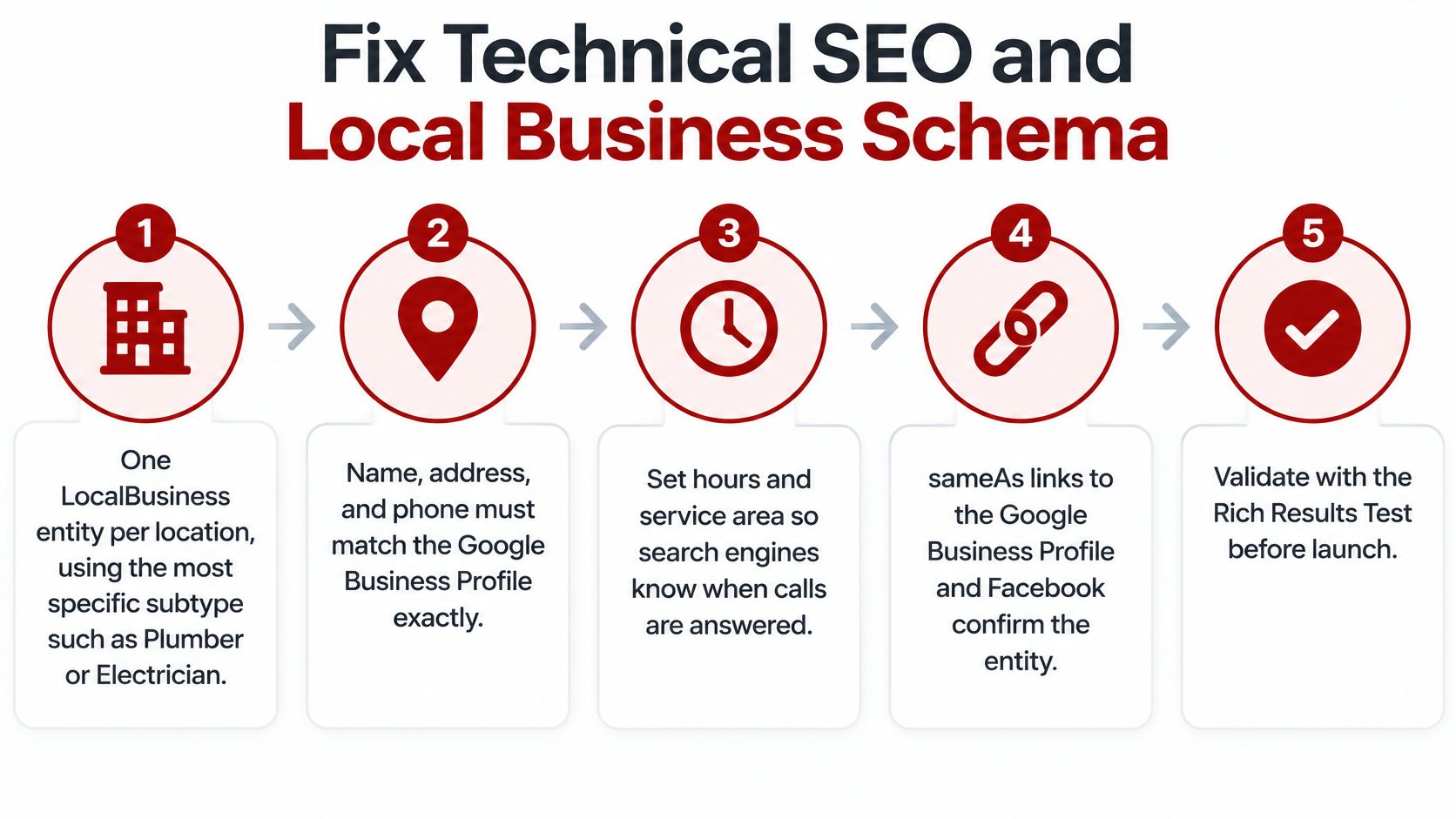
Five Steps in the Order That Matters
Build one entity per physical location. Use the most specific subtype that fits the trade, such as Plumber, Electrician or HVACBusiness, instead of a generic entity cloned onto every city page. A single headquarters entity copied across five towns blurs which office serves which territory, which is the opposite of what the markup is for.
Match the field values to the profile exactly. PostalAddress, telephone, opening hours, service area and URL should read the same in the markup as they do in the Business Profile, including a Prescott base and named areas such as Prescott Valley and Chino Valley. Mismatched name, address or phone details weaken entity recognition.
Validate the JSON-LD in Google's Rich Results Test before the page goes live. Correct every error it reports, and read the warnings too, since they usually mark missing fields Google could have used.
Confirm the page is crawlable. No robots.txt disallow, no noindex tag, no login wall. A blocked page gets nothing from markup at all, and this failure is more common than bad schema.
Check indexing in URL Inspection after each major change. Request a recrawl when you've replaced the entity, then verify the live version rather than the cached one.
The rest of the crawl and speed checklist lives in our guide to technical SEO best practices. Our SEO Consult includes in-depth keyword research, a high-quality content strategy, onsite technical SEO and competitor analysis, and the schema and crawl work sits inside that technical scope rather than arriving as an add-on.
If you run WordPress and would rather not hand-edit JSON-LD, an automatic SEO plugin for WordPress can output the entity from fields you fill in, which removes a class of typos. It doesn't remove step three.
Structured data doesn't guarantee a ranking or a rich result. What it creates is eligibility, plus a clearer set of local business signals for a search engine that's trying to work out which office serves which town.
How Do You Get Reviews Without Breaking Google's Rules
The shortcut most owners reach for is the one that can cost them every review on a profile. That shortcut is the swap: offer a discount for a five-star review, or hand the request only to customers who looked happy at the end of the job.
Google's Maps content policies prohibit fake, misleading, incentivized or biased reviews. Reviews and ratings must reflect a genuine experience with the business, rating manipulation isn't allowed, and it may result in removal. The policy also reaches further than most owners realize. It covers photos, videos, questions and answers, captions, hashtags, tags, links and metadata, so a rule-breaking caption or Q&A answer counts too.
Practice | Status | Why It Matters |
|---|---|---|
Asking every customer for feedback after a completed job | Allowed | Reflects a genuine experience |
Sharing a direct link to your Google review form | Allowed | Makes leaving a review easy |
Replying to every review, positive or negative | Allowed | Shows steady, professional follow-through |
Offering a discount or gift for a review | Not allowed | Incentivized reviews may be removed |
Scripting only positive wording | Not allowed | Biased reviews break Google's policy |
Posting fake or coordinated ratings | Not allowed | Rating manipulation may result in removal |
The Routine That Survives a Busy Week
Ask every customer, not the ones who smiled. Send a direct link to the review form by text the day the job closes. Reply to each review within a few days, and answer a one-star review in the same calm tone you'd use for praise, because the next homeowner reads the response as closely as the rating. Our breakdown of a review management strategy covers the reply templates and the timing in more detail.
What Unnatural Looks Like
Six reviews in one week from a handful of friends reads as coordinated, and it puts the whole profile at risk. A steady trickle from Prescott, Prescott Valley and Chino Valley over months reads like a business that finishes jobs and asks.
Practical rule: Pay for the habit of asking, not for the review. A spiff for requests is defensible. A spiff for stars isn't.
Reviews do double duty as a trust signal and a conversion step, so treat generation as a measurable system. Add a two-line ask to the field checklist and track how many completed jobs produce a review each month. That ratio is a conversion number, not a reputation chore.
Why Good Local Rankings Still Miss Calls
A local ranking can generate a call, but the booked job depends on what happens after the tap. If nobody answers, or the homeowner cannot tell when they will hear back, visibility may bring demand without bringing revenue. For a contractor, the finish line is a scheduled job, not a position in search results.
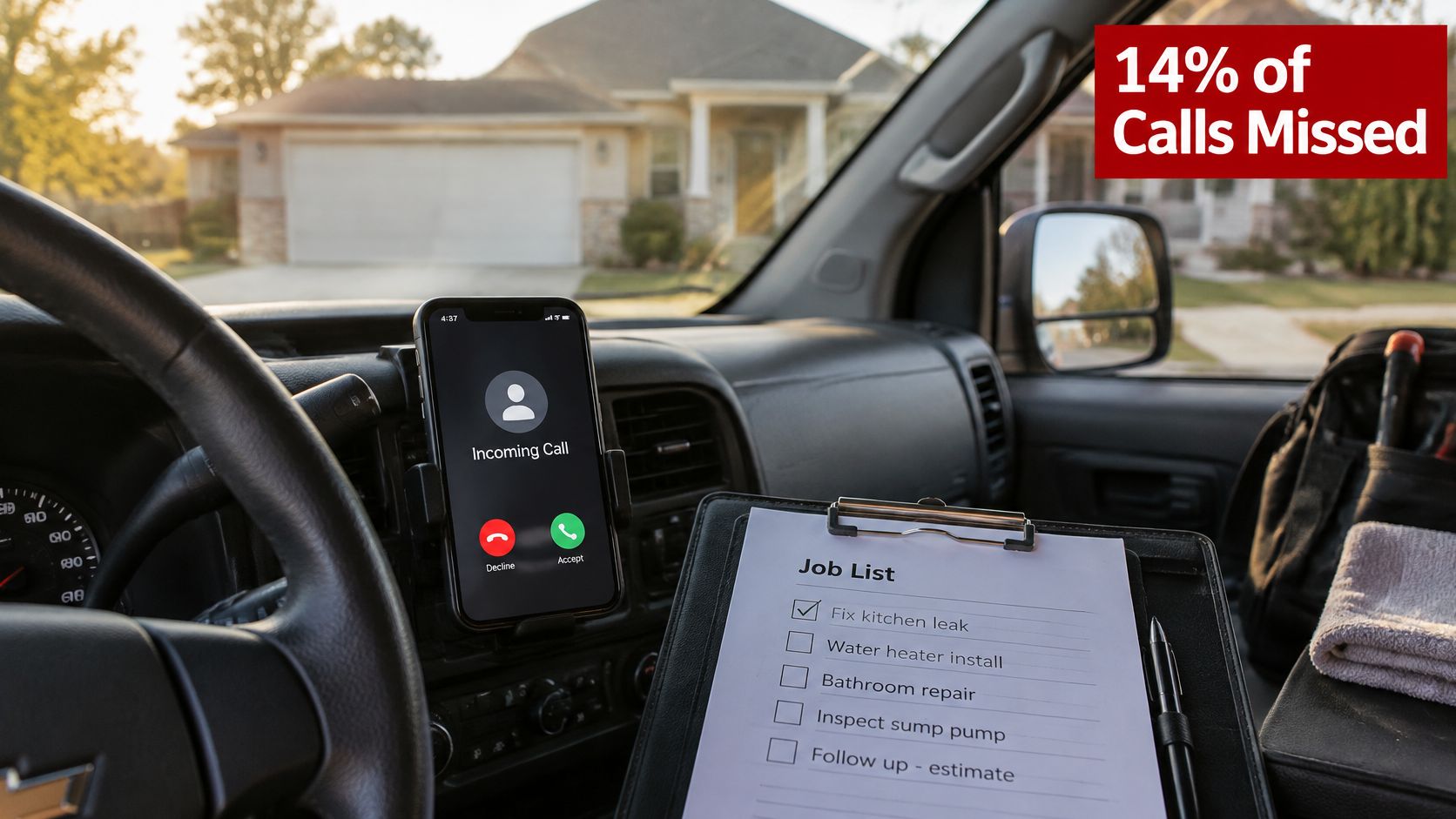
The contractor marketing attribution research reports a 14% missed-call rate for home services businesses. A missed call leaves the homeowner to decide whether to try again, wait, or contact another provider. If your return call comes from a number they do not recognize, they may not answer. Make sure callers know how you will respond, and give them a clear next step if they cannot reach a person immediately.
The conversion point is often a phone in a truck cab, not a position in a report.
The Search Intent Decides the First Screen
An emergency search for a burst pipe or no heat calls for a tap-to-call number near the top, a clear response expectation, and honest after-hours guidance about whether someone will answer.
A planned search for a replacement system or remodel needs project photos, financing information, service areas, and a consultation form. Keep the phone number visible, but give homeowners enough information to compare options.
A maintenance search calls for a price range and online booking. The homeowner may want to schedule work without calling just to ask for a date.
Fixes That Work for a Two-Truck Shop
Set up missed-call text-back so an unanswered call receives a prompt text with a useful next step. If you use call tracking, disclose it clearly at the start of the recording. For after-hours calls, route callers to a live answering option or state when they can expect a callback. A system that matches your actual availability protects the lead without promising a response you cannot deliver.
Search behavior makes that follow-through matter. Tinuiti's 2024 Home Services Marketing Study found that 86% of surveyed U.S. homeowners began searching online for a home services company, with 61% starting on a traditional search engine such as Google or Bing. Scorpion's consumer research, reported by PM Engineer, found that 54% of consumers said they would decide on a home-services provider within four hours of researching options. A slow response can cost you the chance to discuss the job while the homeowner is still choosing.
AI recommendations can introduce a business to a homeowner without producing a website click. When that happens, a clear profile, accurate contact details, and a dependable way to answer or return calls still matter. Discovery is only useful when a homeowner can reach you and take the next step.
Test the customer path by calling your business number during the day and after hours. Check whether a person or a system responds, what the caller hears, and whether the promised next step is clear. Fix the point where a qualified lead is most likely to drop off.
Which Local SEO Numbers Matter Beyond Rankings
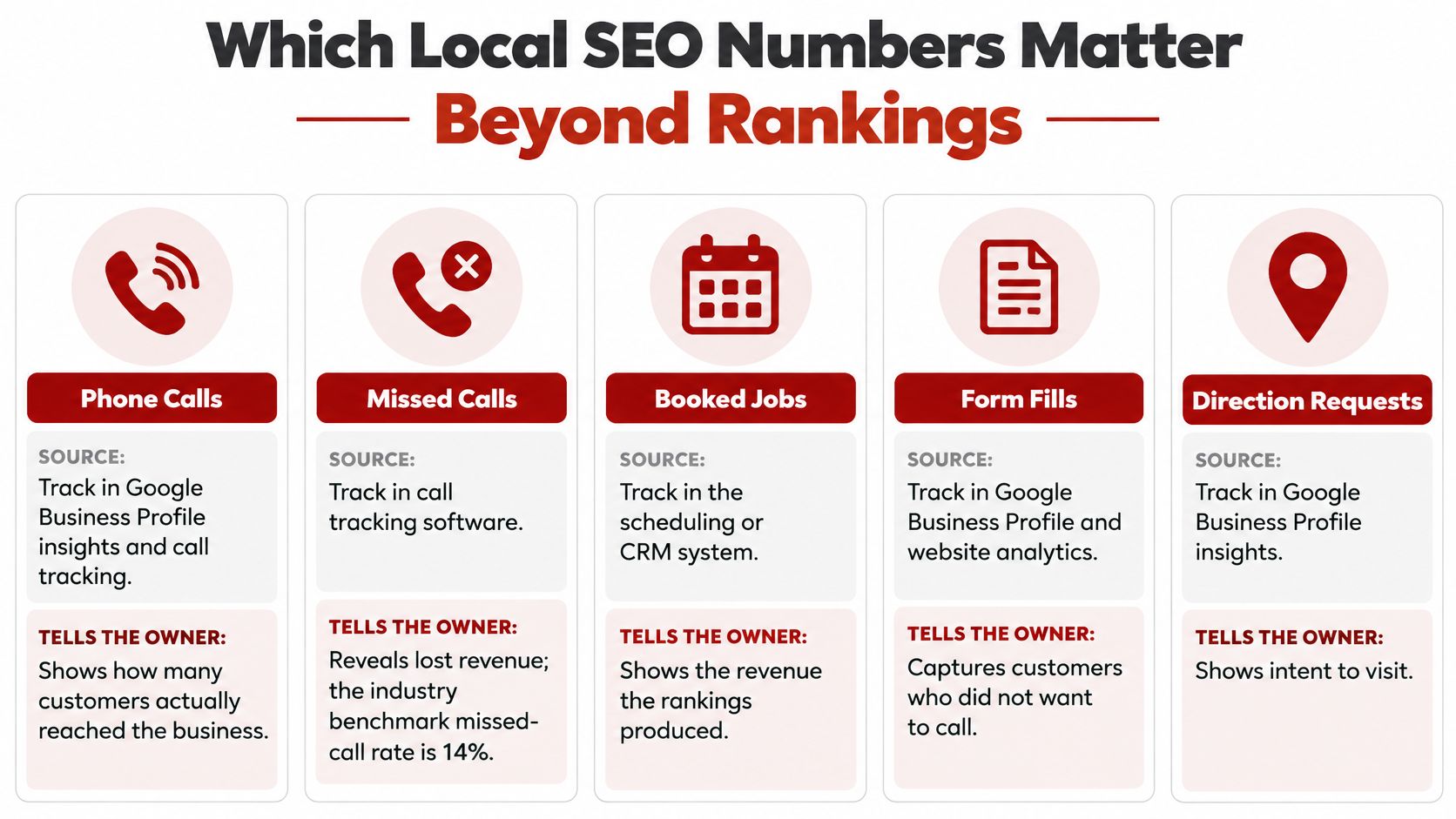
A ranking can bring a homeowner to your business, but a booked job is the finish line. Track where interest turns into calls, where calls fail to qualify, and whether qualified leads schedule work. Review the numbers by service area so a strong result in one city does not hide a weak one elsewhere.
Metric | Where to Track It | What It Tells You |
|---|---|---|
Answered-call rate | Call tracking platform | Share of calls picked up by a person or live answering service |
Qualified-call rate | Call tracking and call notes | Share of answered calls that are genuine job requests within your service area |
Speed to first response | Call logs and CRM | Time from inquiry to first reply |
Booked-job rate | CRM or job software | Share of qualified leads that become scheduled work |
Branded searches | Google Search Console | Searches for your business name, indicating recognition |
Profile actions | Google Business Profile insights | Calls, direction requests, and website clicks from your profile |
AI referrals and mentions | Web analytics and manual prompt tests | Visits from AI tools and how often your business appears in tested answers |
Why AI Visibility Needs Its Own Metrics
AI recommendations can build awareness without sending a measurable visit or producing a call. Research summarized by Cheers found that 23% of consumers encountered AI during a local-business search, yet only 8% began their search on an AI tool. Another 43% returned to Google to verify an AI answer, while only 18% felt ready to contact a business directly from an AI recommendation. The same coverage reported a benchmark in which ChatGPT recommended 1.2% of locations, compared with 35.9% appearing in Google's local 3-pack.
Measure AI visibility alongside the actions that can lead to a booked job. Track referral visits, unlinked brand mentions, and branded search activity together. Test prompts by service, city, urgency, and homeowner scenario, then note whether visibility leads to visits or inquiries. For phone attribution, use these call tracking metrics to connect calls with the pages that prompted them.
A rise in AI mentions without calls or booked work is not proof of revenue growth. AI can assist discovery and validate trust, while Google, Maps, referrals, and phone calls can still complete the buying journey. Keep a one-page report with these seven metrics for each service area, and compare it with the previous month. That makes it easier to see whether the leak is visibility, response, lead quality, or booking.
Start a 30-Day Local SEO Check This Month
Thirty days won't rank a contractor in a competitive market. It will fix the things that make every later month harder.
Week 1, the profile. Confirm the business model, set the most specific primary category, and name the service areas by city.
Week 2, one page. Publish a single local page, then run the schema and crawl check on that URL before you build a second one.
Week 3, the phone and the ask. Add the post-job review request to the field checklist. Call the business number once during the day and once after hours, and time the response.
Week 4, the report. Start the one-page monthly view with answered-call rate, qualified-call rate, booked-job rate, profile actions and branded searches.
A ranking change inside seven days isn't a fair test of any of it. The work compounds over months, which is why the phone and schema items pay off sooner than the pages do.
If you'd rather have an outside read than guess at the setup, Silva Marketing offers a free 30-minute call, and we meet to align on goals and budget before writing any proposal. Bring your last thirty days of call logs.
Questions Home Service Owners Ask Next
Where Do Homeowners Actually Look for a Contractor
Traditional search is still the front door. The 2025 AI and Local Search Consumer Report, summarized by PPC Land, found that 78.7% of surveyed U.S. consumers said they primarily used traditional search engines such as Google, Bing or Yahoo to find local businesses, and the survey included home services among its categories. AI tools sit on top of that behavior, not in place of it.
Which Listings Should Match First
Fix the four places a homeowner checks before you touch a smaller directory. Your website contact page, your site footer, your Google Business Profile, then Facebook and Yelp. Business name, phone number, hours and the city list should be identical in all of them, and a Prescott contractor should show the same Prescott Valley and Chino Valley coverage in each. One stale phone number in a footer does more damage than ten missing citations.
Will AI Answers Replace the Map Pack This Year
No. Treat AI as a selective recommendation layer sitting above the same fundamentals. Most homeowners still verify an answer on Google, and the same three factors still decide who gets the call, so accuracy of service descriptions and service areas remains the highest-return work on the list.
Silva Marketing builds and runs local SEO for home service companies in Prescott, Prescott Valley, Chino Valley and across Northern Arizona, from profile setup and schema work to the call tracking that shows which pages produce booked jobs. If you want an outside read on where your own search presence is leaking calls, the team offers a free 30-minute call and aligns on goals and budget before anything gets proposed. You can visit Silva Marketing to start that conversation.
Comments