
How to Do SEO Audit for Local Service Businesses

Why does a website that looks polished still fail to generate qualified calls?
For a local service business, the answer is often hidden in places customers never see. Google may be unable to crawl an important service page, a mobile template may load too slowly, or a Business Profile may send mixed signals about what the company does and where it operates. An SEO audit finds those gaps and connects them to the pages, searches, and conversion paths that matter.
Silva Marketing helps contractors, home-service companies, professional firms, and growing local brands in Prescott, Prescott Valley, Chino Valley, Dewey-Humboldt, and Northern Arizona identify why qualified prospects aren't finding them. The work covers custom websites, redesigns, technical SEO, local search, content strategy, and Google Ads, with a practical focus on turning visibility into calls and leads. The agency has launched more than 500 websites, a fact stated in its publisher information, and its process centers on analyzing the site, creating a plan, and building authority through measurable execution.
A useful audit doesn't produce a long list of warnings and leave the owner to guess what matters. It verifies access, performance, local relevance, structured data, trust, AI-assisted discovery, and conversion paths in a logical order. The workflow below shows how to do an SEO audit for a local business without confusing tool scores with business results.
Table of Contents
Why Your Website Is Invisible and How We Fix It - What an SEO audit reveals
Running a Crawl and Indexation Audit in Four Passes - Pass one checks robots.txt and XML sitemaps - Pass two inspects the URL and rendering layer - Pass three validates representative URLs - Pass four compares URL sets
Auditing Site Performance for Mobile and Revenue Pages - Start with field data, then diagnose the template - Trace the critical rendering path
Evaluating Local Search Ranking Factors for Map Pack Eligibility - Relevance asks whether the business matches the search - Distance asks where the customer is compared with the business - Prominence asks whether the business appears established and trusted
Checking Structured Data and Trust Signals for Quality - Validate the code and the access path - Assess E-E-A-T in the customer's language
Testing AI-Assisted Local Discovery as an Emerging Audit Layer - Test a realistic local scenario
Prioritizing Fixes and Building Your Audit Report - Rank findings by business impact - Build a report developers can use - Frequently asked questions
Why Your Website Is Invisible and How We Fix It
The first question isn't “What keywords should I add?” It's “Can Google access and understand the pages that make me money?” If the answer is no, more blog posts won't solve the problem. A blocked service page, accidental noindex directive, broken internal link, or conflicting canonical can keep a valuable URL out of organic visibility.
Silva Marketing works with Prescott and Northern Arizona businesses that need more than traffic. Contractors need estimate requests, home-service companies need calls, and established local firms need qualified inquiries from the communities they serve. The problem this audit solves is the gap between having a website and having a website that consistently helps the right people choose the business.
A local website can lose opportunities through technical and commercial weaknesses at the same time. Search engines may struggle with crawlability, while visitors encounter unclear services, slow mobile pages, weak location signals, or no obvious next step. A strong audit checks both sides, because a ranking that produces no call is not a useful business outcome.
What an SEO audit reveals
A practical review examines:
Crawlability: Whether Google can request important URLs and their supporting resources.
Indexation: Whether Google selects the correct pages for its index.
Performance: Whether mobile users can load, read, and interact with key pages smoothly.
Local relevance: Whether the website and Business Profile clearly describe services and service areas.
Trust: Whether customers can verify who operates the business and why its claims are credible.
Conversion paths: Whether a visitor can quickly call, submit a form, or request the next step.
For broader context on how a website supports visibility and credibility, Silva Marketing also explains what an online presence includes.
The rest of the process starts with crawl and indexation, then moves through mobile performance, local ranking signals, structured data, trust, AI-assisted discovery, and prioritization. Each finding should end with a decision: fix it now, schedule it, monitor it, or leave it alone because it has no meaningful effect on qualified demand.
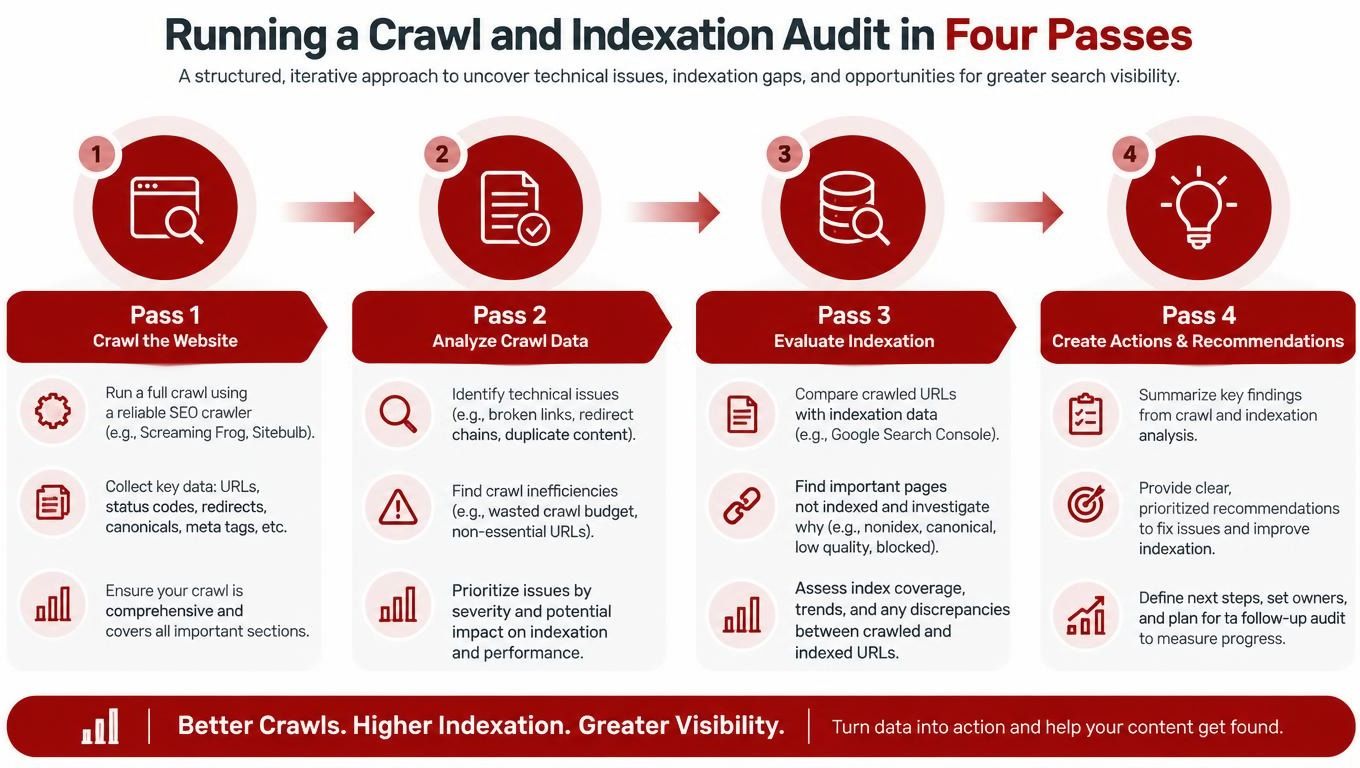
Running a Crawl and Indexation Audit in Four Passes
A page can't generate organic visibility if Google can't discover, crawl, interpret, or select it as the canonical version. The most dependable approach is a four-pass audit that starts with access and ends by comparing what the site offers with what Google has indexed.
Pass one checks robots.txt and XML sitemaps
Fetch the site's file and review every rule against the pages that generate business. Service pages, location pages, contact pages, and important supporting resources should remain crawlable. Check the XML sitemap for important URLs, status codes, redirect entries, errors, and pages carrying noindex directives.
Robots.txt controls crawling, not indexing. Google explains that preventing indexing requires a noindex directive or access restriction. If a page is blocked from crawling, Google may not be able to see a noindex instruction placed on that page. Sitemaps communicate important or newly updated URLs, while canonical tags help consolidate duplicate-page signals. Google identifies URL structure, sitemaps, robots.txt, canonicalization, mobile accessibility, metadata, crawlable links, and HTTP-status handling as core parts of crawling and indexing in its crawling and indexing documentation.
Pass two inspects the URL and rendering layer
Request a representative sample of money pages and record the HTTP status, redirect path, canonical tag, noindex directive, internal links, and rendered content. A page returning a successful status can still be excluded if its canonical points elsewhere, its content appears only after broken JavaScript execution, or no internal page links to it.
JavaScript-heavy sites need a rendered-DOM review, not just a server-HTML review. Confirm that titles, headings, links, canonicals, critical copy, and JSON-LD remain available after rendering. Keep CSS and JavaScript accessible to anonymous crawlers, because blocking those resources can prevent Google from rendering the page accurately.
For teams that need a focused review of how crawling resources are used, Silva Marketing's guide to crawl budget optimization provides related practical context.
Pass three validates representative URLs
Use Google Search Console's URL Inspection tool for the pages that matter commercially. Confirm whether Google can access the URL, which canonical it selected, whether indexing is allowed, and whether the rendered page contains the expected content and links. Don't use a site-search query as proof that a page is indexed. URL Inspection provides the direct diagnostic signal.
Google's move toward mobile-first indexing began in March 2018, after approximately 18 months of testing, making mobile crawlability a foundational part of an audit. The mobile version needs the same meaningful content, internal links, structured data, and metadata as the desktop version.
Pass four compares URL sets
Create a baseline using:
Submitted URLs: Pages listed in the sitemap.
Discovered URLs: Pages search engines know about.
Indexed URLs: Pages Google selected for indexing.
Excluded URLs: Pages Google chose not to index.
Redirected, blocked, and error URLs: Pages requiring corrective action.
Practical rule: Fix an accidental noindex, wrong canonical, blocked resource, or orphaned lead page before polishing low-value metadata.
This comparison turns a crawl into a business diagnostic. Prioritize indexable service and location pages that can generate qualified local leads, then address duplicate or low-value URLs, and leave cosmetic warnings until the revenue-critical problems are resolved.
The video below offers a visual companion to the crawl and indexation workflow.
Auditing Site Performance for Mobile and Revenue Pages
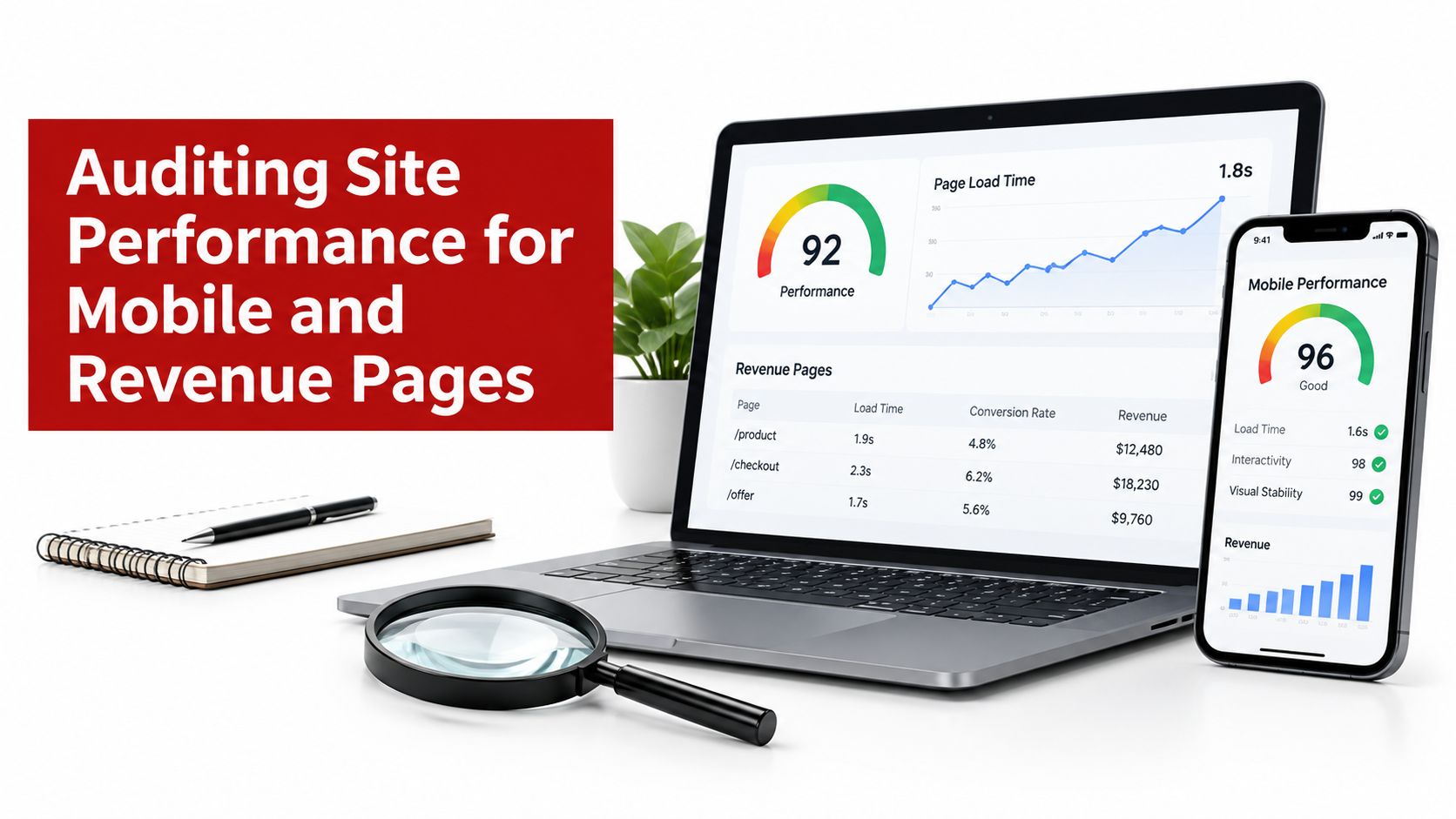
Could a slow service page be costing qualified calls before a visitor reaches your form? Site speed belongs near the start of a local SEO audit because it affects search access and the decision to stay. Google announced in 2018 that slow-loading content could perform less well in search beginning in July of that year. Its mobile-first indexing system uses the mobile version of a page for indexing and ranking. Measure performance instead of reducing the diagnosis to “make it faster.”
In 2025, only 44% of mobile websites had good time to first byte, while 40% needed improvement and 17% performed poorly, according to Google's performance research. The same dataset reported that median mobile total blocking time increased 58%, from 1,209 milliseconds in 2024 to 1,916 milliseconds in 2025. Those figures do not mean every slow page loses every visitor, but they show why a Prescott business should treat responsiveness as a business concern rather than a cosmetic detail.
Start with field data, then diagnose the template
Export the Core Web Vitals report from Google Search Console and group failing URLs by device and template. A sitewide average can look acceptable while a service or location template delays the pages that generate calls. Test the homepage, a core service page, a location page, a blog article, and the contact page separately.
Google's good targets are LCP ≤ 2.5 seconds, INP < 200 milliseconds, and CLS < 0.1, per Google's Core Web Vitals documentation. Use field data to understand real-user conditions, then reproduce failing groups with Lighthouse or PageSpeed Insights for diagnosis. The Core Web Vitals optimization guidance can provide additional context when reviewing page delivery and resource weight.
A useful audit record includes:
Area | What to record | Why it matters |
|---|---|---|
Loading | LCP, TTFB, image loading, server response | Shows whether the main content arrives promptly |
Responsiveness | INP, JavaScript execution, third-party scripts | Identifies delayed taps, forms, and navigation |
Stability | CLS, image dimensions, ads, dynamic modules | Prevents buttons and content from shifting |
Resources | Page weight, CSS, JavaScript, caching, compression | Reveals avoidable delivery costs |
Trace the critical rendering path
For LCP problems, prioritize the largest above-the-fold image, reduce render-blocking CSS and JavaScript, and improve server response time through caching or CDN configuration. For INP problems, reduce unnecessary JavaScript execution, simplify event handlers, and remove third-party scripts that lack a measurable business purpose. For CLS problems, reserve dimensions for images, video, ads, and other dynamic content.
The 2025 Web Almanac page-weight data reported that the median homepage weighed 2.9 MB on desktop and 2.6 MB on mobile. Only 63% of desktop and 53% of mobile pages in the 2 to 3 MB range passed Core Web Vitals. Page weight is a risk signal, not a pass-or-fail rule. A lighter page can still respond poorly when JavaScript blocks interaction, while a heavier page can perform acceptably when delivery is controlled.
Review revenue pages before low-value blog URLs. A shared template fix can improve dozens of service and location pages at once, but confirm that forms, tap-to-call links, booking tools, and tracking still work after deployment. Silva Marketing also publishes practical guidance on Core Web Vitals optimization. Test affected URLs after release and confirm the result with field data before closing the audit item.
Evaluating Local Search Ranking Factors for Map Pack Eligibility
A local SEO audit should evaluate relevance, distance, and prominence, the three local-ranking factors Google identifies in its Business Profile guidance. They answer different questions, so improving one can't compensate for ignoring the others.
Relevance asks whether the business matches the search
Review the Business Profile categories, services, description, website copy, page titles, and location language against the words customers use. A contractor who serves roof repairs, replacements, and inspections shouldn't rely on a vague “home improvement” description if the site and profile can explain those services clearly.
Relevance also depends on service clarity. Each important service needs a page that explains what the business does, who it helps, what the process involves, and where it operates. Avoid creating thin location pages that change only the city name. A Prescott Valley page should offer useful local context, not a duplicated paragraph with a new heading.
Distance asks where the customer is compared with the business
Distance reflects how far the business is from the searcher or from the location named in the query. Service-area businesses should define the cities and regions they serve clearly instead of implying that one office address covers every community in Northern Arizona.
Audit the service-area language across the website, Business Profile, contact details, directory listings, and third-party mentions. Inconsistent coverage can create uncertainty for both customers and search systems. A business that serves Prescott, Chino Valley, and nearby communities should describe that coverage accurately and consistently, without claiming areas it doesn't serve.
Prominence asks whether the business appears established and trusted
Prominence can be influenced by links from other websites and the number of reviews. Examine review activity, the quality and relevance of local mentions, links from credible organizations, and consistency of the business name, address, phone information, and service descriptions.
Factor | Audit question | Practical evidence |
|---|---|---|
Relevance | Does the profile match the service sought? | Categories, services, copy, page topics |
Distance | Is the coverage clear for the searcher's area? | Cities, regions, address, service-area wording |
Prominence | Does the business have credible recognition? | Reviews, relevant links, consistent mentions |
Google doesn't promise a Map Pack position from any single change. A sound audit instead checks whether the business presents a coherent, legitimate profile across first-party and third-party sources. Silva Marketing's resource on setting up a Google Business Profile supports the foundational profile work, while the audit connects that setup to actual service coverage and lead-generation pages.
Checking Structured Data and Trust Signals for Quality
Structured data and trust signals solve different problems. Structured data helps Google interpret the page, while trust signals help customers decide whether the business is accurate, capable, and safe to contact. An audit should check both because valid markup won't rescue a page with unclear ownership or unsupported claims.
Google recommends JSON-LD, while also supporting Microdata and RDFa. Test relevant pages with the Rich Results Test, then inspect the live URL in Search Console to confirm that Google can see the implementation. Validate service pages, location pages, organization information, and other pages that explain what the business does and where it operates.
Validate the code and the access path
A page can contain technically correct markup and still fail to qualify for enhanced search features if Googlebot encounters a robots.txt block, noindex directive, login requirement, or another access restriction. Image URLs referenced by structured data must also remain crawlable and indexable.
Use this sequence:
Identify relevant types: Mark up only information that appears on the page and accurately describes it.
Validate the implementation: Check JSON-LD for errors with the Rich Results Test.
Inspect the live URL: Confirm that Google can access and interpret the page.
Review directives: Check robots.txt, noindex, canonicals, and access controls.
Test referenced assets: Make sure image URLs and other required resources are available.
Markup doesn't guarantee a rich result. It can, however, remove ambiguity when the implementation is accurate, visible, and supported by the page content.
Assess E-E-A-T in the customer's language
Google's Search Quality Rater guidance evaluates experience, expertise, authoritativeness, and trust. The guidance also states that roughly 16,000 external search-quality raters use the guidelines to represent real users and their information needs. Their ratings don't directly determine an individual ranking, but they help evaluate whether search systems return useful results, as described in Google's Search Quality Rater Guidelines.
For a local business, E-E-A-T should appear in practical details:
Experience: Explain relevant first-hand work, methods, or local knowledge.
Expertise: Identify qualifications, training, certifications, or professional experience where applicable.
Authority: Show credible relationships, community involvement, earned mentions, or recognized work.
Trust: Provide a complete business identity, accurate contact details, transparent explanations, and substantiated claims.
Faith-based values, certifications, and community involvement can support trust when they're genuine and relevant to the business. They shouldn't be inserted as decorative SEO language. A customer deciding whether to invite a contractor into a home or schedule a professional service needs clear evidence that the business is real, responsible, and capable.
Testing AI-Assisted Local Discovery as an Emerging Audit Layer
A traditional audit can show whether a business ranks for “contractor Prescott,” but it may not show how a generative interface describes that contractor when a customer asks for a recommendation. AI-assisted local discovery adds a practical question: Does the system identify the business accurately, match it to the right service, and describe its coverage correctly?
In a 2025 survey of 1,000 U.S. consumers, 40% said they actively use generative AI features such as AI Overviews, Copilot, or Meta AI when searching, while 39% estimated that at least 41% of their searches concern local businesses, according to BrightLocal's consumer search behavior research. Only 3% considered an AI platform their default for local searches. That combination makes AI visibility worth monitoring, but not a replacement for conventional Google reporting.
Test a realistic local scenario
Suppose a Prescott contractor offers roof repair across Prescott, Prescott Valley, and nearby communities. A normal ranking check might record positions for service terms. An AI-assisted audit asks the same market questions in natural language:
Which roofing companies serve Prescott Valley?
Who handles emergency roof repair near Prescott?
Which local contractor is a fit for a homeowner needing an inspection?
What services does this company provide, and where does it operate?
Record whether the business appears, whether its service area is accurate, which competitors are cited, and whether the answer confuses specialties or locations. Then compare the answer with the website, Business Profile, review platforms, directories, and other credible mentions.
The audit should also trace the sources behind recommendations. If one platform describes the company accurately while another omits a core service, inconsistent first-party and third-party information may be contributing to the difference. Correct those inconsistencies before treating AI visibility as a content problem.
AI visibility is an emerging risk-monitoring layer, not an undefined “AI ranking.” Silva Marketing can connect answer accuracy to branded searches, calls, direction requests, and qualified leads. That creates a useful measurement discipline without pretending that one prompt represents every customer or every platform.
Prioritizing Fixes and Building Your Audit Report
An audit report becomes useful when a business owner can tell what to fix first, who owns the task, and why the change matters. Tool severity alone isn't enough. A broken link on a rarely visited archive page shouldn't outrank an accidental noindex on a service page that drives calls.
Rank findings by business impact
Use five decision criteria:
Lost-demand potential: Could the issue prevent qualified prospects from finding or using a valuable page?
Conversion importance: Does the affected URL support calls, forms, bookings, or directions?
Affected URL count: Is the problem isolated or repeated across a shared template?
Confidence: Do Search Console, a crawl, field data, or manual inspection confirm it?
Implementation effort: Can the team fix it quickly, or does it require development and testing?
A practical priority order starts with access and indexation problems on money pages. Next come shared mobile-performance issues, incorrect local information, weak service-page content, and structured-data or trust gaps. Cosmetic metadata issues and low-value duplicate URLs can follow when they don't affect a conversion path.
Build a report developers can use
Every finding should include:
Report field | What to include |
|---|---|
Issue | A plain-language description |
Evidence | URL, status, screenshot, Search Console result, or test output |
Business effect | The likely effect on discovery, trust, or conversion |
Recommendation | The specific correction |
Owner | Marketing, development, content, or business staff |
Priority | Based on impact, confidence, and effort |
Validation | The test that confirms completion |
Don't report “improve SEO” as a task. Report “remove the noindex directive from the Prescott roof-repair page, confirm the canonical, request inspection, and monitor the indexed URL set.” Specific work survives handoffs and makes progress measurable.
Frequently asked questions
How often should a local business run an SEO audit?
Run a full audit when the site changes substantially, visibility drops, a migration occurs, or the business expands into new services or locations. Lighter monitoring can catch crawl errors, indexing changes, performance regressions, and local-profile inconsistencies between larger reviews.
Can free tools replace a professional SEO audit?
Google Search Console, URL Inspection, Lighthouse, PageSpeed Insights, the Rich Results Test, and Business Profile tools can reveal important problems. They don't replace judgment about which pages generate qualified leads, how local signals fit together, or whether a technical warning deserves development time.
What makes a local SEO audit different from a generic audit?
A local audit connects technical findings to service pages, location pages, calls, forms, directions, reviews, and service-area clarity. It also checks relevance, distance, and prominence, then adds AI-assisted discovery testing to see whether generative answers represent the business accurately.
What should a business fix first?
Fix anything that prevents Google from accessing, indexing, or interpreting revenue-generating pages. After that, address shared mobile-template problems and inaccurate local signals, then improve content, trust, structured data, and authority in proportion to their likely contribution to qualified demand.
A useful audit doesn't promise a ranking position. It gives a Prescott or Northern Arizona business a defensible order of operations, evidence for every recommendation, and a way to connect SEO work with the calls and leads the company wants.
Silva Marketing offers local SEO audits and related strategy covering keyword research, content planning, technical fixes, on-page optimization, competitor analysis, and local search visibility. Visit Silva Marketing to discuss the pages and search opportunities most relevant to your Prescott or Northern Arizona business.
Comments