
Local SEO Audit Guide for Service Businesses

A Prescott contractor can have a polished website, reliable crews, and years of satisfied customers, yet still disappear from Google Maps when a homeowner searches for help. The phone stays quiet while three competitors appear in the Map Pack. A local SEO audit explains that gap by tracing visibility problems back to the profile, website, listings, reviews, links, and conversion path instead of guessing from rankings alone.
Silva Marketing is a Prescott-based digital marketing agency that helps Northern Arizona contractors, service-area businesses, and local firms turn search visibility into qualified calls. Its work covers custom websites, technical SEO, content strategy, competitor analysis, and Google Ads for businesses serving Prescott, Prescott Valley, Chino Valley, Dewey-Humboldt, and nearby communities.
Table of Contents
Auditing Your Google Business Profile First - Relevance starts with the category and service details - Distance depends on accurate coverage - Prominence determines who wins close comparisons
Checking Local Citations and NAP Consistency - A practical citation sweep
On-Page and Technical Local Signals - Review each service-area page as a conversion asset - Technical checks protect visibility
Reviews and Local Link Prominence - Read the gap before choosing the tactic
Tracking, Reporting, and the 90-Day Roadmap - Turn findings into timed decisions
Local SEO Audit Questions From Prescott Business Owners - How long does a full local SEO audit take? - What does the audit deliver? - What does a local SEO audit cost in Prescott? - When should calls start changing? - Can a provider handle a suspended or duplicate profile? - How often should the audit repeat? - What should the owner provide?
Why Prescott Service Businesses Need a Local SEO Audit
The owner usually notices the problem in a practical way. A customer says they found another contractor on Google, a dispatcher hears that a competitor is “everywhere,” or a business owner checks Maps from home and can't find their own listing. The website may look fine, but local search depends on more than design and general keyword targeting.
Google says local results are primarily shaped by relevance, distance, and prominence. Relevance measures how closely a Business Profile matches the search, distance reflects the relationship between the searcher and the business, and prominence includes signals such as reviews and backlinks. That framework gives an audit a useful order, rather than leaving the owner with a long list of disconnected recommendations. Google's explanation of local ranking is the clearest starting point.
Prescott service-area businesses face a particular challenge because they often work across the Quad Cities without a public storefront. A roofer, HVAC company, plumber, or remodeling firm may serve several communities, but Google still evaluates local relevance and proximity to the searcher. Seasonal tourism, overlapping contractor markets, and changing demand between Prescott, Prescott Valley, Chino Valley, and surrounding Northern Arizona areas make a profile's service clarity and prominence especially important.
Practical rule: Every audit finding should answer one question, does this issue reduce qualified calls, weaken trust after discovery, or block Google from understanding the business?
Local search is already a significant commercial channel. A 2026 industry roundup reported that 87% of people use Google to find local businesses, 46% of local searches have buying intent, and about 76% of local searches lead to a store visit within a day. The same roundup reported that an average small-business Google Business Profile receives 1,009 searches per month. These figures make missing hours, inaccurate categories, weak service descriptions, and broken click-to-call paths operational problems, not cosmetic flaws. Google Business Profile statistics and local search benchmarks provide the cited context.
A useful audit becomes a recurring revenue diagnostic. The first review establishes a baseline, the next review checks whether fixes changed calls and actions, and later reviews catch citation drift, neglected reviews, profile changes, and technical issues before they erase progress. The work should cover Google Business Profile health, citations, on-page relevance, technical SEO, reviews, local links, and conversion tracking, then turn those findings into a 30/60/90-day roadmap.
Auditing Your Google Business Profile First
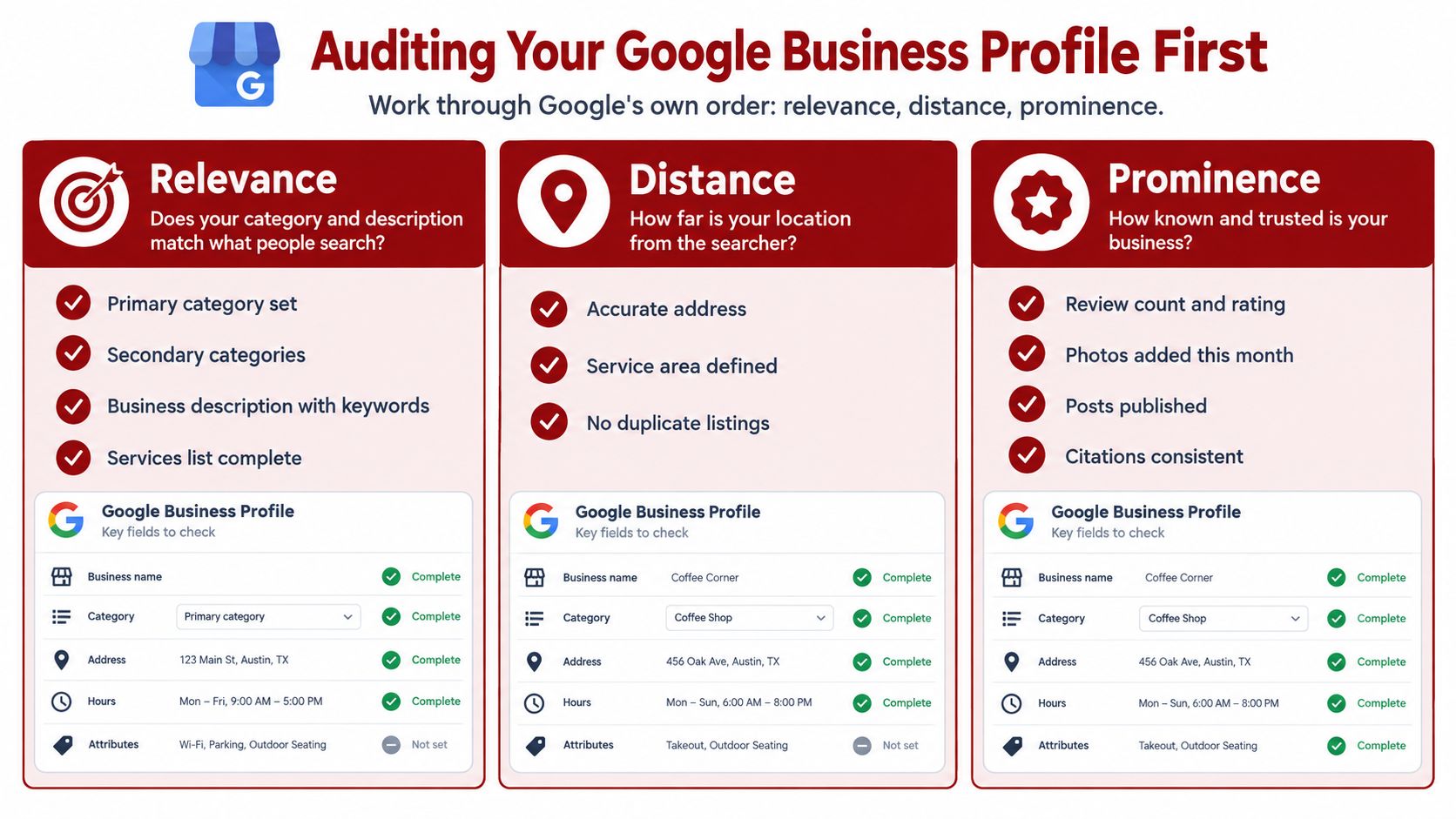
Start with the asset that appears directly in Google Maps and local results. Google's three-factor framework gives the sequence: relevance first, distance second, prominence third.
Relevance starts with the category and service details
Check the primary category against the service customers search for. Add secondary categories only when they describe real offerings. A contractor shouldn't use every vaguely related category to increase reach. That creates ambiguity and can make the profile less trustworthy.
Review the business description, services list, attributes, hours, special hours, and appointment or contact links. Use natural Prescott and Northern Arizona service-area language where it clarifies coverage, but don't turn the description into a string of city names. The profile should tell a customer what the business does, who it serves, and how to contact it.
Distance depends on accurate coverage
A service-area business should define the towns it genuinely serves, not claim a statewide area that the crews rarely reach. Confirm the address settings, service area, map pin, business type, and ownership verification. Look for duplicate profiles, practitioner listings, suspended listings, former businesses at the same address, and managers who no longer have legitimate access.
Google Posts, photos, Q&A, and attributes provide additional context. A weekly posting rhythm is a practical minimum for keeping offers, project updates, and service information current. Add authentic project and team photos from the areas you serve. “Geotagged” files aren't a substitute for relevance, but real local evidence is more useful than stock imagery.
Prominence determines who wins close comparisons
Review count, rating, recency, responses, photos, posts, and citations belong in the prominence review. A 2026 dataset cited by Localo found that profiles with 1–5 reviews had a 39.3% top-three local ranking rate, compared with 73.0% for profiles with 201–500 reviews, a 33.7-point swing. The same dataset identified review count as the strongest measured local ranking factor across 16,098 Google Business Profiles. Localo's local ranking factor analysis explains why review volume and profile completeness deserve early attention.
For a different business model, this local SEO audit for restaurants offers a useful comparison because restaurants and service businesses use some of the same profile controls but have different customer actions.
Owners who need the initial setup documented can also review Silva Marketing's guide to setting up a Google Business Profile. The audit should finish with a relevance, distance, and prominence score so the profile findings feed directly into the priority roadmap.
Use this video as a visual walkthrough of the profile areas worth checking:
Checking Local Citations and NAP Consistency
Citation work is less glamorous than writing a new service page, but it often explains why a well-optimized Google Business Profile still underperforms. NAP+W means name, address, phone, and website. One old LLC name, mismatched suite number, tracking phone line, or outdated domain can split signals across the platforms that supply business data to Google, Apple Maps, Bing, Yelp, and industry directories.
For a Prescott service-area business, begin with the main data and discovery sources. Check Data Axle, Neustar or Localeze, Foursquare, Apple Maps, Bing Places, Yelp, the Better Business Bureau, and relevant industry sites such as Houzz or Avvo. Then review Prescott-area chambers, trade associations, supplier pages, sponsorship pages, and local press.
A practical citation sweep
Export the primary listings and compare every field against the verified business record. Don't correct only the visible name and phone number. Check the website protocol, service description, hours, categories, address formatting, and whether the listing points to the correct location page.
Use this triage order:
Correct the top 20 sources first. Exact-match information on the most important directories has more practical value than scattered submissions to low-quality sites.
Merge or remove duplicates. An old profile can divide reviews, confuse customers, and create competing business entities.
Claim and upgrade useful listings. Add categories, photos, service descriptions, and links where the platform is relevant to the trade.
Build local citations selectively. A Prescott chamber, regional publication, or credible trade directory can provide stronger context than a large batch of generic directories.
Tier | Source | Why It Matters | Action |
|---|---|---|---|
Primary data | Data Axle and Neustar or Localeze | These sources can distribute core business information | Verify name, address, phone, website, and category |
Major maps | Google, Apple Maps, Bing Places | Customers use these platforms for discovery and directions | Claim, verify, and correct the profile |
Consumer directories | Yelp and BBB | They support trust and branded searches | Correct details and monitor reviews |
Industry platforms | Houzz, Avvo, and trade directories | They add service-specific context | Claim relevant listings and remove duplicates |
Local sources | Chambers, associations, and local press | They reinforce geographic relevance | Earn accurate mentions and links |
Citation volume alone isn't the objective. Consistent, useful listings are more valuable than hundreds of weak entries. For link opportunities that arise during this process, Silva Marketing's local SEO link-building guidance provides a related framework.
On-Page and Technical Local Signals
Your website must make the service area understandable to both customers and search engines. A homepage that says “serving Arizona” gives a Prescott homeowner less confidence than a focused service page that explains the work, the towns covered, and what happens after the call.
Review each service-area page as a conversion asset
Open each important city and service page on a phone. Check that the city appears naturally in the title tag and H1, then look for local information such as project references, neighborhood context, climate considerations, permitting questions, and customer FAQs. A page that changes only the city name is not a local resource. It's a thin template.
The page should show a clear call to action above the fold. A Prescott homeowner looking for emergency plumbing or HVAC repair shouldn't have to search through a long introduction to find a phone number. Include the verified NAP, relevant internal links, service details, trust evidence, and an embedded map where it helps the visitor understand the service location.
Technical checks protect visibility
Validate LocalBusiness and Service schema with Google's Rich Results Test or Schema.org's validator. The markup should match visible page content, business details, and the actual service offered. Test mobile usability and performance with PageSpeed Insights, and investigate slow templates, oversized images, intrusive scripts, and difficult tap targets.
In Search Console, inspect indexation, excluded pages, orphaned service pages, duplicate or cannibalizing pages, canonical tags, XML sitemap status, and robots.txt directives. A service page that isn't indexed can't compete, regardless of how carefully its copy is written.
A fast local page doesn't need elaborate design. It needs clear service information, a working phone action, trustworthy evidence, and a crawlable structure.
A contractor can often ship useful improvements within a week by correcting title tags and H1s, linking important pages from the main navigation, replacing stock photos, adding missing hours and phone links, compressing oversized images, and removing or redirecting abandoned location pages. Silva Marketing's technical SEO audit checklist covers the underlying crawlability, indexation, sitemap, canonical, redirect, and status-code checks that support this work.
Reviews and Local Link Prominence
When two Prescott businesses are equally relevant and similarly close to a searcher, prominence often separates them. Reviews and local links provide two different forms of evidence. Reviews show customer experience at scale, while links and mentions show that other organizations recognize the business in the community.
Audit reviews for volume, recency, average rating, unanswered feedback, recurring complaints, and service-specific language. Responses should be professional and useful, not stuffed with city names. A response can acknowledge the project, clarify the service, and show future customers how the business handles accountability.
The Localo dataset cited earlier shows why review volume deserves a place near the top of the priority list. It found a 39.3% top-three rate for profiles with 1–5 reviews and 73.0% for profiles with 201–500 reviews, with review count identified as the strongest measured factor in that dataset. That doesn't mean a business should pursue reviews mechanically. It means a large review gap can represent a real prominence problem that content alone won't solve.
Read the gap before choosing the tactic
The requested competitor table should be populated from the actual local search results, not invented benchmarks. A responsible audit records competitor counts, ratings, and review velocity directly, then uses those observations to decide whether the business needs a review process, better follow-up, or a service-quality intervention.
Local Pack Position | Avg. Review Count | Avg. Star Rating | Avg. Monthly Velocity |
|---|---|---|---|
Your business | Record from the current audit | Record from the current audit | Record from the current audit |
Competitor one | Record from the current audit | Record from the current audit | Record from the current audit |
Competitor two | Record from the current audit | Record from the current audit | Record from the current audit |
Competitor three | Record from the current audit | Record from the current audit | Record from the current audit |
Local links should be evaluated by relevance and effort, not domain metrics alone. A Prescott chamber membership, local sponsorship, supplier partnership, trade association profile, or earned mention from a regional outlet may fit the business better than a generic high-authority directory.
A solo owner can sustain a simple process: request feedback after a completed job, make the review path easy, respond consistently, and review the backlog during a regular administrative block. Silva Marketing's review management strategy offers a related process for turning review activity into an operating habit.
Tracking, Reporting, and the 90-Day Roadmap
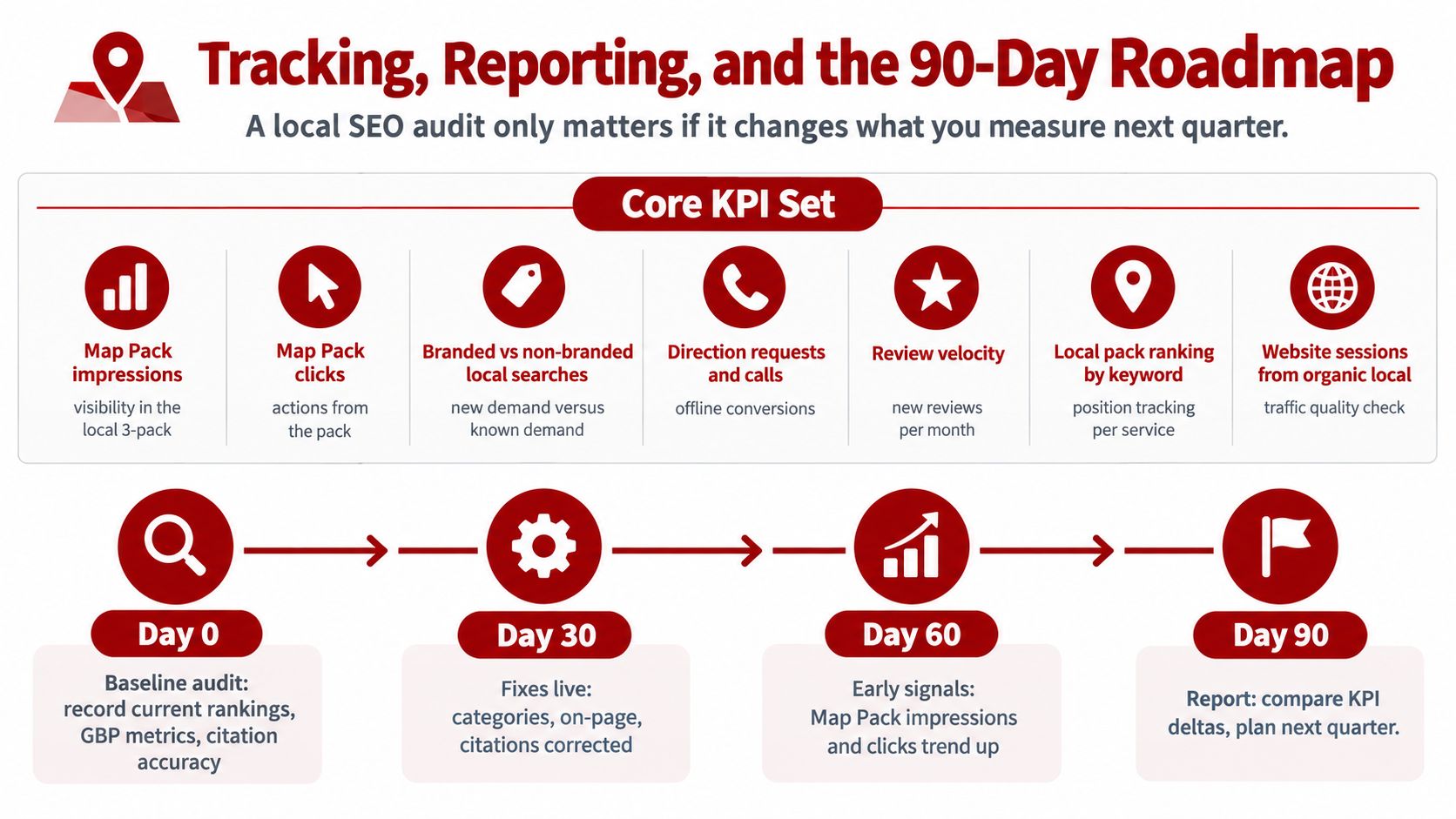
An audit has value only when the business can compare what changed afterward. Google Business Profile reporting exposes search queries, views, calls, direction requests, and website clicks. Record those measures before implementation, then compare the same period after the fixes instead of relying on impressions or rankings alone.
The core KPI set should include Map Pack impressions and clicks, branded versus non-branded local search traffic in GA4, GBP and website click-to-call conversions, direction requests, review velocity, local pack rankings by service, and booked-job quality. A call that reaches the wrong department is not the same outcome as a qualified estimate request.
Turn findings into timed decisions
Days 0 to 30 should address foundational blockers. Correct NAP errors, fix GBP categories and hours, resolve duplicate listings, respond to the review backlog, and repair obvious call or form issues.
Days 31 to 60 should improve discoverability. Publish or revise useful service-area pages, validate schema, correct indexation problems, and build the most relevant citation and local directory placements.
Days 61 to 90 should focus on compounding prominence. Pursue local links, publish useful Prescott and Northern Arizona content, maintain review requests, and compare performance against the original baseline.
A monthly report should connect each change to visibility and customer action. If speed-to-lead is a concern, pair search reporting with a speed-to-lead traffic evaluation so the business can assess whether traffic is reaching a response process that turns inquiries into conversations.
The audit should repeat on a practical cadence. Quarterly check-ins are useful for active campaigns because profiles change, competitors add reviews, listings drift, and seasonal service demand shifts. The report is not the product. The operating loop, audit, implementation, measurement, and re-audit, is what turns local search into a measurable lead-generation channel.
Local SEO Audit Questions From Prescott Business Owners
How long does a full local SEO audit take?
For a small Prescott service business, a full audit typically takes two to three weeks when access and business information are available. The work includes the Google Business Profile, competitors, citations, website, technical signals, reviews, links, conversion paths, and reporting baseline.
What does the audit deliver?
A useful deliverable includes a scored findings spreadsheet, supporting evidence, prioritized recommendations, a 30/60/90-day action plan, and a baseline reporting dashboard. The owner should know which items need immediate correction, which require content or development work, and which activities can wait.
What does a local SEO audit cost in Prescott?
The cost depends on the number of service areas, profile history, website condition, citation volume, and whether the business needs implementation as well as diagnosis. A responsible provider should define the scope before quoting rather than attach one generic fee to every contractor and service firm.
When should calls start changing?
Map Pack movement often needs 60 to 120 days, depending on the starting condition, competition, business location, implementation speed, and prominence gap. Some corrections can improve customer actions sooner, particularly accurate hours, phone links, categories, and profile completeness. Rankings aren't guaranteed, and no audit can overcome an offer or service experience that customers don't value.
Can a provider handle a suspended or duplicate profile?
A local SEO team can investigate ownership, verification, guideline issues, duplicates, and supporting documentation, but reinstatement depends on Google's review. Never create additional profiles to bypass a suspension. That can make the entity problem harder to resolve.
How often should the audit repeat?
A quarterly review is appropriate for businesses actively improving local visibility. Recurring check-ins catch citation drift, changes in competitors, declining review velocity, profile edits, indexing problems, and missed conversion tracking. A one-time audit without implementation produces a report, not revenue.
What should the owner provide?
Provide verified business information, service areas, profile access, website and analytics access, call-tracking details, priority services, competitor names, review process information, and any credentials or certifications that can be displayed accurately. Community involvement and faith-based values can strengthen trust when they reflect how the business operates, but they should be documented rather than implied.
Silva Marketing offers Prescott and Northern Arizona businesses a practical local SEO audit tied to Google Business Profile performance, website conversion paths, technical health, citations, reviews, and a 30/60/90-day implementation plan. Visit Silva Marketing to discuss the current visibility and call-flow problems affecting your service business, then decide which fixes deserve attention first.
Comments