
Local SEO Keywords: What They Are and How to Use Them

Local SEO keywords pair a service with a specific location so your business can appear in Google Maps and nearby search results. About 33% of keyword searches return a Google local pack, and 46% of Google searches have local intent, which is why this combination can turn searches into real calls from customers in Prescott and Northern Arizona. (Moz)
A Prescott homeowner may search for a roofer, HVAC technician, or web designer from a phone, scan the map results, and call the business that looks relevant, nearby, and trustworthy. Silva Marketing helps local service businesses, contractors, professional firms, and growing brands connect those searches with clear service pages, accurate Google Business Profile information, and a stronger local presence across Prescott, Prescott Valley, Chino Valley, Dewey-Humboldt, and Northern Arizona.
The practical question isn't how many keywords you can collect. It's whether the phrases you target match what people need, where they need it, and how Google evaluates businesses in local results.
Table of Contents
Why Local SEO Keywords Matter for Prescott Businesses - Who benefits from local keyword targeting
What Are Local SEO Keywords and Why Do They Rank - Relevance comes before competition
Generic Keywords vs Local Keywords vs Voice Search Phrases - Voice phrases reveal the customer's situation
How to Research Local SEO Keywords for Your Service Area - Build the list around intent - Map phrases before publishing
Local SEO Keyword Examples for Prescott and Northern Arizona Services - Turn clusters into useful assets
Local Keywords Plus Review and Authority Signals - What supports a local keyword strategy
Next Steps for Local SEO Keyword Strategy and FAQs - How long does local keyword implementation take? - Should a business target Prescott or surrounding service areas? - Can generic and local keywords be used together? - How can a business tell whether the strategy is working?
Why Local SEO Keywords Matter for Prescott Businesses
A broad term such as “marketing agency” or “plumber” may describe your business, but it doesn't tell Google which customers you serve. A phrase such as “SEO agency Prescott” or “emergency plumber Prescott Valley” adds the geographic and service context that helps connect a nearby searcher with a relevant provider.
That distinction matters because local searchers often act quickly. Google-related local behavior data reports that 76% of people who search for something nearby visit a business within 24 hours, 28% of local searches lead to a purchase within 24 hours, and 72% of local searchers visit a store within five miles. (SOCi) These figures describe a search environment shaped by proximity and intent, not casual browsing.
Who benefits from local keyword targeting
Local SEO keywords are especially useful for businesses that depend on calls, appointments, estimates, visits, or service-area inquiries. That includes:
Contractors and trades: roofing, plumbing, HVAC, electrical, remodeling, and landscaping companies.
Professional services: marketing agencies, attorneys, accountants, medical practices, and consultants.
Multi-location businesses: brands that need separate relevance for Prescott, Prescott Valley, and other communities.
Service-area businesses: companies that travel to customers instead of operating from a storefront.
For these businesses, a keyword strategy should support a specific landing page, a matching Google Business Profile service, and a clear next step. A list of phrases sitting in a spreadsheet won't move the phone by itself.
Silva Marketing serves Prescott and surrounding Northern Arizona communities with SEO, custom websites, website redesign, Google Ads, and conversion-focused digital marketing. Its local SEO work connects keyword research with technical fixes, content planning, competitor analysis, and measurable lead generation. The agency's guidance on the benefits of local SEO provides additional context for businesses weighing local visibility against broader marketing priorities.
What Are Local SEO Keywords and Why Do They Rank
A Prescott business can target “web designer” for months and still attract researchers outside its service area. “Custom website designer Prescott” gives Google and the searcher clearer information: the service, the market, and a likely hiring need. A phrase such as “Who builds contractor websites near Prescott?” adds conversational wording and a local question.
Local SEO keywords connect an offering with geographic context and intent. They matter because the phrase must fit both the search and the business assets that support visibility in the Map Pack.
Google says local results are mainly based on relevance, distance, and prominence. Relevance measures how well a Business Profile matches the search. Distance reflects the business's location relative to the searcher. Prominence reflects how well-known the business is, with signals that include links and review volume. (Google Business Profile Help)
Relevance comes before competition
Keywords clarify relevance, but they cannot override distance or established authority. A page describing “website redesign for Prescott businesses” gives Google useful service and market context. The business still needs accurate information, a legitimate presence, and enough prominence to compete with providers already recognized in the area.
Map Pack visibility depends on alignment across connected assets:
Google Business Profile: primary category, services, business description, and linked destination page.
Website: title, headings, service details, contact information, and genuine location context.
Supporting signals: local links, citations, and reviews that naturally mention the business and its work.
The phrase should make the page clearer, not interrupt the reader. Before mapping terms to profile fields and pages, review what is search intent in SEO. Businesses seeking a broader explanation can also read what local search optimisation means.
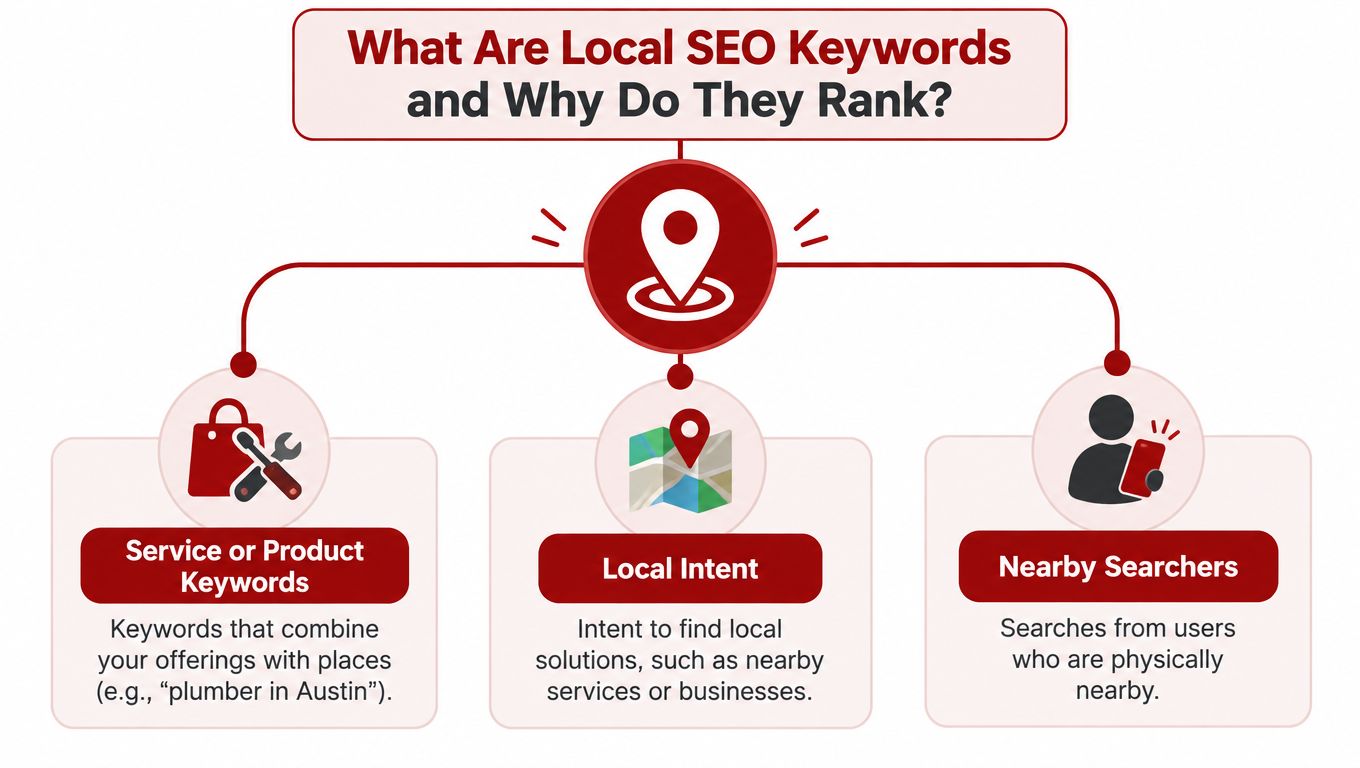
Test each phrase against a real customer scenario: would someone in Prescott use it while trying to hire this business? If yes, assign it to the profile field or page that can support it. If a tool generated the phrase without matching a real service, do not build a page around it.
Generic Keywords vs Local Keywords vs Voice Search Phrases
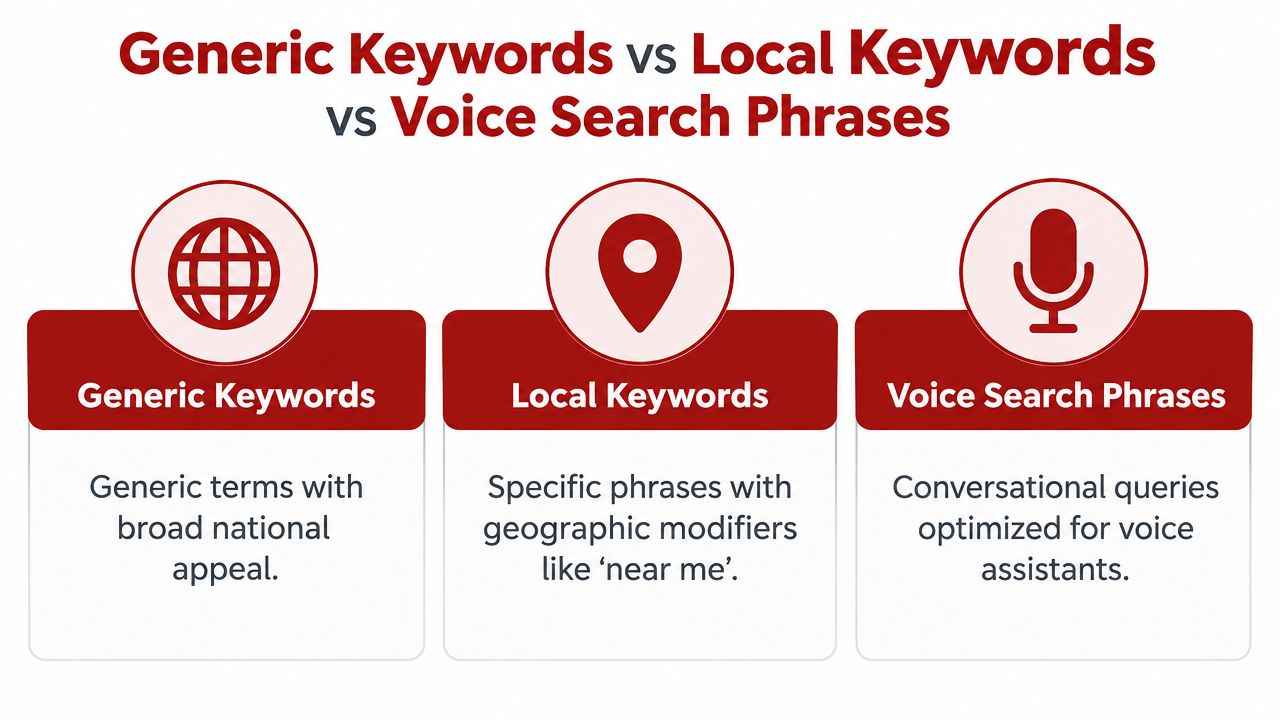
Generic keywords describe a category without telling Google where the searcher wants help. Local keywords add a city, neighborhood, service area, or proximity phrase. Voice search phrases sound more like a spoken request, often including questions, urgency, availability, or a problem statement.
Keyword type | Example | Typical intent |
|---|---|---|
Generic keyword | “SEO agency” | Broad research or comparison |
Local keyword | “SEO agency Prescott” | Find a provider in a defined market |
Voice search phrase | “Who can improve my Google ranking near Prescott?” | Conversational need with local intent |
Generic terms can attract attention, but they often create an inefficient trade-off for small businesses. A national searcher, a student, another marketer, and a local buyer may all use the same phrase. The traffic may look relevant in analytics while producing few calls.
Local phrases narrow the audience in a useful way. “Google Ads management Prescott” tells the business owner what the service is and tells Google where the provider should be relevant. Neighborhood and service-area wording can narrow the match further, provided the business serves that area.
Voice phrases reveal the customer's situation
Conversational searches often expose details that a short keyword hides:
“Who repairs water heaters near me?”
“Is there an emergency electrician in Prescott?”
“What's the best website company for a contractor in Northern Arizona?”
“Can someone redesign my business website in Prescott Valley?”
The phrase “near me” doesn't require a separate page for every possible wording. It requires accurate location signals, a clear service description, and content that answers the underlying need. Availability terms such as “same-day,” “open now,” and “emergency” should only appear when the business offers that service.
The strongest target isn't always the phrase with the highest apparent volume. It's the phrase that makes the customer's need, location, and next action clear.
How to Research Local SEO Keywords for Your Service Area
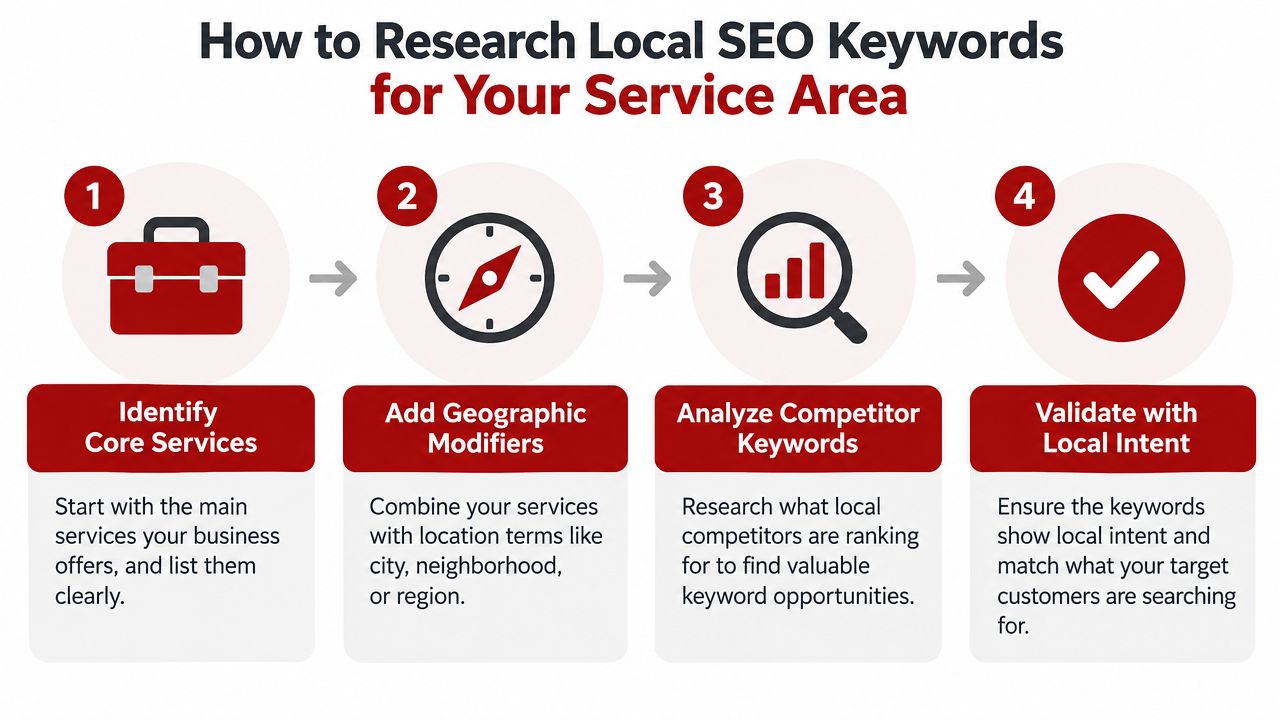
Good research starts with the services you sell. List the core offers, the problems they solve, the customer types you serve, and the communities where you can realistically deliver the work.
Build the list around intent
Start with service terms such as “website redesign,” “Google Ads management,” or “roof repair.” Add geographic modifiers including Prescott, Prescott Valley, Chino Valley, Dewey-Humboldt, and Northern Arizona where those locations reflect genuine coverage. Then add intent modifiers such as “quote,” “company,” “near me,” “emergency,” “same-day,” or “for contractors.”
Group the phrases by the action they imply:
Commercial research: the searcher is comparing providers or services.
High-intent contact: the searcher wants a quote, appointment, estimate, or call.
Problem solving: the searcher describes an issue and needs an answer.
Availability: the searcher needs help within a particular timeframe.
Google Keyword Planner, Semrush, Google Search Console, Google autocomplete, and the “People also ask” results can all contribute ideas. Use the tools to expand and validate the list, not to replace judgment.
A competitor gap review can reveal services competitors mention clearly, locations they cover, and questions they leave unanswered. Silva Marketing's content gap analysis guidance is relevant when a business needs to compare missing topics and weak service coverage without copying another site.
Practical rule: One strong service page with a clear local purpose is more useful than several thin pages that repeat the same city and service terms.
Map phrases before publishing
Assign each important group to one destination. A “Prescott website redesign” cluster may belong on a dedicated service page, while “how much does a website redesign involve?” may belong in supporting content or an FAQ. Don't create separate pages for tiny wording variations when the search intent is identical.
Place the primary phrase naturally in the title, main heading, introductory copy, relevant subheadings, image context, and internal links. The detailed guide to keyword placement for SEO can help teams review those placements without turning the copy into a repetition exercise.
Use this video as a visual complement to the research process, especially when reviewing how search intent and page targeting fit together.
Local SEO Keyword Examples for Prescott and Northern Arizona Services
Keyword examples become useful when they reflect the way a customer chooses a provider. A contractor may need a location and a service. A homeowner with a leak may need urgency. A business owner may search by outcome, such as more calls or a faster website.
The table below shows how to organize phrases by intent rather than publishing every variation as a separate page.
Service Niche | Intent Type | Example Keywords |
|---|---|---|
Web design | Local commercial | “custom website design Prescott,” “contractor website designer Prescott Valley,” “website redesign Northern Arizona” |
SEO | Local commercial | “local SEO agency Prescott,” “SEO consultant Prescott Valley,” “Google Maps SEO Northern Arizona” |
Google Ads | Contact and service | “Google Ads management Prescott,” “PPC agency Prescott Valley,” “Google Ads for contractors Northern Arizona” |
Roofing | Emergency and service | “roof repair Prescott,” “emergency roofer near Prescott,” “roof inspection Prescott Valley” |
HVAC | Availability and service | “HVAC repair Prescott,” “same-day AC repair Prescott Valley,” “heating service Northern Arizona” |
Landscaping | Local service | “landscaping company Prescott,” “yard cleanup Prescott Valley,” “landscape design Chino Valley” |
Legal services | Problem and location | “business attorney Prescott,” “family lawyer near Prescott,” “estate planning attorney Northern Arizona” |
Turn clusters into useful assets
A city and service phrase typically belongs on a service page that explains the work, process, service area, proof, and contact path. A neighborhood phrase may be appropriate in supporting copy when customers from that neighborhood use the business. A question phrase can guide an FAQ, service explanation, or short educational article.
Avoid swapping city names into identical pages. That approach creates weak location pages and gives visitors little reason to trust the business. Instead, make each location reference meaningful through service availability, travel coverage, local constraints, customer questions, and accurate contact information.
For another perspective on organizing service and location combinations, Netco Design LLC's keyword guide offers a useful reference. The principle remains simple: every target phrase should support a real customer decision.
Local Keywords Plus Review and Authority Signals
A keyword can establish relevance, but it can't prove that a business is established, trustworthy, or competitive. Local pack visibility depends on the broader entity around the phrase, including the Google Business Profile, review activity, local links, business details, and the quality of the destination page.
Google's framework separates the jobs of these signals. Keywords and service descriptions help with relevance. The business location and service coverage affect distance. Reviews, links, and recognition contribute to prominence. A business can improve one area while remaining weak in another.
What supports a local keyword strategy
Accurate profile data: Keep the business name, address, phone number, hours, categories, services, photos, and landing-page connection consistent.
Specific reviews: Encourage customers to describe the service they received in their own words. A natural mention of a service or location can add useful context, but businesses shouldn't script or fabricate reviews.
Local authority: Earn links and mentions from relevant community organizations, partners, associations, and local publications.
Strong landing pages: Match the page to the Google Business Profile service and make the page useful before asking visitors to contact the business.
Benchmark-style local pack research places Google Business Profile signals, review volume and velocity, and on-page signals among the strongest groups, while emphasizing that keyword density alone doesn't determine visibility. (Emulent)
A review process should also include thoughtful responses. Silva Marketing's review management strategy addresses how businesses can treat reviews as an ongoing trust and communication channel instead of a one-time ranking tactic.
BrightLocal's 2023 consumer survey found that 87% of consumers used Google to evaluate local businesses, 48% of those consumers used Google Maps during that research, and 76% read online reviews for local businesses. (ClickRank) Those behaviors explain why the profile, map listing, reviews, and landing page must tell the same story.
Next Steps for Local SEO Keyword Strategy and FAQs
A workable strategy begins with a short, accurate map of services, locations, and customer intent. Review the Google Business Profile, inspect the pages that receive impressions in Search Console, compare competing map listings, and connect each priority phrase to one useful destination.
The process should remain manageable. Start with the services that generate the best-fit inquiries, then expand into surrounding communities when the business can serve them consistently. Measure impressions, map interactions, calls, form submissions, booked consultations, and qualified leads rather than treating rankings as the only outcome.
How long does local keyword implementation take?
Research can begin quickly, but implementation depends on the number of services, locations, existing pages, profile condition, and technical work required. Treat it as an ongoing operating process, because rankings and customer language change over time.
Should a business target Prescott or surrounding service areas?
Target Prescott when the business is available there and the page can explain that service clearly. Add Prescott Valley, Chino Valley, Dewey-Humboldt, or broader Northern Arizona coverage when those areas reflect actual operations, not an attempt to create more pages.
Can generic and local keywords be used together?
Yes. Use generic terms to describe the category and local phrases to clarify the market. The page should read naturally, with local wording supporting the customer's decision rather than appearing in every sentence.
How can a business tell whether the strategy is working?
Look for better alignment between search queries, landing pages, profile actions, calls, forms, and qualified conversations. Google Search Console can show which queries bring impressions and clicks, while call tracking and lead records help determine whether visibility produces useful inquiries.
Silva Marketing works with Prescott and Northern Arizona businesses on keyword research, local landing pages, technical SEO, custom websites, competitor analysis, and Google Business Profile alignment. The right first step is a focused review of the services and locations that should produce more relevant calls.
Visit Silva Marketing to request a focused local keyword review for your Prescott or Northern Arizona business. The team can assess your service pages, Google Business Profile alignment, competitor gaps, and conversion path, then outline practical next steps without pressure.
Comments