
Website Design Process Explained for Service Businesses

A service business can have excellent work, a strong reputation, and a website that still produces too few calls. The usual problem isn't a lack of visual polish. Visitors can't quickly tell what you do, whether you serve their area, or what they should do next. On a phone, a slow page or confusing form can end the visit before a prospect ever sees your proof.
Silva Marketing helps contractors, professional services firms, and other local businesses turn outdated or underperforming websites into clear, fast, accessible lead-generation tools. The Prescott-based agency serves Prescott, Prescott Valley, Chino Valley, Flagstaff, and communities throughout Northern Arizona, with a workflow built around qualified calls, usable content, search visibility, and measurable conversion paths.
A structured website design process gives owners more than a mockup. It creates agreed goals, a practical sitemap, tested page layouts, purposeful content, a reliable development handoff, and a launch plan that protects both leads and visibility. Silva Marketing has launched 500+ websites, and its approach treats design as a business system, not a decoration project. For a closer look at conversion-focused planning, review this guide to lead generation website design.
Table of Contents
What the Website Design Process Delivers for Prescott Service Businesses - What a structured process changes - What clients receive
How the Complete Website Design Process Flows From Goals to Launch - The eight stages and their handoffs - How long each stage takes
Discovery Research and Information Architecture That Prevents Rework - How research becomes a usable sitemap - Why wireframes come before mockups
Visual Design Development and Performance Decisions That Drive Conversions - The practical trade-offs - Design Decisions and Their Conversion Impact
QA Launch and Post Launch Optimization That Protects Your Investment - The pre-launch verification list - Launch with local visibility in mind - Measure leads after launch
Frequently Asked Questions About the Website Design Process - How long does a website design process take? - What should a service business prepare before kickoff? - Should SEO happen before or after visual design? - How does accessibility fit into website design? - Does a new design guarantee more leads? - What makes Silva Marketing relevant to Prescott businesses?
What the Website Design Process Delivers for Prescott Service Businesses
A Prescott roofing company, HVAC contractor, law firm, or home-service provider often starts with the same situation. The owner knows the current site feels dated, but the true symptoms are more serious: calls come from the wrong areas, service pages don't answer basic questions, mobile visitors struggle to tap the phone number, and the contact form produces little useful information.
The first deliverable should therefore be clarity. A visitor should understand who you help, what problem you solve, where you work, and how to contact you without hunting through menus. That applies whether someone is searching from downtown Prescott, Prescott Valley, Chino Valley, or a nearby Northern Arizona community.
What a structured process changes
A professional project moves through defined decisions rather than subjective rounds of “make it pop.” Silva Marketing typically aligns the business around:
Business goals: More calls, quote requests, consultations, booked appointments, or qualified inquiries.
Service priorities: Which offerings deserve dedicated pages and which should remain supporting information.
Local coverage: The cities and communities the business serves.
Customer questions: Concerns about price, timing, qualifications, availability, process, and trust.
Conversion routes: Phone calls, forms, scheduling tools, directions, and other appropriate actions.
This structure prevents an attractive homepage from carrying the entire sales burden. A prospect looking for commercial plumbing in Prescott shouldn't have to interpret a general brand message before finding relevant proof and a clear next step.
What clients receive
The handoffs matter as much as the design itself. A well-run project produces a discovery summary, sitemap, wireframes, content requirements, visual direction, clickable prototype, approved designs, development build, QA record, analytics setup, and post-launch recommendations.
The timeline depends on scope, content readiness, integrations, approvals, and the condition of the existing site. A smaller service site can move efficiently when the owner supplies information on time. A larger redesign needs more coordination, especially when it includes multiple locations, extensive SEO migration, booking systems, or custom functionality.
Practical rule: A website project stays on schedule when every approval has a defined owner, a clear deadline, and a specific deliverable to review.
That discipline is valuable for local businesses because missed approvals can delay campaigns, seasonal offers, and sales opportunities. It also keeps the owner involved in decisions that require local knowledge, while the agency manages research, structure, design, development, and testing.
How the Complete Website Design Process Flows From Goals to Launch
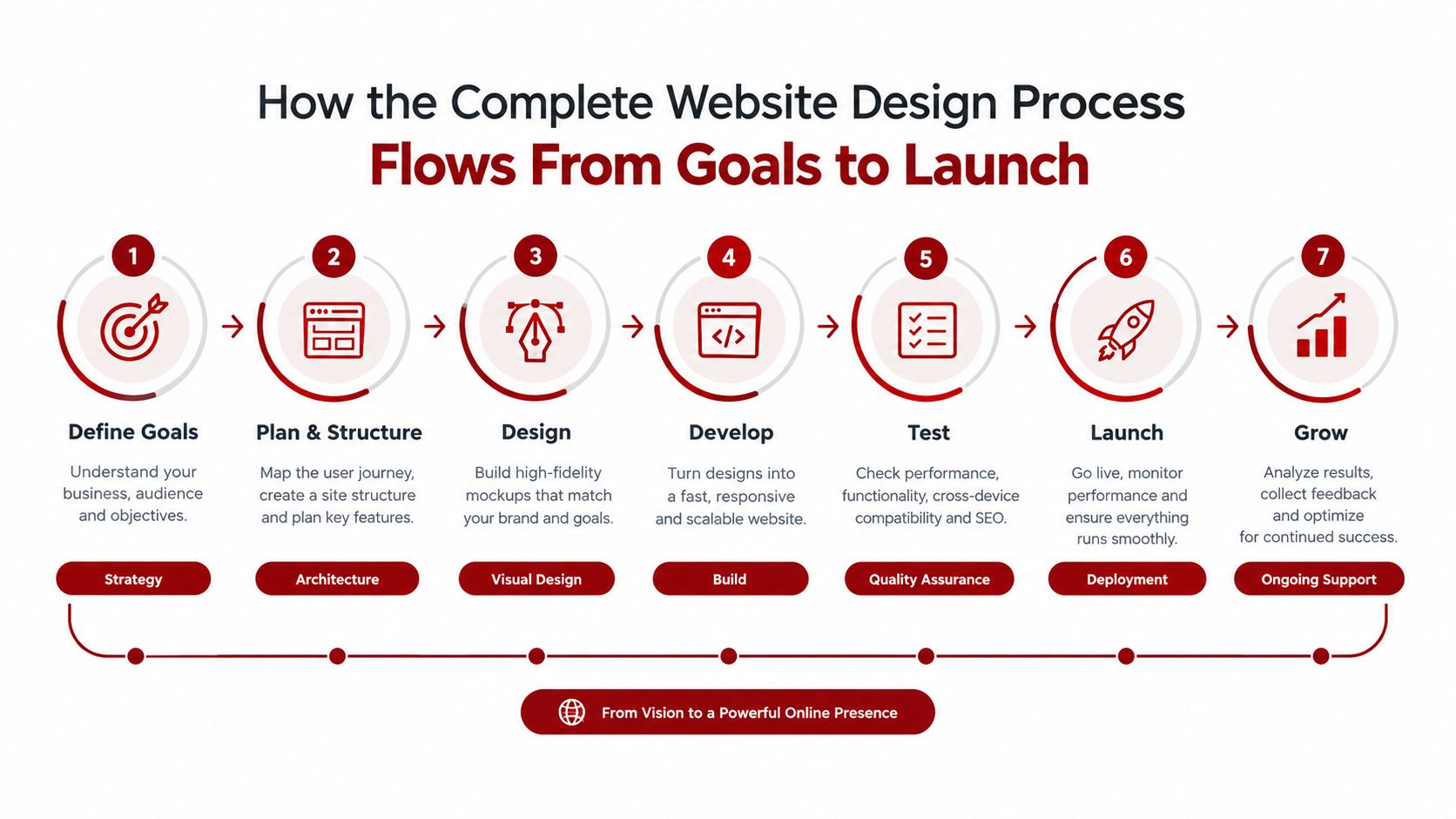
The complete workflow is commonly organized into eight stages, from defining requirements through post-launch optimization, as outlined in this website design process framework. Each stage creates an artifact that the next team member can use, so the project doesn't rely on scattered emails or assumptions.
The eight stages and their handoffs
Define goals and requirements. The owner and strategist identify the commercial objective, priority services, audience, locations, technical needs, and approval process. The handoff is a project brief with agreed success measures.
Research and strategy. The team reviews customer intent, competing local businesses, existing analytics, search opportunities, and the current website. The result is a strategy that connects services to pages and conversion paths.
Information architecture and wireframing. The strategist maps navigation, page relationships, headings, calls to action, and content hierarchy. Low-fidelity wireframes show where information belongs before visual styling begins.
Visual design and prototyping. The designer establishes typography, color, spacing, imagery, buttons, forms, and reusable interface components. A clickable prototype lets stakeholders evaluate the experience before development begins.
Content creation and SEO. Writers and SEO specialists develop or revise page copy, metadata, internal links, location information, image guidance, and structured content. Content isn't filler added after design. It determines whether a visitor understands the offer and whether search engines can interpret the page.
Development and implementation. Developers build the approved system, connect forms and third-party tools, apply semantic structure, and make the experience responsive. The design file becomes a working site through a controlled handoff.
Testing and quality assurance. The team checks forms, buttons, links, layouts, accessibility, speed, browser behavior, mobile usability, tracking, and redirects. Issues are documented and resolved before launch.
Launch and post-launch optimization. The site goes live with monitoring in place. The team reviews lead activity, search visibility, user behavior, and technical health, then improves pages based on evidence.
How long each stage takes
A realistic schedule is shaped less by the number of pages than by decision speed and project complexity. A service business that has approved branding, usable photography, clear service descriptions, and one decision-maker can move faster than a company still debating its offer.
A redesign also requires care around existing rankings and URLs. For a practical overview of the decisions involved, Silva Marketing's website redesign process explains why strategy, content, development, migration, and review need to work together.
The most important sequencing principle is simple: structure comes before visual detail, and visual detail comes before interactive complexity. That sequence has historical roots. Håkon Wium Lie proposed Cascading Style Sheets in October 1994, and the World Wide Web Consortium released CSS1 in December 1996. By the end of 1994, the web had expanded to about 10,000 web servers and 10 million users, according to this history of web design. Separating presentation from structure made larger websites more maintainable, while Dynamic HTML in 1995 to 1996 made richer behavior possible.
Modern component systems follow the same logic. Teams define a dependable foundation, then reuse it across pages instead of drawing every screen as an isolated composition.
Discovery Research and Information Architecture That Prevents Rework
Discovery prevents a common failure: designing pages before deciding what the business needs those pages to accomplish. A service business shouldn't begin with a color palette if it hasn't settled its priority services, service areas, customer objections, or lead-handling process.
The kickoff should collect the materials that affect decisions:
Business information: Services, differentiators, credentials, service boundaries, hours, and contact methods.
Customer insight: Common questions, buying concerns, language customers use, and reasons people choose or reject the company.
Existing assets: Logo files, photography, reviews, brochures, analytics access, and current URLs.
Commercial priorities: Services with the strongest margins, highest demand, or greatest strategic importance.
Operational details: Who answers calls, who receives form submissions, and what happens after a lead arrives.
How research becomes a usable sitemap
Research should produce decisions, not a long document that nobody uses. The team reviews the current site, search intent, competitor positioning, internal business knowledge, and local expectations. For a contractor serving Prescott and Prescott Valley, that may reveal a need for separate pages for emergency work, maintenance, installations, and each meaningful service area.
The sitemap then assigns a job to every important page. A homepage establishes the overall promise. Service pages answer specific needs. Location pages clarify coverage without making unsupported claims. About and proof pages reduce uncertainty. Contact pages make the next action obvious.
A useful site structure for SEO should also help users move naturally from a broad need to a specific solution. Navigation labels should sound like the words customers use, not internal department names.
Why wireframes come before mockups
Wireframes expose structural problems while changes are still inexpensive. They show the order of the headline, supporting explanation, proof, service details, FAQs, and call to action. If the phone number is difficult to find in a wireframe, visual styling won't solve the underlying issue.
The team should also identify accessible patterns at this stage. Semantic heading levels, keyboard navigation, form labels, color contrast, focus states, and readable content need a place in the design system before development.
Clickable prototype testing belongs before code. One practical recommendation is to test specific tasks with 5 to 8 target users, such as finding a service, requesting an estimate, or completing a sign-up, as described in this prototype testing process. The point isn't to collect vague opinions about whether the site looks modern. It's to see where people hesitate, misinterpret labels, or fail to complete the action.
Visual Design Development and Performance Decisions That Drive Conversions
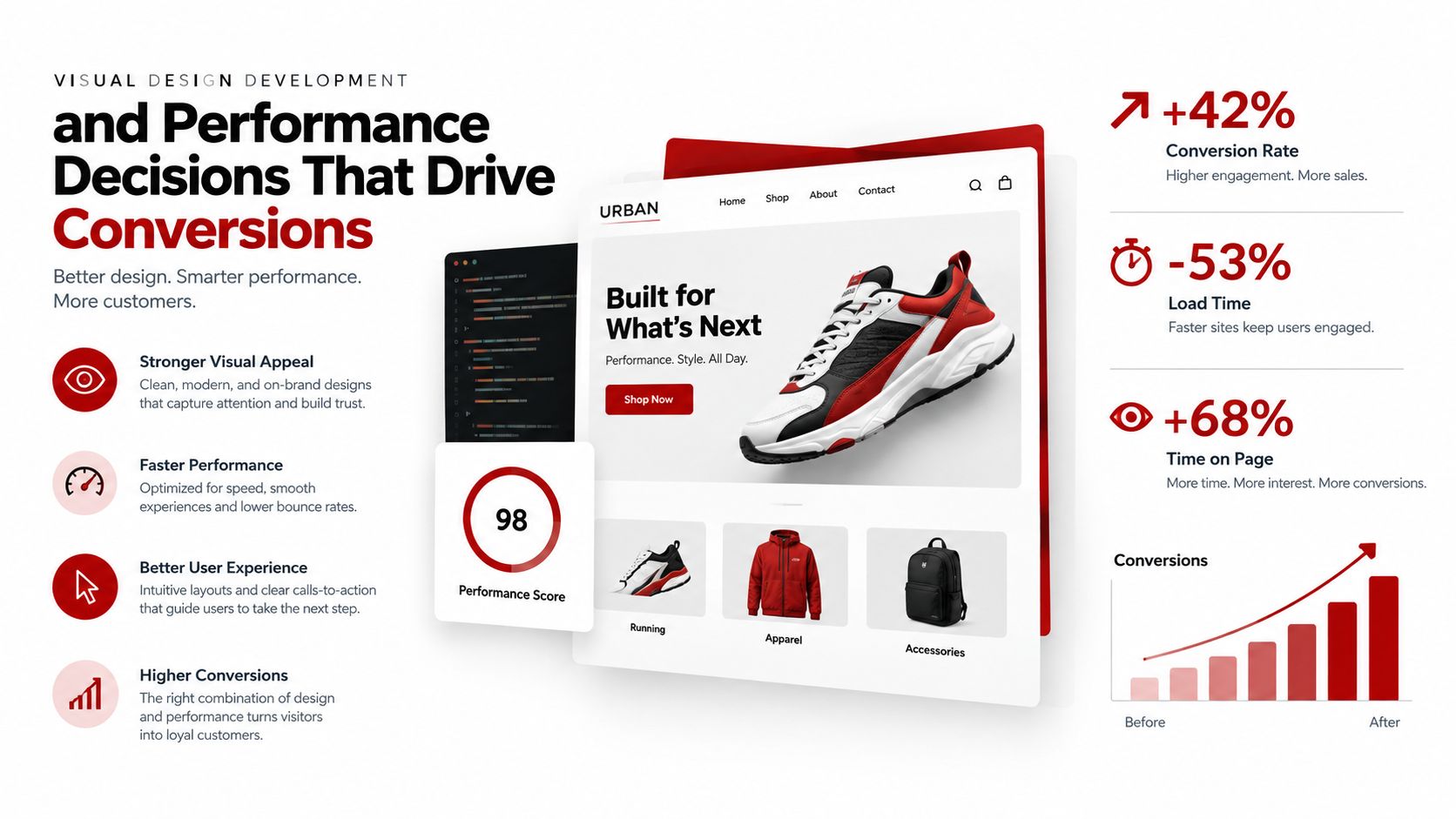
Visual design influences trust, but speed and accessibility determine whether visitors can use the design. A polished page that loads slowly on a mobile connection can lose the call before a prospect reads the headline. A beautiful form that can't be completed with a keyboard excludes users and creates avoidable friction.
Retail benchmark data cited by Designforce's web design statistics connects small speed improvements with meaningful commercial outcomes. The cited research reports that a 0.1-second speed improvement increased retail conversions by 8% and customer spending by 10%, while ecommerce conversion rates were reported at 3.05% for pages loading in 1 second and 0.67% at 4 seconds. The same source reports that each additional second of load time costs about 0.3% in conversions.
These figures don't guarantee the same outcome for every Prescott service business. They do establish the right design priority: performance belongs in the brief, not in a cleanup list after launch.
The practical trade-offs
Large background videos, oversized image galleries, animation, and third-party scripts can create atmosphere, but each adds weight and potential failure points. A local service page usually benefits more from a clear service explanation, authentic project imagery, visible phone access, and stable layout than from decorative motion.
Image strategy starts during design. The team chooses appropriate dimensions, compresses assets, uses modern formats where supported, and avoids loading every image before the visitor needs it. Code efficiency, restrained scripts, mobile-first layouts, and layout stability support the same goal.
Accessibility requires equal planning. WebAIM's 2025 analysis found 94.8% of the top 1 million homepages failed WCAG checks, while only 28% of organizations began addressing accessibility during planning and 27% during design, according to this web design statistics resource from Figma. The same source reports that the typical homepage loads 59 separate images per visit, making asset governance and lazy loading practical design concerns.
Design decision: Choose the visual treatment that improves understanding or trust. Treat decoration as optional when it adds weight without helping the visitor act.
The shift projected for 2026 also changes the build. Industry coverage points toward semantic HTML, component-driven systems, faster server-first performance, and AI or agentic journeys that can bypass traditional funnels, as discussed in web design and development trends for 2026. A site now needs to be understandable to people, search engines, assistive technology, and machine systems.
Design Decisions and Their Conversion Impact
Decision Area | What to Do Early | Why It Matters for Leads |
|---|---|---|
Page hierarchy | Put the customer problem, service, proof, and next action in a clear order | Visitors can understand relevance without searching |
Images | Select useful, compressed assets and define loading behavior | Pages remain faster and the layout stays stable |
Components | Create reusable buttons, forms, cards, alerts, and headings | Consistency reduces confusion across service pages |
HTML structure | Plan semantic headings, labels, landmarks, and meaningful links | People using assistive technology and machine systems can interpret the content |
Mobile interaction | Design tap targets, phone links, forms, and menus for smaller screens | Local prospects can contact the business from the device they already use |
For Silva Marketing, the practical solution is custom website design and development that joins wireframes, content, SEO, performance, and conversion paths instead of treating them as separate deliverables.
QA Launch and Post Launch Optimization That Protects Your Investment
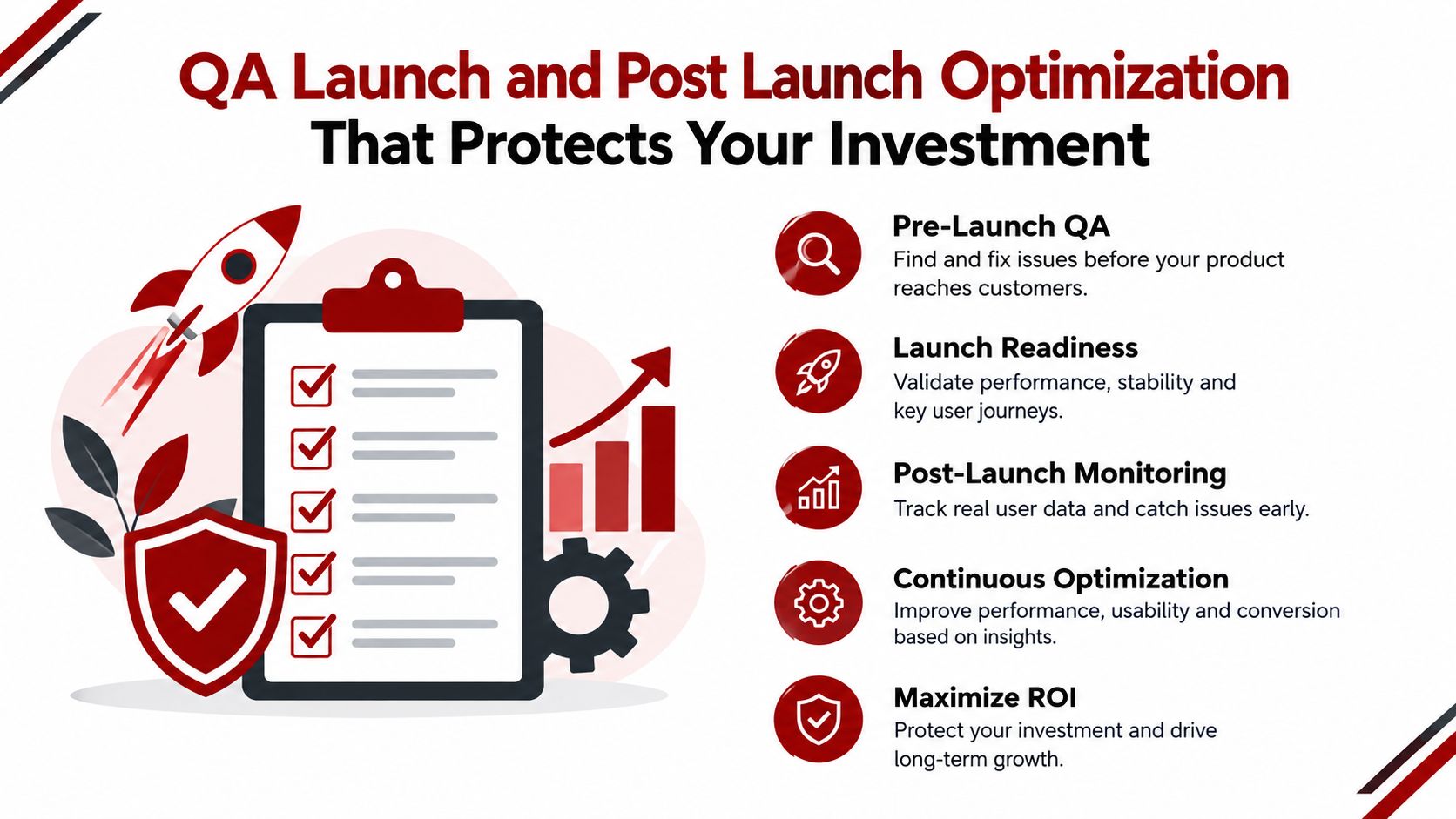
A Prescott service business can lose qualified leads on launch day through a broken form, an incorrect phone link, or a redirect that sends search visitors to the wrong page. A launch is complete only after visitor tasks work, tracking records meaningful actions, existing search equity has been addressed, and the team knows who receives each inquiry.
The pre-launch verification list
Quality assurance should follow real devices and real workflows, not only a desktop browser review. Test:
Forms and calls: Submit every form, tap phone numbers, confirm success messages, and verify that notifications reach the right person.
Navigation: Check menus, service links, location links, buttons, footer details, and internal search when included.
Accessibility: Review contrast, keyboard access, visible focus, heading order, labels, alternative text, and error messages.
Performance: Compress images, remove unnecessary scripts, review layout shifts, and compare important pages with the agreed speed budget.
Responsive behavior: Test phones, tablets, and desktop widths, including long headings, validation errors, and unusual content lengths.
SEO migration: Map important old URLs, apply appropriate redirects, preserve useful metadata, and check indexability. A documented website redesign and SEO migration plan helps protect search equity while templates and page paths change.
Measurement: Confirm analytics, call tracking where used, form events, scheduling actions, and search reporting.
Record each test, its result, the person responsible, and the fix status. This QA record makes ownership clear and gives the owner a useful handoff instead of a general assurance that “everything has been checked.”
Launch with local visibility in mind
A local launch extends beyond the website. Google Business Profile categories, services, photos, contact information, and review signals support business legitimacy in local search. One 2026 local SEO factor breakdown estimates roughly 32% weight for Google Business Profile signals and about 20% for review signals, as reported in this Map Pack ranking analysis.
Those figures do not guarantee Map Pack visibility. The practical requirement is consistency. Align the website, profile, service descriptions, hours, phone details, and location information so customers and search systems receive the same information across Prescott and Northern Arizona.
Owners reviewing a site that receives visits but few calls or forms can use this resource to boost local site conversions. The review should follow the actual path from landing page to phone call, form submission, or appointment request.
Measure leads after launch
Start with a baseline before changing the site. Record qualified calls, form submissions, booked consultations, key landing-page actions, speed condition, and important search pages. After launch, compare those same actions instead of judging the redesign by appearance alone.
The global median website conversion rate is reported as 2.35%, while the top 10% is reported at 11.45% in this 2026 website redesign ROI benchmark. Industry, offer, traffic quality, and conversion definition affect those benchmarks, so use them to frame questions rather than set automatic targets. The same source distinguishes UX-focused improvements from UI-only changes, with claims of up to 400% lift from strong UX and up to 200% from strong UI alone.
Post-launch work may simplify a form, clarify a service page, improve a phone call to action, strengthen proof, or fix a slow template. Silva Marketing keeps those changes tied to measurable lead behavior, so optimization reflects how Prescott prospects contact the business.
Frequently Asked Questions About the Website Design Process
How long does a website design process take?
The timeline depends on page count, content readiness, integrations, review speed, and whether the project is a new build or a redesign. A focused service-business site can move efficiently when one decision-maker provides materials and feedback, while a larger Northern Arizona company with multiple locations or complex systems needs more coordination.
What should a service business prepare before kickoff?
Prepare service descriptions, priority locations, brand files, customer questions, project photos, testimonials or reviews, current website access, analytics information, and details about how calls and forms are handled. Also identify who can approve content and design. Clear ownership prevents avoidable pauses.
Should SEO happen before or after visual design?
SEO should begin during discovery. Search intent influences the sitemap, page priorities, headings, content requirements, internal links, location strategy, and migration plan. Adding SEO after development often forces changes to layouts and copy that could have been handled earlier.
How does accessibility fit into website design?
Accessibility belongs in planning, wireframes, component design, development, and QA. The team should address contrast, keyboard navigation, semantic headings, form labels, focus states, readable content, and meaningful alternative text throughout the project, not wait for a final audit.
Does a new design guarantee more leads?
No. A redesign creates an opportunity to reduce friction, improve clarity, strengthen local relevance, and make performance more reliable. Lead results also depend on traffic quality, the offer, sales follow-up, reputation, pricing, and ongoing testing. Baselines and post-launch measurement provide a more honest evaluation than visual approval alone.
What makes Silva Marketing relevant to Prescott businesses?
Silva Marketing is based in Prescott and works with local service businesses, contractors, small and midsize companies, entrepreneurs, and location-based brands across Northern Arizona. Its work connects custom website design, SEO, Google Ads, content, local visibility, and conversion measurement, with faith-based values and a straightforward client experience.
FAQ content should remain visible on the page and answer genuine user questions. If structured data is used, the page should implement a top-level FAQPage with Question and acceptedAnswer fields, following these FAQ schema best practices.
Silva Marketing offers custom website design, redesign, SEO, and Google Ads support for service businesses in Prescott and Northern Arizona that need clearer paths to calls and qualified leads. Visit Silva Marketing to review the services and request a free consultation about your current site, goals, and next practical step.
Comments