
What Is Smart Bidding in Google Ads a Local Guide

Smart Bidding is Google's automated bidding system that uses machine learning to set individual auction-level bids aimed at conversions or conversion value, replacing manual bid adjustments. Google identifies Target CPA, Target ROAS, Maximize Conversions, and Maximize Conversion Value as Smart Bidding strategies.
You may be running Google Ads for a Prescott plumbing company, contractor, law firm, or home-service business, checking spend each day and changing bids when the calls don't match the budget. Silva Marketing helps local businesses in Prescott, Northern Arizona, and nearby service areas connect advertising spend with qualified calls and leads, but automation only helps when Google receives accurate information about what a valuable customer looks like.
That distinction matters. Smart Bidding can make a more informed decision for each auction than a fixed manual bid, but it can't reliably separate a booked job from a duplicate form or an unqualified inquiry unless conversion tracking is configured to show the difference.
Table of Contents
What Is Smart Bidding in Google Ads - What Smart Bidding does not mean
How Smart Bidding Works Behind the Scenes - The auction-level process
The Conversion Tracking Risk Most Guides Ignore - A local conversion-readiness checklist
Getting Started with Smart Bidding - Start with the primary conversion - Add a target only when the data supports it - Use value-based bidding for real value differences
What Is Smart Bidding in Google Ads
A Prescott contractor might notice that a campaign receives searches throughout the day, yet the best opportunities happen under specific conditions. A mobile user near Prescott searching during business hours may be more valuable than a similar query from outside the service area. Manual bidding can account for broad patterns, but it can't evaluate every auction individually.
Smart Bidding uses machine learning to set a bid for each individual ad auction. Instead of applying one bid across a campaign or adjusting bids every few days, Google estimates the likelihood and expected value of a conversion, then chooses a bid aligned with the advertiser's objective. Google introduced the Smart Bidding name in July 2016 as a label for conversion-based automated bidding across AdWords and DoubleClick Search, as described in Google's announcement of Smart Bidding.
For a local service company, the objective might be more qualified calls, more booked appointments, or a target cost per lead. That shifts attention away from clicks alone and toward outcomes closer to revenue. A click can indicate interest, but a qualified call or completed appointment gives the bidding system a more useful signal.
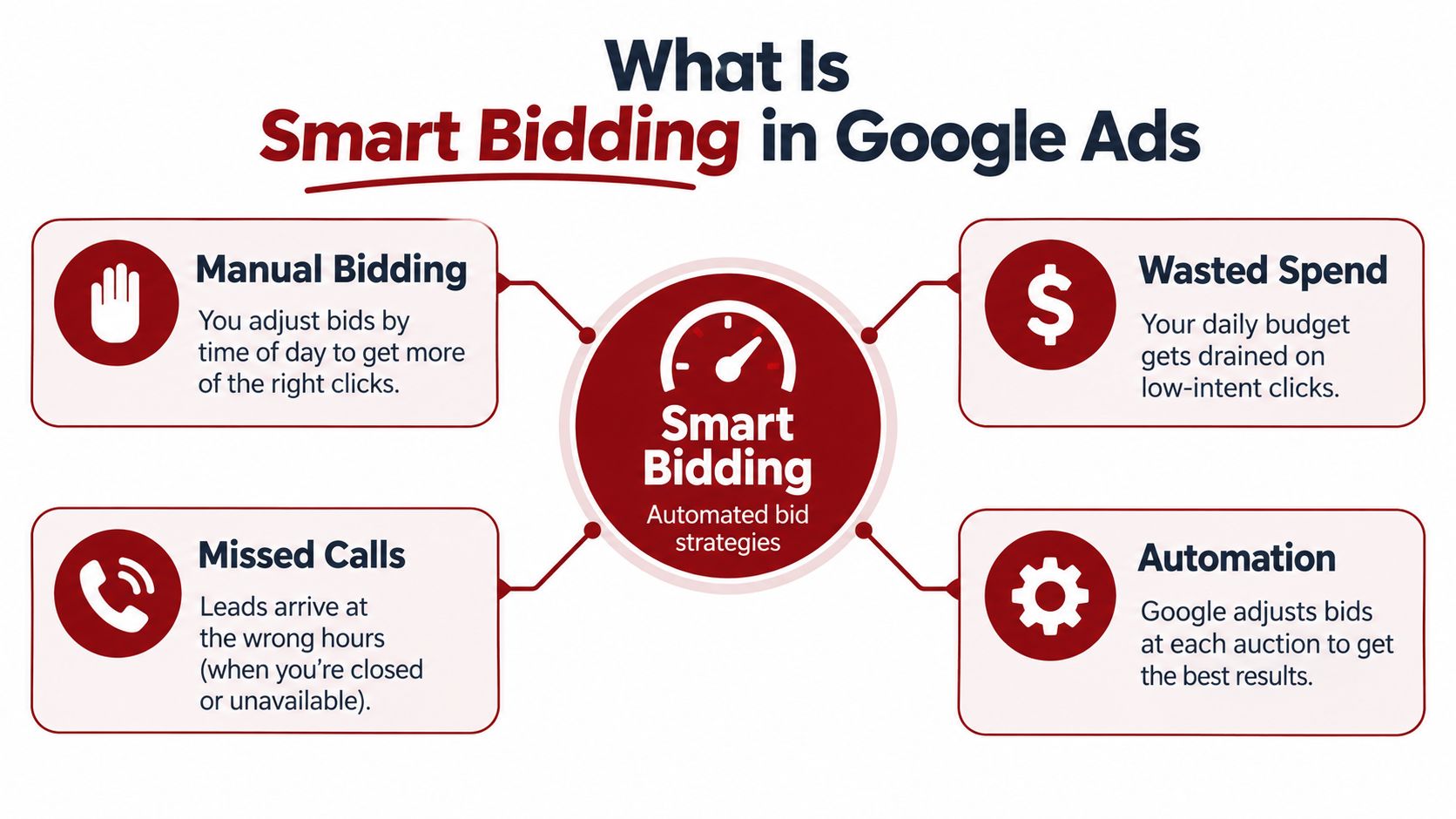
What Smart Bidding does not mean
Smart Bidding isn't a campaign type, a guarantee of lower costs, or a button that makes campaign management unnecessary. It replaces repeated manual bid adjustments with algorithmic decisions aimed at measurable outcomes.
At Silva Marketing, the practical difference is clear: campaigns with a defined primary conversion and dependable tracking give automation something useful to optimize. Campaigns that count every page view, duplicate inquiry, or low-quality call as equal conversions can direct budget toward the wrong audience.
Practical rule: Decide what counts as a valuable customer before choosing an automated bidding strategy.
Smart Bidding Strategies Explained
Google groups four conversion-focused strategies under Smart Bidding. The right choice depends on whether the campaign needs more conversion actions, more conversion value, a target acquisition cost, or a target return.
Strategy | Optimizes For | Best For |
|---|---|---|
Maximize Conversions | The highest number of recorded conversions within the budget | A local service campaign with reliable primary conversions and no dependable target yet |
Target CPA | Conversions toward a specified average cost per conversion | A business with consistent lead quality and a realistic acceptable acquisition cost |
Maximize Conversion Value | The total assigned value of conversions | A company where different lead types or customer outcomes have materially different values |
Target ROAS | Conversion value toward a specified average return per advertising dollar | A business that passes reliable revenue or differentiated lead values into Google Ads |
Maximize Conversions is often the most practical starting point for a local lead-generation campaign. It asks Google to pursue as many recorded conversions as possible, but the result depends entirely on what the account marks as a conversion. A campaign that counts qualified calls will give the system a different objective from one that counts every contact-page visit.
Target CPA adds a cost-efficiency objective. Google attempts to maximize conversions while reaching the specified average cost per conversion. Individual conversions can cost more or less than the target, so it shouldn't be treated as a fixed price for every lead.
Maximize Conversion Value becomes more useful when a booked emergency service, a routine estimate, and an unqualified inquiry shouldn't all have identical importance. The advertiser must assign meaningful values, otherwise the strategy has little economic distinction from optimizing for conversion count.
Target ROAS uses predicted conversion value to pursue a specified average return per advertising dollar. For a service company with dependable revenue imports or differentiated values, it can reflect business economics more closely than treating every lead as equal. Google recommends reporting conversion values for at least four weeks or one to two conversion cycles before activating value-based bidding, according to its Target ROAS guidance.
For a broader introduction to automated campaign controls, the Google Ad Automation guide provides useful background. Prescott businesses can also review Silva Marketing's Google Ads automation tools when comparing software and management workflows.
How Smart Bidding Works Behind the Scenes
Smart Bidding makes its decision at auction time. Google can use contextual signals such as device, geographic location, time of day, day of week, operating system, browser, language, remarketing-list membership, and search context to estimate how likely a conversion may be.
A search from a mobile user near Prescott during business hours can receive a different bid from a similar search on a desktop outside the service area. The keyword may look identical in the account, but the surrounding context isn't identical.
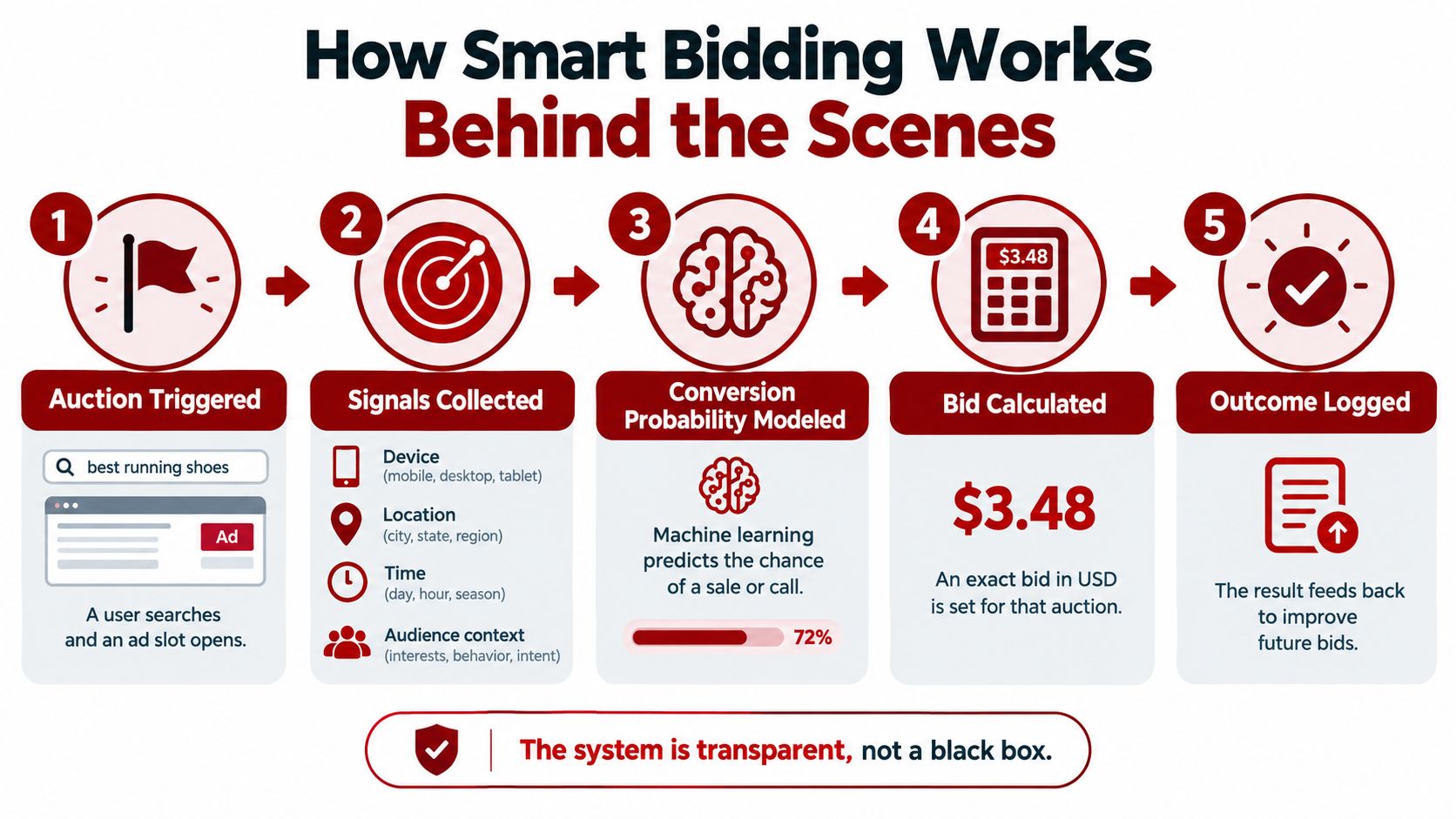
The auction-level process
An auction begins. Someone searches, and an ad opportunity becomes available.
Google evaluates signals. The system considers the user's context, including location, device, timing, language, and search details.
The model estimates conversion likelihood. It predicts whether the search may produce a recorded conversion and, where relevant, the likely conversion value.
Google calculates the bid. The system chooses a bid consistent with the campaign's selected objective.
The outcome becomes feedback. The recorded result helps inform future bidding decisions.
The system learns from conversion data at account scale and estimates how different bid amounts may affect conversion volume or value. That makes account structure and conversion tracking part of the bidding system itself, not administrative details.
A page view isn't the same as a qualified call. A duplicate form isn't a new customer. A call from outside a contractor's service area may be technically valid but commercially irrelevant. Google's Smart Bidding documentation explains the role of conversion tracking and contextual signals in the system.
A budget plan should also reflect keyword economics and local competition. A resource on budget planning with LLMrefs CPC can help organize that research before changing bids. For related campaign diagnostics, see Silva Marketing's guide to Google Ads Quality Score.
The Conversion Tracking Risk Most Guides Ignore
The biggest Smart Bidding mistake isn't always choosing the wrong strategy. It's feeding the right strategy the wrong conversion data.
Google's system optimizes toward whatever the account records. That might be a qualified phone call, a short form submission, a duplicate lead, or an inquiry from someone who can't use the service. If those actions are all treated alike, the algorithm has no reliable basis for distinguishing profitable customers from low-value activity.
Google recommends evaluating Smart Bidding over periods containing at least 30 conversions, or 50 for Target ROAS, and warns that inaccurate conversion tracking can cause the system to react to inaccurate data, creating fluctuations in volume, CPA, or ROAS. Those thresholds come from Google's Smart Bidding support guidance.
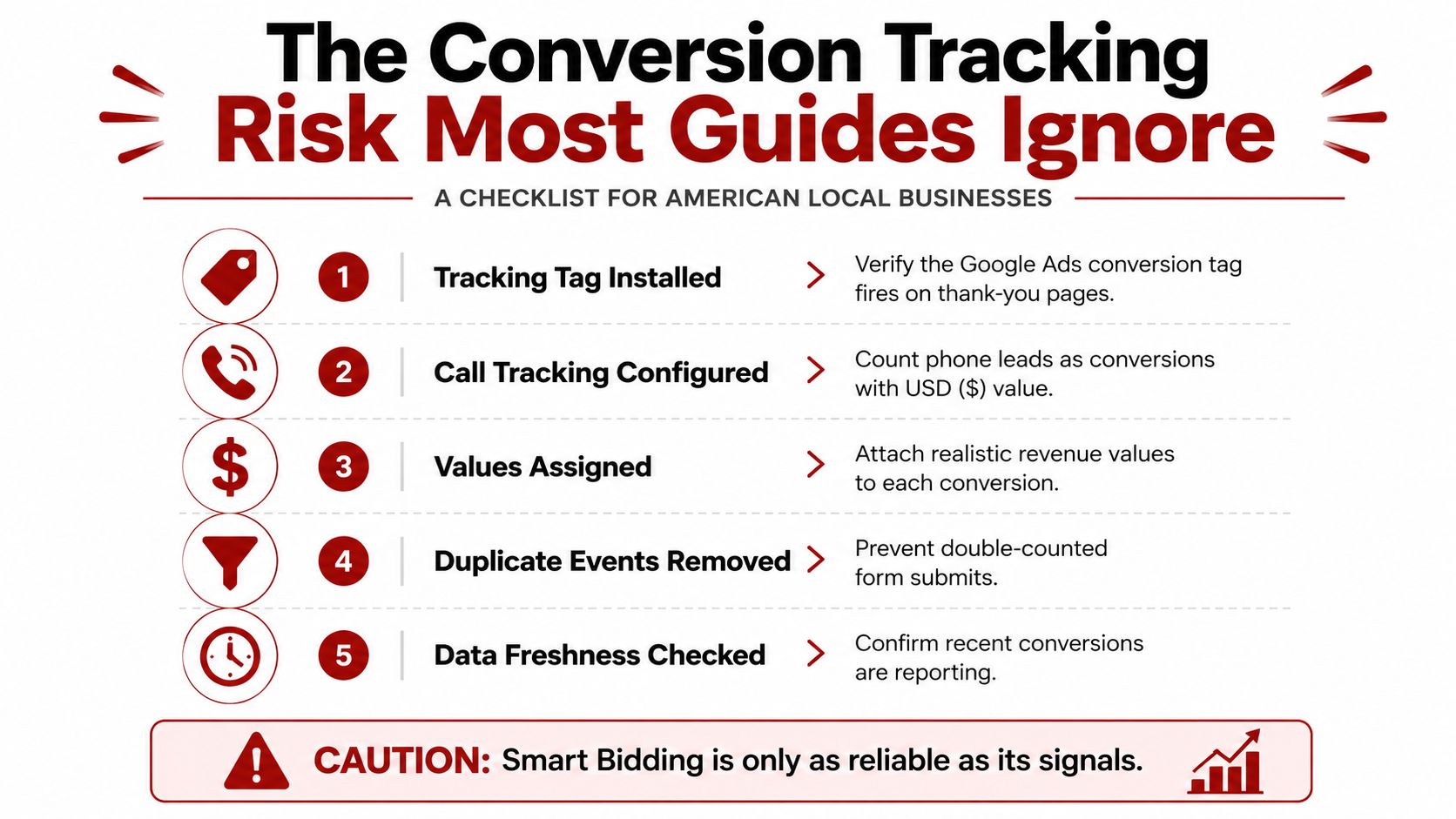
A local conversion-readiness checklist
Call quality: Decide whether a call must meet a meaningful duration threshold or another qualification standard before it becomes a primary conversion.
Duplicate handling: Check that repeated form submissions, refreshes, and multiple tracking events don't inflate conversion counts.
CRM imports: Import qualified outcomes such as booked appointments, completed jobs, or revenue when the sales process continues after the first inquiry.
Lead values: Assign values that reflect the economic difference between service types, customer categories, and sales outcomes.
Data volume: Confirm that the account has enough recent, trustworthy conversion information before applying a restrictive target.
A contractor can make performance worse by switching from Manual CPC to Smart Bidding while tracking remains incomplete. The system may then find more of the actions it has been told to value, even when those actions don't produce revenue.
The automation isn't the source of truth. Your conversion design is.
Businesses that want to understand visitor behavior beyond standard form submissions can also learn how to spot anonymous visitors before they leave. For implementation details, Silva Marketing's Google Ads conversion tracking setup offers a relevant reference.
Smart Bidding vs Manual Bidding for Local Campaigns
Manual CPC gives a business direct control over keyword or ad-group bids. That control can feel reassuring for a Prescott service provider, especially when the account has limited conversion history or the owner needs to restrict activity while tracking is repaired.
Smart Bidding has a different strength. It can evaluate contextual signals for each auction rather than applying one broad bid or a simple schedule rule. Rules-based automation can lower bids at night or adjust a category at a set time, but it doesn't model every available signal in the same way.
Factor | Manual CPC | Smart Bidding |
|---|---|---|
Main control | The advertiser sets bids directly | Google calculates auction-level bids |
Best use | Limited data, controlled testing, or deliberate restrictions | Reliable conversion data and a clearly defined outcome |
Context | Broad adjustments by keyword, device, or schedule | Auction-specific signals such as location, device, timing, and search context |
Main risk | Missed opportunities and slow manual reaction | Misguided optimization when conversion signals are poor |
Local concern | Less flexibility across changing search conditions | More reach can introduce weak geographic or commercial intent |
Google announced Smart Bidding Exploration in May 2025 as a way to use flexible ROAS targets to pursue less obvious queries and broaden converting search-query categories. In internal global data collected from March 11 to April 11, 2025, Google reported an average 18% increase in unique converting search-query categories and a 19% increase in conversions. Those figures are from Google's own Smart Bidding Exploration announcement, not a guarantee for a Prescott campaign.
Broader reach can uncover demand, but it can also introduce weaker geographic intent or lower-margin customers. The useful test isn't whether the platform reports more conversions. It is whether the additional activity produces profitable calls in the intended service area.
A phased transition usually makes more sense than an abrupt handoff. Keep location settings, exclusions, budget boundaries, search-term review, and lead-quality checks active while comparing volume with booked-job rate and close quality. Silva Marketing's explanation of Google Ads cost per acquisition can help frame that comparison around business economics.
Getting Started with Smart Bidding
A local campaign should move into automation in stages. The objective is to give Google enough reliable information to make useful decisions without surrendering oversight of the service area or sales process.
Start with the primary conversion
Choose a conversion that represents a meaningful business action. For a Prescott home-service company, that might be a qualified call or a completed contact form. Keep low-value actions out of the primary goal if they don't represent a realistic opportunity.
Begin with a sufficiently broad campaign and reliable tracking. Maximize Conversions can help the system collect outcome data without forcing the advertiser to guess at a target too early. Monitor search terms, locations, lead quality, and conversion lag while the campaign gathers evidence.
Add a target only when the data supports it
Move toward Target CPA when lead volume and quality are consistent and the business knows what acquisition cost it can support. The target should reflect profit, close rate, and actual sales timing, not an arbitrary figure copied from a platform recommendation.
A sudden target change can restrict eligible auctions and reduce volume. Make changes deliberately, then judge results over a period that reflects the business's conversion lag rather than reacting to a single day.
Use value-based bidding for real value differences
Target ROAS or Maximize Conversion Value makes more sense when an emergency service call, a routine estimate, and a low-intent inquiry have materially different outcomes. Import offline sales or differentiated values when possible, and verify that the values represent actual business priorities.
Warning signs that automation isn't ready include duplicate conversions, missing calls, unexplained gaps between ad-platform leads and CRM records, and a campaign that produces activity outside the intended service area. Correct those issues before tightening targets or moving deeper into value-based bidding.
Final Thoughts on Smart Bidding for Local Businesses
Smart Bidding is an automated decision system, not a guaranteed performance setting or a single campaign type. It can replace repeated manual bid changes with auction-level optimization, but the quality of the result depends on the objective, conversion definitions, location controls, and business data behind the account.
For Prescott contractors, Northern Arizona home-service companies, legal practices, and other local providers, the opportunity is practical. Google can respond to changing auction context more quickly than a person adjusting bids periodically. The risk is equally practical: if the account counts the wrong actions, automation can pursue the wrong customers with greater efficiency.
The most reliable approach is to connect advertising data with actual commercial outcomes. That means distinguishing qualified calls from noise, reviewing geographic fit, importing meaningful offline results when appropriate, and choosing a strategy that matches the business's sales cycle. More reported conversions don't automatically mean more profitable work.

Silva Marketing serves Prescott and surrounding Northern Arizona communities with custom website development, Google Ads campaign management, conversion tracking, search engine optimization, and reporting. Its work focuses on connecting local visibility with qualified lead flow, while its stated process emphasizes clear strategy, measurable execution, and no long-term contracts.
If you're unsure whether Smart Bidding fits your current conversion data, Silva Marketing can review the campaign structure, tracking signals, service areas, and business goals with you. Visit the site to request a free consultation and determine whether your account is ready for automation or needs a stronger measurement foundation first.
Comments