
Affordable Small Business SEO Packages That Drive Real Leads

Affordable small business SEO packages in 2026 typically run $500–$1,500 per month for local service businesses, with credible entry-level work starting around $300–$800 per month and meaningful lead-generation retainers sitting at $1,000–$2,500+ per month. If you're a contractor, home service company, or multi-location brand in Prescott or anywhere in Northern Arizona, that's the price reality you should use when you compare proposals.
Most owners come in asking for the cheapest option. They usually leave with a better question, what minimum scope turns SEO into a real source of calls and booked jobs instead of a maintenance expense. That's the right way to think about it, especially if you're trying to judge a pitch from Silva Marketing or any other agency serving local service businesses in this market.
Table of Contents
What Affordable Small Business SEO Packages Should Actually Include
Realistic Price Ranges for Local Service Businesses - How pricing breaks down
The Technical Baseline a Sound Package Must Cover - The order matters - What done looks like
Comparing Package Types by Business Outcome - What each tier really does
Red Flags and False Economies to Avoid - The warning signs - The false economy test
How to Measure SEO ROI Beyond Rankings - What to track - What to ignore early - What the dashboard should answer
Negotiating, Onboarding, and Next Steps with Silva Marketing
What Affordable Small Business SEO Packages Should Actually Include
A Prescott roofer, plumber, or remodeler buying affordable SEO should expect one thing above all else, more calls, more form fills, and more booked jobs. That means the package has to be built around lead flow, not around a stack of tasks that look busy on paper.
The starting point is local visibility work that clears the path for searchers to find you and contact you. Google Business Profile optimization, citation cleanup, core on-page improvements, and a technical baseline that lets search engines crawl and understand the site belong in the package. The same logic shows up in the affordable small business hosting guide, because cheap only matters when the foundation stays stable enough to support real demand.
A package also needs a plan for the first 90 days. If an agency cannot explain what gets cleaned up, what gets published, and what gets measured in that window, the scope is too vague for a business that depends on leads. That is where the small business SEO services conversation should start, with a clear outline of what the work is supposed to produce, not just a list of deliverables.
Affordable SEO has to continue month after month. Current pricing guidance puts basic local SEO in the $300–$800 per month range, broader small-business retainers at $500–$2,000 per month, and more competitive campaigns at $2,500–$5,000+ per month as outlined in current pricing guidance. That spread makes sense because the cheapest useful work is local and focused, while tougher markets need more content, authority building, and technical depth.
The key question is simple. Does the package match the calls you need and the competition in your service area, or does it just keep a vendor busy?
Realistic Price Ranges for Local Service Businesses
Local SEO pricing only makes sense when you tie it to scope and outcome. A Prescott roofer, plumber, or remodeler does not need the same package as a regional brand with multiple locations, and that is why the market breaks into clear tiers instead of one magic number.
How pricing breaks down
A local service business should buy SEO based on the work needed to drive calls, form fills, and booked jobs. A tiny plan can keep your site tidy and visible, while a larger retainer should push real lead volume in a competitive service area.
A 2026 industry roundup places legitimate plans from $39–$99/month for DIY software, $300–$600/month for entry-level managed plans, and $2,500+ per month for agency work ranked pricing guidance. Another 2026 guide puts the average monthly cost of SEO at $1,000–$2,500, with a small business tier of $501–$1,000/month described as standard for established small businesses with simple websites Backlinko's pricing guide.
That same pattern shows up in survey data. In Ahrefs' 2024 survey of 439 people, SEO costs averaged $2,917 per month, 23% of SEOs charged $500–$1,000 per month, and 78.2% used a monthly retainer model. Ahrefs also reported that local SEO averaged $1,557 per month, which is a good reminder that local work usually costs less than broader campaigns Ahrefs pricing survey. A 2025 GoodFirms survey of 150 companies found 30.5% paid $1,000–$1,500 monthly, 25.7% spent under $500 monthly, and 36.3% expected to spend less than $10,000 annually GoodFirms survey context.
The point is simple. Affordable means scoped.
Package Tier | Monthly Price Range | Typical Scope | Best Fit For |
|---|---|---|---|
DIY Software | $39–$99 | Basic tools, self-execution, limited support | Owners with time and SEO skill |
Entry-Level Managed | $300–$600 | Core on-page work, local setup, simple reporting | Very small local businesses |
Local Agency Retainer | $500–$1,500 | Ongoing local SEO, GBP work, citations, fixes | Contractors and service businesses |
Campaigns with more depth | $1,000–$2,500+ | Content, technical work, link building, strategy | Competitive markets and growth-minded brands |
A Prescott business in a moderately competitive market usually needs to think in the $500–$1,500 band if the goal is lead flow. That is the range where SEO starts to behave like a channel that brings in calls, not a vendor line item that only produces reports.
If the proposal feels too cheap to support real work every month, it probably is.
Small business SEO cost guidance for contractors points in the same direction. A single-location business in a moderately competitive market typically lands in the $800–$1,500/month range with an established agency, while entry-level agency and local SEO packages commonly sit at $500–$1,500/month local pricing guidance. That is the range I would trust when a contractor asks what to expect in Arizona.
The right budget also depends on who is doing the work. A DIY stack can make sense for an owner who has time, patience, and some technical comfort. A managed local package fits better when the business needs steady search visibility and cannot spare hours every week to manage pages, listings, and tracking.
For a local contractor, the lowest package worth buying is the one that keeps the site clean, the map listing active, and the lead sources measurable. Anything below that usually turns into busywork. The LunaBloom AI starter app can help with simple content support, but it does not replace a package that is built to win local demand.
The Technical Baseline a Sound Package Must Cover
A contractor who buys SEO without the technical baseline is paying for motion, not traction. The site has to be crawlable, indexable, and readable by Google before content or links can help produce calls.
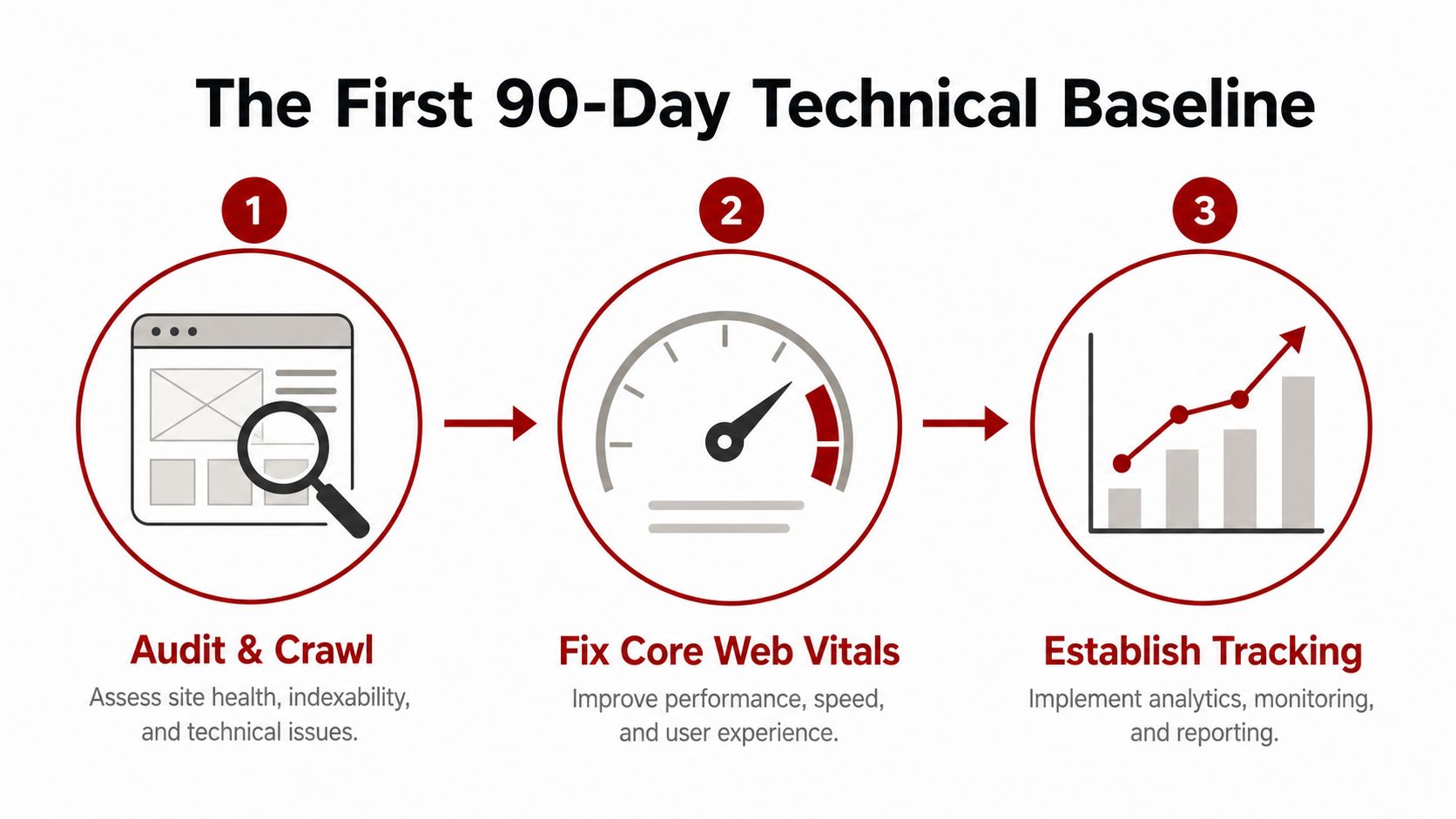
The order matters
Start with a baseline audit. Check crawlability, indexation, broken internal links, duplicate titles, thin service pages, and the technical problems that stop pages from ranking cleanly. If that audit is missing in week one, the package is built on guesswork.
After that, fix crawl and indexation problems first. Map keywords to the pages that bring in work. Then optimize the core pages that drive calls, usually the homepage, service pages, and location pages. Finish the early-stage work with Google Business Profile optimization and citation cleanup, because local businesses need consistent business data before they can compete well in map results. If you want a plain-English breakdown of that foundation work, what technical SEO covers for local service sites is the right place to start.
A package in the $500–$1,000/month range is usually built around those fundamentals rather than heavy content production or aggressive link building technical package guidance. That sequence fits a small business that needs to stabilize first.
If you want a simple tool stack to support that first 90-day push, the LunaBloom AI starter app is a practical example of how teams are organizing SEO support around content and workflow without pretending software alone replaces strategy.
What done looks like
Done looks like visible progress in the places that matter. Core pages should read cleaner, service terms should point to the right URLs, the profile should stay consistent, and the site should stop leaking equity through technical errors. That is the baseline any agency should be able to show in reporting.
Good SEO work makes the site easier to understand before it tries to make it louder.
If an agency cannot explain the crawl, index, page, and local profile work in plain English, the package is probably built to sound busy instead of perform.
Comparing Package Types by Business Outcome
The cheapest package is rarely the right one. The better question is whether the package turns search into a lead-generation channel or leaves it as a maintenance expense.
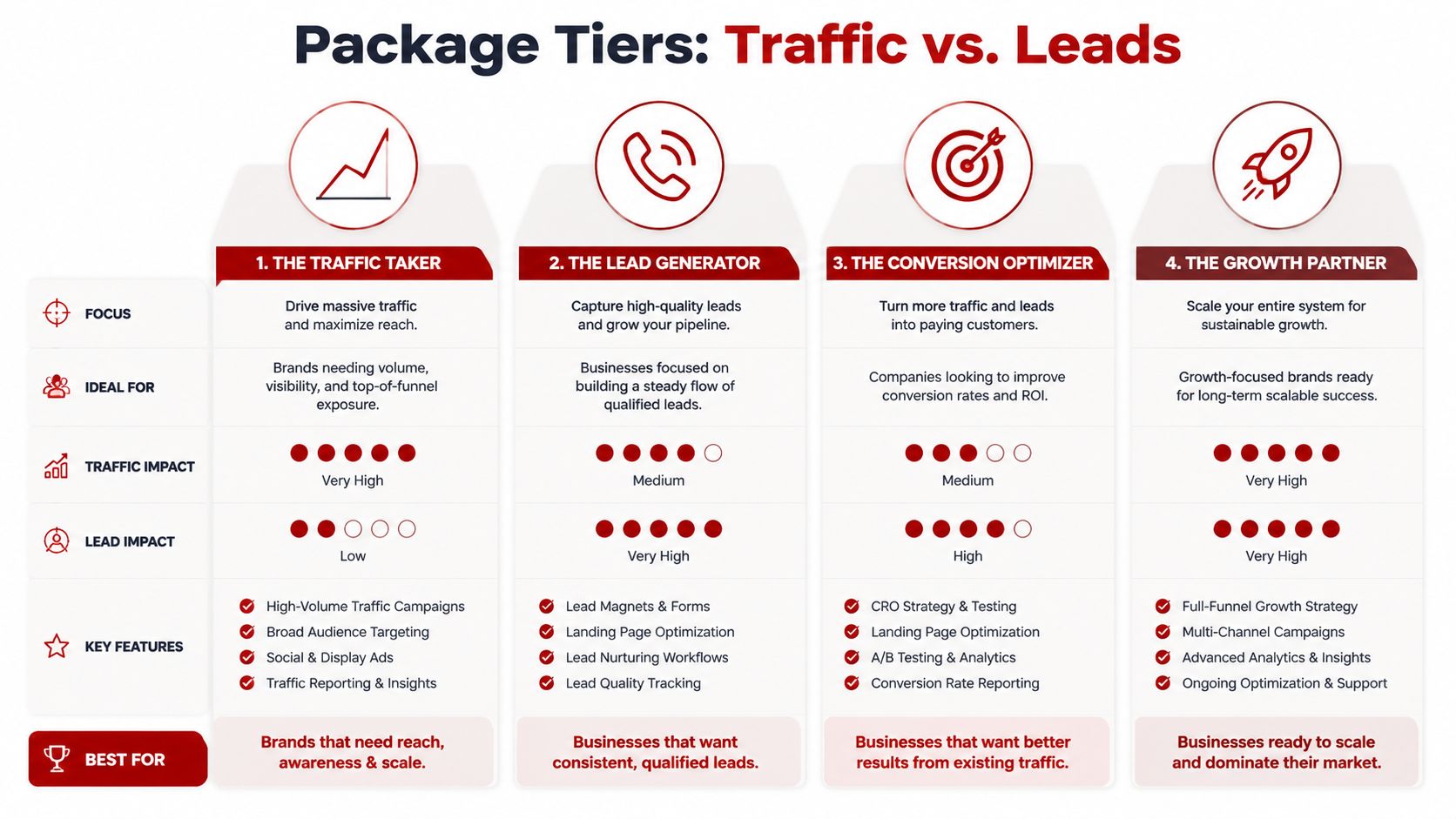
What each tier really does
DIY software helps owners who can do the work themselves. It can be fine if you're disciplined, but it usually produces partial coverage because most contractors are already busy running crews, estimating jobs, and managing customers. You get tools, not accountability.
Entry-level managed SEO is enough for some very small businesses that mainly need local visibility and a cleaned-up presence. It's often the right move when your market is simple, your website is small, and your main problem is technical clutter or inconsistent local data. It's not enough when you're fighting for every lead in a crowded city.
Established local agency work is where SEO starts to behave like a sales channel. That's the tier that usually includes local page optimization, GBP management, citation work, technical fixes, and selective content support, which is the mix most service businesses need when calls matter more than vanity traffic.
Multi-location or competitive-city campaigns need more. They usually require deeper content, stronger authority signals, and tighter measurement because the market is harder and the results matter more. That's where the budget moves toward the $1,000–$2,500+ range mentioned earlier, and sometimes beyond it.
A useful way to judge any package is by outcome, not deliverables alone. If the plan mostly promises rankings, it's a traffic package. If it's built around service pages, map visibility, and conversion tracking, it's a lead package. That difference matters for contractors in Prescott, especially if you serve surrounding areas like Chino Valley, Dewey-Humboldt, Camp Verde, or Prescott Valley and need jobs, not just impressions.
Ask one question before you buy: will this scope help me get more calls in my real service area, or just a nicer dashboard?
Silva Marketing's SEO work, for example, is built around on-page SEO, content, technical SEO, backlinks, and local SEO, which is the right mix when the goal is qualified lead flow rather than traffic for its own sake. That's the kind of scope comparison that helps owners separate real strategy from padded retainers.
Red Flags and False Economies to Avoid
Cheap SEO gets expensive fast when it wastes six months of lead flow. The worst proposals usually look tidy on paper and weak in practice.
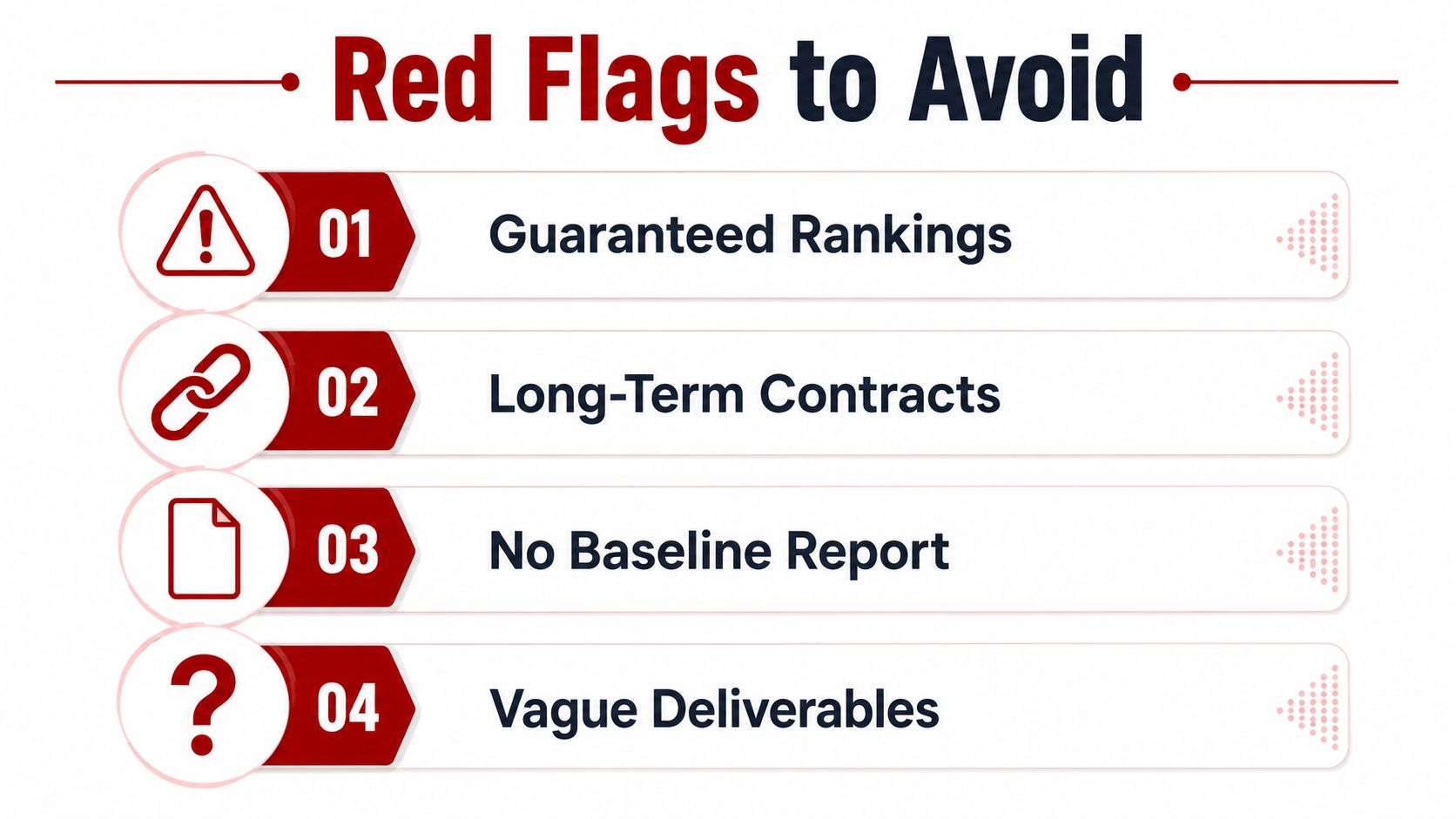
The warning signs
A guarantee of #1 rankings is the first thing I'd throw out. No one controls Google, and anyone promising a fixed position is selling certainty they don't have. The same goes for vague “we'll get you more traffic” language with no mention of calls, forms, or booked work.
No baseline report is another problem. If an agency can't show what the site looked like before work started, it's hard to know whether the monthly fee is producing real movement or just activity. That's especially risky when the report focuses on rankings alone, because rankings don't pay invoices.
Long-term contracts without performance review are a bad deal for a small business. You need room to evaluate whether the work is improving visibility, cleaning up the site, and supporting lead flow. If the agency won't discuss scope changes after the first 90 days, that's a sign they're protecting the contract instead of the client.
The last red flag is packaged work that skips technical fundamentals or leans on outsourced link schemes. Those shortcuts can create short-term noise, but they don't build durable local authority. In a Northern Arizona market, that kind of shortcut tends to fall apart as soon as competition tightens.
The false economy test
If one proposal is dramatically cheaper than the others, ask what got cut. Usually it's reporting quality, technical work, content, or real human time. The savings disappear when you have to buy the missing pieces later or wait another season for leads that should already be coming in.
The safer approach is to demand clarity. Ask what's included, what's excluded, how the first 90 days are structured, and what success looks like in terms of inquiries. That's how a professional engagement sounds.
How to Measure SEO ROI Beyond Rankings
Rankings matter, but they are not the outcome. A small business only gets value from SEO when it turns search traffic into qualified leads, booked estimates, and real jobs.
What to track
Start with tracked calls, form fills, quote requests, Google Business Profile actions, and assisted conversions. Those metrics show whether organic search is feeding the sales pipeline, and they belong in a simple monthly dashboard that a contractor can read without translation.
For the money side of the equation, the master ROI with HarvestMyData resource keeps the focus on cost per lead instead of vanity reporting. That is the right standard for service businesses that need appointments and signed work, not just traffic.
What to ignore early
Ignore every keyword wobble in the first few weeks. Early impression growth can matter, but it does not prove lead quality, and it does not pay the bills.
A service business in a moderately competitive Arizona market usually needs time before meaningful movement shows up, especially when technical cleanup, content, and local authority all need attention at once. Independent current timing guidance puts effective work in the 3–6 month range before meaningful results appear. That is not a reason to wait passively. It is a reason to watch the right signals every month.
What the dashboard should answer
Your dashboard should answer three questions. Are calls going up? Are forms improving? Is the local profile and organic channel contributing to booked work? If the answer stays fuzzy after a few months, the strategy needs a correction.
Simple rule: if rankings move but leads don't, the package needs conversion work, not more vanity reporting.
Use cost per acquisition calculation as the reference point for the next decision. That keeps the discussion tied to whether the package is producing profitable leads, whether scope needs to change, or whether the offer itself needs tightening.
Negotiating, Onboarding, and Next Steps with Silva Marketing
Negotiate scope before you negotiate price. A smaller package with the right work is more valuable than a bigger package stuffed with the wrong work, especially when you need calls from Prescott and the surrounding area, not a bloated monthly invoice.

A healthy onboarding process should start with a baseline audit, then move into a 30-60-90 day plan, reporting cadence, and clear deliverables. You want a team that can explain the work without hiding behind jargon, and you want flexibility instead of a long-term contract that locks you in before anyone proves results. Silva Marketing works this way with analyze, initiate, build, which is a practical structure for local service businesses that want calm execution and measurable progress.
The firm has 500+ websites launched and $50M+ in client revenue influenced, which gives it a useful operating history for local contractors, small businesses, and location-based brands. If you're comparing agencies, that kind of track record matters less as a sales line and more as a signal that the team has seen enough real campaigns to know what scope belongs at each price point.
For Prescott and Northern Arizona businesses, the right next step is a scoped recommendation, not a hard sell. If you want a clear read on whether your current SEO is underbuilt, overbuilt, or just pointed at the wrong goals, a free consultation is the right place to start.
If you want straight answers about what your SEO package should include, Silva Marketing can review your site, your local market, and your current lead flow, then recommend the scope that fits your business. Visit Silva Marketing to request a no-pressure consultation and get a practical plan for turning search into calls, forms, and booked jobs.
Comments