
Call Tracking Metrics That Turn More Calls Into Customers

A Prescott contractor can spend a full morning answering calls and still be unable to tell which marketing produced the best opportunities. The phone rings after a Google search, a paid ad, a referral, or a visit to the company website. In the CRM, those conversations may all appear as the same type of lead. Meanwhile, a campaign that generates plenty of calls may be producing few qualified jobs.
Call tracking metrics solve that visibility problem. They connect phone leads to their marketing source, call handling, and eventual outcome. The useful question isn't just, “How many calls did we receive?” It's, “Which channels generated qualified conversations, which calls became appointments, and where did potential customers get lost?”
Silva Marketing helps local service-based businesses across Prescott, Prescott Valley, Chino Valley, Dewey-Humboldt, and Northern Arizona understand that connection. The agency works on the problems that usually sit behind weak lead flow, including wasted Google Ads spend, unclear SEO performance, slow websites, and missed calls. Its work includes custom websites, website redesign, SEO, and Google Ads built to produce measurable customer conversations.
Table of Contents
Introduction What Call Tracking Metrics Mean for Prescott Service Businesses
How Call Tracking Actually Works and Why Attribution Matters - What makes DNI attribution accurate - Choosing the right attribution view
The Key Call Tracking Metrics Every Service Business Should Prioritize - Volume and source metrics - Quality and outcome metrics - Efficiency and cost
How to Interpret Benchmarks and Spot What Needs Fixing - A practical diagnostic sequence
Using Call Tracking Metrics to Optimize Local SEO Google Ads and Your Website - Local SEO decisions - Google Ads decisions - Website conversion decisions
Putting It All Together and Taking the Next Step With Silva Marketing - Frequently asked questions
Introduction What Call Tracking Metrics Mean for Prescott Service Businesses
A call tracking metric is a measurable signal from a phone interaction. It may identify the source of a call, whether someone answered, how long the conversation lasted, whether the caller was qualified, or whether the call led to a booked appointment. Taken together, these signals show how marketing and phone operations perform as one system.
Consider a local HVAC company serving Prescott and nearby communities. Its Google Business Profile may generate calls from organic search, while Google Ads sends callers to a landing page with a different message. If both channels display the same untracked phone number, the owner sees activity but not reliable source detail. That makes it difficult to decide whether to improve local SEO, revise ad targeting, change landing-page messaging, or improve call handling.
Practical rule: A call only becomes useful marketing data when you can connect its source to its quality and outcome.
Call volume still matters, but it's an entry point rather than a final business result. A roofing company may receive many inquiries after a storm, yet some callers may be outside its service area, seeking repairs it doesn't offer, or asking questions without booking. A smaller group of calls can create more value when the conversations are relevant, answered promptly, and handled well.
For Prescott businesses, local context makes this especially important. Calls from a service-area page, a Google Business Profile listing, an ad for Prescott Valley, and a referral from a nearby community can represent different customer intent. Good measurement helps business owners protect their budget and give marketing teams clearer direction.
The rest of this guide focuses on the metrics that turn raw phone activity into qualified-call economics. You'll learn how attribution works, which measurements deserve priority, how to diagnose weak performance, and how to apply the findings to local SEO, Google Ads, and your website.
How Call Tracking Actually Works and Why Attribution Matters
Basic call tracking records a phone event. Reliable attribution adds the answer to a more useful question: what brought this caller to the business?
Dynamic number insertion, or DNI, is the central mechanism. A script identifies a visitor's traffic source and replaces the website's standard phone number with a unique tracking number. The call still forwards to the company's real line, but the tracking system can associate the conversation with a channel, campaign, or keyword. CallRail's explanation of dynamic number insertion describes this source-swapping process and why it matters for phone attribution.
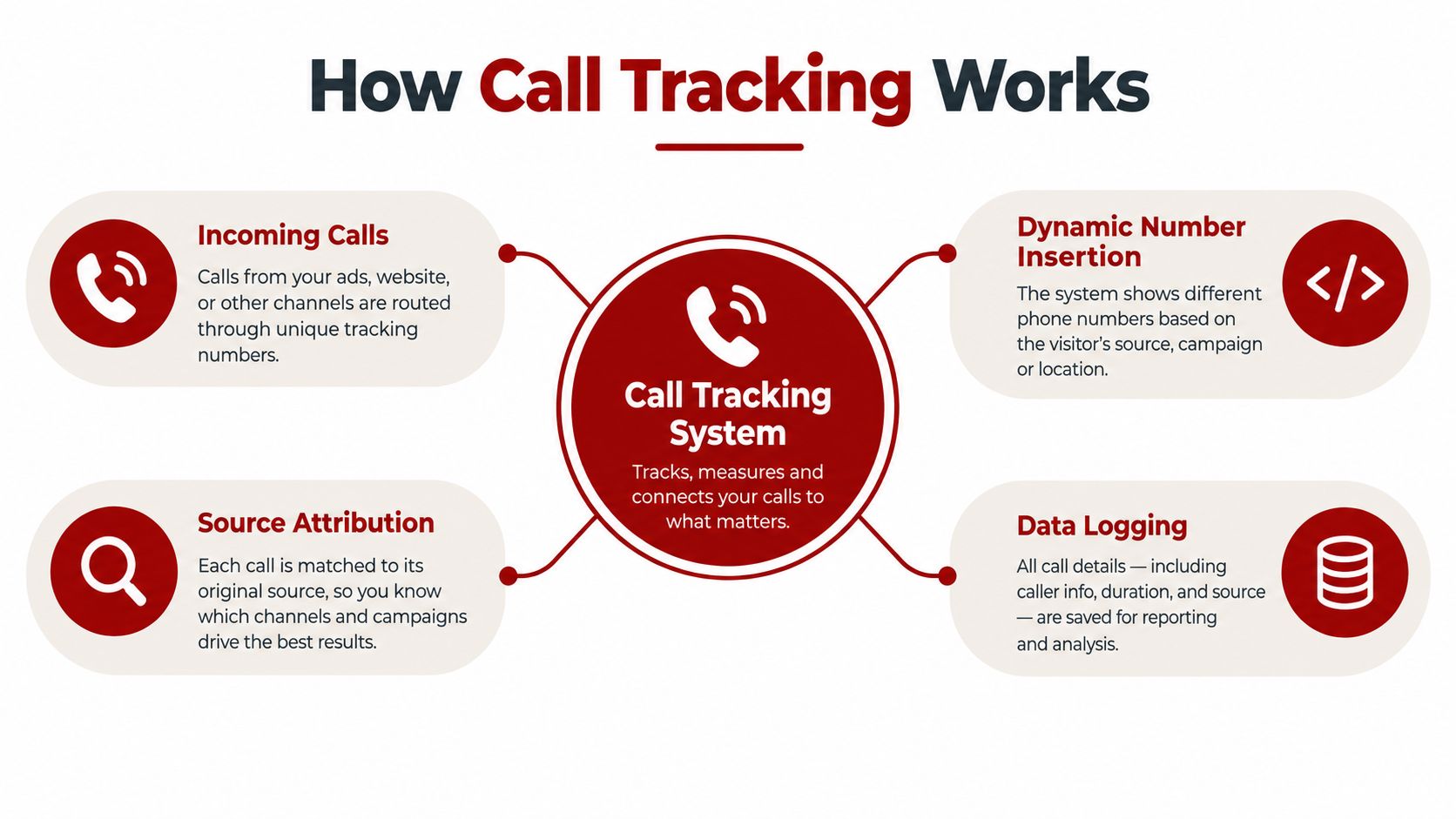
Think of DNI like assigning a different receptionist extension to each visitor source. A caller from a Google Ads landing page sees one number. A visitor from an organic service page sees another. The business answers both calls through its usual line, while the tracking platform preserves the source record.
What makes DNI attribution accurate
Three technical details affect the quality of the data:
Session identity: The system needs to connect the visitor session with the later call event.
Number-pool sizing: The tracking pool needs enough numbers for concurrent visitors. If it's too small, numbers can recycle before the original session ends, creating noisy source assignments.
Script placement: The DNI script must load correctly on the pages where visitors make decisions. A broken or delayed script can leave the default number in place and lose attribution.
This matters to local service businesses because calls from organic search, paid search, email, and referrals often look identical once they reach a CRM. A properly configured tracking system can preserve the originating session instead of reducing every phone lead to “website call.” Silva Marketing also explains the broader role of website visitor tracking in connecting visitor behavior with lead activity.
Choosing the right attribution view
First-touch attribution credits the channel that first introduced the visitor. It can help identify the sources that create initial awareness.
Last-touch attribution credits the channel or page that immediately preceded the call. It helps identify the final conversion influence, but it can overlook earlier interactions.
Campaign-level attribution connects the call to a particular ad group, keyword, email, or landing page. This view is often more actionable when a Prescott business is deciding which campaign to adjust.
Phone leads don't always follow a single path. A homeowner may discover a company through organic search, return through a paid ad, and call after reading a service page. For that reason, businesses should look beyond beyond last-click attribution when the customer journey includes several meaningful interactions.
The Key Call Tracking Metrics Every Service Business Should Prioritize
A Prescott HVAC company may receive forty calls after raising its Google Ads budget, yet book fewer jobs than it did before. The volume looks positive until the business checks caller intent, answer rate, and revenue. Call tracking works like a filter: it separates activity from opportunities the team can serve and close.
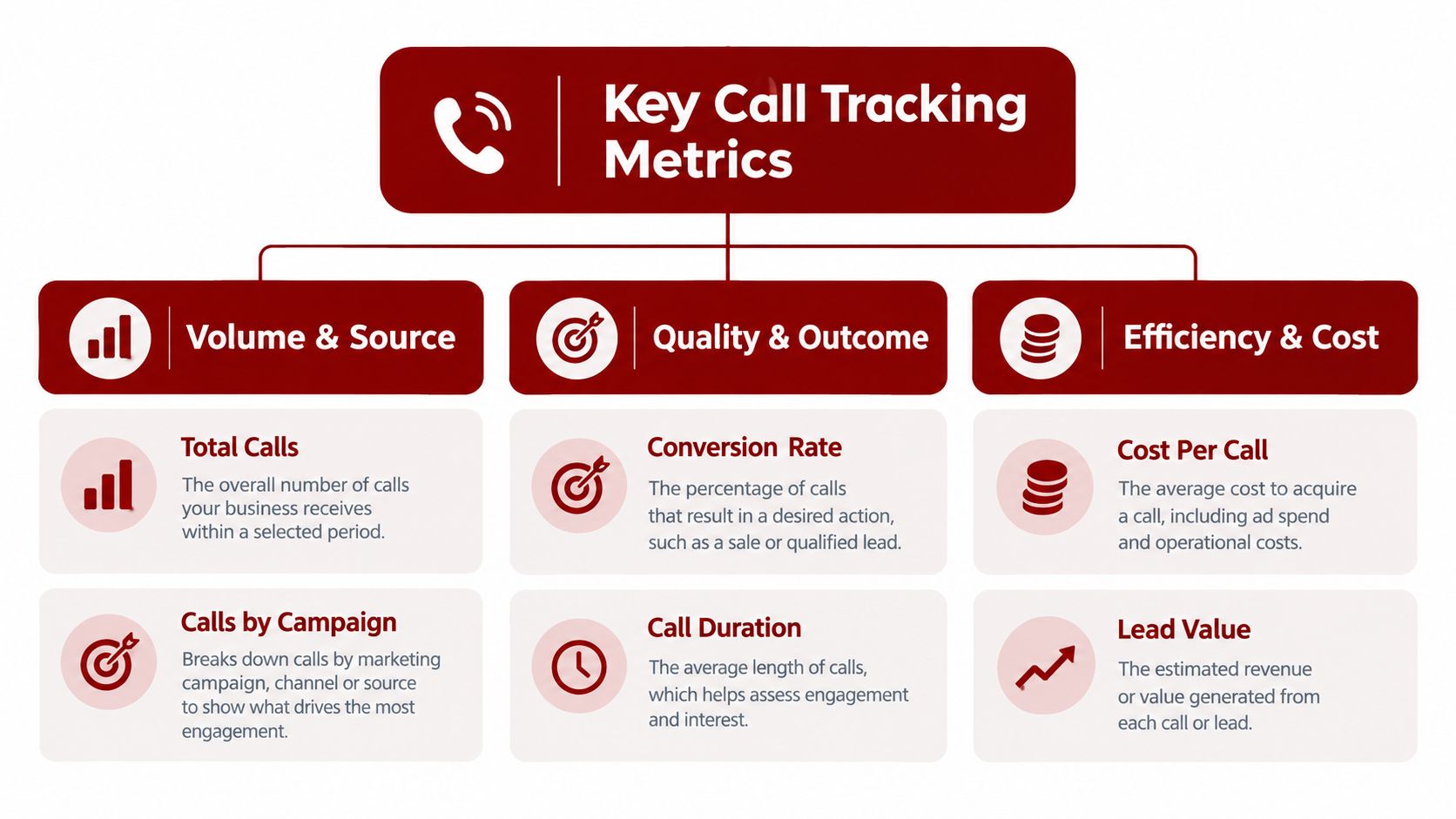
The most useful reporting groups metrics by the business question they answer. Volume and source identify demand and attribution. Quality and outcome show whether calls can become customers. Efficiency and cost connect those opportunities to marketing spend and operational capacity.
Volume and source metrics
Call volume counts incoming calls during a defined period. It can reveal seasonal demand, campaign changes, and response to a website or listing update. Volume alone does not show whether callers are in the service area, need an offered service, or are ready to book.
Calls by source separates calls from Google Ads, organic search, Google Business Profile activity, email, referrals, and other channels. Dynamic number insertion, or DNI, swaps the phone number shown on a website according to the visitor's source. Google Ads uses its own forwarding-number system for eligible call reporting. Without that attribution, a plumbing company may credit every website call to organic search and make the wrong budget decision.
Calls by campaign or keyword provides a more precise view. An emergency plumbing ad may produce fewer calls than a broad plumbing term but generate conversations that are more likely to become jobs. That comparison can guide bids, landing-page content, and budget allocation.
Quality and outcome metrics
Qualified-call rate measures the share of calls meeting a defined business standard. A qualified call might come from the service area, concern an offered service, and show a realistic path to booking. Record the definition consistently so comparisons remain useful.
Call outcome records what happened, such as an appointment, estimate request, sale, follow-up, wrong number, or unqualified inquiry. A long call is not automatically valuable. Outcome data gives duration its business context.
Call duration can support that context. Very short calls may involve wrong numbers, missed connections, or quick disqualification. Longer calls may reflect a consultation, though duration should never replace quality scoring and outcome records.
Answer rate and abandoned calls reveal operational leakage. A well-targeted campaign can still lose revenue when callers reach voicemail, wait too long, or hang up before speaking with someone. Benchmark figures vary by setting, so use them as directional references rather than universal requirements. Invoca's call monitoring guidance explains why answer performance and call quality belong in the same review.
Efficiency and cost
Cost per call connects marketing spend with call volume. Cost per qualified call is more useful because it excludes conversations unlikely to produce customers. Conversion rate by channel shows whether SEO, Google Ads, or another source creates the strongest business result.
A dental practice with many calls but few booked appointments may need clearer ad expectations, better receptionist training, or help to hire dental receptionist. These metrics do not choose the fix. They show whether the breakdown begins with targeting, the conversation, or the booking process.
How to Interpret Benchmarks and Spot What Needs Fixing
A benchmark is a reference point, not a verdict. The same call volume can represent strong demand for one Prescott service business and wasted staff time for another. Read each number beside the outcome it helps explain.
Start with the economic question: did the call create a realistic path to revenue? A campaign may generate more calls while producing fewer qualified conversations. That pattern often points to broad targeting, unclear service language, or searches from outside the company's coverage area. If qualified calls stay steady but booked jobs fall, examine scheduling, pricing communication, follow-up, and the sales conversation.
A practical diagnostic sequence
Trace each call in order. First identify the source, campaign, and landing page. Then confirm whether someone answered, whether the caller matched the service and location criteria, and what outcome the team recorded. Compare that outcome with advertising spend and revenue information in the CRM.
This sequence prevents a common reporting error: assigning the marketing channel responsibility for a breakdown that occurs after connection. Google Ads may produce the right callers, while the office loses them through missed calls or weak follow-up. Organic search may bring fewer conversations, yet those calls can produce a lower acquisition cost and more booked work.
Pair operational signals with financial results. Answer and abandonment patterns can reveal capacity problems, but they do not show whether the calls were worth acquiring. Quality scoring, call outcomes, booked appointments, and revenue add that missing context.
Reporting Focus | What It Tells You | Risk If Used Alone | Better Paired Metric |
|---|---|---|---|
Total call volume | How much phone activity occurred | It combines qualified, missed, and irrelevant opportunities | Qualified-call rate |
Calls by campaign | Which marketing effort produced calls | It does not show customer value | Call outcome |
Average duration | How long conversations lasted | A long call may still end without a booking | Conversion rate |
Answer rate | Whether callers connected with the team | It says little about conversation quality | QA score |
Abandonment rate | How often callers left before connection | It does not identify the staffing cause | Hold-time review |
Cost per call | What spend produced phone activity | Low-cost calls may have little value | Cost per qualified call |
Conversion rate | How often calls produced a desired result | It can hide differences between channels | Conversion by source |
A useful review asks what should change next. If qualified-call rate is weak, inspect keywords, location targeting, and service-page expectations. If quality is strong but appointments are low, review call handling and follow-up. If appointments are healthy but acquisition cost is high, compare channel spend with booked revenue before increasing budget.
For the financial calculation, Silva Marketing's guide to cost per acquisition calculation provides a framework for replacing raw lead counts with qualified calls and booked outcomes. That shift turns call tracking into a decision tool for local SEO and Google Ads, rather than a report centered on phone volume.
Using Call Tracking Metrics to Optimize Local SEO Google Ads and Your Website
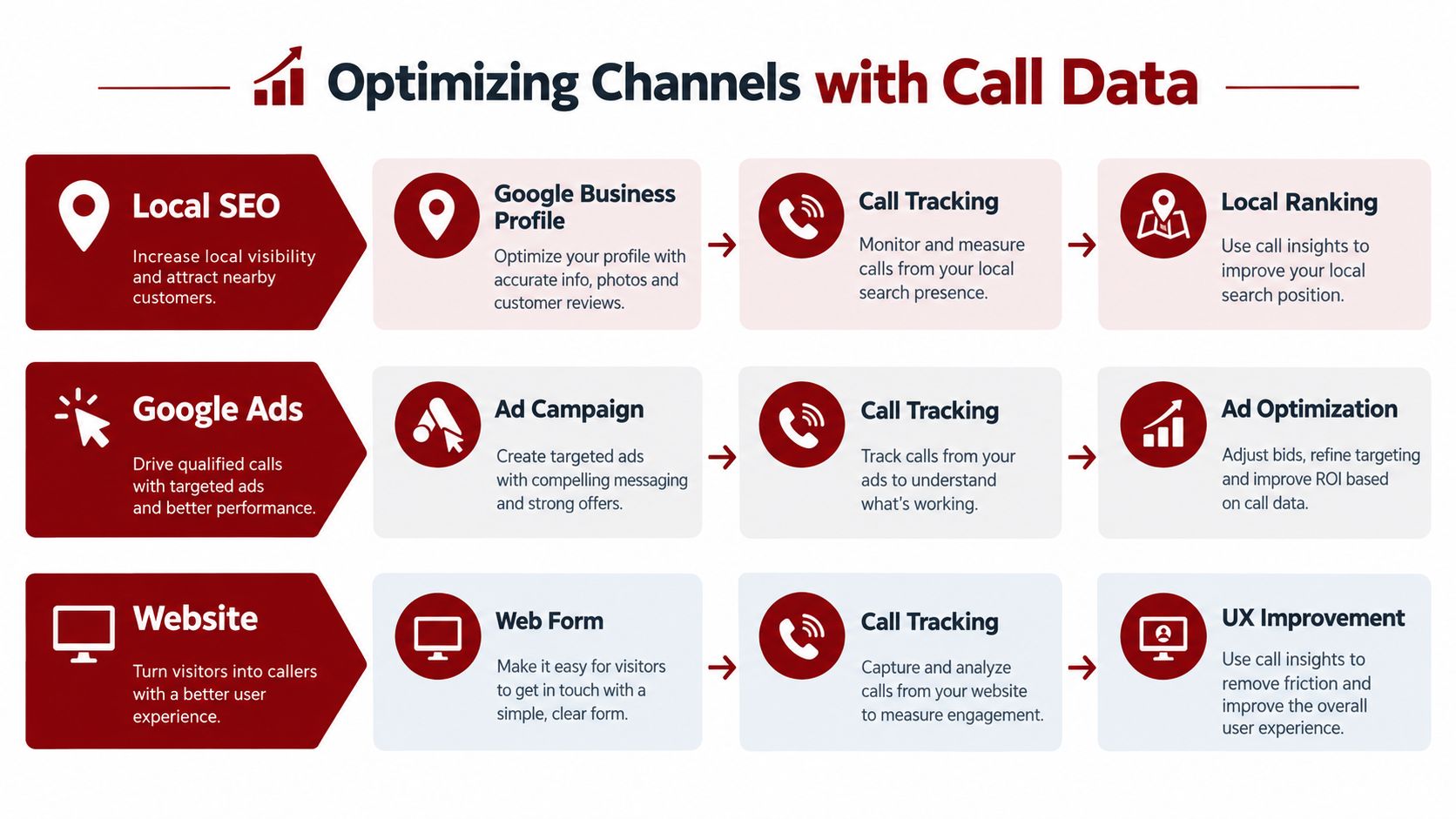
Call data becomes valuable when it changes a marketing decision. A Prescott service business can use the same measurement system to improve local SEO, Google Ads, and the website experience, but each channel requires a different response.
Local SEO decisions
Begin with the source and landing page. Compare calls from the Google Business Profile, organic service pages, location pages, and branded searches. If a Prescott water-damage page produces qualified calls while a general home-services page produces mostly informational inquiries, the service page deserves clearer internal linking, stronger calls to action, and continued content support.
Review the caller's service area and requested service. A location page that attracts calls from outside the company's coverage may need more precise copy. Businesses serving Prescott Valley, Chino Valley, or Dewey-Humboldt can make those boundaries clear instead of relying on broad regional language.
Local SEO reporting should connect visibility with outcomes. A page isn't successful merely because it receives visits or ranks for a phrase. It should help the right person call, understand the offer, and take the next step.
Google Ads decisions
Google Ads call reporting uses a Google forwarding number that replaces the business number in an ad and routes callers to the business line. Google says this reporting can include call duration, call start time, caller area code, and whether the call connected, and in some cases the caller's phone number for calls lasting over 15 seconds. The assigned number may be toll-free or local depending on availability and geographic region, as documented in Google Ads call reporting.
Use that data with qualified-call rate and channel conversion. If one campaign produces connected calls but few qualified opportunities, adjust its keywords, geographic targeting, ad message, or landing page. If another campaign produces fewer calls but stronger booked-job outcomes, its economics may justify more attention.
Google's reporting also differs by market. In countries where forwarding numbers are available, phone interactions are reported as calls. Where forwarding-number support isn't available, the same interaction may appear as a call click instead of a reported call, according to Google's Smart campaign reporting guidance. That distinction matters when comparing Prescott campaigns with campaigns in other regions.
For implementation details, Silva Marketing provides a resource on Google Ads conversion tracking setup.
Website conversion decisions
Check whether the tracking script loads on every important landing page. Confirm that the displayed number changes by source, that the tracking pool is sufficient, and that the phone number remains easy to find on mobile. A visitor shouldn't need to search through a long page to call a Prescott service provider.
Then connect website behavior with call outcomes. If visitors from a paid landing page call frequently but abandon quickly, review page speed, offer clarity, contact expectations, and call routing. If organic visitors call after reading detailed service content, preserve that structure and make the next action more visible.
Common Mistakes That Make Call Data Misleading
More calls don't automatically mean more revenue. “Volume without qualification is noise” is the central warning in recent call-tracking guidance, including Service Grower's discussion of actionable call tracking metrics. A campaign can inflate activity by attracting broad searches, repeat callers, wrong numbers, or people outside the service area.
That problem becomes worse when the business changes its definition of a qualified call from one reporting period to the next. A month that counts every connected conversation can't be compared fairly with a month that counts only service-area callers seeking a bookable service. Choose a definition, document it, and keep it stable.
Small number pools create a technical version of the same problem. When numbers recycle too quickly, the system may assign the wrong source to a visitor. The resulting reports can make ROI look unstable even when campaign performance hasn't changed.
Privacy creates another risk. Call recording and tracking require clear consent workflows, suitable notices, and attention to jurisdiction-specific rules. GDPR guidance for call centres emphasizes explicit consent and the need for businesses to demonstrate that consent was handled correctly. A company expanding across markets should review its process with appropriate legal counsel rather than assuming one recording policy works everywhere.
Google Ads data also requires careful comparison. Imported call-conversion debugging data is available only to users of the uploading Google Ads account and authorized Google employees, retained for 90 days for error resolution, and not shared with third parties except when required by law or legal process, according to Google's imported call-conversion debugging documentation. Don't treat missing historical debugging detail as proof that the campaign never generated calls.
Putting It All Together and Taking the Next Step With Silva Marketing
A dependable call measurement system follows a simple order:
Capture accurately: Use DNI and confirm that source assignment works across important pages and visitor sessions.
Judge quality: Separate qualified calls, answered calls, outcomes, and customer conversations from raw activity.
Interpret the system: Read source, operational, and financial metrics together.
Apply the findings: Improve local SEO pages, Google Ads campaigns, call handling, and website conversion paths.
Silva Marketing is a Prescott-based digital marketing agency with 500+ websites launched and $50M+ in client revenue influenced, according to the publisher information for the business. Its services include custom websites, redesigns, SEO, Google Ads, competitor analysis, technical improvements, and conversion-focused digital strategy for Prescott and Northern Arizona businesses.
For businesses that need their marketing and customer records connected, a CRM integration can preserve lead source, call details, and outcome information in one workflow. Silva Marketing outlines that approach in its resource on CRM integration with a website.
Frequently asked questions
What is the most important call tracking metric?
Start with qualified-call rate by source, then connect it to booked appointments or revenue. Call volume shows demand, but qualified outcomes show business value.
Can call duration prove that a call was valuable?
No. Duration provides context, but a long conversation can still end without a qualified opportunity. Review duration beside outcome and QA data.
Should every business record calls?
Not necessarily. Recording depends on business needs, consent practices, and applicable jurisdictional requirements. A business should establish a clear, compliant process before recording.
Silva Marketing offers custom websites, website redesign, SEO, and Google Ads conversion tracking that connect marketing activity with qualified calls and customer outcomes. Visit Silva Marketing to request a free consultation and discuss a clear measurement plan for your Prescott or Northern Arizona service business.
Comments