
On Page SEO Keyword Research: A Local Service Guide

Your Prescott business has a good-looking website, but the phone's quiet and you're not sure which pages need work. On page SEO keyword research means finding the words customers search, choosing the page that should answer each need, and shaping its title, headings, and copy around that purpose.
Silva Marketing helps service businesses in Prescott and across Northern Arizona connect those searches to useful local website pages. For contractors, home service companies, medical and dental offices, and professional firms, the problem isn't just finding more keywords. It's identifying searches that can lead to qualified calls, appointments, and booked jobs.
Table of Contents
How On Page SEO Keyword Research Works for Local Services - What does the research process produce?
Building a Seed List From Real Customer Language - Which questions stop someone from calling? - How should you expand the list?
Matching Search Intent to the Right Page Type - How do you check an ambiguous query?
Which Keyword Metrics Matter for Local Service Pages - What does keyword difficulty leave out? - How do AI Overviews change the decision?
Finding Competitor Gaps in Prescott Search Results - What should you record in a local search audit? - Does the gap also support local legitimacy?
How to Prioritize Keywords and Map Them to On-Page Elements - How do you turn a cluster into a page?
Frequently Asked Questions About On Page Keyword Research - What is on page SEO keyword research? - Do I need a separate page for every town I serve? - How many keywords should one page target? - How often should I review keyword performance? - Is search volume enough to choose keywords?
Pick Your First Three Local Pages to Build - What should you measure after publishing?
How On Page SEO Keyword Research Works for Local Services
The practical deliverable is a keyword-to-page map, not an exported list of phrases. That map gives each URL a primary search intent, a target query, supporting terms, an intended conversion action, and a performance baseline.
For example, a roofing company might need separate pages for repairs and replacements because those customers need different answers. Someone with an active leak wants help assessing the problem and requesting service. Someone considering replacement needs information about materials, the project process, and an estimate.
Google's SEO Starter Guide recommends clear, accurate titles and readable content organized with headings. Google can generate search-result title links from the HTML title and other page elements, including headings. Your page's main topic should therefore remain consistent from the search result through the content visitors read.
What does the research process produce?
Follow this sequence so each decision has evidence behind it:
Build a seed list from customer language.
Validate demand, intent, and ranking feasibility before committing to a target.
Match each query to a page type that can satisfy the search.
Check local competitors and identify missing answers or proof.
Prioritize clusters and assign them to pages and on-page elements.
Measure impressions, clicks, and calls, then refine.
The overview below groups the workflow into its main publishing decisions.
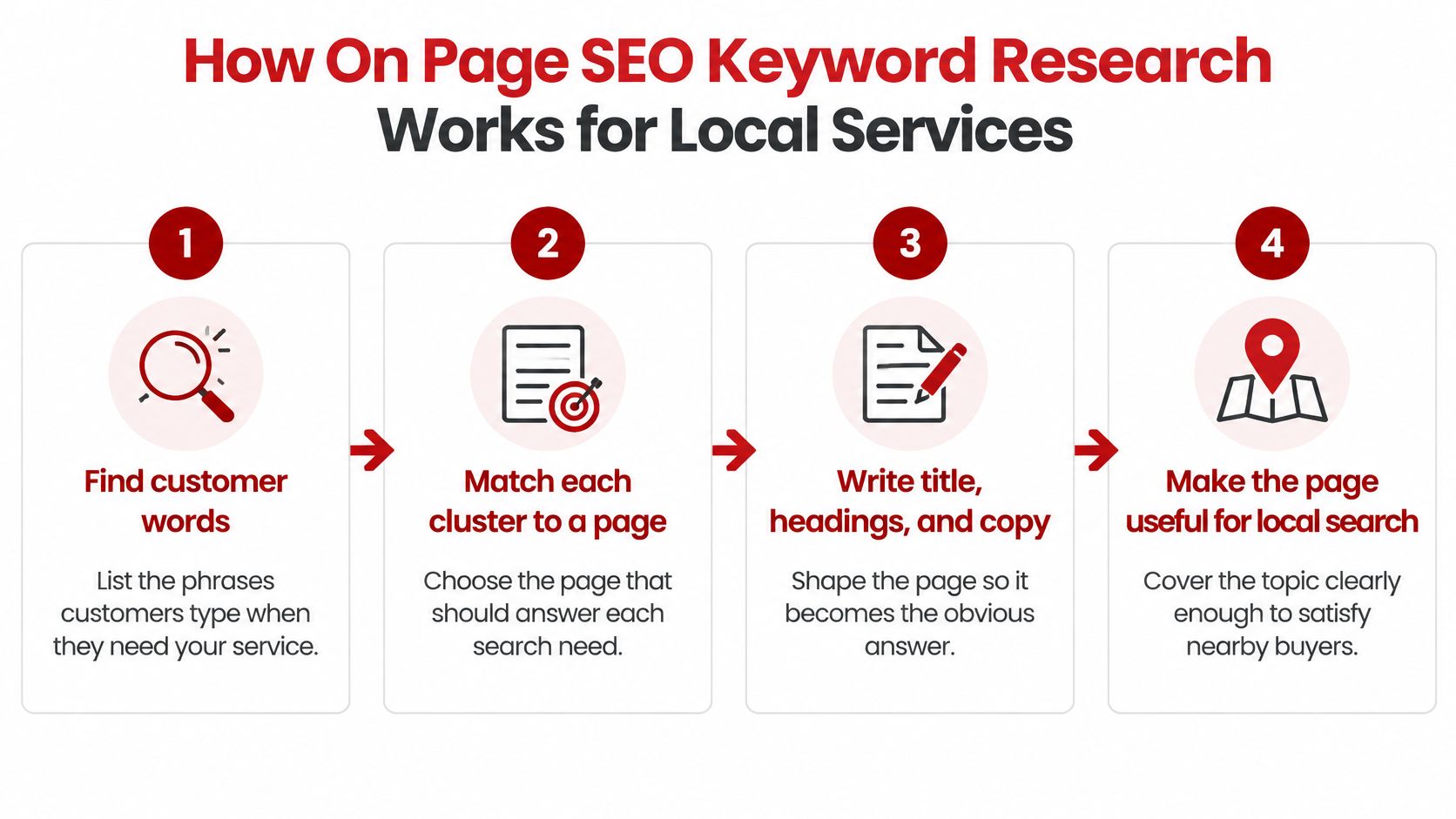
The order matters. A keyword list without a suitable page gives you nothing useful to publish, while a page built around an untested assumption can consume time without addressing a real buying need.
For a complementary planning resource, SemDash explains how to map target keywords to pages. Use that mapping exercise to connect a search to both its destination and its business purpose.
Practical rule: Before approving a keyword, name the page that will answer it and the action a qualified visitor should take.
For a Prescott service website, that action might be a repair call, a consultation request, or an appointment inquiry. Those outcomes keep the research grounded in the business rather than in rankings alone.
Building a Seed List From Real Customer Language
Customer language is a better starting point than tool output because customers describe their problems before they learn your service categories. Say a Prescott roofer hears homeowners describe a water spot over the garage more often than they ask for roof repair. The symptom belongs in the seed list, even if the eventual destination is a repair page.
Start with the sources closest to actual buying conversations:
Calls and front-desk questions: Record the problem, urgency, and questions people ask before booking. Review recordings only when appropriately collected and accessible.
Contact forms: Preserve the customer's phrasing rather than translating everything into industry terminology.
Business Profile interactions and reviews: Look for descriptions of the service, communication, availability, and reasons customers chose the business.
Search evidence: Add Search Console queries from existing pages, then competitor service headings to expand your vocabulary.
A spreadsheet should retain enough context to distinguish a research question from a request for service. A phrase about a stain could indicate a roof leak, a plumbing problem, or uncertainty about which professional to call.
Which questions stop someone from calling?
Create a separate group for trust and qualification terms: licensing, warranties, financing, service boundaries, emergency response, availability, and project fit.
These aren't decorative additions. In Rio SEO's 2025 survey of more than 1,000 U.S. consumers, 75% read at least four reviews before deciding, and 53% would avoid a business because of inaccurate listings. A page that explains the service but leaves basic trust questions unanswered can still leave prospects uncertain.
For Northern Arizona businesses, capture questions about travel fees, seasonal availability, and whether a property falls inside the actual service radius. Volume tools can miss conversational and hyperlocal wording, so don't discard a recurring sales question because a tool reports little demand.
How should you expand the list?
Google Trends guidance supports comparing up to five terms and examining interest over time, geography, and related searches. Compare relevant service terms across Arizona, then treat Rising queries as ideas to validate, not automatic priorities.
If your customer-language collection spans several systems, NotFair provides a contact route to discuss how to connect AI agents to marketing platforms. Keep automation subordinate to privacy controls and human review of what customers mean.
Finish with spreadsheet columns for service, location, problem, and trust. Remove duplicates and spelling variants, but retain meaningful differences such as emergency service versus planned maintenance.
Matching Search Intent to the Right Page Type
Give each URL a primary intent, and choose a page type that matches the search results. Search intent is the job someone wants to complete, such as finding a provider, comparing options, or resolving a concern before calling.
The same service can generate several intents. Silva Marketing's explanation of search intent in SEO provides additional context for distinguishing them.
Search intent types and the page each one needs
Intent | Prescott example query | Page to build | On-page focus |
|---|---|---|---|
Service plus city | SEO agency Prescott | Dedicated service page | Title, main heading and opening paragraph name the service and the area served |
Question before buying | how long does a website redesign take | Explanatory guide or FAQ section | Question as an H2 with a direct answer in the first two sentences |
Comparison | custom website or template Prescott | Comparison page | Side-by-side criteria block near the top of the page |
Trust and qualification | licensed contractor website Northern Arizona | Proof section on the service page | Credentials, reviews, project examples and service boundaries |
Urgent or availability | how fast can a contractor site launch in Prescott | Process page | Timeline, response steps and a clear phone or form path |
A service-plus-city page must establish that the business provides the requested service locally. A buying question needs an immediate explanation, not a long company introduction.
A comparison page should help the reader assess choices through practical criteria such as flexibility, maintenance, and project requirements. Trust searches require evidence, while availability searches require an honest process and an obvious contact route.
How do you check an ambiguous query?
Open the top ten results in a private browser window and classify what appears: service pages, directories, maps, guides, or AI summaries. Note your search location because a private window doesn't remove geographic influence.
Some phrases need especially careful interpretation. The contractor website example could mean someone seeking a licensed contractor's site or someone seeking website design for contractors. Don't force a phrase onto your preferred page when the results reveal a different need.
Question formatting is useful, but it isn't a complete strategy. According to Create and Grow's compilation of SEO research, approximately 14.1% of keywords were phrased as questions in 2024. Use question headings where they help customers, rather than turning every phrase into a question.
If the results don't match your planned page type, change the page plan before you write.
Avoid publishing nearly identical pages for Prescott, Prescott Valley, and every nearby community. Consolidate overlapping variants into a useful service page that names the areas served, reserving additional pages for meaningfully different needs.
Which Keyword Metrics Matter for Local Service Pages
Sorting a keyword list by search volume puts the biggest number first, not necessarily the best opportunity. A specific Prescott service query can be more useful than a broad phrase if the searcher needs exactly the work you want to book.
Use a scorecard that considers demand alongside intent, competition, and commercial fit. Silva Marketing's keyword research planner can help organize those decisions.
Keyword metrics and how to read them for a local service
Metric | What it tells you | How to read it for a local service |
|---|---|---|
Monthly search volume | Directional demand for the exact phrase | Treat as a rough floor for a city term, not a forecast of calls |
Keyword difficulty | Strength of link competition among top-ranking pages | Compare with the local results you see, not as a universal score |
Search intent match | Whether results show your planned page type | If results are mostly directories or maps, a service page may not rank |
SERP features | Whether map packs, reviews or AI answers take the space | Shared clicks mean the page needs stronger proof to earn one |
Lead value | How likely the query is to become a call or form | A small query that brings booked jobs beats a broad term with no buying signal |
Treat the volume row as a directional screening aid, not a statistical lower bound. Estimates can overstate or understate demand, and close variants may share grouped estimates.
What does keyword difficulty leave out?
Ahrefs' explanation of keyword metrics describes difficulty primarily through referring domains pointing to ranking pages. It's location-specific and mainly reflects link competition, not whether your business has stronger local evidence or a more useful answer.
Don't add every close variant's volume together. Grouped meanings can make the combined total look larger than the audience available.
Small-volume terms deserve inspection. In an SEO statistics compilation citing Ahrefs, 94.74% of keywords received ten or fewer monthly searches in 2024. That finding supports reviewing long-tail phrases, not assuming every obscure phrase is valuable.
How do AI Overviews change the decision?
A 9to5Google report on Pew Research Center's study of 900 U.S. adults states that users clicked a traditional result on 8% of searches with an AI Overview, compared with 15% without one; only 1% clicked a link inside the overview.
Record whether an AI Overview appears for each target. Distinguish answer visibility, qualified website clicks, and conversion actions such as calls or direction requests.
For a lead-generation service page, retain the target when you can provide a clear, supportable answer and a stronger reason to contact the business. Rank by lead value and intent fit first, then volume.
Finding Competitor Gaps in Prescott Search Results
Competitor gap analysis identifies where an existing result leaves a local buyer without a useful answer. It's not an exercise in copying competitors' keywords or making a longer version of their page.
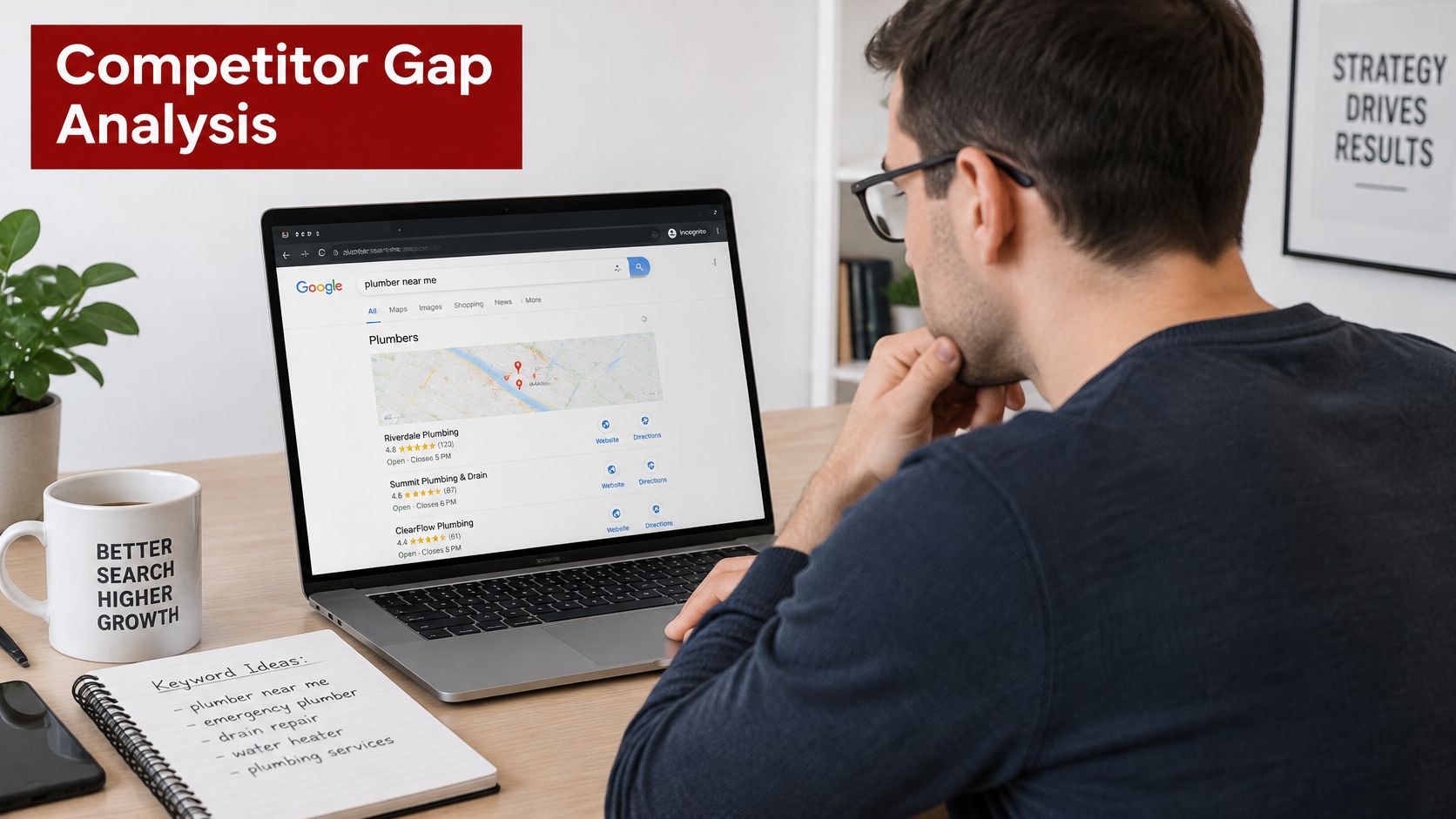
Use a worksheet beside your browser to capture evidence rather than impressions.
What should you record in a local search audit?
Search the cluster locally. In a private window, search the service with Prescott or the relevant community. Record the top ten organic results and the businesses appearing in the map pack separately.
Inspect the actual pages. Note page type, useful detail, service areas, credentials, reviews, and answers to likely caller questions.
Run a keyword gap comparison. Use Ahrefs or Semrush to identify relevant terms competitors appear for that your site doesn't address.
Classify the missing value. Label each opportunity as a missing page, thin page, missing proof, or missing question.
Silva Marketing's guide to competitor keyword analysis offers a focused companion for that comparison.
Say a competing web design business appears for a Prescott query with a generic homepage. If that page doesn't explain coverage or process, a possible gap is a dedicated service page naming Prescott, Prescott Valley, and the surrounding communities served, supported by real project examples.
That's a hypothesis to validate, not a claim about today's rankings. Your page still needs to satisfy the query and offer credible evidence.
The following video provides another format for reviewing the topic.
Does the gap also support local legitimacy?
Google's local ranking guidance names relevance, distance, and prominence as the primary local ranking factors. Better copy can clarify relevance, but it can't relocate the business or replace genuine prominence.
Check that the business name, address where publicly displayed, and service-area descriptions agree with the Business Profile and directory listings. For service-area businesses, preserve appropriate address privacy rather than publishing an address solely for keyword placement.
Record competitors' credentials, reviews, and community involvement, then identify the proof your page can provide. Don't add unsupported certifications, affiliations, or claims.
Missing page: A valuable service has no suitable destination.
Missing detail: The page omits process, boundaries, or project fit.
Missing proof: Claims lack examples or verifiable support.
Missing answer: A buying question remains unresolved.
Also note which sources AI summaries cite. Finish with a shortlist you can answer more accurately and usefully, not a list of wording to imitate.
How to Prioritize Keywords and Map Them to On-Page Elements
Use a simple one-to-five working score for each cluster's local buying signal, intent match, ranking feasibility, service fit, and writing effort. This is a planning method, not a search-engine metric. For effort, assign the higher score when the work is more manageable so the totals remain consistent.
Prioritize clusters tied to services you want more of and pages you can support with accurate information. A promising query isn't ready for publication if the business can't substantiate its main claims.
Use this checklist to keep the decisions visible.
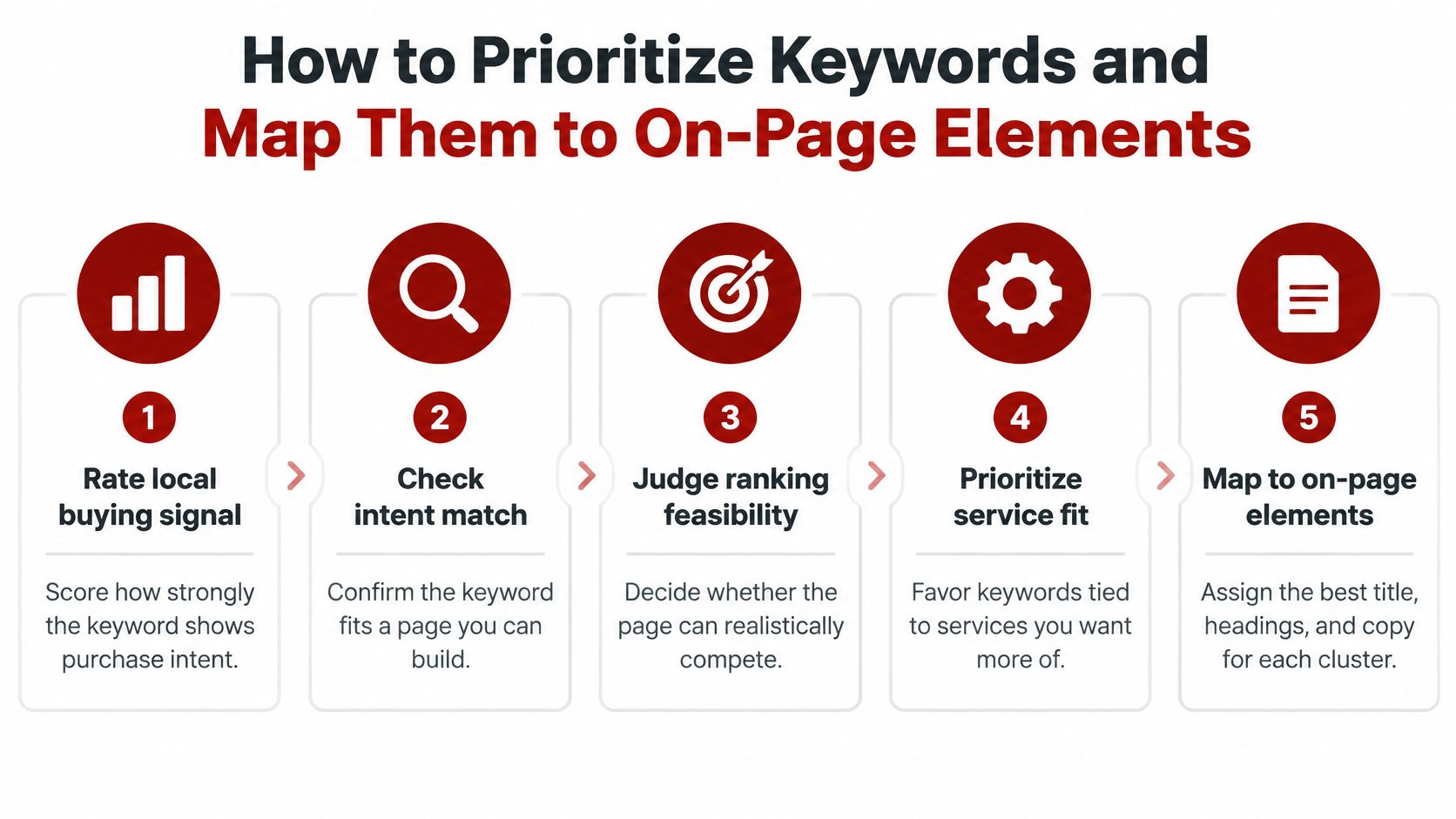
How do you turn a cluster into a page?
Group related phrases under a primary query. Keep terms together when they express the same need and produce substantially overlapping results. Separate distinct services or buying tasks.
Score the cluster. Write a short reason beside each rating. This prevents a large volume estimate from overriding weak local fit.
Choose the destination. Update an existing relevant page when possible. Create a new URL when the intent needs its own complete answer.
Draft the title and main heading. Express the target phrase naturally and accurately. An exact wording match is useful only when it reads clearly.
Write the opening and supporting headings. State the service, audience, and geography early. Use subheadings to answer distinct needs rather than repeating the primary phrase.
Describe images and link destinations. Alt text should explain the actual image, while internal anchor text should describe the destination. Neither needs an awkward exact-match phrase.
Write a faithful meta description. Summarize the page's value and next step without promising anything the content doesn't deliver.
Google's Search Essentials recommends using searchers' words in prominent places, including titles, main headings, alt text, and link text. That's a rule for meaningful description, not permission to repeat a phrase everywhere.
Where the target keyword goes on a local service page
On-page element | Where the keyword goes | Prescott example |
|---|---|---|
Title tag | Front of the title, once, in natural wording | Roof Leak Repair in Prescott, AZ |
Main heading | Describes the service and area in plain language | Roof Leak Repair for Prescott Homes |
Opening paragraph | First 100 words, stating service, area and who it helps | We repair roof leaks for homeowners across Prescott and Prescott Valley |
Subheadings | Questions or steps that use the same service terms | How long does a roof leak repair take in Prescott? |
Image alt text | Describes the photo and includes the service where accurate | Crew sealing a roof valley in Prescott |
Internal link text | Names the destination page clearly | See our roof replacement process in Prescott |
The opening placement is a drafting guideline, not a Google threshold. For more detail on search-result wording, use Silva Marketing's title tag optimization guide.
Phrases such as roof repair Prescott and roof leak repair Prescott AZ can belong on the same page without appearing verbatim throughout it. Before publishing, confirm the URL's intent, primary query, conversion action, and logged baseline.
Frequently Asked Questions About On Page Keyword Research
What is on page SEO keyword research?
On page SEO keyword research identifies the words customers search and assigns each search need to an appropriate page. You then use that understanding to write a useful title, headings, and content, rather than inserting keywords into unrelated copy.
Do I need a separate page for every town I serve?
No. A service page can name Prescott, Prescott Valley, and surrounding areas when the service and customer needs are substantially the same. Build separate pages when the services or location-specific information differ enough to justify a distinct answer, not merely to swap town names.
How many keywords should one page target?
Choose a primary query plus a small group of closely related supporting terms. For example, roof repair Prescott and roof leak repair Prescott AZ can support the same repair page when they reflect the same customer need. Coverage matters more than hitting a keyword count.
How often should I review keyword performance?
Review monthly after recording a baseline, and allow a full reporting cycle before making another nonessential change. Keep a change log so you can connect edits with later results. Correct factual errors or broken contact paths immediately rather than waiting for the scheduled review.
Is search volume enough to choose keywords?
No. Prioritize lead value and intent fit, then use volume to understand directional demand. A specific phrase that attracts suitable service inquiries can be more useful than a broad topic that brings visitors who aren't looking to hire.
Pick Your First Three Local Pages to Build
Choose the three clusters with the clearest local buying signal and page type. Starting with a manageable set lets you complete the pages properly, establish measurement, and learn before expanding.
For a local service company, that might mean a core service page, a higher-value specialty service page, and a process or comparison resource that supports a booking decision. Select them from the evidence you've collected, not from a generic list every Prescott business is expected to publish.
What should you measure after publishing?
Google's Search Analytics documentation describes impressions, clicks, click-through rate, and average position, with grouping by page, country, and device; the performance report can display up to 1,000 top queries. Scan the query list for service problems, local wording, and decision-stage questions, remembering that some rare queries may be omitted.
Interpret signals cautiously:
High impressions with low clicks: Inspect the title, snippet, result position, and competing search features. The page's value may be unclear, but weak wording isn't the only possible cause.
An unexpected landing page: Check whether the intended destination exists, answers the query, and receives understandable internal links.
Clicks without qualified inquiries: Review service fit, proof, geographic coverage, and the contact path.
New language in calls: Add useful customer questions to the appropriate headings or FAQs when they improve the answer.
Search Console doesn't tell you which calls became booked jobs. Keep a separate record of inquiry source, requested service, and outcome so you can judge business value alongside visibility.
Measurement discipline: Log the baseline, record the change, and avoid changing several page elements at once when you want to understand what helped.
Silva Marketing's Prescott-based process begins by aligning goals and budget before a proposal. After a client's strategy session, work starts within 5–7 business days. You can also complete your own map and validate it against local results before deciding whether you need help.
Choose the clusters, build or update the pages, then measure for a full reporting cycle before expanding.
Silva Marketing offers a free 30-minute call to review your goals, audit current marketing, and map a plan with no pressure or obligation. Visit Silva Marketing to discuss which local keyword clusters belong on your current pages and which deserve a new page.
Comments