
Keyword Research for Google Ads That Converts

A Prescott HVAC company can spend through a daily budget while its ads attract people searching for DIY furnace fixes, replacement parts, or troubleshooting videos. At the same time, a customer searching for emergency AC repair in Prescott may never see the ad because the campaign is organized around broad service labels instead of buying intent.
Silva Marketing helps local service businesses in Prescott, Prescott Valley, Chino Valley, Flagstaff, and across Northern Arizona turn Google Ads clicks into calls, form submissions, and booked appointments. The problem it solves is straightforward: too much budget goes to searches that look relevant but don't produce qualified leads.
Keyword research for Google Ads should reduce wasted spend before it tries to increase reach. That means identifying the service, intent, location, and conversion action behind every search. The process below is designed for contractors and service businesses that depend on phone calls, not online checkout transactions.
Table of Contents
Why Keyword Research for Google Ads Starts With the Goal - Define the action that creates value - Follow the customer's intent - Filter before you fund
Sources That Reveal What Prescott Buyers Search - Start with Keyword Planner - Use Trends to expose timing - Mine the search terms report - Check competitor coverage
Grouping Keywords by Intent and Service Area - A Prescott HVAC grouping example
The Negative Keyword System Most Accounts Skip - Review queries with a reason
Tracking Conversions and Proving the Research Worked - Review the account through three views
FAQ and Next Steps With Silva Marketing - How often should a Google Ads keyword list be refreshed? - How many negative keywords should be added in each review? - Does broad match still work for local service businesses? - When should a campaign be split? - How should a zero-impression keyword be interpreted? - What is a realistic timeline before CPA stabilizes in Prescott?
Why Keyword Research for Google Ads Starts With the Goal
A Prescott HVAC company bidding on every term containing “HVAC” can attract searches from homeowners asking why a furnace is loud, students looking for training, or people searching for replacement parts. Those searches may be related to the business, but they don't necessarily represent someone ready to book a technician.
Keyword research has three jobs to complete before bidding begins.
Define the action that creates value
Start with the conversion, not the keyword list. A conversion might be a qualified phone call, a completed service form, or a booked appointment. Once that action is clear, each keyword can be judged by its ability to create revenue rather than traffic.
A commercial search such as “water heater replacement Prescott” deserves a different evaluation from “what is a thermocouple.” A click on either term may cost money, but the first search suggests a service decision while the second may only seek an explanation. Your maximum acceptable CPA should reflect the economics of each service line, including the value of a booked job and the likelihood that a lead becomes a customer.
Follow the customer's intent
A searcher asking “why is my furnace loud” is problem-aware. Someone searching “HVAC company Prescott Valley open now” is decision-ready. Both searches can inform your marketing, but they shouldn't receive the same budget, ad message, landing page, or bidding approach.
Practical rule: Treat search volume as an input. Treat commercial intent and lead quality as decision criteria.
Filter before you fund
Google Keyword Planner uses historical search data and, by default, reports average monthly searches across a 12-month period. Its historical metrics also include approximate search volume, competition, bid ranges, location, and Search Network settings, which helps advertisers evaluate demand by place and seasonality before spending budget. See Google's explanation of Keyword Planner historical metrics for the platform's own description of these planning features.
Use those figures to understand whether a service has demand, not to assume every search will become a lead. A $40 click may be acceptable for a high-value replacement service, while the same click on an informational query may be waste. A useful PPC guide for small businesses can provide broader campaign context, but local service accounts still need their own intent filters.
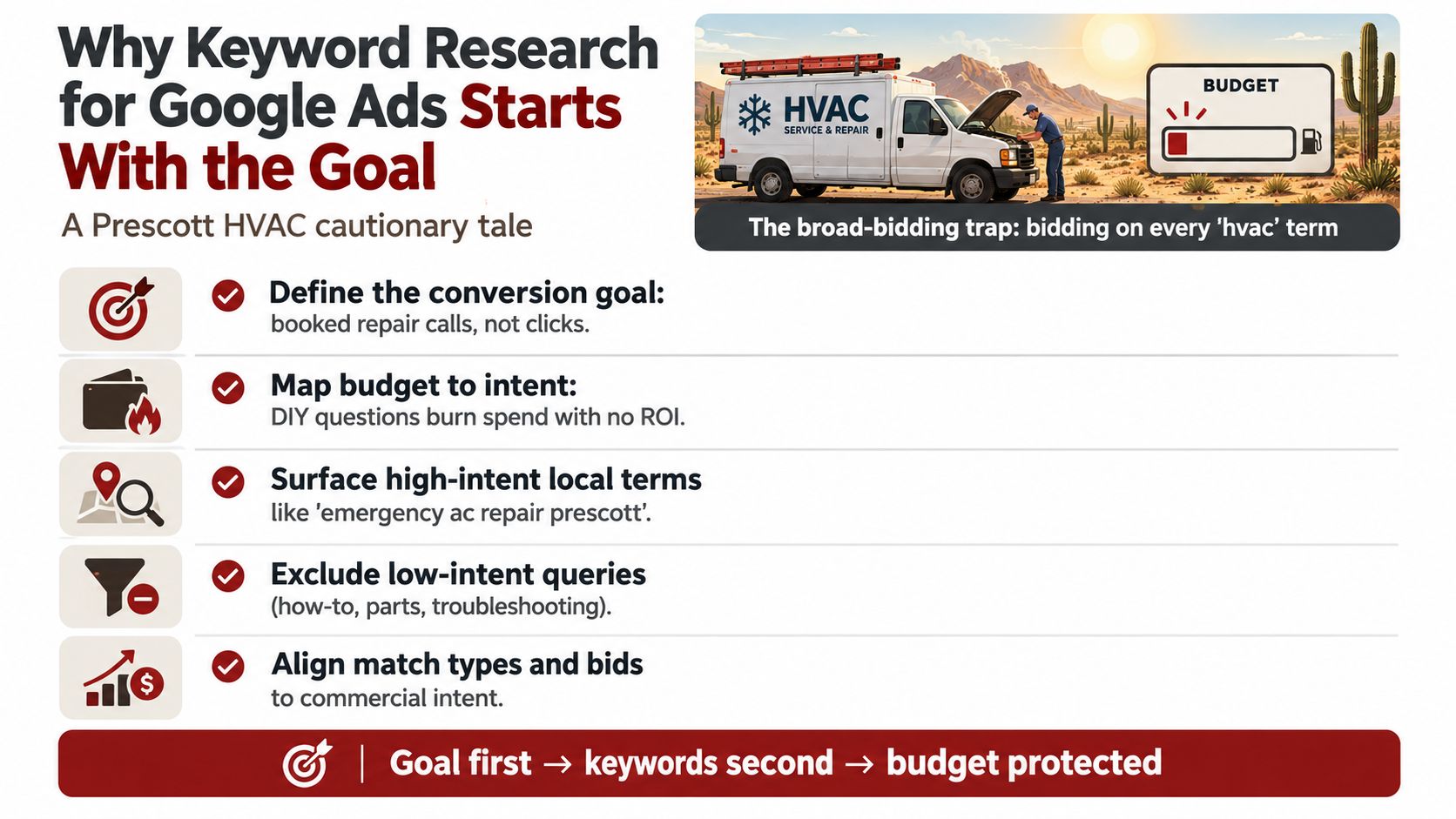
Before launch, document the conversion action, target CPA, service line, location, and unwanted query themes. That simple filter keeps research focused on protecting spend before generating leads. For a related profitability framework, review how return on ad spend works.
Sources That Reveal What Prescott Buyers Search
No single tool captures the full language customers use before calling a local business. The strongest keyword list combines planning data, seasonality, live account behavior, and competitor observation.
Start with Keyword Planner
Build a seed list for each service line, not one large list for the entire business. An HVAC account might begin with AC repair, furnace repair, heat pump service, emergency HVAC, and installation. Apply location settings for Prescott, Prescott Valley, Chino Valley, and Flagstaff, then review the available search-volume and competition ranges.
Keyword Planner can also forecast clicks, impressions, average position, and conversion rate from a keyword list, budget, and bids. Google recommends reviewing forecasts with a group of 10 to 20 keywords, as described in Google's forecasting guidance. Treat the output as directional. It helps compare demand and planning scenarios, but it cannot tell you whether a call is qualified.
Use Trends to expose timing
Google Trends is useful for comparing related services across Northern Arizona. Furnace repair may show stronger interest during colder periods, while AC repair can become more relevant as temperatures rise. The point is not to copy a trend line into a budget forecast. It is to identify when ad copy, landing pages, and negative-keyword coverage should change.
Google says Trends data can extend back to 2004, giving marketers a long historical view for regional and global comparisons. Use the tool to compare terms in the same location and check whether interest is steady, seasonal, or too limited to justify a dedicated campaign.
Mine the search terms report
Existing accounts contain the most valuable discovery source because the report shows the queries that triggered ads. Review it regularly and look for profitable long-tail wording that was not in the original plan, such as a specific service combined with Prescott Valley, “near me,” or an urgent problem description.
The report also reveals irrelevant themes that need exclusions. For a broader explanation of how intent data explained informs marketing decisions, local PPC teams should connect those signals to calls and booked work, not clicks alone.
Check competitor coverage
Search key services in Prescott and surrounding areas, review visible ad copy, and inspect Auction Insights in an existing account. Competitor language may reveal service combinations, guarantees, or location terms your campaign has not addressed. It does not prove that a competitor's keyword is profitable, so use the observation as a discovery prompt rather than a bidding order.
Keep all four sources in one master sheet. Add columns for source, service, location, intent, match type, landing page, and negative-keyword status. Deduplicate the list before it reaches the account. For local search language that also supports organic visibility, the local SEO keyword guide offers useful complementary context.
Match Types and the Shift to Semantic Matching
Google Ads supports broad, phrase, and exact match. Broad match is the default for keywords, exact match offers the most control with less reach, and broad match is designed to cover related searches beyond the literal keyword. Google's current explanation of these differences is available in its keyword matching documentation.
The practical mistake is treating match types as fixed versions of an older Google Ads system. Broad match can use the meaning of the search, landing-page content, ad-group keywords, and other account signals. That can uncover useful local variations a planner wouldn't have written down, but it can also expose gaps in your landing-page alignment and negative-keyword system.
For example, an ad group centered on emergency plumbing in Prescott may reach a search about a leaking water heater in Prescott Valley if the ad, landing page, and account structure support that relationship. If the business doesn't handle water heaters, that semantic expansion becomes waste rather than opportunity.
Match Type | Behavior in 2024+ | Best Use for Local Service Campaigns |
|---|---|---|
Broad | Reaches related searches using meaning and account signals, not only the literal terms | Discovery and scalable coverage when negatives, ad groups, and conversion tracking are strong |
Phrase | Preserves the phrase's meaning and allows related expansion | Tightly themed services, brand-adjacent searches, and controlled expansion |
Exact | Provides the tightest control but reaches fewer searches | High-value, sensitive, or highly specific services where query control matters most |
A sensible starting point for a new local service campaign is broad match with strong exclusions, tightly themed ad groups, and reliable conversion tracking. Move proven converting queries into phrase or exact match when the data justifies greater control. Don't assume narrow targeting is automatically safer. A narrow list can miss valuable language, while an uncontrolled broad campaign can buy irrelevant demand.
Google also notes that match types can overlap. The research question isn't only which keywords to add. It's which searches should never enter the auction. For campaign-level structure and automation considerations, review Google Ads Performance Max guidance, while keeping search campaign intent and query control distinct.
Grouping Keywords by Intent and Service Area
Ad groups should reflect the way a customer describes a problem and the service a business can deliver. Don't start by forcing a large keyword list into arbitrary ad groups. Tag the list first, then let the tags determine the structure.
Use three practical fields:
Service type: Water heater repair, furnace repair, drain cleaning, or AC replacement.
Intent stage: Emergency, comparison, or learning.
Geography: Prescott, Prescott Valley, Chino Valley, Flagstaff, or the wider Quad-City region.
An urgent search such as “no hot water Prescott” shouldn't share an ad group with “how long does a water heater last.” The first needs a direct service message and a call-focused landing page. The second may need educational content or a negative exclusion if the business is focused on immediate repair leads.
A Prescott HVAC grouping example
Keyword | Intent Tag | Ad Group | Landing Page |
|---|---|---|---|
Emergency AC repair Prescott | Emergency, Prescott | Emergency AC Repair | Emergency AC repair service page |
HVAC company Prescott Valley open now | Emergency, Prescott Valley | Local HVAC Service | Prescott Valley HVAC service page |
Furnace replacement Prescott | Comparison, Prescott | Furnace Replacement | Furnace replacement service page |
Keep each ad group tightly themed around one offer and one destination URL. A small group is easier to write relevant ads for, easier to diagnose, and easier to connect to a specific call-to-action. The right size depends on the service and available search language, but a compact group is usually more useful than a large collection of loosely related terms.
For a business serving multiple locations, separate campaigns can keep budgets, reporting, and geographic adjustments clean. A Prescott campaign may need different location language from a Flagstaff campaign, even when both promote the same service. Relevant ad copy and landing pages also help the visitor confirm that the business serves their area.
A clean structure improves the relationship between the query, ad, and landing page. That alignment can support stronger ad relevance and Quality Score, but the business goal remains qualified calls and booked work. Google Ads campaign structure guidance provides additional planning context.
The Negative Keyword System Most Accounts Skip
The highest-value work in many local accounts is deciding what not to buy. A keyword can look relevant in a planning tool and still be a poor fit once the full query appears in the Search Terms report.
Build negative coverage before launch with three starting lists:
DIY signals: “how to,” “tutorial,” “DIY,” “video,” and “YouTube” often indicate that the searcher wants instructions rather than a technician.
Employment signals: “jobs,” “hiring,” “salary,” “career,” and “training” identify recruitment or education intent.
Low-value research signals: “versus,” “review,” “best,” “cheap,” and “free” may be unsuitable when the business sells a premium service rather than comparison content.
These aren't universal exclusions. A company that publishes repair education or competes on price may handle them differently. Negative lists should reflect the offer, margins, and lead quality the business can serve.
Add account-level exclusions for service mismatches. If a plumber installs traditional water heaters but doesn't offer tankless systems, “tankless” deserves a deliberate exclusion. If a company serves Prescott and Prescott Valley but not Flagstaff, geography can also become a negative theme where appropriate.
Review queries with a reason
Google defines negative broad, phrase, and exact match differently. A broad negative blocks searches containing all negative terms in any order. A phrase negative blocks the terms in the same order, while an exact negative blocks only the exact phrase without extra words. Google's negative keyword documentation explains these controls.
During each weekly review, assign every irrelevant query one reason:
Wrong intent.
Wrong service.
Wrong geography.
Wrong audience.
Then ask three questions. Did this query cost money without a qualified action? Is it likely to recur through semantic matching? Should the exclusion apply only to one campaign or to the entire account?
Move recurring offenders from campaign-level lists to account-level lists only when the exclusion is universal. The owner of the account should review the report weekly, while the person responsible for lead quality should confirm borderline decisions. This cadence turns negative keywords into a compounding system instead of a one-time cleanup.
Tracking Conversions and Proving the Research Worked
A keyword list cannot prove value on its own. An account has to connect the query to a call, a form submission, a qualified conversation, and, where possible, a booked job before anyone can judge the research.
For Prescott service businesses, that usually means call tracking tied to Google Ads and Google Tag-based tracking for forms. Count meaningful actions, not every page interaction. If a replacement inquiry is worth more than a routine quote request, give each conversion an estimated value so bidding can separate high-intent leads from low-value ones.
Forecast estimates help with planning demand, but once the account is live, only call recordings and booked-job outcomes can show whether a keyword deserves more budget. Judge actual search terms by qualified outcomes using Google's search-term and keyword improvement documentation. The relevant guidance appears in Google's search-term and keyword improvement documentation.
Review the account through three views
Protect: Identify the top converting keywords and queries. Keep their ads, landing pages, budgets, and match types stable while testing carefully.
Investigate: Find spending terms with no conversions. Check the query, service fit, location, landing page, and call quality before deciding whether to exclude or rewrite.
Improve: Compare ad-group relevance, landing-page alignment, and Quality Score trends. A weak result may come from the keyword, but it may also come from a vague ad or an unsuitable destination page.
Review cost per qualified call instead of cost per click. A low CPC can still produce poor economics if callers are not seeking the service. Google says the Search Terms report shows the actual queries that triggered ads, and its guidance notes that a Search CTR below 1% can indicate that keyword improvement is needed. Use that threshold as a diagnostic signal, not as a standalone success metric.
Monthly reporting makes these patterns easier to act on. Tools such as custom reports for agencies can organize campaign, call, and lead-quality data for recurring reviews. Feed those findings back into the next research cycle so future keyword discovery starts with real performance rather than assumptions.
FAQ and Next Steps With Silva Marketing
How often should a Google Ads keyword list be refreshed?
Review search terms weekly and refresh the broader keyword list when a service, location, season, landing page, or performance pattern changes. Keyword research is ongoing because customers use new combinations of service, urgency, and location language.
How many negative keywords should be added in each review?
Add the exclusions that the query data supports rather than chasing an arbitrary count. One recurring irrelevant theme may matter more than a long list of speculative negatives, especially if an exclusion could block a valuable search.
Does broad match still work for local service businesses?
Broad match can work when the account has strong conversion tracking, relevant landing pages, tightly themed ad groups, and active negative-keyword management. Use phrase or exact match when the service is highly sensitive, expensive per click, or requires tighter query control.
When should a campaign be split?
Split a campaign when the service area, budget, conversion goal, landing page, or reporting requirement needs separate control. Don't split only to create more campaigns. A Prescott and Flagstaff campaign may warrant separation if lead economics or messaging differ, while closely related areas may remain together.
How should a zero-impression keyword be interpreted?
A zero-impression keyword may have limited demand, restrictive targeting, low eligibility, or an issue with the match and account setup. Check settings and related query coverage before deleting it, then decide whether the term belongs in another group or should remain a low-priority test.
What is a realistic timeline before CPA stabilizes in Prescott?
CPA stabilizes after the account has collected enough relevant conversion and search-term evidence to support decisions. The timing depends on service demand, budget, call volume, tracking quality, seasonality, and the amount of irrelevant traffic being removed. Avoid judging the research from clicks alone.
A free keyword audit from Silva Marketing can include a search-terms review, a negative-keyword starter list, and a match-type recommendation for each ad group. The review is designed for Prescott and Northern Arizona service businesses that need a clearer path from local searches to qualified calls.
Visit Silva Marketing to request a free keyword audit focused on wasted spend, local intent, and conversion tracking. You'll receive practical recommendations for search terms, exclusions, and match types that fit your service areas and lead goals.
Comments