
Local Search Results: How to Win Them in Prescott

If you're a Prescott HVAC company, dentist, roofer, or attorney watching another shop get the call you should've answered, the problem usually isn't mysterious. Your business either isn't showing up where local buyers make fast decisions, or your listing and website aren't giving Google enough confidence to put you in front of them.
At Silva Marketing, we work with service businesses across Prescott, Prescott Valley, Chino Valley, and the wider Northern Arizona market that need more qualified calls from local search results, not more vague SEO activity. Local visibility for Yavapai County businesses comes down to a small set of signals that compound when they're handled correctly. It also breaks when core details are inconsistent, generic, or incomplete.
Buyers don't spend much time comparing ten options anymore. They search, scan a map, read a few reviews, and call. If you're trying to win more local jobs in Prescott and the surrounding quad-city area, this is what moves rankings, what doesn't, and how AI-driven local discovery is starting to change the playbook alongside the Google Map Pack.
Table of Contents
Why Local Search Results Matter for Prescott Businesses - Why this matters in Prescott - Local visibility compounds when the basics are right
What Local Search Results Actually Are - Map Pack versus local organic results - Explicit versus implicit local intent - How those factors play out in Northern Arizona
Inside the Local SERP and Map Pack - What appears on a typical local SERP - What decides who appears in the Map Pack - What drives the other blocks
Setting Up Your Google Business Profile the Right Way - Start with the fields Google uses to identify the business - Write and build for the customer first - Avoid the edits that trigger trust problems
Building Local Authority Beyond Your Profile - Reviews are not a side task - Citations and local pages reinforce trust - Schema and local links close the loop
Measuring Local Search Results Without Guesswork - Use three dashboards, not fifteen - Local SEO metrics that actually matter - What to ignore when rankings wobble
Preparing for AI-Driven Local Discovery - What AI discovery tends to reward - Why Map Pack success doesn't automatically transfer
Why Local Search Results Matter for Prescott Businesses
For a local service business in Prescott, local search results aren't a branding exercise. They're the point where demand turns into phone calls, estimate requests, and booked appointments.
Google's local system has been building toward this for a long time. A major early milestone came on January 8, 2005, when Google introduced the /10-Pack / Local Listings in blended search, a precursor to today's local pack. Another came in March 2005 with the launch of the Local Business Center, later merged with Google Maps into a single destination for local business information, helping establish the modern local results ecosystem businesses use today (history of Google's local search updates).
That system is now massive. One 2026 industry compilation reports more than 200 million Google Business Profile listings worldwide, with about 76% verified, and says the Map Pack appears in roughly 93% of local searches. The same source says the average small or midsize business receives 1,009 searches per month through its profile, including 781 discovery views and 228 direct branded views (Google Business Profile statistics compilation).
Why this matters in Prescott
In Prescott, a lot of local buying happens on mobile while someone is dealing with an immediate need. AC out. Tooth pain. Roof leak. Locked out. Voice search and mobile search have shortened the path from question to call.
That matters because the local pack still gets a large share of clicks. Recent 2026 coverage reports the local pack captures about 44% of clicks, versus 29% for organic and 21% for ads, even as AI Overviews begin to crowd local SERPs (local SEO statistics summary).
Practical rule: If your Prescott business isn't visible in the map-driven part of the results, you're often competing for whatever attention is left.
Local visibility compounds when the basics are right
What works is rarely flashy. A verified and complete Google Business Profile. Consistent service area data. Strong category alignment. Real reviews that arrive steadily. Location pages that clearly match the towns you serve in Northern Arizona.
What doesn't work is chasing hacks while the fundamentals are broken.
For Prescott service businesses, local search results behave like a compounding system. Fixing one weak point helps. Fixing the connected set of weak points is what usually changes call volume.
What Local Search Results Actually Are
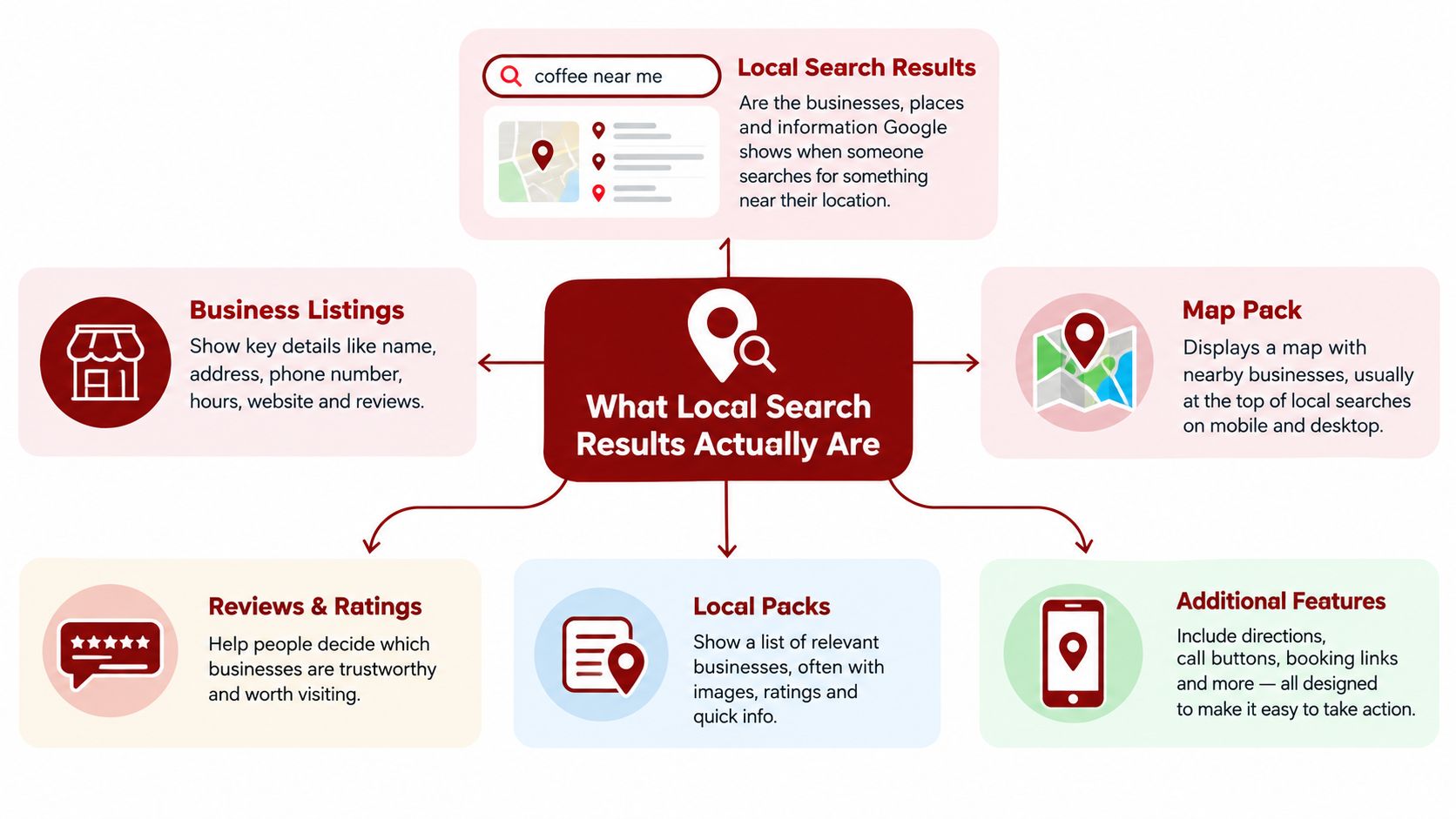
Local search results are the location-sensitive results Google shows when someone needs a nearby service, business, or place. Google states that local results are mainly based on relevance, distance, and prominence, where relevance is how well a Business Profile matches the search, distance is how far the business is from the searcher or implied location, and prominence is how well-known the business is (Google's local ranking guidance).
Map Pack versus local organic results
The Map Pack is the map block with three business listings that usually appears near the top of the page. Local organic results are the regular website listings below or around it.
They aren't the same thing, and they don't rank the same way.
Map Pack visibility leans heavily on your Google Business Profile, categories, proximity, review profile, and overall business prominence.
Local organic visibility leans more on your website pages, location relevance, internal linking, content quality, and links from other sites.
Strong businesses usually need both because some searchers tap the listing, while others compare websites before calling.
Explicit versus implicit local intent
Google also treats local intent differently depending on how the search is phrased.
An explicit local search names the place directly, like "plumber Prescott" or "dentist Prescott Valley." A business owner can usually spot these because the city is part of the query.
An implicit local search doesn't name the city, but still carries local intent, like "water heater not working" or "emergency tooth extraction." Google often infers that the person wants nearby help and builds a local SERP anyway.
When Google senses urgency and location intent, it often shifts from showing information to showing businesses.
How those factors play out in Northern Arizona
Take two contractors. One operates from downtown Prescott. The other works from Prescott Valley. If a searcher is near Courthouse Plaza and looks for a nearby service, the downtown business has a distance advantage. If the searcher is in Prescott Valley, that advantage can flip quickly.
Relevance can still change the outcome. If one profile clearly matches the service searched and the other uses broad or muddy categories, Google may prefer the more precise listing. Prominence adds another layer. A better-known business with stronger reviews and better web presence can outperform a weaker competitor, but only within the limits of geography.
That's why Prescott-area local SEO isn't just "rank higher." It's matching the right service to the right place with enough authority to earn the click.
Inside the Local SERP and Map Pack
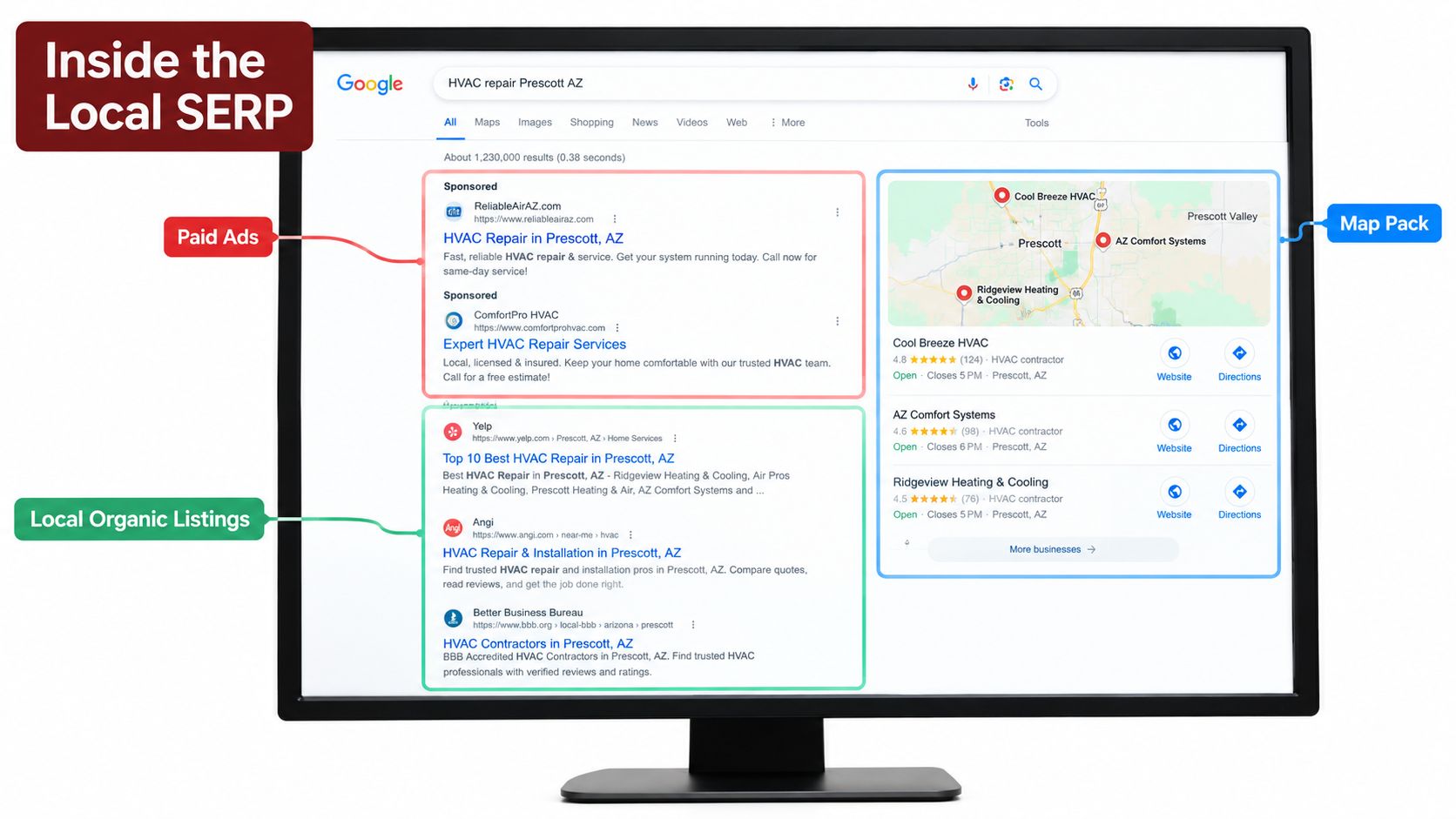
Search for something like "HVAC repair Prescott AZ" and the page is doing several jobs at once. It's comparing paid options, nearby providers, trusted websites, and business entities. If you don't know which block you're trying to win, it's easy to do busy work that never changes lead flow.
What appears on a typical local SERP
For a realistic Prescott service query, you'll usually see some combination of these blocks:
Paid ads at the top. These pull from Google Ads settings, ad relevance, landing page quality, and location targeting.
The Map Pack with three listings and a map. Many service businesses want to be here.
Local organic results below the pack. These are standard web results with local intent layered in.
A knowledge panel if Google strongly recognizes a business or place entity.
People Also Ask questions, especially for research-heavy services like dental care, legal help, or roofing.
On mobile, these blocks compress and reorder. The map, reviews, call buttons, and directions can dominate the screen before a user ever reaches a traditional blue link.
What decides who appears in the Map Pack
For the pack, Google Business Profile quality matters a lot. Primary category choice, accurate service areas, business description clarity, hours, photos, services, and review activity all shape how competitive a listing looks.
Review signals are a real ranking lever, not decoration. A widely cited 2021 Local Search Ranking Factors report summarized by Whitespark says four of the top 20 Google ranking factors involve reviews, specifically high star ratings, a high number of reviews, a steady flow of reviews over time, and recent reviews (Whitespark review ranking factors summary).
For a Prescott HVAC company, that means a profile with fresh, specific customer feedback usually beats a stale profile that only looks complete on paper.
What drives the other blocks
Local organic results respond more to website signals. A roofer with a strong Prescott page, a separate Prescott Valley page, embedded map context, and solid internal linking often earns more organic visibility than a competitor with one thin services page.
The knowledge panel is different again. Google tends to reward businesses whose brand facts, website, and third-party mentions line up clearly enough to form one coherent entity.
A short walkthrough helps if you want to see the page anatomy in action.
The local SERP isn't one ranking system. It's several systems sharing one screen.
For Prescott service companies, that's the practical takeaway. You don't win more local search results by optimizing one asset in isolation. You win by making your profile, website, reviews, and brand signals agree with each other.
Setting Up Your Google Business Profile the Right Way
A Prescott plumber can do solid work for years and still lose calls if the profile sends mixed signals. I see it often with Northern Arizona service businesses. The phone number is right, but the category is off. The service area is broad enough to look unrealistic. The photos feel generic. Google can still index the listing, but it has less confidence in what the business does and where it belongs.
Start with the fields Google uses to identify the business
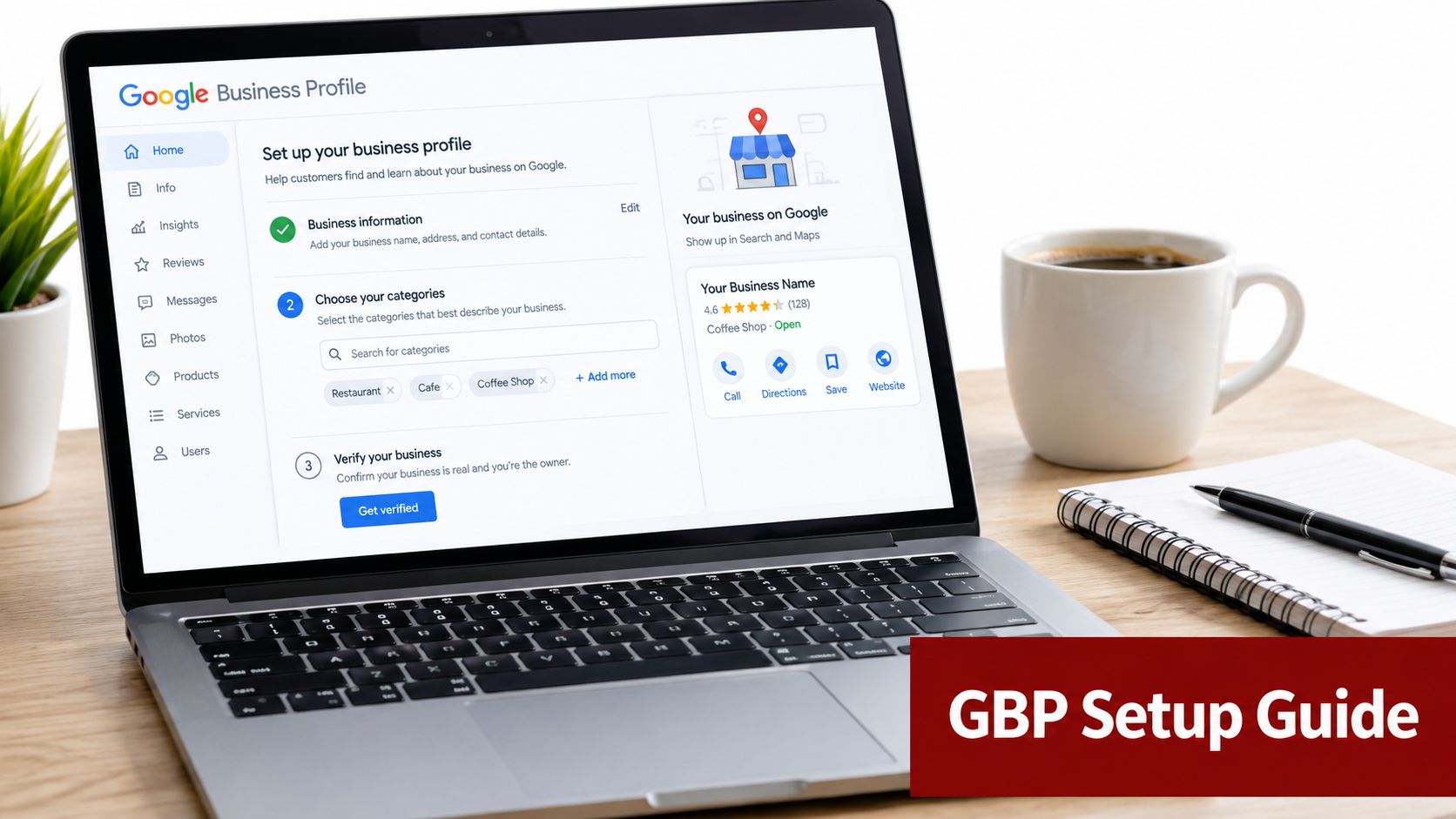
Set the profile up in the same order Google evaluates it. Claim it. Verify it. Then clean up the core details before adding extras.
Use the business name exactly as it appears on signage and legal documents. Leave out extra keywords.
Choose the best primary category for the main service you sell. A Prescott HVAC company should use the HVAC category, not a broad home services label.
Add secondary categories with restraint so they reflect real adjacent services, not every job the team might take.
Set hours accurately, including seasonal changes that affect customers in Prescott, Prescott Valley, and higher-elevation communities nearby.
Define service areas precisely if you travel to the customer. List the towns you actively cover instead of claiming half the state.
If you need the step-by-step process, this guide to setting up a Google Business Profile covers the mechanics.
Write and build for the customer first
The business description should answer basic buying questions fast. What do you do, who do you serve, and where do you work? Mention Prescott and nearby areas only if they match your actual operation. Add individual services so Google and searchers can connect the listing to specific jobs, from AC repair to emergency dental care.
Photos do more work than many owners expect.
For Northern Arizona service companies, local context matters. Show wrapped trucks in front of real homes, crews on actual job sites, storefront signage, treatment rooms, office interiors, and completed work. A Prescott profile should look like Prescott. That same visual proof also helps with AI-driven local discovery tools that summarize businesses from profile content, images, and matching web mentions.
Useful profile features often get skipped:
Messaging if someone can reliably reply
Q&A for recurring pre-sale questions
Appointment, booking, or estimate links that go to the right page
Attributes that accurately describe access, ownership, or service options
Avoid the edits that trigger trust problems
Google suspensions and soft ranking drops usually come from preventable setup choices. Common examples include keyword-stuffed names, fake suite numbers, duplicate profiles, and using a virtual office as if it were a staffed location.
For service-area businesses, there is a trade-off here. Hiding the street address is often correct if customers do not visit your location. But the rest of the business information still needs to line up cleanly across your website, profile, and major directory listings. If your site says you serve Prescott Valley and Chino Valley, your profile should not imply daily service in Flagstaff unless that is true operationally.
Field note: Profiles perform better when Google does not have to guess the business type, service area, or legitimacy.
That clarity matters in two places now. It helps the Map Pack rank the listing correctly, and it gives AI search systems cleaner facts to cite when they recommend local providers.
Building Local Authority Beyond Your Profile
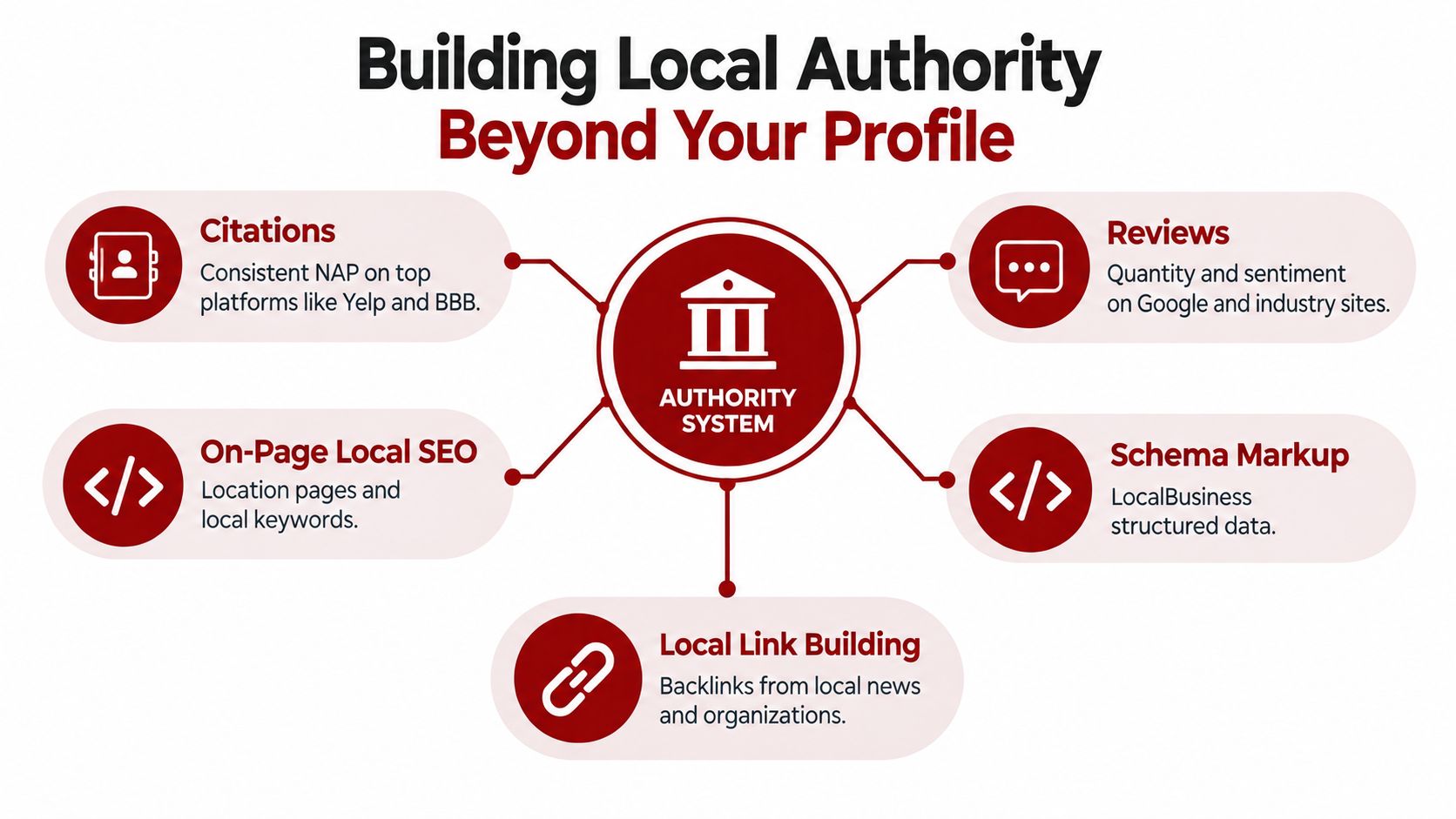
A Google Business Profile can open the door, but it usually doesn't carry the whole ranking load by itself. The businesses that hold visibility in Prescott, Prescott Valley, and Chino Valley tend to build the same authority signals in multiple places. Citations, reviews, local pages, schema, and links work best as one connected system.
Reviews are not a side task
Review volume has a measurable effect on local visibility. In a 16,098-listing analysis, businesses with 1 to 5 reviews reached the local top three 39.3% of the time, while those with 201 to 500 reviews reached it 73.0% of the time, a difference of 33.7 percentage points (local ranking factor analysis).
That doesn't mean you should chase reviews carelessly. It means review acquisition needs a repeatable workflow. For local trades and clinics, the simplest version is often the best: finish the job, send a short text, include the direct review link, and ask for honest feedback while the experience is still fresh.
Citations and local pages reinforce trust
Citations still help Google validate that your business exists where it says it exists. For Prescott-area businesses, that means tightening the major platforms first, then the industry-specific directories that fit your trade or clinic type.
A practical stack usually includes:
Core platforms like Google, Apple Maps, Yelp, Bing Places, and Facebook
Trust directories such as BBB or chamber listings where relevant
Industry directories for contractors, dentists, attorneys, medspas, or other service niches
Local sources tied to Prescott and Yavapai County organizations
On your website, give each real service area enough specificity to stand on its own. A Prescott page should not be a copy of the Prescott Valley page with the city name swapped. Include the services offered there, nearby landmarks or neighborhoods when relevant, embedded map context, and clean internal links.
Silva Marketing covers this in more depth in its guide to local SEO link building for service businesses.
Schema and local links close the loop
Schema markup helps search engines read your business details more cleanly. LocalBusiness and Service schema won't rescue a weak website, but they can remove ambiguity when the rest of the site is already strong.
Local links still matter because they connect your business to real Northern Arizona entities. The tactics that tend to work here are straightforward:
Community sponsorships such as Prescott High School athletics or local events
Chamber membership and local business associations
Professional partnerships with Prescott real estate agents, property managers, or complementary trades
Coverage and mentions from regional news, nonprofits, and civic organizations
If you're also trying to grow local presence with social media, treat social as support for local authority, not a replacement for it. Good social content can reinforce your brand and earn local mentions, but it won't compensate for weak citations, thin location pages, or a review pipeline that isn't running.
A strong local brand is easier for Google to trust when the same facts keep appearing in the same form across the web.
Measuring Local Search Results Without Guesswork
Most local businesses either track too little or they stare at the wrong numbers. What matters is knowing whether visibility is turning into actions, and which changes moved the outcome.
Use three dashboards, not fifteen
For local search results, three views usually tell the story.
Google Business Profile Insights shows how people find and act on your profile. It's where you watch profile searches, direct versus discovery demand, calls, website clicks, and direction requests.
Google Search Console shows what your website is earning in local organic search. Look at the queries, the pages getting impressions, and whether branded searches are rising faster than non-branded local terms.
Call tracking ties the search activity back to phone leads. If you don't separate calls from your profile, your website, and referral sources, it's hard to know what changed because of SEO and what changed because of seasonality. This guide on call tracking metrics is useful if you want a clean setup.
Local SEO metrics that actually matter
Metric | Source | Review Cadence |
|---|---|---|
Profile views and searches | Google Business Profile Insights | Weekly |
Direct and discovery searches | Google Business Profile Insights | Monthly |
Calls, direction requests, and website clicks | Google Business Profile Insights plus call tracking | Weekly |
Branded versus non-branded local queries | Google Search Console | Monthly |
Rankings for a fixed set of Prescott keyword seeds | Local rank tracking tool | Weekly |
Leads by source | Call tracking and CRM or intake log | Monthly |
What to ignore when rankings wobble
A one-day ranking jump or drop often isn't actionable, especially in map results. Local pack placement moves with searcher location, device, category interpretation, and normal SERP testing.
What matters more is trend direction. If calls from the profile improved after you fixed categories, expanded real service areas, and added stronger reviews, that's signal. If one keyword slid for two days while calls held steady, that's usually noise.
A simple monthly review works well for owner-operators in Prescott:
Check profile actions and compare them with the previous month.
Review query data in Search Console for service plus city terms.
Listen to call quality if you record calls.
Tie changes to actions taken that month, such as new photos, review requests, citation fixes, or page updates.
That cadence is enough to make better decisions without turning local SEO into a full-time reporting job.
Preparing for AI-Driven Local Discovery
A lot of businesses still act like winning the Map Pack is the whole game. It isn't anymore.
AI assistants now create a second visibility layer on top of traditional local search. SOCi's 2026 Local Visibility Index found Google's local 3-pack surfaced brands in 35.9% of brand-visible local queries, while ChatGPT recommended only 1.2% of locations, Gemini 11%, and Perplexity 7.4% across nearly 350,000 locations and 2,751 multi-location brands. The same coverage notes that fewer than half of the top Google local brands also appeared among the most visible brands in AI results, with overlap at about 45% (AI local visibility report summary).
That gap matters for Prescott service businesses because AI systems don't mirror map rankings. They often rely on cleaner entity understanding across the open web.
What AI discovery tends to reward
For local businesses, the practical moves are familiar, but the tolerance for inconsistency is lower:
Tight entity descriptions across your website, Google profile, and major directories
FAQ content that matches how locals ask for help out loud
Third-party mentions from local news, organizations, and niche publications
Consistent business facts across every platform an AI system might parse
If you want a rough planning tool for how your business might be found across web and voice surfaces, the web and voice sales estimator is a useful reference point. For strategy work, this guide on optimizing for AI search is a practical next read.
Why Map Pack success doesn't automatically transfer
Google's map system and AI recommendation systems ask overlapping but different questions. The map often asks who is nearby, relevant, and prominent enough to click. AI tools more often ask which entity can be described confidently and cited cleanly.
If your business facts are messy, AI systems become cautious. Cautious systems don't recommend often.
For Northern Arizona businesses, that means local SEO hygiene now does double duty. It supports both the classic local search results page and the newer answer-driven discovery layer.
Common Pitfalls and Quick Wins in Northern Arizona
In Prescott and the surrounding towns, the same mistakes show up over and over. The category is too broad. The service area leaves out Prescott Valley or Chino Valley even though the business works there every week. Yelp, Apple Maps, and the website don't agree on core business details. Review responses sound copied. The page looks pretty, but the actual service information is buried under scenic photography and brand fluff.
Quick wins are usually more practical than dramatic.
Claim and finish the profile so every core field is accurate.
Add fresh real-world photos from jobs, staff, vehicles, or the office each month.
Ask for reviews after every completed job with a simple, honest workflow.
Build one useful town page at a time for the places you serve.
Fix NAP consistency across the top directories first.
Add LocalBusiness and FAQ schema so your site is easier to interpret.
For Northern Arizona service businesses, local search results improve fastest when the business becomes easier to verify, easier to understand, and easier to trust. That's usually a tighter path than buying another generic SEO package or rewriting the homepage for the fifth time.
Silva Marketing helps Prescott and Northern Arizona service businesses improve local search results through Google Business Profile work, local landing pages, call-focused website SEO, and clear measurement tied to leads. If you want a focused look at what's helping or blocking your visibility in Prescott, Prescott Valley, or Chino Valley, visit Silva Marketing and start with a practical audit instead of a broad pitch.
Comments