
Prescott AZ Web Design That Brings Local Calls

Prescott, Arizona is a small city with an unusually connected customer base: 91.7% of households had a broadband Internet subscription during 2020–2024, according to the U.S. Census Bureau's QuickFacts profile for Prescott. Roughly nine in ten homes can reach a local business website in seconds, and that single fact changes what a website is for.
Silva Marketing designs websites for service businesses across Prescott, Prescott Valley, and Chino Valley, and the problem we solve is specific: sites that look current but don't produce qualified calls. This guide covers the standard worth holding a build to, from conversion structure and speed thresholds to local search, the pages that earn calls first, and the accessibility and markup that let both people and search systems read the same facts.
Table of Contents
Speed Targets a Lead Page Should Pass - What Each Number Feels Like to a Customer - Fixes That Move Each Metric
How Google Chooses Local Prescott Results - Relevance and the Pages That Carry It - Distance and the Coverage You Can Claim - Prominence and the Reputation You Build
Accessibility and Facts Search Systems Can Read - The Machine-Readable Layer
Who Prescott Web Design Is Built For
The problem rarely shows up in the design. A Prescott roofing company can have a clean, modern homepage and still sit through a quiet Tuesday, because the page never says what to do next and the few calls it earns aren't traced back to the page that produced them. Prescott AZ web design is judged on qualified calls and booked work, not on how the header photograph looks on a desktop monitor.
Silva Marketing builds and rebuilds sites for the businesses that live on that difference: contractors and home-service companies, professional firms, dental and medical practices, and other location-based businesses in Prescott, Prescott Valley, and Chino Valley. Every project starts with the jobs those customers are trying to finish. Getting a roof inspected before monsoon season. Pricing a bathroom remodel. Finding out whether a plumber really drives out to Chino Valley on a Saturday morning.
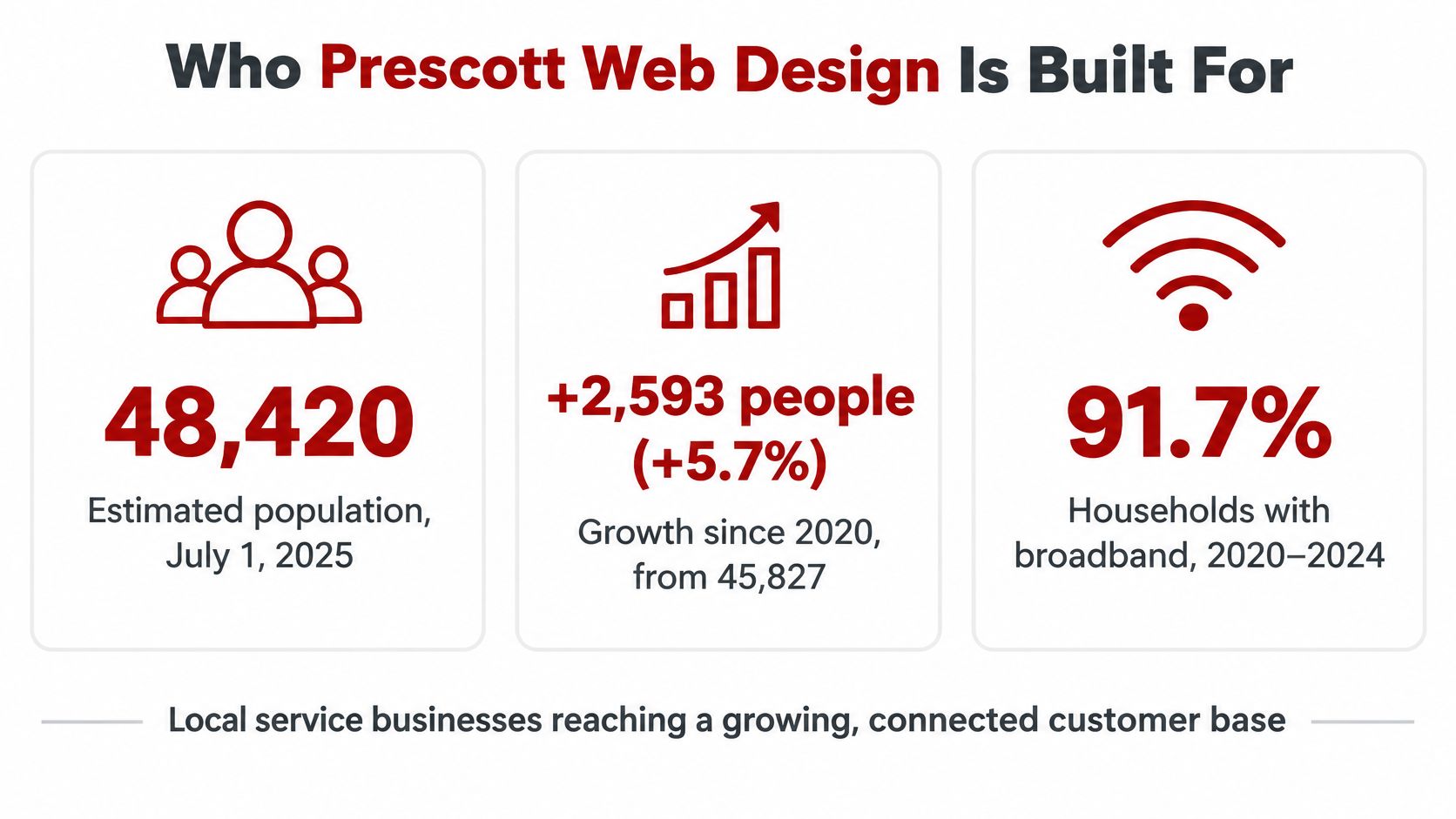
Census estimates put Prescott's growth at 2,593 residents between the 2020 Census and July 1, 2025, about 5.7%, and Prescott Valley reached 50,045 residents in 2023 with broadband in 91.1% of households during 2018–2022. A market that is both expanding and connected doesn't need a website that behaves like a business card.
The practical shift: when almost every household in town is already online, the question stops being whether people can find you and becomes whether the page gives them a reason to call instead of tapping back to the map results.
Competition for that attention is real. Prescott had 2,465 business establishments in 2024, employing about 26,767 people, per Business Census data compiled by ZIP-Codes.com. A generic brochure blurs into that crowd. A page that names the service, the town, and the next step does not.
What follows is the standard I would hold any Prescott web design project to: a build organized around calls, speed numbers you can check on a real phone, local search done by the rules Google publishes, the pages worth building first, and accessibility that makes all of it usable.
What Changes When the Site Is Built for Calls
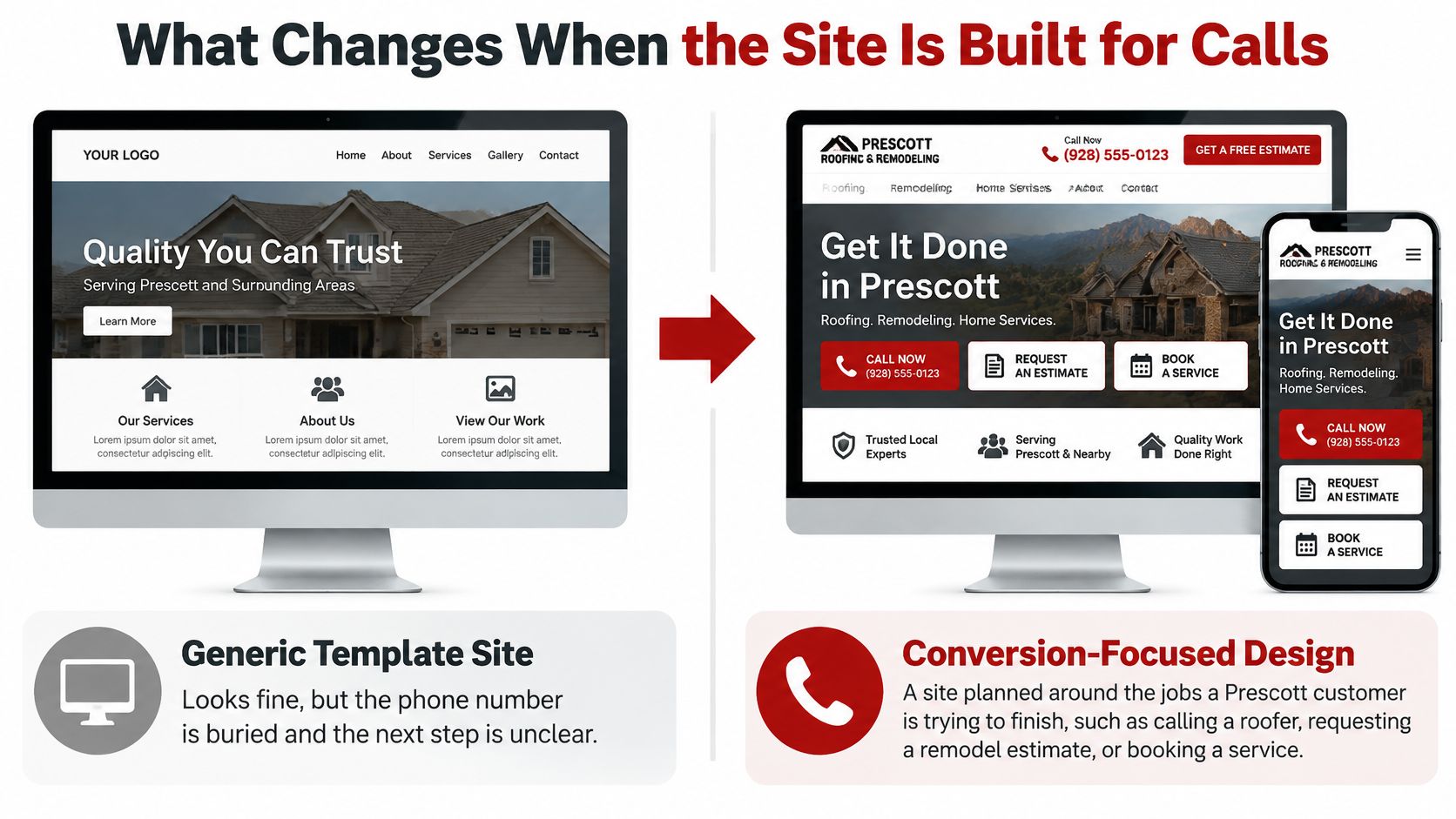
Conversion-focused design means the site is planned around the jobs a Prescott customer is trying to finish. Calling a roofer after a leak. Requesting a remodel estimate. Checking whether a firm covers their town. A template is planned around the owner's preference for one shade of blue over another.
A modern-looking site can still miss that work. If the page never connects the search someone made, the service page they land on, and the proof they need to tracked calls or booked jobs, the design is decoration.
The difference is visible in six places you can check without a design background.
Job of the site | Typical brochure site | Conversion-focused custom site |
|---|---|---|
First screen | Logo, slider, and a generic menu | Service, town, and click-to-call visible without scrolling |
Proof | Stock photos and vague claims | Named local projects, reviews, and credentials |
Page structure | One combined services page | Separate pages for each money service and real service area |
Measurement | Visits and bounce rate only | Calls, forms, map actions, and booked jobs tracked apart |
Local consistency | City name added to the title | Name, address, phone, hours, and coverage match the Business Profile |
Speed on a phone | Plugins and oversized heroes left unchecked | LCP, INP, and CLS checked on real mobile visits |
First screen. Someone landing on a Prescott plumbing page decides quickly whether to stay. A rotating slider of stock bathrooms above the fold, with the phone number buried in a footer, loses most of them. The alternative is the service, the towns served, and a tappable number inside that first screenful.
Proof. Stock photography signals nothing to a homeowner comparing bids. Named local projects, review quotes with a first name attached, license numbers, and manufacturer certifications do, and they belong beside the estimate form rather than on an "About" page nobody opens.
Page structure. One "Services" page listing every item is a filing cabinet. Separate pages for each revenue service, and for each town you schedule work in, let a visitor land on the exact job they searched for.
Measurement. Many redesigns fail at this point. If calls, form submissions, map taps, and booked jobs all land in one pile labeled traffic, nobody can tell which page paid for itself. Separate tracking numbers and separate form destinations turn a redesign into a decision you can defend.
Local consistency. Name, address, phone, hours, and coverage area have to match your Google Business Profile character for character. A suite number typed two ways splits your signals and confuses customers who call the wrong line.
Speed on a phone. An oversized hero image and a stack of plugins will lose a visitor standing on a Prescott street with weak signal. Test on a real phone on cellular data, never on office Wi-Fi.
The reason the right-hand column matters is a gap in measurement, not a design trend. BrightLocal's local SEO statistics report that 52% of U.S. consumers began their most recent local search on Google and 71% used Google Search at some point during that process, while only 22% of small-business owners named Google as a top-two source of new customers. Customers search where owners aren't measuring.
A free fix first: score your current site against the right-hand column before anyone opens a design file. Moving a phone number above the fold costs nothing and usually earns more than a new palette.
Silva Marketing has launched more than 500 websites, and that checklist exists because the rows on the right are the ones that move call volume.
Speed Targets a Lead Page Should Pass
Google publishes "good" thresholds for Core Web Vitals at the 75th percentile, measured separately for mobile and desktop. They are Largest Contentful Paint of 2.5 seconds or less, Interaction to Next Paint of 200 milliseconds or less, and Cumulative Layout Shift of 0.1 or less, per Google's Core Web Vitals guidance on web.dev. For a Prescott service business those belong in the contract as acceptance criteria, not in a proposal as design goals.
What Each Number Feels Like to a Customer
LCP is how fast the main offer appears, meaning the headline, hero photo, and phone number. INP is how quickly the page responds after a tap on the call button or the form. CLS is whether the button jumps down the screen while the page finishes loading, which is exactly when a thumb misses.
Metric | Good threshold | What the visitor feels | First fix |
|---|---|---|---|
Largest Contentful Paint | 2.5 seconds or less | The main offer appears quickly | Smaller hero, modern image format, faster server response |
Interaction to Next Paint | 200 milliseconds or less | A tap on call or the form responds quickly | Shorter JavaScript tasks and fewer third-party widgets |
Cumulative Layout Shift | 0.1 or less | Buttons and text stay put while loading | Reserved width and height for images, maps, and embeds |
These numbers matter more on a local lead page than on a brochure, because the visitor usually needs one of three things within seconds: tap the number, submit the form, or open directions. Every one of those actions sits on top of a metric.
Fixes That Move Each Metric
Hero images: compress and correctly size them, then serve modern formats so a 4 MB photo stops being the page.
JavaScript: cut render-blocking scripts and load the rest after the content a visitor came for.
Layout space: reserve width and height for images, embedded maps, and review widgets so nothing shifts after paint.
Third-party widgets: audit chat, tracking pixels, and review carousels. Three widgets can cost more responsiveness than the entire rest of the page.
Validate with real-user field data at the 75th percentile, not only a lab score, and test the high-value pages independently: roofing, remodeling, legal, healthcare, and contractor service pages rarely share the same problem. When a metric fails, fix that metric only. LCP points to server response and image delivery, INP points to long tasks and event handlers, CLS points to layout reservation and stable component dimensions. There is a fuller walkthrough of site speed optimization if you want the technical sequence.
Ask any provider one question before launch: which three numbers will you report from the live mobile pages, and on which template? A vague answer about "optimizing for speed" is not a measurement.
How Google Chooses Local Prescott Results
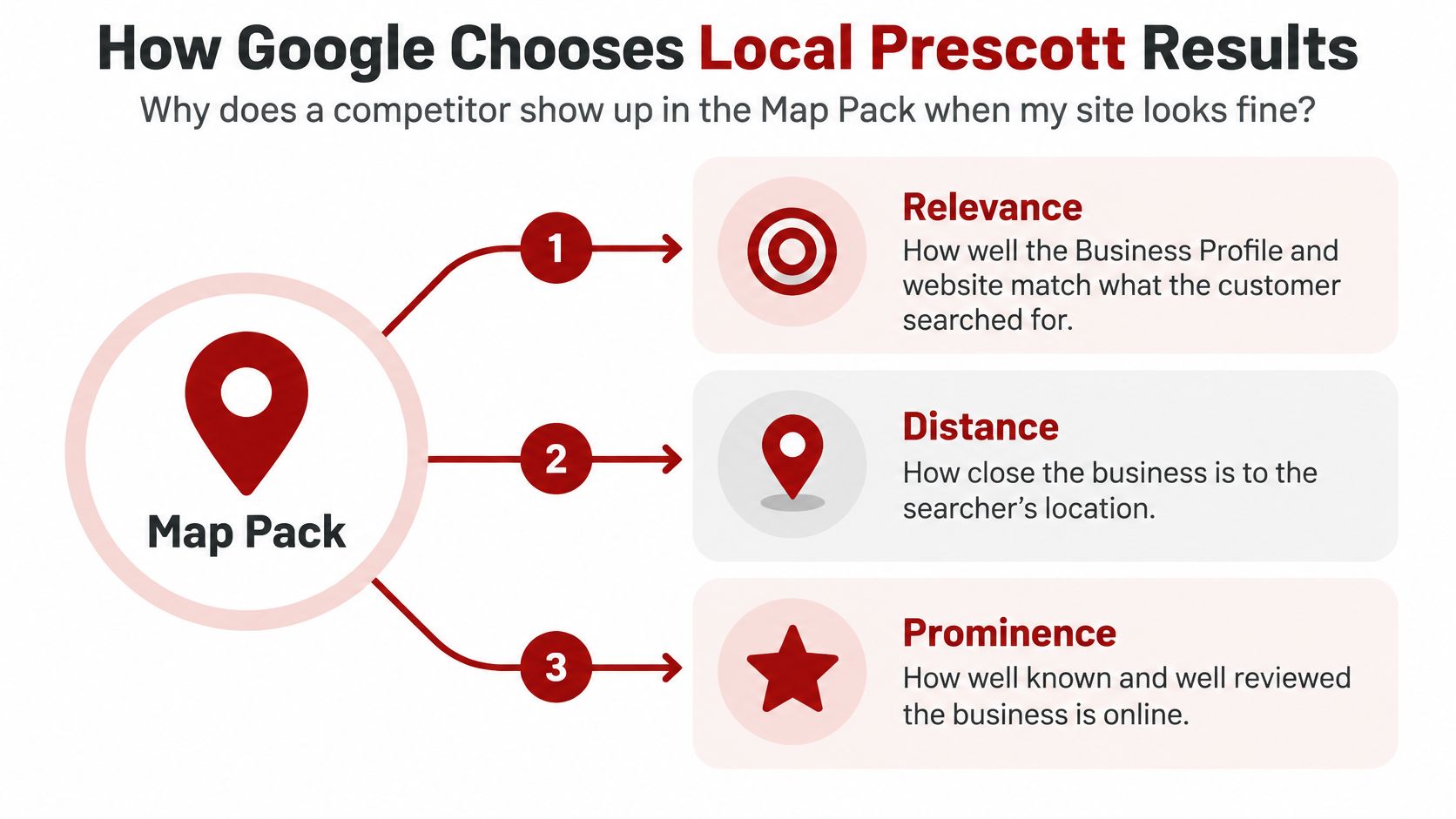
"Why does a competitor show up in the Map Pack when my site looks fine?" Because the map result isn't ranking websites. It's ranking businesses, and your site is one input. Google states that local results are primarily determined by relevance, distance, and prominence, as explained in Google's Business Profile help on local ranking.
Relevance and the Pages That Carry It
Relevance is how well your Business Profile and website match what someone typed. Adding "Prescott" to a title tag creates none of it. What creates it is a strong primary Prescott page, plus distinct pages for Prescott Valley and Chino Valley. Different, meaning each one shows service-area boundaries, the project types common there, scheduling details, local testimonials, and a clear way to call. A page with the town name swapped and everything else cloned proves nothing.
Distance and the Coverage You Can Claim
Distance is the relationship between the searcher's location and the business, and you can't rewrite it. What you can control is honesty. List only the towns you schedule, keep service-area settings aligned with the pages you publish, and let real project evidence do the work of showing you operate there.
Prominence and the Reputation You Build
Prominence is how well known the business is across signals such as links, directories, articles, review volume, and review ratings. Reviews you request after a completed job, a local chamber listing, a supplier page, a sponsorship mention: each one is a small vote that a website alone can't manufacture.
Consistency holds all three together. Silva Marketing's office is at 8101 E Pecos Dr., Prescott Valley, AZ 86314, and that address, the phone number, the hours, and the coverage list have to read identically on the site, the profile, and every directory that scraped them.
After launch, watch the five things that report progress: Business Profile actions, calls from organic landing pages, form submissions, rankings by service and town, and new reviews. That set is covered in more detail in this guide to local search results. Revenue follows those numbers, not the reverse.
Pages Prescott Service Businesses Should Build First
Three trade examples show the pattern before anyone pays for a full site.
A roofer's first page answers storm damage and full replacement in town, shows recent local roofs with the street or neighborhood named, states service coverage that includes Prescott Valley or Chino Valley only where crews go, and puts click-to-call beside the estimate form rather than under it.
A remodeler's page separates kitchens, baths, and additions, because a search for one job should never land on a mixed portfolio. It shows the current schedule, mentions financing only if the firm offers it, and carries before-and-after proof from named local projects.
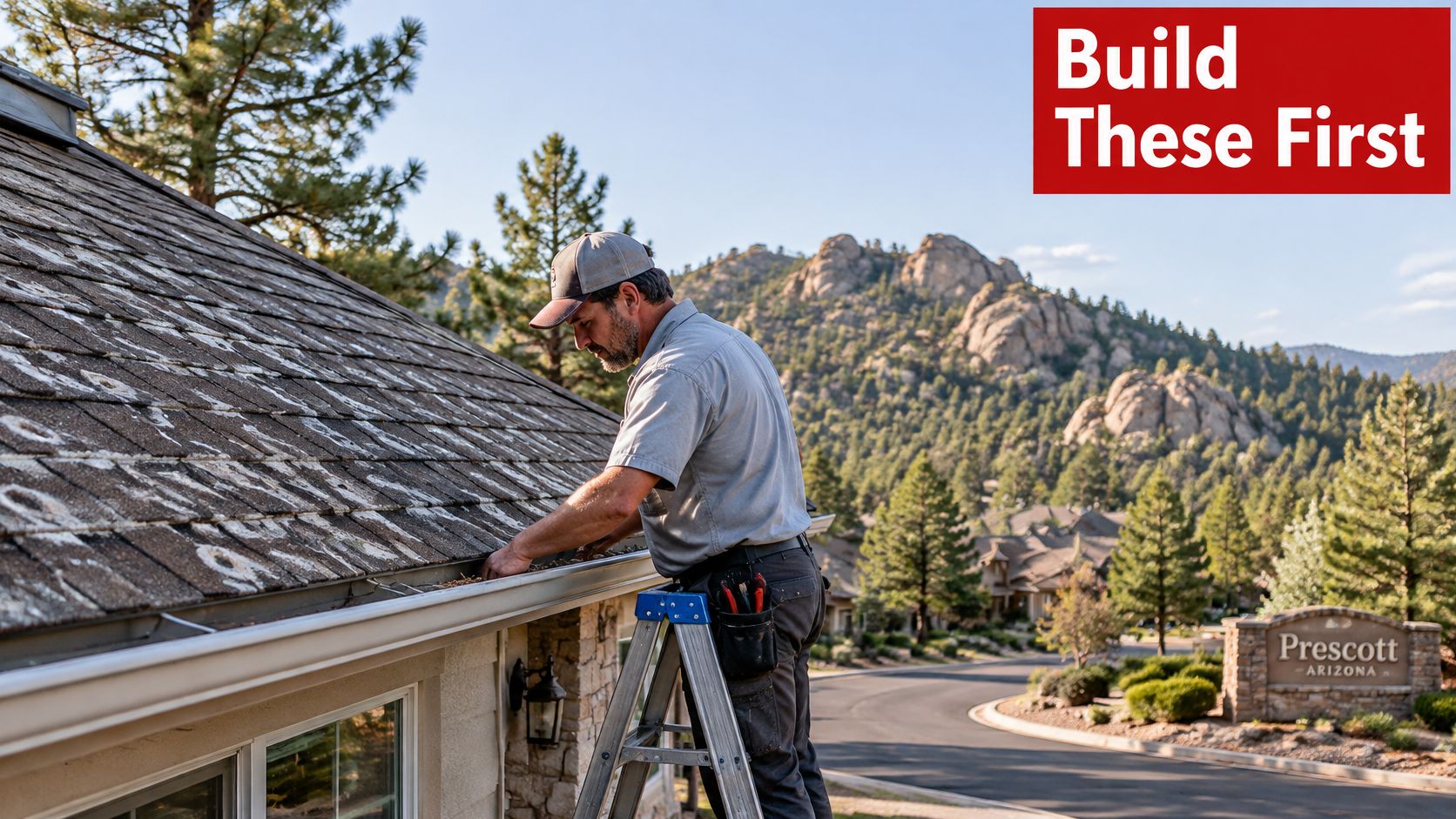
The work that earns the call is usually ordinary and specific, the debris in the gutters before the first big rain, not a hero shot of a ladder.
An HVAC, dental, or law page leads with the problem in the customer's words, posts real hours, names who is served across Prescott and the nearby valley towns, and offers one primary action. Not four. One.
The build order that keeps a budget honest:
A homepage that names the main service and the town.
The highest-revenue service page.
One differentiated service-area page with boundaries and project types.
The next service the business wants calls for.
Seasonal pages earn a slot only when the requested job changes, such as monsoon leak repair or winter heating, and they carry new facts rather than a cloned heading. The structure question is answered thoroughly in this piece on site structure for SEO, and the payoff is measurable. One client, Mark B., reported that changes made "within two weeks" brought an increased flow of qualified calls. Jim put it plainly: "it was customized to my business and I couldn't be happier."
Accessibility and Facts Search Systems Can Read
A site can be fast, clear, locally useful, and readable by search systems at the same time. It rarely happens by accident.
The practical standard is WCAG 2.2, published as a W3C Recommendation on October 5, 2023, and set out in the W3C's WCAG 2.2 specification. Four requirements do most of the work for a local service site. Text alternatives for non-text content. A contrast ratio of about 4.5:1 for ordinary text and images of text. A single-pointer alternative to any multipoint or path-based gesture. Repeated navigation in the same relative order across pages.
Each one maps to a Prescott phone call. Contrast decides whether a homeowner can read your number on a phone screen in midday glare. A text alternative decides whether a screen reader announces "call Silva Marketing" instead of "link." Consistent navigation decides whether a returning visitor finds the estimate form where they found it last week.
The Machine-Readable Layer
LocalBusiness structured data is how you hand search engines your hours, departments, and reviews in a format they can parse, following Google's LocalBusiness structured data documentation. The sequence that works: add the required properties, follow the guidelines, validate with the Rich Results Test, fix critical errors, deploy on pages that can be crawled, then confirm with URL Inspection. Pages blocked by robots.txt, a noindex tag, or a login wall can't be expected to appear at all.
The risk is measurable. Small-business website research found that 86.2% of homepages failed at least one automated WCAG 2.0/2.1 check, most often insufficient color contrast and links without useful screen-reader text, and that 83.7% of sites scored below 70 for AI-search readiness while 19.9% carried no structured data, according to SEO Score API's state of small-business websites research. Strong SEO didn't rescue it either: 82.6% of sites scoring at least 70 for SEO still scored below 70 for AI readiness.
A limit worth stating plainly: structured data and clean writing don't replace a Business Profile, real reviews, or ordinary local SEO. They make the facts you already have legible.
Three checks before launch: contrast on the call button, alt text on every project photo, and validated business details that match what's visible on the page. More on the markup side is covered in this guide to local business schema markup. Attractive design and usable information are not the same thing, and the second one is what sends the phone ringing.
Start With a Clear Prescott Website Plan
After all the standards, the next step is a scoped conversation about one thing: which service should ring the phone first.
Silva Marketing meets owners across Prescott, Prescott Valley, and Chino Valley to align on goals and budget before anything is proposed, then sends an itemized proposal within 48 hours. After the strategy session, production starts within 5 to 7 business days. Custom website design starts at $3,998, and the consults covering web design, Google Ads, logo work, SEO, and AI SEO are free, including a 30-minute call. Ongoing maintenance runs $150 per month for backups, updates, security, and performance.
Bring two things to that call: your current homepage, and the service you most want calls for. Add any Business Profile details that must stay identical on the new pages, because a rebuild is the moment addresses and hours drift.
The conversation settles whether a new build or a redesign fits, and which page launches first: the homepage, the top service, or one real service-area page. Coverage stays limited to towns the company can schedule. Results get discussed as calls, forms, and booked jobs to track, not as a guaranteed revenue figure or a promised date for the phone to ring.
Silva Marketing designs and redesigns websites for service businesses in Prescott, Prescott Valley, and Chino Valley, built around tracked calls rather than a color palette. If your site looks fine but the phone stays quiet, start with the service you most want to book and a review of the page that should be earning it. Visit Silva Marketing to set up a free 30-minute call and map the first page worth building.
Comments