
Website Design for Landscapers: Get More Local Calls

A tenth of a second. Google measured 37 brand websites over four weeks, pairing speed measurements with web analytics and funnel data, and found that a 0.1-second improvement in mobile load time was associated with a 6.9% increase in page views per session and a 1.9% increase in conversion rate (BrightLocal's summary of the Google speed study). The same work found that the probability of a mobile visitor bouncing rose 90% on slower-loading pages. For a yard care pro, that fraction of a second sits between a homeowner tapping your number and tapping a competitor's.
Silva Marketing designs and rebuilds websites for yard care pros and other local service businesses in Prescott, Prescott Valley, Chino Valley and the surrounding Northern Arizona communities. The problem we solve is narrow and specific: most contractor sites describe the company and never answer the questions a homeowner asks before calling, and they push every job, from a fall cleanup to a full patio build, through the same generic contact form.
The fix isn't a longer homepage. It's structure that matches how outdoor services are sold. One page per service named the way customers speak, location pages built on real coverage, proof a homeowner can check, pages that open fast on a phone, and two distinct conversion paths so routine work books itself while custom projects get qualified. Everything below is the version of website design for yard-care businesses that earns calls rather than compliments.
Table of Contents
The Landscaper Website Blueprint That Earns Calls - Why the blueprint matters in a crowded market
Service Pages That Match How Landscapers Get Hired - Start with five to seven services, named plainly - The anatomy of a service page - Three pages doing three different jobs
Local Signals That Put Your Landscaping Business on the Map - Build location pages on what you can actually reach
Two Conversion Paths for Routine Work and Custom Projects - Keep the first step short on both paths
Speed and Mobile Usability That Protect High-Intent Calls - The three numbers, translated into fixes - Three tests before you call it done
Proof That Makes Your Landscaping Business the Safer Choice - Project entries that do the selling - Reviews and credentials where the decision happens - Why AI visibility doesn't replace proof
Content That Answers Questions for AI Search - The pattern every answer follows
Questions to Ask Before You Hire a Website Designer - How much does a landscaper website cost - How long does a project take - Do I need a blog - Can I keep my domain and my reviews - What should I ask a designer
The Landscaper Website Blueprint That Earns Calls
A landscaper website needs nine working parts: a mobile-first homepage, a services overview, one page per major service, service-area pages, a project gallery, reviews and credentials, an About page that shows the crew, an estimate and contact page, and a small set of local advice answers. Get those right and the site does what a good estimator does on the phone. It answers the homeowner's real question, which isn't "who are you" but "can you handle my property, and can I trust you with it."
Site element | Visitor question it answers | What it must include | Primary action |
|---|---|---|---|
Homepage | Can this company handle my property? | City and service area in the H1, three proof points, a real project photo, phone number and estimate button | Call or request an estimate |
Services overview | Do they offer what I need? | Five to seven plain-language service cards with links to full pages | Open a service page |
Individual service pages | Do they understand this specific job? | Scope, materials, a three-to-five-step process, timeline, price guidance, photos, FAQs | Request an estimate or book routine work |
Service-area pages | Do they work in my city or neighborhood? | Unique local details, real projects, drive-time coverage, consistent name and phone | Call the local office |
Project gallery | Have they done work like mine? | Eight to twelve projects, before and after photos, city, materials, problem solved | Start a similar project |
Reviews and credentials | Can I trust them on my property? | Google reviews, license and insurance, warranties, certifications, affiliations | Read more or call |
About and team | Who will actually show up? | Owner and crew photos, years in business, community involvement, values if genuine | Meet the team |
Estimate and contact page | How do I start? | Short form, phone number, email, response expectation, financing note | Submit a request or call |
Local advice section | Can they help me plan? | Irrigation timing, drought-tolerant plants, seasonal cleanup, permit guidance | Read an answer and contact |
Read that table as a specification, not inspiration. Each row maps to a decision a homeowner makes in the ten minutes between searching and calling. Skip a row and the decision happens on someone else's site.
Why the blueprint matters in a crowded market
Landscaping isn't a niche. The U.S. Census Bureau counts 117,969 employer establishments in landscaping services under NAICS 561730, and separate 2022 nonemployer data for the broader NAICS 56173 grouping reports 523,071 establishments (U.S. Census Bureau industry data). A homeowner comparing irrigation contractors can open a dozen tabs in minutes.
That comparison is where a brochure loses. A welcome message, five stock photos and a contact form tell the visitor nothing they can't get from the next tab. What separates the site that earns the call is specificity: the neighborhoods you serve, the materials you install, the problems you solve, and evidence you solved them a few miles away.
Specificity also means knowing where your work stops. A patio conversation often grows into a pergola, a fire feature or a deck, and homeowners ask about all of it at once. For the deck portion, Utah Deck Supply is a useful reference on decking materials and profiles. Pointing a homeowner to a supplier you trust beats pretending you build everything.
Audit your own site against the table this week. Open it on a phone, walk each row, and mark whether the answer is obvious or missing. If two or more rows are vague or absent, the site is handing calls to competitors who did the work.
Service Pages That Match How Landscapers Get Hired
A service page is a sales conversation that happens without you in the room. The homeowner already has a rough idea of what they want. Your page either confirms you do it, explains how the work goes, and offers the next step, or it hands them to someone who did.
Start with five to seven services, named plainly
Build the list from your own invoices, not from an industry taxonomy. For most residential crews, the core set is lawn maintenance, garden design and installation, irrigation repair and installation, sod installation, tree and shrub care, hardscaping, and seasonal cleanups.
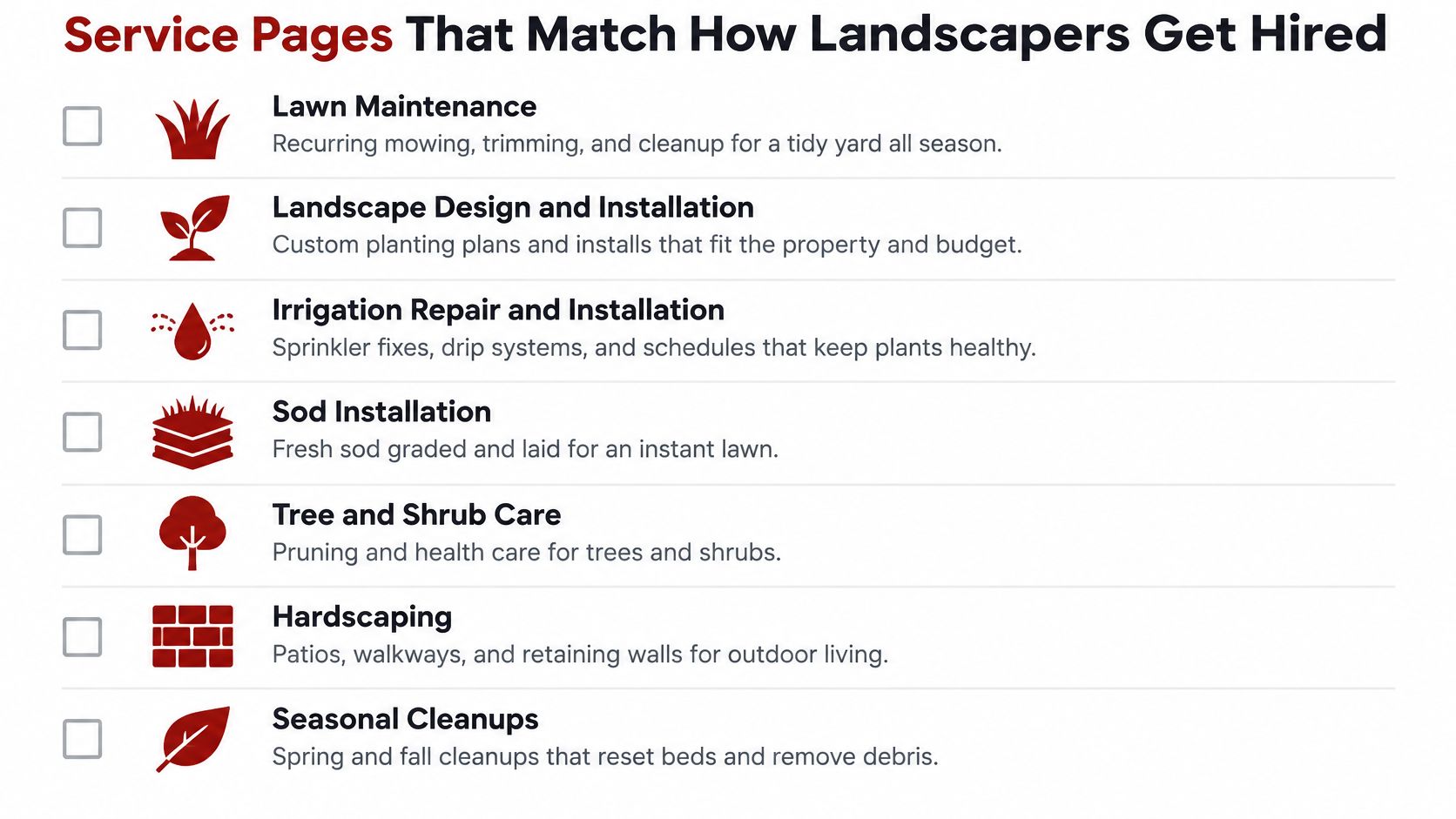
Those labels work because they match what people say. "Yard cleanup" and "sprinkler repair" are the phrases that come out of a homeowner's mouth, and they're the phrases typed into a phone. If your navigation says "Environmental Enhancement Solutions," you've added a translation step nobody will perform.
The anatomy of a service page
Every service page needs the same eight pieces. An H1 that names the service and, where it reads naturally, the city. A first paragraph that answers what the service includes, who it suits and what happens next. Scope and materials. A three-to-five-step process. A realistic timeline. Price guidance or starting-at ranges if you're comfortable publishing them. Four to eight project photos from that service line. And three FAQs lifted from questions your estimator answers on real calls.
The FAQ section is the most valuable part and the one most sites skip. Write the answers in plain sentences, not keyword strings. "A zone that won't come on is usually a valve, a wiring break or a controller setting, and we test all three before quoting a repair" beats "irrigation repair Prescott services."
Three pages doing three different jobs
An irrigation page answers why one zone stopped working and what a service call involves. A hardscape page answers whether a retaining wall needs a permit in Prescott Valley, because that single question decides whether someone calls now or waits until spring. A seasonal cleanup page is standardized, date-based work, so it should carry an availability calendar and online booking instead of a consultation form.
Commercial maintenance is its own animal. Crews, equipment, scheduling and fuel options for lawn care businesses all enter the buying decision when a property manager is comparing contractors, so the commercial page should talk about capacity and reporting, not backyard patios.
Link services to the cities they're sold in, and link both to the projects you've completed there. A service page that stands alone is a dead end. When you're running ads to one offer, a focused landing page for a single service keeps the paid traffic from wandering into the navigation.
Before you publish, check each page against this list:
Service and city in the H1: the service name first, the city only if it reads like English.
Answer-first opening: what it includes, who it suits, what the next step is.
Proof within one scroll: photos from that service line, not a generic hero shot.
Price guidance: a starting-at range or a clear statement of what drives cost.
Three real FAQs: pulled from calls, answered in complete sentences.
One primary call to action: estimate request for custom work, booking for routine work.
Local Signals That Put Your Landscaping Business on the Map
Repeating the city name eleven times on a homepage doesn't make a yard care pro local. Google names three factors behind local rankings: relevance, distance and prominence (Google Business Profile Help). Relevance is how well your profile and site match the search. Distance is how far the business sits from the searcher or the location in the query. Prominence reflects how well known the business is.
You can't move a searcher's driveway, and you can't manufacture prominence overnight. Relevance is the lever, and it's built page by page: clear service pages, consistent business information, and local content that could only have been written by someone working in that area.
Local signal | Where it belongs | Prescott-area example | Mistake to avoid |
|---|---|---|---|
Primary service and city | Homepage title and H1 | Landscape design and installation in Prescott, AZ | Stuffing every nearby city into one H1 |
Service-area page | One page per served city | A Prescott Valley page with neighborhood names and local project photos | Copying one template and swapping city names |
Google Business Profile categories | GBP primary and secondary categories | Primary Landscaper; secondary Landscape Designer and Irrigation Contractor only if offered | Adding categories for services the crew does not perform |
Name, address and phone | Footer, contact page and GBP | Same business name, phone and Prescott Valley address everywhere | Using a virtual office or a different number on each page |
Reviews | GBP and review section | Ask customers to mention the service and city naturally | Buying generic reviews or never replying |
Local project proof | Gallery and city pages | High-desert plant photos, a retaining wall in Chino Valley, an irrigation retrofit in Prescott | Using stock photos of green lawns that do not match the area |
Service boundary | Contact page and FAQ | We serve Prescott, Prescott Valley and Chino Valley within a realistic drive time | Listing towns the crew will not reach |
Internal links | Service and location pages | Link irrigation repair to the Prescott Valley service-area page | Leaving location pages orphaned |
Build location pages on what you can actually reach
Google's guidelines for representing your business require a service-area business to use one profile for its central office or location and to designate its service area accurately, and they note the overall service area generally shouldn't extend farther than about two hours of driving time from the base (Google Business Profile guidelines). That's a practical constraint, not a suggestion. Pages for towns your crew won't drive to create calls you can't serve and listings that look manufactured.
What a location page needs is local texture. Soil and watering conditions in the high desert. HOA or neighborhood notes that affect approvals. A project you completed on a named street or in a named subdivision. The same phone number and business name as every other page, word for word.
The test: swap the city name on your Prescott Valley page for "Prescott" and read it again. If nothing else needs to change, the page isn't local. It's a template with a new label.
Reviews support prominence, and how you ask matters. Request the review while you're still on site, and ask the customer to mention what you did and where. "They replaced the irrigation valves at our house in Prescott Valley and explained the controller settings" is worth more than a five-star row of hearts.
Once a month, spend twenty minutes on the boring maintenance: confirm hours and services on the Google Business Profile, add two recent projects to the gallery, request three reviews, and hunt down any address or phone number that drifted out of sync on a directory listing.
Two Conversion Paths for Routine Work and Custom Projects
A single "Contact Us" button treats a fall cleanup and a patio rebuild as the same purchase. They aren't. One is a fixed-scope, date-driven job a homeowner will book on a Tuesday night. The other is a high-consideration project that needs a conversation, a site visit and a number.
That split is the most underexplained idea in website design for yard care pros, and it changes results fastest. A 2025 survey of 2,122 decision-makers across the United States, Australia and South Africa found that 75.07% preferred online booking, while 21.63% still preferred the phone (Social Places' 2025 digital marketing and customer experience survey). Both groups are on your site. Forcing one behavior on everyone loses one of them.
Service type | Best primary call to action | Form fields to ask for | Proof to show | What to avoid |
|---|---|---|---|---|
Routine mowing and maintenance | Book online or call | Address or ZIP, service, frequency, preferred start date | Reviews, starting price, availability | A long consultation form |
Seasonal cleanup and aeration | Check availability and book | Property size, service, preferred date, optional photos | Before and after photos, price bands | Hiding price behind a generic contact form |
Mulch, soil and delivery | Order with a delivery-area check | Address, quantity, delivery date, access notes | Product photos, delivery zone, minimum order | No delivery area information |
Irrigation repair and tune-ups | Request service or call | Address, system type, problem, urgency | Licensed technician, response window, warranty | Promising same-day service without checking capacity |
Landscape design and installation | Request a consultation | Budget range, timeline, project type, goals, optional photos | Portfolio, process, financing notes | Instant booking without qualification |
Hardscaping and retaining walls | Request a site visit | Scope, photos, HOA or permit question, budget range | Engineered examples, warranties, crew experience | A generic quote form with no project detail |
Commercial landscape contracts | Request a property walkthrough | Property type, square footage, frequency, decision-maker role | Insurance, crew capacity, reporting, similar contracts | Residential-only proof |
Keep the first step short on both paths
The routine path needs a calendar that shows real availability, a ZIP or address check so you don't book work outside your service area, and starting prices. If you'd rather not publish numbers, publish bands and say what moves a job between them: lot size, slope, gate access, overgrowth.
The custom path needs qualification, not an interrogation. Three to five fields in the first step, an optional photo upload that accepts phone pictures without fuss, no account creation, and a stated response expectation such as a call within one business day. Budget range and timeline can move to step two, where they filter serious inquiries without scaring off the curious. Keep the phone number visible without scrolling on every screen.
What happens after submission matters as much as the form itself. Routine bookings should land straight on the schedule with a confirmation message and a reminder the day before. Custom requests should trigger a personal reply that references the project type, not a generic autoresponder.
I would rather see a landscaper publish a starting price and lose the wrong-fit inquiry than hide every number and attract people who think a retaining wall costs a few hundred dollars. Price transparency pre-qualifies.
A dedicated online appointment scheduling system pays off for standardized services. The homeowner who wants to book at 9 p.m. gets to book. The homeowner who wants to talk to the owner still finds a phone number. Set capacity rules so the calendar never sells slots your crew can't cover, then review booking and call data monthly to see which path each service earns.
Speed and Mobile Usability That Protect High-Intent Calls
Your customer is standing in the yard with a phone in one hand, on a weak signal, trying to find out whether anyone can look at a broken sprinkler zone this week. The page that loads in a second and a half gets the call. The one that stutters through a hero video does not.
Google's Core Web Vitals targets are LCP of 2.5 seconds or less, INP of 200 milliseconds or less and CLS of 0.1 or less, measured at the 75th percentile of real mobile and desktop visits rather than a single passing lab test (web.dev's Core Web Vitals guide). Small contractor sites regularly miss that bar. In 2025, 48% of mobile websites passed all Core Web Vitals, against 56% of desktop sites, according to HTTP Archive Web Almanac figures reported by UXCam's UX statistics roundup.
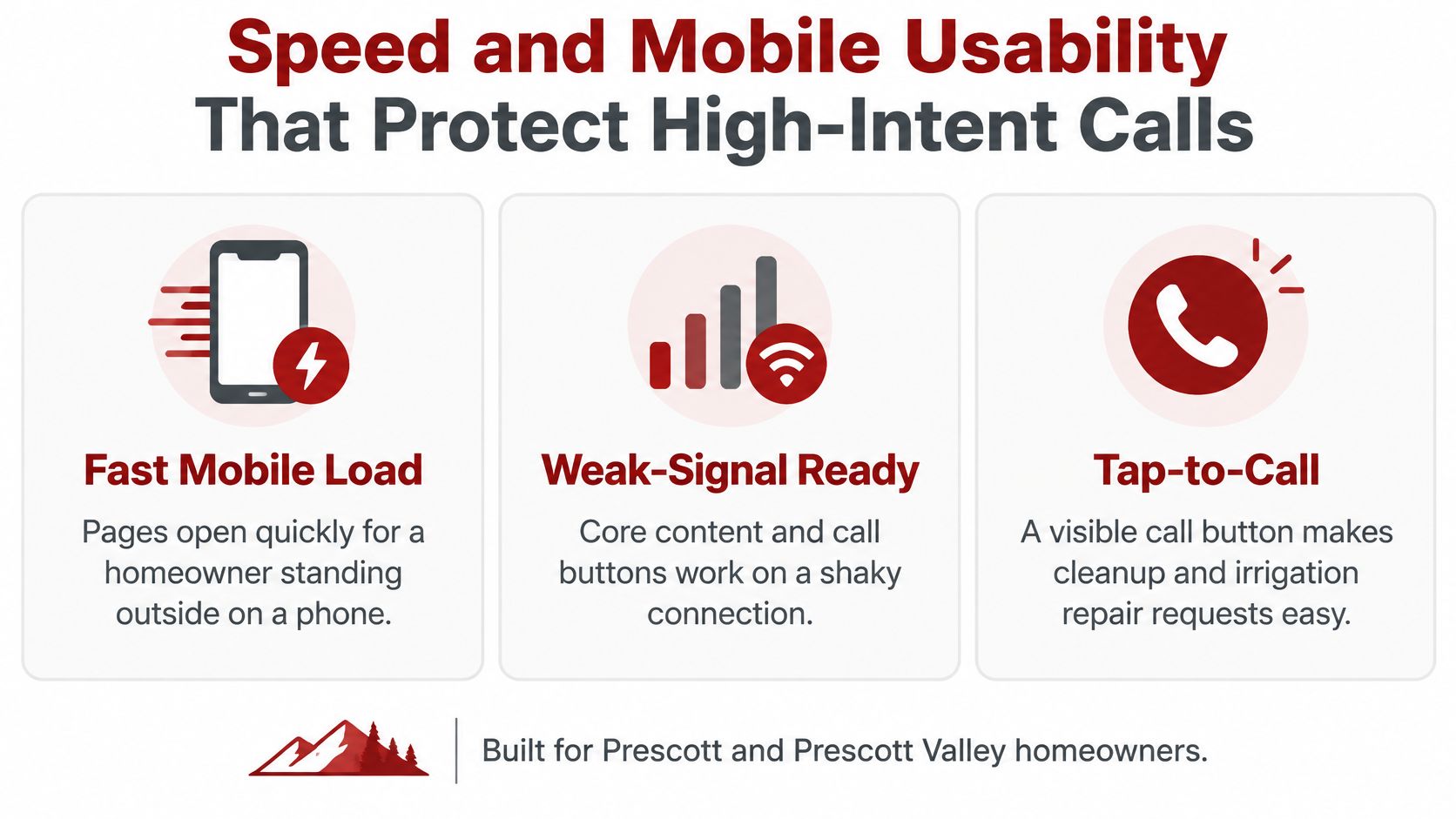
The three numbers, translated into fixes
LCP is almost always your hero image or a render-blocking font. Compress project photos to WebP or AVIF, serve responsive sizes, preload only the above-the-fold hero, and drop the autoplaying 12 MB video of a mower. INP is usually third-party weight: map embeds, chat widgets and tracking scripts competing with the tap. Defer the chat and map widgets, remove unused plugins and scripts, and test again. CLS is layout math: set fixed width and height on gallery and testimonial images, and stop injecting banners that shove the call button down just as someone reaches for it.
Google's published case studies consistently tie faster page loads and stronger vitals scores to higher conversion rates. Speed is a conversion lever, not a technical vanity metric.
Accessibility belongs in the same pass. WCAG 2.2 requires a contrast ratio of at least 4.5:1 for normal text and a pointer target of at least 24 by 24 CSS pixels at Level AA (W3C's WCAG 2.2 specification). In practice that means service descriptions in readable contrast rather than light gray on white, form labels tied to their inputs, visible focus states, and buttons a thumb can hit without aiming.
Three tests before you call it done
Run PageSpeed Insights: on the homepage, one service page and one location page, and read the mobile score first.
Load it on a real phone on cell data: standing outside, not on office Wi-Fi, and time how long until the call button is tappable.
Hand it to five people: ask them to call you and then request an estimate, and watch where they hesitate. That hesitation is your next fix.
A slow mobile page taxes both conversion paths at once. The homeowner with a flooded sprinkler zone needs the call button instantly, while the homeowner weighing a patio build will abandon an estimate form that stutters halfway through. Keep a sticky click-to-call and estimate bar on mobile so the primary action never scrolls out of reach, and label the two actions differently: "Call now" for urgent work, "Request an estimate" for project inquiries. Two paths, two labels, one thumb-reachable bar.
Proof That Makes Your Landscaping Business the Safer Choice
A homeowner is deciding whether to let a stranger with equipment onto a property they've spent years improving. Trust isn't a paragraph on your About page. It's evidence they can check in fifteen seconds.
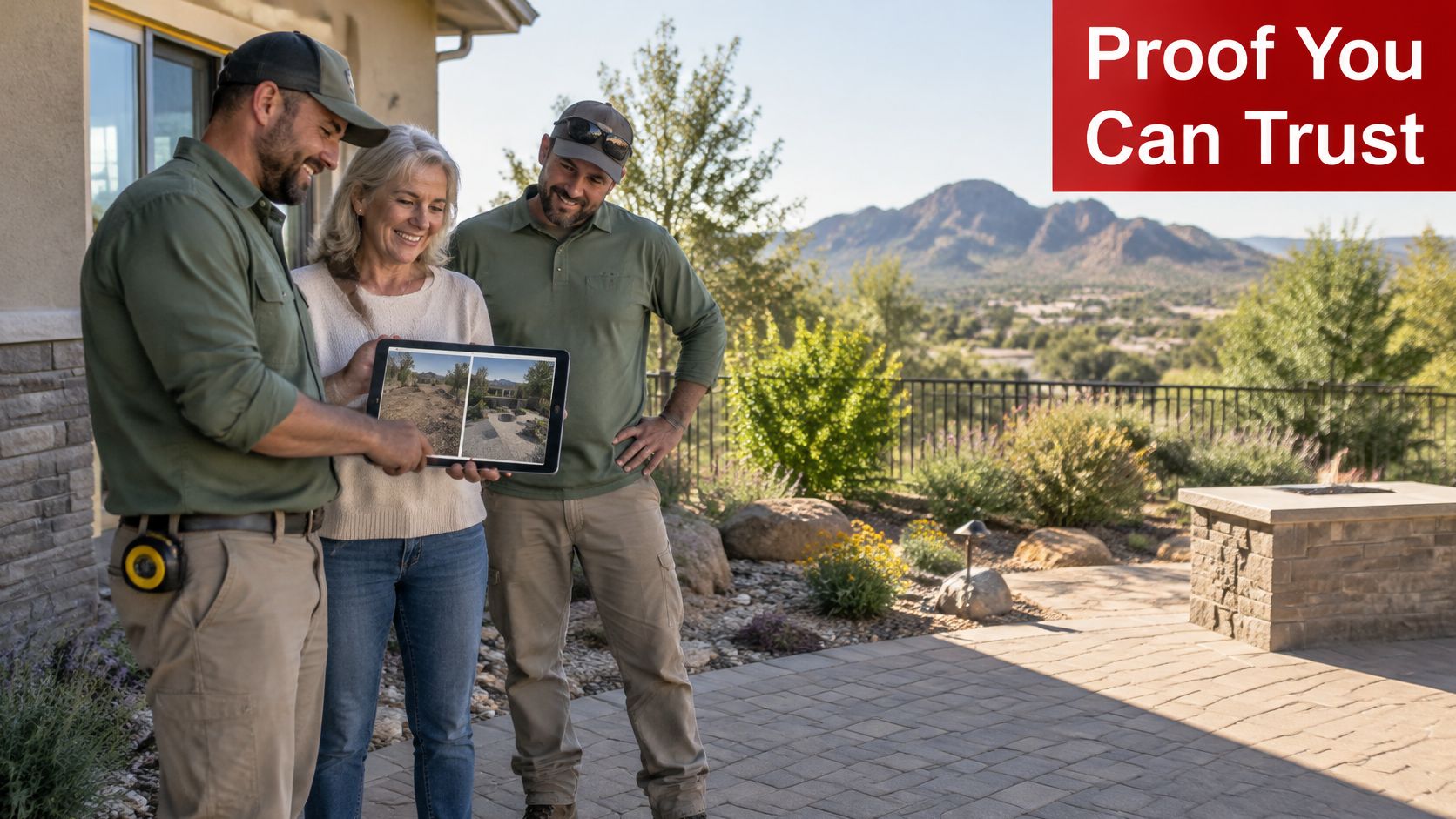
Project entries that do the selling
Build eight to twelve project entries, each with six to ten photos, a before and after pair, the city or neighborhood, the materials used, the timeline, and the problem you solved. Name the constraint. A Chino Valley retaining wall entry should say what the slope was doing, what soil conditions you hit, which block or stone you used, and how long it took. That specificity reads as competence, and competence is what a homeowner is really shopping for.
Budget ranges are optional. If the owner is comfortable sharing them, a range filters out mismatched inquiries before anyone picks up the phone.
Reviews and credentials where the decision happens
Place reviews beside the estimate form, not only on a testimonials page nobody visits. Show the reviewer's first name, the service and the city where they offered them. Put credentials next to the main call to action: license and insurance, warranties, manufacturer certifications, association memberships, and community or faith-based involvement stated plainly with the certifying body or the year. Vague trust claims ("fully insured, satisfaction guaranteed") carry less weight than a named certification and a real warranty term.
Rule of thumb: every claim on the site should be checkable. If a homeowner can't verify it in one click or one call, it reads as marketing rather than fact.
The About page does more work than most owners expect. Photographs of the owner and the crew, years in business, and the values the team puts into practice. Families who hire a pro are often hiring a relationship that lasts years, and they want to know who's coming through the gate.
Why AI visibility doesn't replace proof
There's a lot of advice right now telling yard-care pros to optimize for AI answers. The opposite deserves a hearing. 2025 analyses of AI Overviews found exposure for roughly 57.9% of question-based queries but only about 7% of local queries (Sideways8's analysis for landscaping companies). The homeowner searching for a pro near me is usually seeing a map pack, a website and a phone number, not a generated summary.
That's the argument for spending your next dollar on project evidence before AI-oriented pages. Trust is cumulative across the site. One thin gallery or a generic About page undercuts the speed work and the local structure you already paid for.
Content That Answers Questions for AI Search
Advice content has a place, but it's supporting work. It earns its keep when it answers a planning question and links the reader to the service that solves it. It fails when it becomes a keyword page with a question on top.
Plan six to ten answers for Prescott-area homeowners:
When to run irrigation in high-desert heat, and at what hour.
Which drought-tolerant plants suit Prescott-area yards and soils.
How cleanup timing affects lawns and beds.
Whether a retaining wall or hardscape needs a permit in Prescott Valley.
How local water rules affect watering schedules.
The pattern every answer follows
Each answer uses a question as an H3, opens with a direct two-to-three-sentence reply, adds one piece of local proof (a project, a photo, a named neighborhood, a seasonal detail), and links to the matching service page. That structure is easy for a person to skim and easy for a search engine or an AI assistant to summarize cleanly.
Keep the writing useful rather than promotional. A homeowner reading about irrigation timing should finish the paragraph knowing exactly what to do this week, whether or not they call you. The call comes from the confidence that you know the area.
Sequence matters. Launch the service pages, location pages, gallery, reviews and estimate form first. Add the advice answers after the core pages are live and indexed, because they're built to support those pages, not replace them.
Questions to Ask Before You Hire a Website Designer
The last objections are usually about money, time and control. Here are the honest answers.
How much does a landscaper website cost
A DIY builder costs little in cash and a lot of owner weekends, and it usually weakens local SEO because the template dictates the page structure. A freelancer adapting a template lands somewhere in the middle, with a wide range depending on scope. Custom work, with written service pages, a structured gallery, location pages, an estimate flow and local SEO, is the largest line item. Silva Marketing's custom website design starts at $3,998.
How long does a project take
Most small business website projects move in four to eight weeks once photos and copy are ready. Delays almost always come from missing project images, slow approvals or a service list that keeps growing. Gather photos before the kickoff, not during the build.
Do I need a blog
Not at first. Launch five to seven service pages, your location pages, the gallery, reviews and an estimate form. Once those are working, add the six to ten advice articles. A blog with no service pages behind it attracts readers, not customers.
Can I keep my domain and my reviews
Yes, and you should insist on it. The domain should be registered in the owner's name with the owner's billing, and Google reviews stay with the Business Profile no matter who builds the site. Ask before you sign.
What should I ask a designer
Ask for examples from pros or contractors, who writes the copy, how local SEO is handled, who owns the site and the hosting, what maintenance costs monthly, and how phone calls and form submissions get tracked. If the answers are vague, keep looking. Our own working process has four stages: Free Strategy Call, Custom Plan, Build & Launch, and Optimize & Grow, and you can review services and pricing before you book anything.
If the project touches fencing along with planting and hardscape, it helps to think about planning your fence project first, since fence lines and planting beds usually get designed in the same conversation.
Silva Marketing helps yard care pros and contractors in Prescott, Prescott Valley and Chino Valley, and we've launched more than 500 websites along the way. Bring a service list and a few project photos to a free strategy call and we'll map the service pages, location pages and conversion paths your work requires.
Silva Marketing builds fast, conversion-focused websites for outdoor pros in Prescott, Prescott Valley, Chino Valley and the surrounding Northern Arizona communities, with service pages, location pages and conversion paths structured around how outdoor work is sold. Bring your service list and a handful of project photos, and we'll show you which pages to build first and what each one needs to earn the call. Visit Silva Marketing when you're ready to take that next step.
Comments