
What Is a Responsive Search Ad? a Plain-English Guide

A responsive search ad is a Google Search ad built from up to 15 headlines and 4 descriptions that Google mixes into combinations for each search. If you're trying to understand why one ad can show different wording to different people, the short answer is that you supply the pieces and Google chooses among eligible combinations.
Say a plumber in Prescott wants an ad that can speak to someone searching for a burst pipe, someone comparing local plumbing companies, and someone looking for a routine repair. A single fixed message may fit one of those searches well and feel less relevant to the others. For local businesses in Prescott and across Northern Arizona, Silva Marketing helps turn Google Ads clicks into measurable calls and leads by building campaigns around the services and areas a business actually serves.
Table of Contents
How Google Builds and Serves RSA Combinations - The four steps behind an RSA - What pinning controls
Ad Strength Targets and Pitfalls That Weaken an RSA - Targets that support useful testing - Six mistakes to watch for
Frequently Asked Questions About Responsive Search Ads - Does a higher Ad Strength rating guarantee more leads? - How many responsive search ads should one ad group run? - Can I still create expanded text ads? - Should every headline include my city name? - How often should I review RSA reports? - What should I track to know whether an RSA is working?
What a Responsive Search Ad Is in Plain Terms
Before a Prescott plumber writes an ad, they need to decide what a local searcher should understand at a glance: the service, the area, and a reason to make contact. A responsive search ad (RSA) lets the plumber provide multiple headlines and descriptions instead of locking every visitor into the same prewritten sequence.
Think of the assets as interchangeable puzzle pieces, not a finished picture. A headline about emergency plumbing could appear alongside a description about licensed technicians, while another combination might emphasize the service area and a request for an estimate. The advertiser writes the pieces, but Google assembles eligible combinations for different searches.
That flexibility exists because people search for the same service in different ways. One person may search for “plumber near Prescott,” another for a leaking pipe repair, and another for a contractor serving Prescott Valley. Searches also happen on different devices and in different circumstances. One fixed sentence can't address every service need, local context, and stage of decision equally well.
In a traditional fixed ad, the headline and description appeared in the order the advertiser wrote them. An RSA gives Google more options to match the wording to the search, but the trade-off is straightforward: you gain coverage and give up control over every final line. A combination still needs to make sense when the pieces appear together, so each asset should be clear on its own.
For a local service business, begin by answering three practical questions:
Which service do you sell? Name the work clearly, such as drain cleaning or roof repair.
Which towns do you serve? Include Prescott or nearby communities only where your business operates.
What makes your business different? Choose a concrete point, such as a written warranty, financing, or a clear booking process.
Those answers shape the message before you enter Google Ads. They also help prevent an ad from making a broad promise that the business can't deliver consistently.
How Google Builds and Serves RSA Combinations
Google Ads takes the headlines and descriptions you write and uses them to assemble eligible versions of your ad. The platform considers context, but the advertiser still controls the claims and information supplied in the assets. Google's responsive search ad guidance explains the asset limits, combination approach, and role of signals such as the search query, device, location, prior interaction patterns, and available ad space.
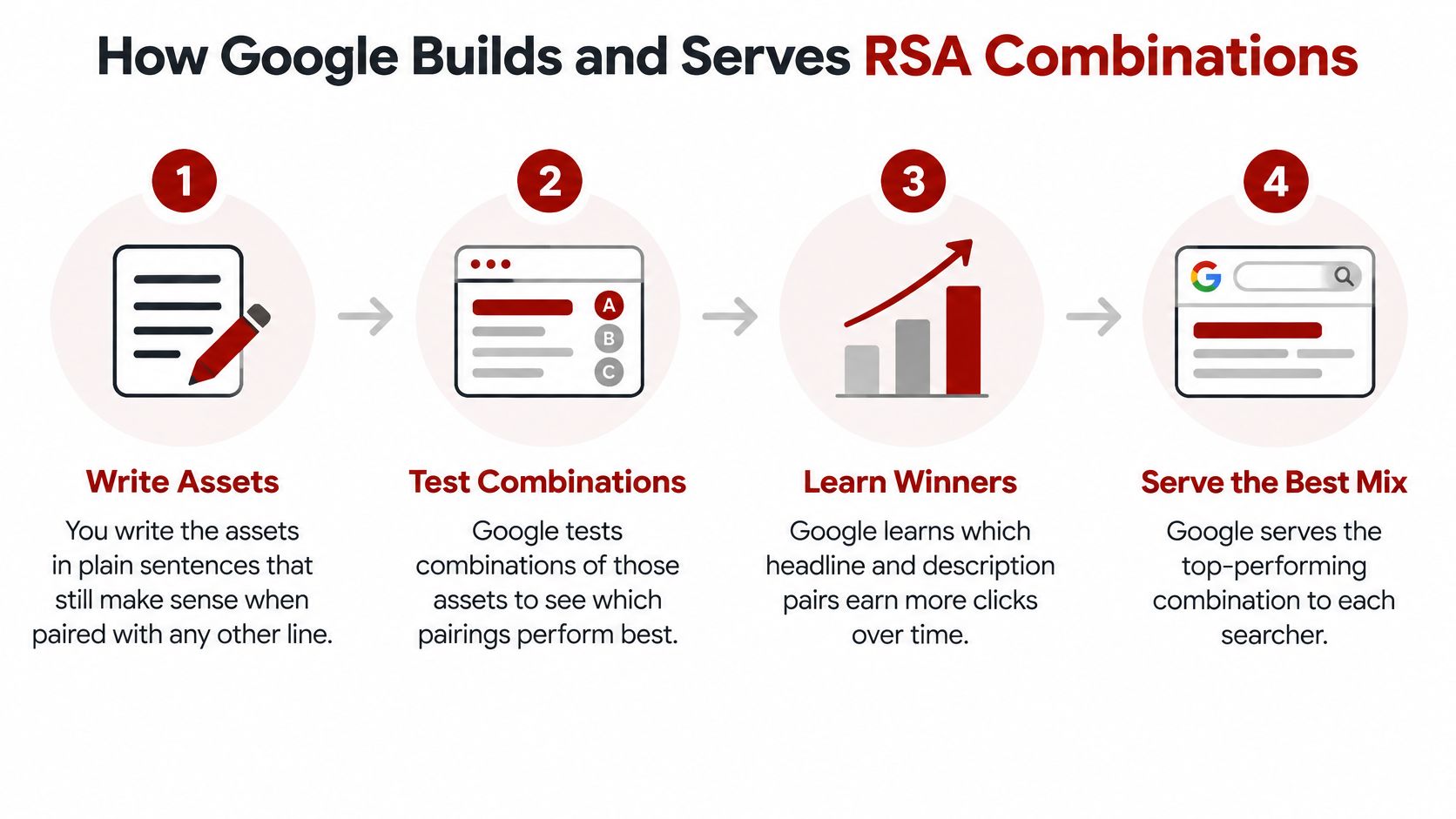
The four steps behind an RSA
Write assets. Create headlines and descriptions that are understandable in more than one pairing. A headline about roof repair should still make sense beside a description about estimates or workmanship.
Test combinations. Google evaluates eligible pairings in the context of each search. Query wording, device, location, earlier interactions, and available ad space can all help determine which combinations are suitable.
Learn from delivery. The system uses performance patterns to predict which pairings may be relevant in particular contexts. It can then show those combinations more often, but it doesn't guarantee that each searcher will see a particular line.
Review and refresh. Check the combinations and asset reports to understand what the system is showing. Use that information to improve weak or repetitive lines rather than making changes without a reason.
What pinning controls
Pinning attaches an asset to a specified position. For example, a contractor can pin a service keyword to headline position 1 when that structure is essential. But pinning too many assets restricts the combinations Google can test, so reserve it for real requirements rather than applying it to every headline.
Asset | Allowed count | Character limit | Typical local use |
|---|---|---|---|
Headlines | 3 to 15 | 30 characters each | Service, area, proof, offer |
Descriptions | 2 to 4 | 90 characters each | Warranty, process, call to action |
Display path | Up to 2 fields | 15 characters each | Short service or area label |
Reporting summarizes performance across combinations. Give assets distinct themes and keep track of what each is meant to communicate. If several lines make nearly the same claim, it becomes harder to tell which message is adding useful coverage.
How Responsive Search Ads Differ From Expanded Text Ads
Feature | Responsive search ad | Expanded text ad |
|---|---|---|
Headlines per ad | Up to 15 | Up to 3 |
Descriptions per ad | Up to 4 | Up to 2 |
Message order | Google mixes and tests combinations | Fixed order you wrote |
Control of final text | Shared with the system, pinning available | Full control over each line |
New creation | Standard format for Search ads | Phased out for new creation |
The key difference is who chooses the final sequence. With an expanded text ad, Google showed the wording in the order the advertiser supplied. With an RSA, an advertiser supplies a broader set of assets, and Google selects eligible combinations for delivery.
That changes the balance between certainty and reach. A fixed message can make sense when a promotion or required wording must appear in a precise form. An RSA is more adaptable when a local business wants to address different searches for one service, such as urgent repairs, routine work, and estimate requests.
Google has phased out creating new expanded text ads. Businesses setting up Search campaigns in Prescott and Northern Arizona should plan around RSAs, and review any older expanded ads before using their wording as a template. Keep the accurate, useful message, but make sure each RSA asset works in more than one possible combination.
For information about a related ad format, see this guide to when to use responsive display ads.
Practical verdict: Use an RSA when you want the system to match a range of searches for the same service. Keep wording tightly controlled when exact language is a legal or brand requirement, and verify that the format you use supports that requirement.
Writing Headlines and Descriptions for Local Services
A Prescott roofing contractor might need to reach someone with an active leak as well as someone comparing repair options. Build the ad around distinct intent layers, so the assets answer different questions instead of repeating one selling point in slightly different words.
Intent layer | What it does for the searcher | Example headline |
|---|---|---|
Service category | Matches the core search | Roof Repair Prescott |
Geography | Signals local relevance | Serving Prescott Valley |
Availability | Answers urgency | Same-Week Roof Repairs |
Financing | Removes cost hesitation | Flexible Financing Options |
Warranty | Builds trust after the click | Written Workmanship Warranty |
Local expertise | Separates from generic listings | Licensed Local Roofers |
Call to action | Prompts contact | Call for a Free Estimate |
A person searching for a roof leak needs to see the repair service and understand whether the business operates locally. Someone comparing the cost of work may care more about financing or an estimate. These messages can complement one another, provided they reflect what the contractor actually offers.
Use these writing rules as a practical quality check:
Keep headlines within the limit. Each headline must fit the 30-character maximum.
Make each line stand alone. Don't rely on another headline to explain a vague phrase.
Avoid duplicated claims. Don't use more than two headlines to make the same point with minor wording changes.
Name towns accurately. Mention Prescott Valley only if the crew serves it; don't add nearby locations just to sound local.
Pin only when necessary. Pin the service keyword to position 1 only when it must lead the message.
Use claims the business can honor. Don't promise a response time or warranty term the office won't consistently support.
Descriptions give you room to connect proof, an offer, and a clear next step. A roofing company might explain its estimate process, describe a written workmanship warranty, and invite the reader to request an estimate. Match each description to the landing page, so someone who clicks from an ad about Prescott Valley service doesn't arrive at a page that leaves that service area unclear.
A useful landing page should continue the conversation the ad begins. This guide to landing pages for Google Ads leads offers context for connecting the ad's message to the visitor's next step. For additional campaign guidance, review these Google Ads best practices.
Ad Strength Targets and Pitfalls That Weaken an RSA
Ad Strength is a diagnostic, not a lead-quality guarantee. It helps assess whether the ad contains varied, relevant assets, but a strong rating can't tell you whether the calls will be qualified or the jobs will be booked.
Google reports that advertisers improving RSA Ad Strength from Poor to Excellent saw 15% more clicks and conversions on average. Google also reports that adding a second RSA to an ad group was associated with a 6.6% conversion increase at a similar cost per conversion. These are average reported outcomes, not guaranteed causal results for a Prescott plumber or any particular local business. Google's guidance on improving responsive search ads offers a reason to test better coverage, not a promise about booked work.
A separate Google Ads explanation of RSA performance reports an average 3.7% conversion increase when a third RSA was added. Taken together, the figures can help with account planning, but the right result still depends on the business's qualified leads and costs.
Change | Google-reported average effect | What it means for you |
|---|---|---|
Ad Strength from Poor to Excellent | 15% more clicks and conversions | Coverage and variety matter |
Adding a second RSA to an ad group | 6.6% more conversions at similar cost per conversion | Run at least two per ad group |
Adding a third RSA | 3.7% more conversions | Gains taper but remain positive |
Targets that support useful testing
Aim for Good or Excellent Ad Strength, and keep at least two RSAs in an ad group when the campaign has enough relevant material to support distinct messages. The ads should test different angles, such as service area, price, speed, or warranty, rather than minor rewrites of the same claim.
Varied assets give Google more combinations to evaluate against search intent. Additional ads give the account other message routes to test. Neither change replaces sound targeting, a relevant landing page, or reliable conversion tracking. For lead generation, judge performance by qualified calls, completed forms, and cost per qualified lead, not clicks alone. A higher click-through rate can still hurt return if the ad attracts people who aren't likely to become customers. Keep Google Ads Quality Score considerations distinct from the question of whether leads turn into jobs.
Six mistakes to watch for
Over-pinning. Fixed positions can limit useful testing. Remove pins that aren't needed for a structural or brand requirement.
Near-duplicate assets. “Roof Repair Prescott” and “Roof Repairs Prescott” offer little message variation. Replace one with a different benefit or service detail.
A mismatched landing page. An ad that promises Prescott Valley service shouldn't send visitors to a generic home page that doesn't confirm coverage. Use a page that supports the ad's promise.
Constant rewrites. Swapping assets too quickly can make performance harder to interpret. Let combinations gather useful delivery before changing them.
Irrelevant search terms. Poorly matched queries can bring clicks from people who don't need the advertised service. Review search terms and refine targeting or exclusions.
Claims the office can't honor. A promise of same-day arrival can damage trust and lead quality if the team can't keep it. Use only claims staff can consistently deliver.
When you do make changes, replace one weak asset at a time where possible. Preserve proven claims while you test alternatives, so you can interpret the result without discarding every message that has already shown value.
Measuring RSA Results for Client Campaigns
A useful RSA isn't just one that earns clicks. It should attract the kind of customer the business wants and contribute to the outcome the campaign is meant to produce. For a local service company, that might mean qualified phone inquiries, completed forms, or estimates that become booked work.
Goal | Metric to track | Where to check |
|---|---|---|
Phone leads | Qualified calls and cost per qualified call | Call reporting and the call log |
Web form leads | Completed forms and cost per completed form | Conversion actions in Google Ads |
Booked jobs | Estimates booked and revenue per click | CRM, with offline conversion import |
Asset learning | Impressions by combination and asset | Combinations report and asset report |
Google's responsive search ad reporting guidance describes two reports that help make delivery visible. The combinations report shows which ad combinations were created and how often they appeared. The ad-level asset report lists assets and performance statistics to help decide what to keep, improve, or replace.
Read asset results in context. Google recommends evaluating assets at the asset-group or campaign level rather than judging one line in isolation, because assets work together within combinations. A headline with limited delivery might still help complete a useful pairing. For practical instructions on measuring form and call outcomes, see this guide to Google Ads conversion tracking setup.
A Northern Arizona service company could compare two RSA sets over a full quarter, checking search terms, qualified calls, booked estimates, and spend. The comparison is more useful when the business records which assets changed and when. If the account has a CRM, importing offline outcomes can help connect an ad interaction to a qualified lead or completed job rather than stopping at a form submission.
A click is an early signal. A qualified call or booked estimate tells you more about whether the campaign is helping the business.
Make reviews regular rather than reactive. Compare lead quality and cost with the campaign's actual objective, then use the asset and search-term reports to decide whether the message, targeting, or landing page needs attention. Avoid treating an increase in clicks as success if the people contacting the business don't match its service area or work.
Frequently Asked Questions About Responsive Search Ads
Does a higher Ad Strength rating guarantee more leads?
No. Ad Strength is a diagnostic of asset coverage and variety, not a promise of qualified calls or booked estimates. Evaluate whether the campaign produces the leads your business can serve.
How many responsive search ads should one ad group run?
Aim for at least two RSAs per ad group, with materially different angles, such as price, speed, warranty, or service area. Rewording one claim without changing the message doesn't create a meaningful test.
Can I still create expanded text ads?
Google has phased out new expanded text ads. New Search campaigns should use RSAs, and older ads should be reviewed for accurate, useful messaging rather than copied without checking the fit.
Should every headline include my city name?
No. Include a town when it helps a searcher understand local coverage, and only if the business genuinely serves that area. A Prescott Valley headline makes sense for a crew that works there.
How often should I review RSA reports?
Review the asset and search-term reports regularly, rather than rewriting the ad every day. A steady review routine makes it easier to understand what changed and whether lead quality improved.
What should I track to know whether an RSA is working?
Track qualified calls, completed forms, and estimates booked against campaign spend. Choose the main success measure before you launch, so you don't mistake activity for business results.
Confirm Your Next Step for Your Account
Before launching or revising an RSA, check that you can answer these questions:
Service: Do you sell a specific service, rather than advertising a vague range of work?
Area: Have you defined the towns you serve?
Assets: Can you prepare distinct headlines and descriptions that make sense in different pairings?
Ad group: Can you build at least two RSAs with different message angles?
Tracking: Are call and form conversions set up before the ads run?
Success measure: Have you decided which qualified-lead result will count as success?
From there, choose a practical next step. You can review an existing account against the checklist, or create a first RSA set and assess it after a full reporting period. Either way, keep a record of meaningful changes and compare leads with campaign spend.
If your team is organizing product recommendations or related content for a separate marketing effort, these ideas about building shoppable listicle pages may also be useful. For paid search and local lead generation, Silva Marketing is a Prescott-based digital marketing agency that designs, runs, and measures Google Ads campaigns and SEO for local service businesses in Prescott and across Northern Arizona. The agency offers free consultations and no long-term contracts, and an in-house account review is also a sensible choice if your team has the time and skills to manage it.
Silva Marketing helps local service businesses plan, run, and measure Google Ads campaigns with a focus on qualified calls and leads. If you want a calm review of your RSA assets, tracking, or landing-page fit, visit Silva Marketing to book a free consultation, or use the checklist with your own team.
Comments