
Competitor Keyword Analysis for Local Service Businesses

You're paying for Google clicks, but the calls still aren't coming in. A rival appears when nearby customers search for the jobs you want.
Competitor keyword analysis shows where those businesses appear in search results and where your business is missing. The useful gaps are the searches that match the services you offer and are likely to lead to a customer inquiry.
Silva Marketing is a Prescott-based digital marketing agency. Its SEO Consult includes keyword research and competitor analysis alongside content strategy and technical SEO.
Table of Contents
Set Your Goal and Pick the Right Competitors - Why do competitors change between nearby towns?
Data Sources and Tools to Compare Competitors - Which tools are worth paying for?
How to Extract and Filter Competitor Keywords - How do you build a usable keyword list? - How do you check review-site credibility?
Finding Gaps and Ranking Them by Call Intent - Why should Maps and AI answers have separate competitor lists?
Turning Gaps into Pages, Map Listings and Ads - What should a service page contain? - How should you test gaps in Google Ads?
Common Questions About Competitor Keyword Analysis - What is competitor keyword analysis in plain terms? - Do I need special schema or an AI file to appear in Google AI features? - Can I run the analysis for free? - Are review sites that rank local businesses reliable sources?
Track Results and Decide Your Next Step - When is a keyword gap closed?
What Competitor Keyword Analysis Tells a Local Business
Say a contractor attracts visitors through broad Arizona service terms. Some visitors live in Phoenix or Flagstaff, outside the contractor's practical coverage, while nearby customers searching for immediate help find a competitor's Google Business Profile.
The problem isn't necessarily a shortage of traffic. It's a mismatch between where the business appears and where its next customer is looking.
For owners and marketing leads spending money on Google, competitor keyword analysis should answer practical questions: Which local searches are we missing? Who appears instead? Is the opportunity in Maps, an organic service page, or an informational answer?
Practical rule: A rival's keyword is only an opportunity if you can serve the customer behind it.
The finished deliverable is a keyword-gap sheet, not an oversized export. Give each term its own row containing:
Search context: The keyword, service, town, and device.
Winning competitor: The business or publisher appearing instead of you.
Result type: Map pack, organic page, or AI answer.
Intent and priority: What the searcher wants and how strongly the term deserves action.
Next action: The listing correction, page improvement, or advertising test needed.
At Silva Marketing, competitor analysis belongs alongside keyword research, content strategy, and technical SEO, rather than standing alone as a ranking report. The useful sequence is straightforward: establish goals, collect evidence, filter keywords, rank gaps, implement changes, and measure customer actions.
Set Your Goal and Pick the Right Competitors
Choose the goal before choosing competitors. A business competing for emergency calls needs a different comparison set from a company trying to answer installation-cost questions.
Start by mapping where your customers actually need service.

Separate map-pack rivals, organic rivals, and informational publishers or directories. A plumbing company appearing in Maps competes for immediate customer actions; a publisher answering water-heater questions competes for attention at a different stage.
Why do competitors change between nearby towns?
Google's local ranking guidance identifies relevance, distance, and prominence as the primary local ranking mechanics, and explains that links, review volume, and positive ratings can influence prominence. That means keyword wording alone won't explain why another business appears.
A Prescott Valley competitor may be highly visible to someone searching nearby without appearing as strongly from Prescott. Build a service-by-town grid, then compare categories, service relevance, location coverage, review sentiment, and credible local links within each combination.
Goals, competitor sets and progress metrics
Goal | Competitor set to study | Metric that shows progress |
|---|---|---|
More phone calls | Map-pack rivals in each service town | Calls and direction requests |
Organic leads on a service page | Page-one organic rivals for that service | Clicks and form fills per service page |
Cheaper paid clicks | Advertisers bidding on the same terms | Cost per lead on gap terms |
AI answer visibility | Informational publishers and directories | Impressions on question-style queries |
Review parity | Top-reviewed rivals in the same town | Review count and rating trend |
Treat these metrics carefully. Direction requests aren't phone calls, and impressions on question-style searches don't prove that an AI answer cited your business. Keep separate records of actual citations when AI visibility is the objective.
Use the video alongside your planning worksheet.
Write the goal in one sentence, such as increasing qualified water-heater repair calls from Prescott Valley. Then select the top three rivals for each priority service-town combination and name the three metrics you'll review monthly.
Data Sources and Tools to Compare Competitors
For a Prescott plumber, the map-pack businesses shown for “water heater repair” may differ from the websites ranking for “why a water heater leaks.” Track those competitors separately: the first set competes for local calls, while the second competes for informational searches. Google is the dominant search engine in most markets, so prioritize it and record mobile and desktop results separately.
Data sources for competitor keyword work
Data source | What it reveals | Main limitation |
|---|---|---|
Google Search Console | Queries and pages where your own site already appears | Shows nothing about rival sites |
Google Business Profile insights | Calls, direction requests and search queries for your listing | Covers only your listing |
Google Ads Keyword Planner | Monthly search volume ranges for terms | Ranges only, and volume is a weak proxy for calls |
Semrush or Ahrefs | Organic keywords and ranking pages for a rival domain | Estimates; local pack results are thinly covered |
Similarweb | Traffic share and benchmarks across websites | Directional, not a local ranking tool |
Manual search in a private window on a phone | The actual three-pack and page-one results for each service and town | Time-consuming and a snapshot in time |
Which tools are worth paying for?
Use Semrush or Ahrefs to find candidate keywords and ranking pages, not to decide which competitor matters most locally. Silva Marketing's guide to competitor analysis tools can help match tool features to the research task.
For page-level research, analyze rival stores' content and backlinks to assess how their pages cover a topic and what links support them. For local service businesses, weigh service relevance and local authority rather than copying an ecommerce approach.
Pair a paid keyword tool with free Google data and manual searches for each service and town. Record the date, device, and search location. A private window reduces some personalization, but it does not remove geographic context.
How to Extract and Filter Competitor Keywords
Exporting keywords is easy. Filtering out searches that won't produce a serviceable customer takes judgment.
Use Silva Marketing's local keyword research method to organize service language before comparing rival domains. Keep the original exports separate from the working sheet so you can trace every retained term to its source.
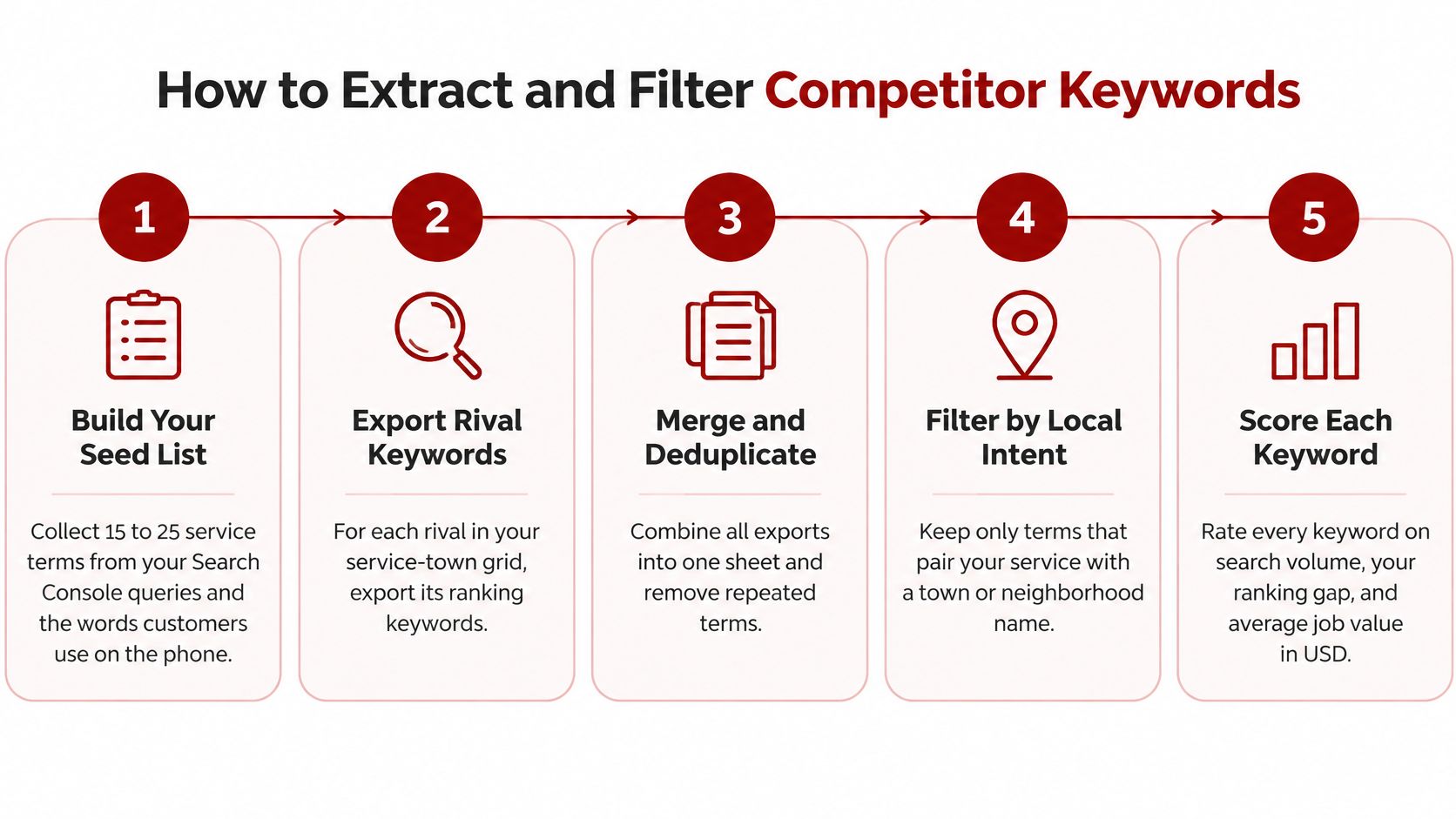
The extraction workflow keeps discovery, filtering, and prioritization distinct.
How do you build a usable keyword list?
Build the seed list from customer language. Start with 15 to 25 service terms drawn from Search Console and the words callers use, such as drain cleaning, leaking water heater, or electrical panel replacement. Don't start exclusively with industry terminology, because customers may describe the symptom rather than the repair.
Export each rival's ranking keywords. Save the domain, ranking page, export date, and estimated position, then merge the files and deduplicate repeated terms while preserving competitor associations. A common mistake is exporting only the top 100 rows and overlooking small-town searches buried beneath broader terms.
Check the results manually. Search each service plus town on a phone in a private window, recording the map pack and first page of organic results. Capture the location context too, because a result checked from elsewhere isn't reliable evidence of what a nearby Prescott customer sees.
Remove brands and irrelevant searches. Exclude rival business names, unrelated services, hiring queries, and locations you don't serve. Branded searches can inflate an opportunity list with demand for another company's reputation, while a generic term deserves retention only when its results clearly serve your market.
Keep genuine local relevance. Retain Prescott, Prescott Valley, Chino Valley, neighborhood, and near-me searches that fit your actual coverage. Don't require a town name mechanically, because a customer can express local intent without typing a location.
Tag the customer's intent. Assign emergency, service, price, comparison, or research to every remaining term, and attach the relevant service page where one exists. Don't combine similar-looking phrases if the results show that customers need different answers.
Verify the apparent authority. Inspect who operates directories, comparison pages, and review sites before treating their recommendations as independent evidence. Remove self-published best-of rankings from your trust benchmark when ownership or endorsement relationships aren't transparent, but retain a note if they occupy relevant search results.
How do you check review-site credibility?
The FTC's Consumer Reviews and Testimonials Rule guidance prohibits misrepresenting a controlled review website as independent, prohibits incentives conditioned on positive or negative sentiment, and explains that material relationships require clear, conspicuous disclosure. Don't treat an incentive alone as proof of wrongdoing, or review quantity alone as proof of trust.
For larger grids, WebscrapingHQ's guide to search result scraping for competitor analysis explains collection options. Use permitted methods, respect applicable terms, and manually validate local results before acting.
Finish with a compact service-specific list you can inspect row by row. A smaller defensible list is more useful than an export nobody can explain.
Finding Gaps and Ranking Them by Call Intent
Search volume measures demand, not customer readiness. A narrowly worded leaking-water-heater search from Prescott can deserve more attention than a broad Arizona term attracting people outside your coverage.
Score each retained keyword on intent weight, local match, and rival weakness. Give emergency and service searches the strongest call-intent weighting, price and comparison searches the next tier, and research questions the lowest direct-call weighting.
Local match should reflect both geography and operational fit. A high-value job in a town you can't serve promptly isn't a strong opportunity.
Don't mistake a low difficulty score for a weak local competitor. Inspect the listing and page that actually occupy the result.
Rival weakness means a specific deficiency, such as a missing service page, unclear coverage, or incomplete listing. Fewer reviews can justify closer inspection, but they don't establish that a rival is easy to displace.
Why should Maps and AI answers have separate competitor lists?
In the local-query evidence summarized by BCC Interactive, AI Overviews appeared for 15% of strictly local-intent queries, compared with 92% of informational local queries and 97% of hybrid queries, while Local Packs appeared for 93% of strictly local queries. These findings describe that query analysis, not a guaranteed result for your business.
Build separate lists for map-pack competitors earning calls and directions and publishers or third-party sites earning informational visibility. Silva Marketing's explanation of search intent in SEO helps distinguish a service request from a question that needs an educational answer.
Intent stages, priority rules and actions
Intent stage | Example query | Priority rule | Action |
|---|---|---|---|
Emergency | emergency plumber Prescott | Highest priority when a rival holds the three-pack and you are absent | Strengthen the Business Profile service list and call tracking |
Service | water heater repair Prescott Valley | High when the top rival has fewer reviews or no service page | Build or refresh a dedicated service page |
Price | how much does a water heater install cost Prescott | Medium; prioritize when paired with a service term | Publish a clear pricing range with the scope it covers |
Comparison | tankless vs tank water heater Arizona | Medium; target organic and AI answers | Write an answer-first comparison with a clear verdict |
Research | why is my water heater making a popping noise | Low for direct calls; useful for AI answers | Add a short answer in an FAQ section |
Use a consistent internal scoring scale, total the components, and break ties using job value and implementation effort. Put the top ten terms into an action sheet, grouping phrases that genuinely belong on the same page.
Turning Gaps into Pages, Map Listings and Ads
Start with the Business Profile when the scored gap is in Maps. Correcting an inaccurate category or omitted service can require less work than producing new content, although it won't overcome every competitive disadvantage.
Check primary and secondary categories against the services you provide. Include priority services accurately, keep contact details consistent, and use genuine photos and posts that reflect your work and coverage.
For an unclaimed or unfinished profile, GrandviewGuide's Google listing setup guide provides a practical setup reference. Don't create extra listings just to manufacture a presence in nearby towns.
What should a service page contain?
Build or improve a page around the priority service, with actual job scope, towns served, scheduling information, and relevant customer feedback. Explain what affects the work rather than filling paragraphs with repeated location names.
Avoid producing interchangeable Prescott, Prescott Valley, and Chino Valley pages with only the city name changed. Create separate location pages when you have meaningful location-specific information to offer, and use a content gap analysis to identify what the current page fails to answer.
Google's guidance on AI features says sites don't need a special AI file, AI text file, or special schema.org markup to appear in those features. Put the answer in accessible text, connect related pages with crawlable internal links, and state the service area accurately.
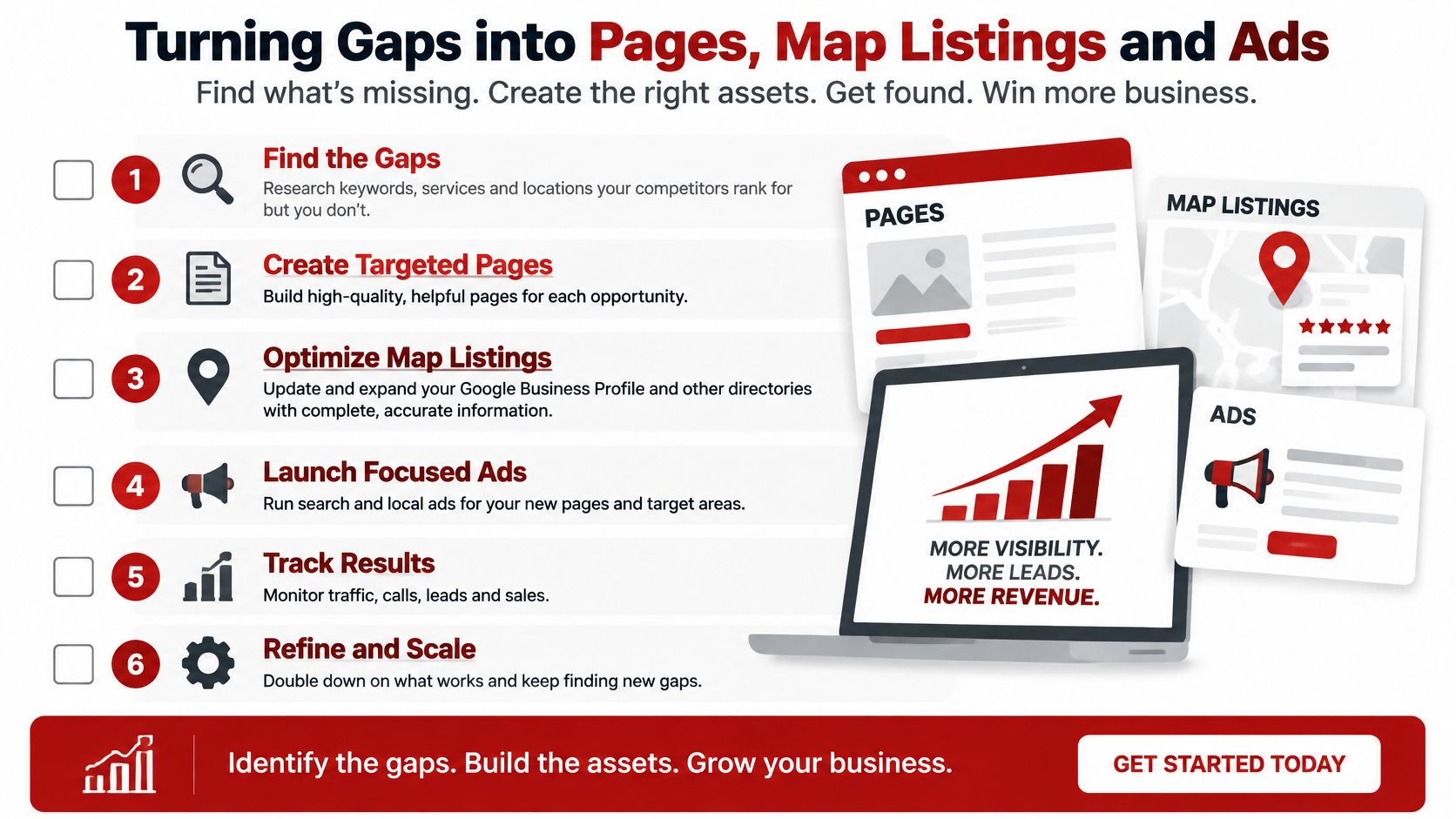
Use this checklist to connect each implementation task to its scored gap.
How should you test gaps in Google Ads?
Use high-call-intent gaps as paid keyword candidates with tightly matched ads and landing pages. Treat research phrases as negative-keyword candidates for direct-response campaigns, but inspect them first so you don't exclude useful demand accidentally.
Review the search terms report weekly, judging actual inquiries rather than cheap clicks. Publish pricing only from your own supported estimates, with clear inclusions and exclusions.
Listing check: Categories, services, contact details, and coverage accurately represent the business.
Page check: The answer is clear, the scope is useful, and customers can reach the relevant contact action.
Paid test check: Search terms, geographic targeting, and qualified-lead tracking match the opportunity.
Fix the map listing first, improve answer-first pages second, and run paid tests third when that order matches the gaps you've identified.
Common Questions About Competitor Keyword Analysis
What is competitor keyword analysis in plain terms?
It's a list of searches where competing businesses appear and your business doesn't, prioritized by their potential to generate qualified inquiries. For a Prescott contractor, the useful result is a decision about which listing or page to improve, not just a larger keyword collection.
Do I need special schema or an AI file to appear in Google AI features?
No. Focus on readable, crawlable content, accessible internal links, and accurate answers rather than buying a special file as an entry requirement.
Where structured data is appropriate, Google's structured-data guidance explains that it helps classify page information but doesn't guarantee rich results. Markup should reflect the content customers can see.
Can I run the analysis for free?
Yes. Search Console, Business Profile performance information, manual searches, and an existing Google Ads account's search terms report can support the work without a paid competitor database.
You won't receive rival-domain exports from those tools, and collecting evidence takes more manual effort. Start with a tightly defined service-town combination rather than attempting all of Northern Arizona at once.
Are review sites that rank local businesses reliable sources?
Not automatically. Check ownership, ranking methodology, and clear disclosure of incentives or material relationships before treating a recommendation as independent.
Exclude misleading self-published best-of lists from your credibility assessment. If a questionable site appears prominently, document its visibility without adopting its claims or copying its practices.
Track Results and Decide Your Next Step
Review priority positions monthly and assess trends at 90 days. Keep the keyword, location, device, and checking method consistent so you aren't comparing unrelated snapshots.
For each metric below, add a baseline entry and a dated 90-day entry in your working sheet. Mark unavailable information as not recorded, rather than entering a zero that falsely implies no activity.
Monthly tracking template for competitor keyword gaps
Metric | Source |
|---|---|
Priority gap terms in the map pack | Manual three-pack checks with dates |
Calls and direction requests from Business Profile | Business Profile insights |
Organic clicks to each priority service page | Google Search Console |
Review count and average rating | Business Profile dashboard |
Cost per lead on gap terms | Google Ads search terms report |
For cost per lead, combine search-term spending with configured conversion tracking and qualified-lead records. The search terms report alone can't tell you which inquiry became a suitable job.
When is a keyword gap closed?
Use an internal rule: mark a visibility gap closed only after the term appears in the map pack or on page one across at least two dated checks. Then assess whether the visibility produced useful inquiries, because rankings and revenue are different outcomes.
You can manage the sheet internally or use an outside team for the initial assessment. Silva Marketing's working process follows Free Strategy Call, Custom Plan, Build & Launch, and Optimize & Grow, giving the analysis a defined path into execution and review.
Choose the three gaps with the clearest customer fit and assign an owner to each. More research can wait until those actions are underway.
Silva Marketing's free SEO Consult includes in-depth keyword research, SEO optimization, a high-quality content strategy, onsite technical SEO, and competitor analysis. Visit Silva Marketing to arrange a Free Strategy Call and discuss which Prescott-area keyword gaps deserve action first.
Comments