
SEO Campaign Cost for Prescott Service Businesses

There's no universal SEO campaign cost: monthly pricing varies substantially by provider and scope, with reported averages of $2,917 across providers, $3,209 for agencies, and $1,349 for freelancers. Prescott and Northern Arizona businesses should budget around deliverables, geographic coverage, website needs, and qualified-lead goals rather than a single industry standard.
You might be comparing proposals that sound similar but leave you unsure what you're buying. One promises ongoing optimization, another lists content and keywords, and neither clearly explains who will fix your website or how you'll know whether the work produces useful inquiries.
Silva Marketing is a Prescott-based agency helping local service businesses connect website improvements and search visibility with calls and qualified leads across Northern Arizona. The right investment starts with your operating reality, not a package name.
Table of Contents
Why SEO Campaign Cost Varies - What do SEO pricing benchmarks actually tell you?
Comparing SEO Pricing Models - Which SEO pricing model fits your business? - Is performance-based SEO a safer purchase?
What Determines the Work You Need - What should an agency inspect before quoting? - How does service territory affect the workload?
Planning Budgets by Business Size - What should a small service company prioritize? - When does a broader program make sense?
What Results and Milestones to Expect - What should you see before lead growth? - How long should you wait before questioning progress?
How to Evaluate SEO ROI - What belongs in an SEO ROI review? - What if traffic grows but inquiries don't?
Spotting Pricing Red Flags - Which contract terms deserve scrutiny? - Can cheap local SEO put a Business Profile at risk?
Choosing a Local SEO Partner - What should you ask before signing? - Does the agency need to offer every service?
Why SEO Campaign Cost Varies
Consider a Prescott contractor comparing proposals. A lower-priced offer covers basic page edits and a report. A broader proposal includes technical repairs, service-page development, local profile work, conversion tracking, and someone responsible for implementation.
Those aren't equivalent purchases. If the contractor chooses the cheaper offer but still needs a developer, writer, and tracking specialist, the headline fee doesn't describe the actual investment.
The comparison below highlights why scope matters.

What do SEO pricing benchmarks actually tell you?
A global survey of 439 SEO providers summarized by Brenton Way reported monthly averages of $2,917 across providers, approximately $3,209 for agencies, and about $1,349 for freelancers. It also identified $501–$1,000 as the most frequently reported monthly price band and reported that 63% of businesses spent $500–$5,000 monthly.
These are comparison benchmarks, not Prescott-specific quotes. They don't establish whether a particular proposal includes enough work to solve your problem.
For background while reviewing unfamiliar terminology, IndieTool's SEO guide provides an additional reading resource. Keep the buying decision focused on your proposal rather than general optimization advice.
Ask providers to distinguish between:
Diagnosis: What will they investigate before recommending changes?
Execution: Which changes will they complete?
Accountability: Who checks the work and explains its business relevance?
Exclusions: Which development, content, or software costs remain your responsibility?
Buying principle: Compare scope, expertise, execution, and evidence before comparing the monthly fee.
A low price can make sense for a tightly defined assignment. It becomes a poor investment when you expect full support but buy only superficial maintenance.
Comparing SEO Pricing Models
Choose the pricing model that matches the assignment. Ongoing market development and a defined technical repair shouldn't automatically use the same commercial arrangement.
A monthly retainer can support continuing strategy, implementation, and review. Project pricing works better when the finish line is clear. Hourly consulting fits a specific question or specialist task, while performance-based agreements demand unusually careful definitions.
Which SEO pricing model fits your business?
SEO Pricing Models Compared
Pricing Model | Best Fit | Common Pricing Basis | Key Question |
|---|---|---|---|
Monthly retainer | Continuing optimization with recurring priorities | Agreed monthly scope and responsibilities | What work gets completed, and how are priorities changed? |
Project-based | Audit, website overhaul, or defined content build | Specified deliverables and acceptance criteria | Does the fee include implementation and revisions? |
Hourly consulting | Troubleshooting, strategy, or specialist guidance | Time spent on approved tasks | What spending limit requires additional approval? |
Performance-based | Work with clearly attributable business outcomes | Agreed definition of leads, revenue, or another result | Who verifies results and resolves attribution disputes? |
With a retainer, insist on a working plan rather than an open-ended promise to improve SEO. The agreement should explain how the provider allocates effort when urgent technical problems interrupt scheduled content work.
With a project, define completion. An audit document isn't the same purchase as repaired templates, updated pages, and verified tracking.
Hourly support can be sensible when your team already handles execution. Without an agreed spending limit and written task approvals, however, you may struggle to predict the final invoice.
Is performance-based SEO a safer purchase?
Not automatically. A performance agreement can create disagreements about whether an inquiry was qualified, whether an existing customer counts, or whether another marketing channel deserves credit.
Define exclusions, duplicate inquiries, attribution, and payment triggers before signing. Don't accept a convenient reporting metric as a substitute for a meaningful business result.
For a contrasting industry context, ContentBuck's SaaS SEO agency guide is another agency-selection resource. Your local service proposal still needs its own scope, customer definition, and commercial terms.
Use the agency's services and pricing information as a starting point for questions, not a replacement for a written agreement.
Before committing, get clear answers about what's included, what's excluded, who performs the work, and how completion is verified. Also establish who owns the website, content, profiles, and reporting accounts if the relationship ends.
What Determines the Work You Need
A meaningful quote requires a diagnosis of your website and market. The agency should explain what needs attention, why it matters, and which tasks deserve priority.
A technically sound website with clear service pages presents a different assignment from a site with crawlability problems, confusing navigation, slow templates, or broken inquiry forms. Buying more content before investigating those problems is the wrong sequence.
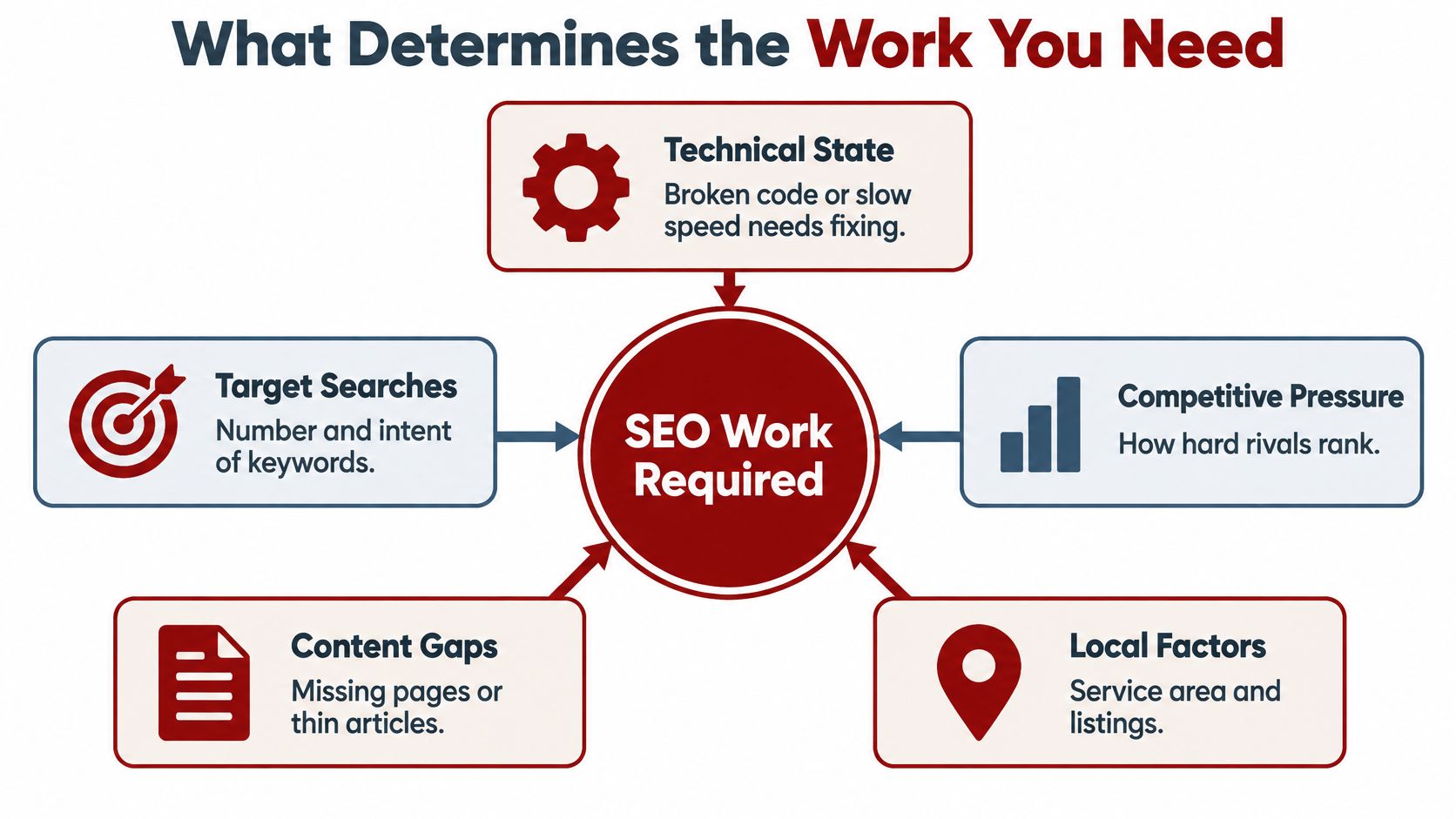
The main planning inputs are connected.
What should an agency inspect before quoting?
Start with the website's ability to support the services you want to sell. Ask the provider to inspect indexing access, page organization, mobile usability, structured-data implementation where appropriate, and the path from landing page to inquiry.
Then examine search intent. A homeowner looking for an urgent repair needs different information from a property manager evaluating ongoing maintenance.
Technical condition: Separate essential repairs from optional refinements.
Content gaps: Identify missing service information instead of ordering articles by volume.
Competitive pressure: Examine what relevant competitors explain well and where your business can provide a stronger answer.
Conversion readiness: Check whether visitors can understand coverage, assess suitability, and contact your team.
Measurement needs: Decide which actions must be recorded before implementation begins.
If the current site can't support those requirements, discuss website design and rebuilding options alongside SEO. Don't pay repeatedly to work around a structural problem without comparing the alternatives.
How does service territory affect the workload?
A focused Prescott campaign and a program serving Prescott Valley, Chino Valley, and Dewey-Humboldt need different geographic planning. Broader coverage should reflect actual services and customer needs, not copied pages with town names swapped.
Google identifies relevance, distance, and prominence as its primary local ranking factors. Accurate service descriptions address relevance, while links and customer reviews contribute to prominence; your actual location remains part of the equation.
That's why the scope should connect website work, reputation, and operating information. Ask the agency to explain those connections before accepting a list of keywords as a strategy.
Planning Budgets by Business Size
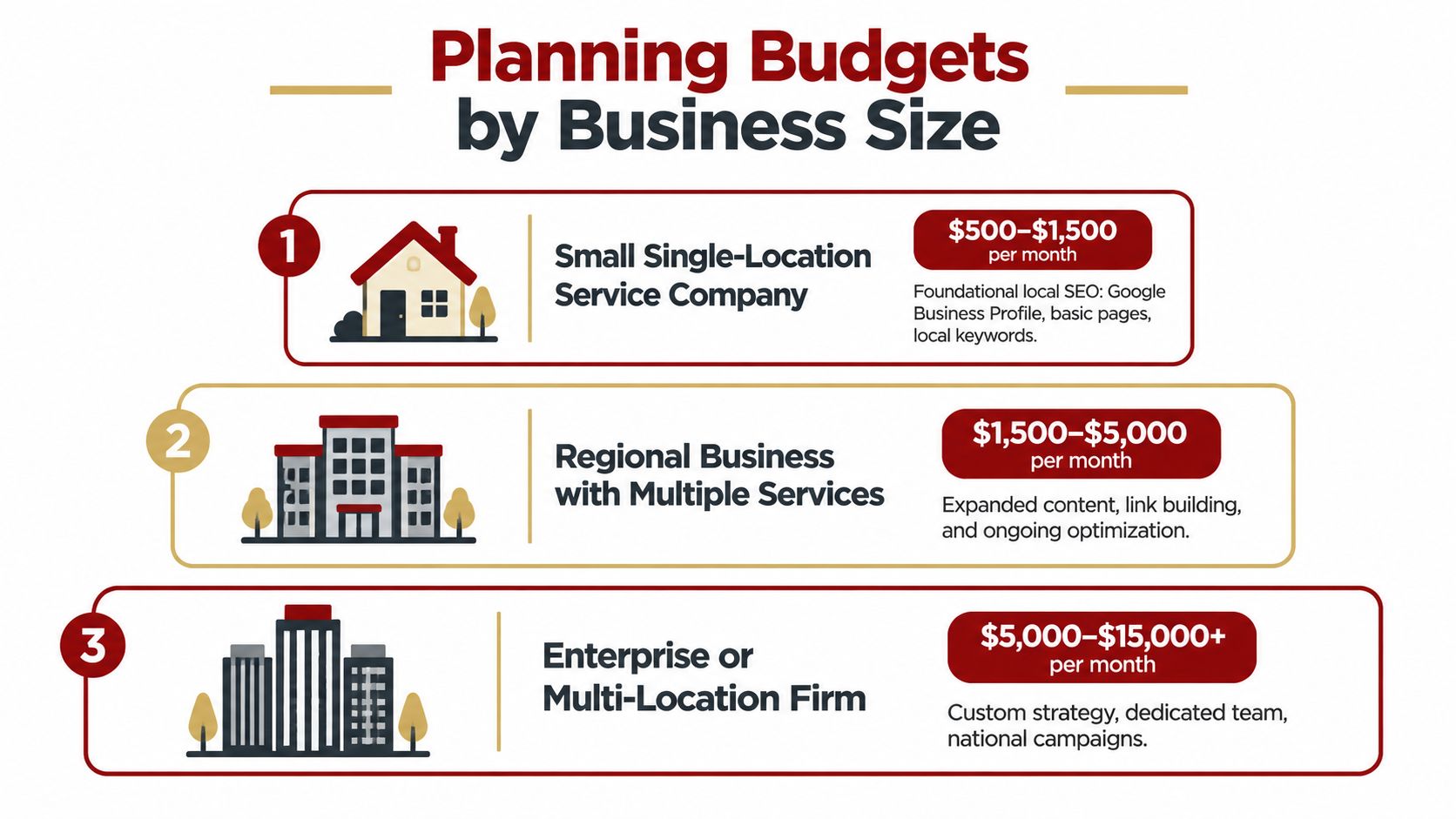
Set the scope first, then decide what you can fund consistently. Business size is useful context, but it doesn't reveal website condition, competitive difficulty, or the value of the work you're trying to win.
The earlier survey benchmarks provide context, not spending instructions. Use the following visual as a broad planning illustration, not verified local pricing or a substitute for a custom proposal.
What should a small service company prioritize?
For a single-location business establishing its presence, I'd prioritize accurate business information, usable core service pages, essential technical corrections, and working inquiry tracking. The objective is a dependable foundation, not publishing as much content as possible.
A limited budget should mean narrower priorities, not incomplete execution across every possible activity. Choose the services and customer areas that matter most, then document what will wait.
For an established Prescott business, the assignment may involve differentiating several services, improving weaker pages, and addressing stronger competitors. Here, the trade-off is between concentrating resources on valuable opportunities and distributing effort too thinly across the entire website.
When does a broader program make sense?
A multi-service or multi-location company needs coordinated planning. Individual locations may have different staff, service capabilities, customer questions, and website requirements.
Before funding expansion, establish:
Commercial priorities: Which services warrant additional demand?
Operational capacity: Can the business answer inquiries and deliver the work?
Coverage accuracy: Which communities can the team serve reliably?
Implementation capacity: Who supplies approvals, service expertise, and location details?
A more detailed budget is justified when the added work has a clear purpose. It isn't justified merely because a business has grown.
Fund a manageable scope completely before expanding a campaign your team can't support.
This video offers another format for considering the investment.
Ask each provider to separate essential work from expansion options. That gives you a practical way to adjust spending without abandoning the tasks needed to make the campaign measurable.
What Results and Milestones to Expect
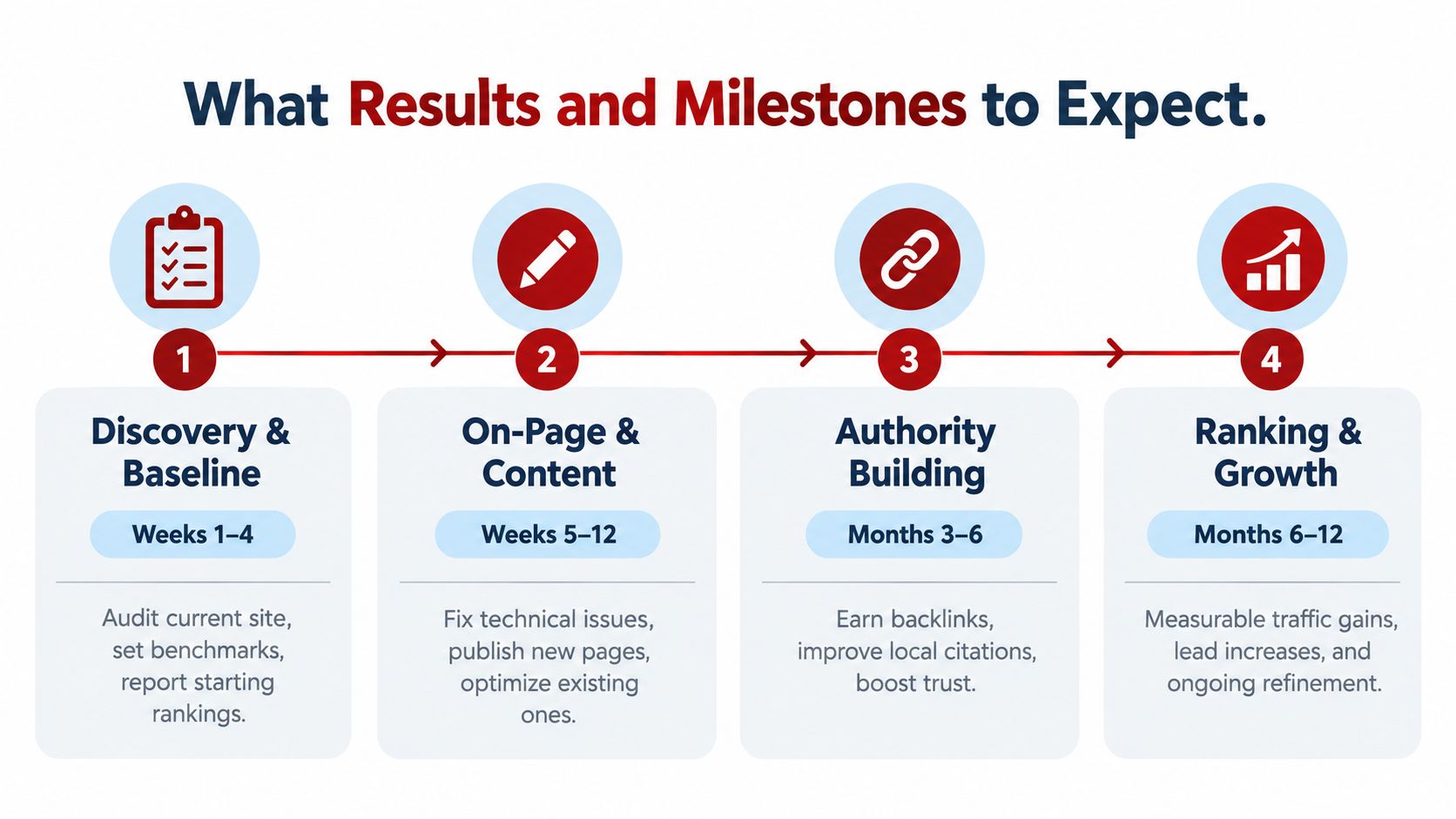
Expect documented progress through discovery, implementation, and ongoing review, not a guaranteed ranking date. Your proposal should specify delivery milestones while clearly separating work the agency controls from outcomes it can't promise.
Discovery establishes the starting position: website condition, existing visibility, relevant competitors, tracking reliability, and priority opportunities. Implementation should produce identifiable changes you can inspect.
Treat the schedule in this visual as illustrative rather than a commitment about when your business will gain traffic or leads.
What should you see before lead growth?
You should see a reliable baseline and completed work. A useful update identifies the affected pages, explains the change, and states what the agency will monitor.
Google's guidance on Search Console and Analytics explains that Search Console reports how often a site appears in Search, how often people click, and which queries generate that traffic. These signals help distinguish visibility changes from actual website visits.
Ask for a milestone record that separates:
Delivered work: Repairs, revised pages, published content, and profile updates.
Observed signals: Relevant impressions, clicks, and search queries.
Business outcomes: Qualified calls, form submissions, and revenue opportunities.
Outstanding dependencies: Access, approvals, development tasks, or missing business information.
How long should you wait before questioning progress?
Question unclear execution immediately. You don't need to wait for rankings to ask why agreed work hasn't been delivered.
Outcome reviews require more context. A recently revised service page, an unresolved technical dependency, and a mature campaign shouldn't be assessed as though they're at the same stage.
Set review dates in the proposal and agree on what decisions those reviews support. The agency should explain whether the evidence supports continuing, changing priorities, or resolving a blocker.
A report that acknowledges uncertainty is more useful than a confident prediction without supporting evidence. Demand clarity about what happened, not certainty about what happens next.
How to Evaluate SEO ROI
Judge SEO as a business investment, not a ranking contest. A visible page is useful only if it helps the right customer move toward a service your company can profitably deliver.
Begin by defining a qualified opportunity. For a Prescott contractor, that might mean an inquiry for an offered service, inside the operating territory, from someone ready to discuss a real project.
That definition prevents reporting disputes later. An out-of-area request or an inquiry for a service you don't provide shouldn't be treated as equivalent to a suitable prospect.
What belongs in an SEO ROI review?
Connect marketing records with sales records rather than expecting a search dashboard to explain everything.
Lead suitability: Did the inquiry match the agreed customer and service criteria?
Sales handling: Did someone respond and record the outcome?
Customer value: What revenue and contribution did the completed work produce?
Acquisition cost: What campaign and supporting expenses were required?
Timing: Has the sales cycle progressed far enough to judge the opportunity fairly?
Close rate, average transaction value, and delivery costs all affect whether additional leads justify the investment. Use your own business records, not a provider's promised return multiple.
What if traffic grows but inquiries don't?
Investigate the mismatch before expanding the budget. The campaign may be attracting unsuitable searches, or visitors may struggle to understand the offer and take the next step.
Review the customer's path from search query to page to contact. A conversion-focused landing page can be part of that discussion when the existing experience doesn't clearly explain the service or support an inquiry.
Measurement rule: Don't label visibility growth as revenue growth.
An authority-first approach should connect useful service information, credible business representation, and an accessible contact process. The review question is whether those efforts are producing better business opportunities, not whether the report contains more upward arrows.
Spotting Pricing Red Flags
The cheapest proposal isn't necessarily risky, but an unexplained proposal is. A modest, clearly bounded service can be sensible. An expansive promise with no accountable delivery plan deserves scrutiny.
Be cautious when a provider guarantees rankings, emphasizes keyword counts without discussing intent, or substitutes automated reports for explanations. Ask what happens when priorities change and whether additional work requires written approval.
Which contract terms deserve scrutiny?
Review the commercial details with the same care as the strategy.
Undefined deliverables: Replace “ongoing optimization” with identifiable responsibilities.
Unexplained fees: Clarify software, development, content, and third-party charges.
Changing commitments: Check renewal, cancellation, notice, and termination terms.
Restricted ownership: Keep access to business accounts and the work you've purchased.
Unverifiable reporting: Request evidence you can reconcile with your own records.
Low pricing doesn't excuse unclear terms. High pricing doesn't establish competence.
Can cheap local SEO put a Business Profile at risk?
Yes, if the offer relies on misleading representation. Google's Business Profile eligibility rules require eligible businesses to make in-person customer contact during stated hours and exclude online-only businesses, lead-generation companies, and P.O. box or remote-mailbox addresses.
For service-area businesses, Google's representation guidelines generally call for a central-office profile and a service area extending no farther than about two hours of driving time. Separate profiles may be appropriate when locations have separate staff and service areas.
Reject offers built around fake addresses, duplicate profiles, or virtual-office shortcuts. A contractor serving Northern Arizona needs an accurate representation of real operations, not an artificial footprint.
The trustworthy proposal identifies the business being represented, the work being purchased, the limitations, and the evidence available for review. If the provider won't document those basics before payment, keep looking.
Choosing a Local SEO Partner
Choose a partner who can explain the work in ordinary business language and put the explanation in writing. Local familiarity matters when it changes the plan, not merely when an agency mentions nearby towns.
Ask how the provider distinguishes Prescott customers from opportunities in Prescott Valley, Chino Valley, and Dewey-Humboldt. The answer should reflect actual service coverage, customer needs, and operating capacity.
For additional background when discussing business listings, StartupSubmit's guide to local citations for founders is a useful reference point. Ask the prospective agency which listings deserve attention and how it will keep business information consistent.
What should you ask before signing?
Use these questions during your consultation:
Scope: What does the quoted SEO campaign cost include and exclude?
People: Who performs the work, and who answers for its quality?
Local planning: How will you map our real services and territory?
Measurement: How will you distinguish relevant inquiries from unsuitable contacts?
Milestones: Which deliverables will we review, and when?
Limitations: Which outcomes can you measure but not guarantee?
Compliance: How will you check Business Profile eligibility and representation?
Does the agency need to offer every service?
No. A specialist can fit well when your website and internal support are already strong. A broader agency can be useful when design, SEO, and paid advertising need coordinated decisions.
Review the Prescott agency's available marketing services against those needs. Its offering includes custom websites, Google Ads, and full SEO, with free consultations and no long-term contracts.
Evaluate the proposed plan rather than the breadth of the menu. Request a clear starting scope, named responsibilities, and an explanation of how ongoing investment will be reviewed.
Silva Marketing offers custom websites, SEO, and Google Ads for service businesses in Prescott and Northern Arizona, with free consultations and no long-term contracts. Visit Silva Marketing to discuss your website, service territory, and lead goals, and request a clear scope before committing to an SEO budget.
Comments