
7 SEO Audit Report Examples for Local Businesses

The best SEO audit report example isn't the one that lists the most warnings, it's the one that connects technical findings to local visibility, user experience, qualified calls, and a clear order of fixes. If a report doesn't tell you which service page is losing leads and what to fix first, it's a scorecard, not a roadmap.
What if the report you received looks thorough, but never answers which problem is costing you jobs? That's the gap in most audits. They catalog errors without explaining the business effect. Silva Marketing helps Prescott and Northern Arizona service businesses, including contractors and professional service companies in Prescott Valley, Chino Valley, and Dewey-Humboldt, turn those findings into improvements for calls, inquiries, and qualified leads. Our work is built on professionalism, service clarity, and honest guidance, so you can see the issue, the evidence, and the next step in one place.
What Should You Look for First in an SEO Audit Report Example
Look for issue, evidence, business impact, recommendation, owner, and validation method for every finding. The seven formats below each answer a different question, from page speed to Map Pack visibility. If you're comparing approaches, note how other models handle remediation priorities for Shopify stores, then judge each example here by whether it tells you what to do next, not just what's broken.
Table of Contents
What Should You Look for First in an SEO Audit Report Example
1. Google Lighthouse Annotated Performance Report - What Do the Core Web Vitals Thresholds Actually Mean
2. Google Search Console Indexing and Performance Audit Report - How Do You Know If a Page Has a Crawling or a Ranking Problem
3. Screaming Frog SEO Spider Crawl Audit Export - What Does a Crawl Reveal That a Health Score Misses
4. Semrush Site Audit Health Score Report - What Should a Prioritized Fix List Actually Produce
5. Ahrefs Site Audit Report - Which Broken Page Should You Fix First
6. Sitebulb Prioritized Audit Report with Hints - Why Does Plain Language Change Whether Fixes Happen
7. Local SEO and Google Business Profile Audit Report - What Does a Local Audit Find That a Crawler Cannot
Turn Audit Findings into a Local SEO Roadmap - Does Optimizing for AI Search Require a Separate Strategy - Frequently Asked Questions About Choosing a Report
1. Google Lighthouse Annotated Performance Report
Google Lighthouse is built into Chrome DevTools and available through PageSpeed Insights. It scores a page from 0 to 100 across Performance, Accessibility, Best Practices, and SEO, then explains each failed check in plain language. You're not left guessing what a warning means, because the report pairs the finding with a suggested fix.
Watch how the annotated layout ties a technical failure to a visitor's experience.
What Do the Core Web Vitals Thresholds Actually Mean
A strong report shows the metric, the current value, the target, and the affected URLs. Google's targets are Largest Contentful Paint of 2.5 seconds or less, Interaction to Next Paint of 200 milliseconds or less, and Cumulative Layout Shift of 0.1 or less, measured at the 75th percentile of page loads, and HTTP Archive's Web Almanac performance data shows only 24% of mobile sites met the good standard in 2020, rising to 39% by 2022. Those metrics cover loading, responsiveness, and visual stability, and they've factored into Google Search ranking since 2021.
For a Prescott plumber, an oversized hero image can delay the main content while a customer searches from a job site. For a Dewey-Humboldt landscaper, a late-loading chat widget can shift the page just as someone taps Call. Compressing images, reducing blocking scripts, and reserving space for dynamic elements address those problems directly, which is why Silva Marketing starts here when a service page isn't converting mobile visitors. You can see the wider process in our guide on how to do an SEO audit step by step.
Run it clean: Test in incognito mode so extensions don't skew results.
Start with savings: Work the Opportunities list first, then confirm in Search Console.
Test money pages first: Prioritize service, contact, and location pages.
2. Google Search Console Indexing and Performance Audit Report
Start with what Google did, not what a crawler predicts. Search Console separates the process into crawling, indexing, and search serving, and Google's explanation of how Search works makes clear a page can't rank if it can't be discovered and stored first. That distinction changes how you read every other report.
The Page Indexing report tells you whether a URL is indexed and, if not, why. Reasons like Crawled, currently not indexed or Duplicate without user-selected canonical point to different fixes. The Performance report then shows which queries and pages earn impressions and clicks, so you can see whether a roof repair search in Prescott lands on a service page or drifts to a blog post.

How Do You Know If a Page Has a Crawling or a Ranking Problem
Classify each finding by stage. A crawl block, a noindex directive, and weak intent alignment aren't interchangeable problems, and they need different owners. Google also notes that crawlable links need a standard HTML anchor with an href attribute, which is why orphaned service pages for Chino Valley or Dewey-Humboldt disappear from discovery.
Practical rule: Fix discovery and indexation before you write more content. Content can't rescue a page Google isn't storing.
A Chino Valley HVAC company, for example, might find near-duplicate city pages where Google chose a different canonical, which calls for consolidation, not more pages. A Prescott contractor might see strong impressions with few clicks, which points to the title tag. For background on the audit itself, see what an SEO audit is and what it covers.
Compare against the sitemap: Catch pages you didn't mean to exclude.
Inspect after fixing: Use URL Inspection to confirm Google's current view.
Filter by place: Track location-based queries to measure local visibility.
3. Screaming Frog SEO Spider Crawl Audit Export
Where Search Console shows outcomes, Screaming Frog shows structure. The desktop crawler exports status codes, titles, meta descriptions, headings, canonicals, redirect chains, orphaned pages, and internal link counts into one spreadsheet your team can work from. Scale is the point. A site with service pages across Prescott, Prescott Valley, and Chino Valley can be reviewed as a whole, so patterns stand out instead of hiding on single pages.
That pattern view matters more than most owners expect. In one documented large-site case, a technical SEO case study inventory of indexable URLs found more than 180,000 indexable URLs created mainly by duplicate faceted navigation, canonicals misconfigured on 40% of category pages, and a 34% organic traffic decline over 12 months. Crawl waste, rendering failures, and canonical confusion were connected problems, not separate line items.
What Does a Crawl Reveal That a Health Score Misses
It reveals repetition. A Northern Arizona business might discover several location pages sharing identical H1 tags and body copy, which tells Google those pages aren't meaningfully different. A Prescott Valley contractor might find an old service URL passing through a redirect chain when a single direct redirect would do. Our technical SEO audit checklist for crawl findings lays out how to sort those patterns by template.
Every location URL needs distinct value, a clear canonical target, and internal links pointing to it. If your Prescott and Chino Valley pages say the same thing with the city name swapped, the crawl will show it before your rankings do.
Crawl rendered pages: Use JavaScript rendering if key content loads dynamically.
Sort by inlinks: Find important pages that receive few internal links.
Compare exports monthly: Catch regressions after site changes.
4. Semrush Site Audit Health Score Report
Semrush takes the opposite approach from a raw crawl export. It produces a health score from 0 to 100 and groups findings into errors, warnings, and notices, each with an explanation and fix guidance. That's useful for a Prescott owner who needs a prioritized list, not a spreadsheet with thousands of rows.
Treat the score as a trend line. It tells you whether fixes are moving the site in the right direction, but it doesn't tell you which service page generates calls. A rising score paired with flat inquiries means you're fixing easy issues instead of important ones.

What Should a Prioritized Fix List Actually Produce
It should produce measurable movement. In one documented case, a technical SEO case study tracking before and after results started with 420 monthly organic sessions, 34 of 61 pages indexed, a mobile PageSpeed score of 41 out of 100, and 27 crawl errors. After four months of prioritized fixes to noindex problems, broken links, canonicals, performance, and structured data, sessions reached 1,193, indexed pages rose to 58, mobile PageSpeed reached 87, and top-10 keywords grew from 43 to 333.
A health score is a starting point for a conversation. It isn't evidence that the phone will ring.
A Prescott Valley home services company can use that same structure, recording each issue, the affected URL, severity, owner, and the KPI that proves the fix worked. Cross-check flagged errors in Search Console before you assign them, because not every warning affects a real visitor.
Fix errors first: They usually block indexing or access.
Verify before assigning: Confirm impact in Search Console data.
Track the trend: Judge the score over time, not as a final grade.
5. Ahrefs Site Audit Report
Ahrefs adds something the previous tools don't. Its audit covers crawlability, indexability, on-page elements, links, and performance, and it sits beside backlink and keyword data in the same platform. That context changes your priorities. A broken page with links from Prescott-area directories or community organizations is worth repairing before an orphan page nobody references.
Consider a Prescott nonprofit with a 404 page that still holds links from local news coverage. Redirecting it to a relevant current page preserves that authority. Without the backlink view, that URL looks like routine cleanup and sits at the bottom of the list for months.
Which Broken Page Should You Fix First
Fix the one with traffic or links. That sounds obvious, but most audit exports sort by issue type, so a missing meta description on a high-value service page gets buried among hundreds of identical warnings on pages nobody visits. Ahrefs lets you weight the fix list by page value instead.
The Compare Crawls view also documents whether your title tag or heading changes were picked up in the next crawl. That's the validation step many reports skip. For a Prescott Valley contractor reporting progress to a partner or office manager, a before and after crawl is more persuasive than a promise that work was completed.
There's a trade-off. Ahrefs is a paid platform, and its strength in link data can pull attention away from local signals it doesn't measure well, like review responses or Business Profile categories. Use it to rank technical fixes by page value, then hand the local questions to a local audit.
Start with linked pages: Prioritize issues on URLs with backlinks or traffic.
Document progress: Compare crawls to confirm fixes registered.
Verify ownership: Use Ahrefs Webmaster Tools for basic audit access.
6. Sitebulb Prioritized Audit Report with Hints
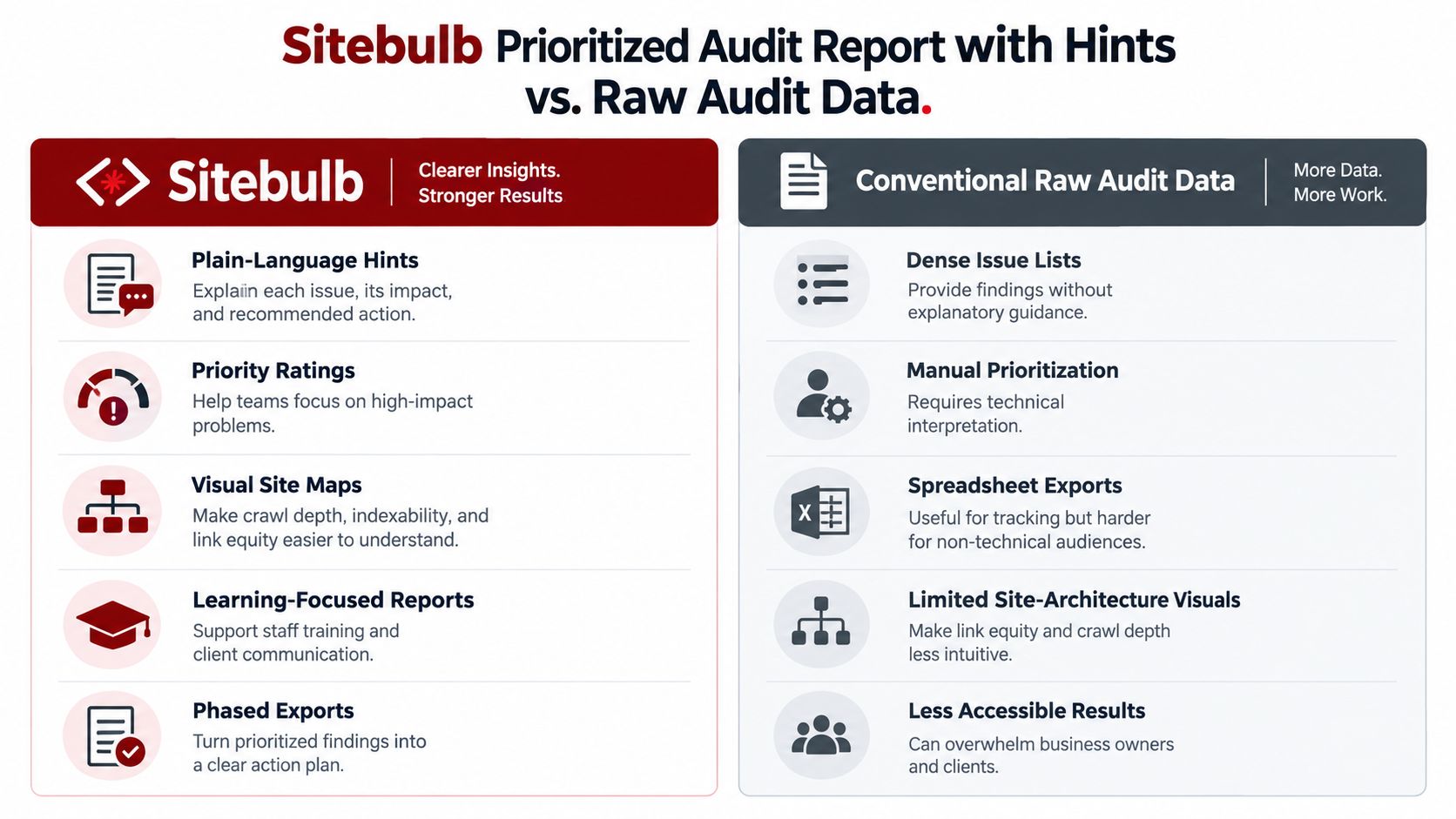
Sitebulb is built for explanation. Each finding comes with a hint describing the problem in plain English, why it matters, and what to do about it, plus a priority rating and visual charts for crawl depth, indexability, and link equity. If you've ever handed a developer a spreadsheet and watched nothing happen, you'll understand why that framing matters.
A Prescott web design team can put the crawl map in front of a client and show exactly why deep service pages receive almost no internal link equity. A Chino Valley contractor can read a hint and understand why an accidental noindex tag on a contact page is urgent, rather than debating severity labels.
Why Does Plain Language Change Whether Fixes Happen
Because implementation is where audits die. Findings that only a specialist can interpret stay in a folder. Findings a business owner can explain to their own developer get scheduled. Sitebulb narrows that gap, which makes it a strong teaching tool for Northern Arizona teams training junior staff or owners who want to understand their own sites.
Sitebulb is also a sensible place to check LocalBusiness structured data as a validation task rather than a ranking promise. Google advises site owners to validate LocalBusiness markup with the Rich Results Test and confirm the page isn't blocked by robots.txt, a noindex directive, or a login. Record whether the markup exists, whether required properties are present, and whether critical errors remain. That keeps the recommendation grounded in how Google reads the page.
Read the hint first: Understand the issue before assigning it.
Use the crawl map live: Explain site architecture in client meetings.
Export by priority: Build a phased plan instead of one long list.
7. Local SEO and Google Business Profile Audit Report
This is the report that decides whether you appear when someone searches plumber near me or roofer Prescott AZ. A local audit reviews Business Profile completeness, primary and secondary categories, name, address, and phone consistency, citations, reviews, service area settings, and local landing pages. Local customers often call straight from search results, so these signals sit closer to revenue than most technical warnings.
Google evaluates local results on relevance, distance, and prominence, and Google's guidance on local ranking factors notes prominence is shaped by links, articles, directories, review count, and review score across the web. That explains a frustrating pattern. Your website can be technically sound and relevant, yet still miss the Map Pack because the profile lacks geographic alignment or authority signals.
What Does a Local Audit Find That a Crawler Cannot
It finds inconsistency. A Prescott Valley HVAC company might have an outdated suite number on its profile that conflicts with its website and several directories. A Dewey-Humboldt landscaper might repeat identical text across city pages instead of writing useful pages for Prescott and Chino Valley. Silva Marketing builds local audits around that service area clarity, and our local SEO audit approach for Northern Arizona businesses covers the full review. Teams comparing methods can also review the CitationOS audit for legal marketers to see how citation checks are structured in another service category.
Match your details exactly: Keep name, address, and phone identical everywhere.
Choose honest categories: Reflect services customers search for.
List only real service areas: Support each one with relevant content.
Respond to reviews: Consistent, professional replies support credibility.
Review quarterly: Treat the audit as an ongoing checklist.
SEO Audit Report Examples: 7-Point Comparison Guide
Audit report | 🔄 Implementation complexity and resources | ⚡ Efficiency | 📊 Expected outcomes | ⭐ Key advantage and 💡 ideal use |
|---|---|---|---|---|
Google Lighthouse Annotated Performance Report | Low; free through PageSpeed Insights or Chrome DevTools; tests one URL at a time | Fast, though scores can vary between runs | Identifies page-speed, accessibility, SEO, and Core Web Vitals issues | ⭐ Plain-language fixes and mobile/desktop results; 💡 best for diagnosing performance on priority pages |
Google Search Console Indexing and Performance Audit Report | Low; free with a verified property; data may lag by days | Efficient for checking Google's indexing and search data, but not real-time | Shows indexing exclusions, search queries, clicks, impressions, and user experience data | ⭐ Uses Google's own site data; 💡 best for investigating indexing and local search visibility |
Screaming Frog SEO Spider Crawl Audit Export | Moderate to high; desktop software and technical familiarity; free up to 500 URLs | ⚡ Crawls hundreds of pages in minutes; large crawls use more memory | Reveals site-wide issues such as broken links, duplicate elements, redirects, and crawl depth | ⭐ Detailed, exportable crawl data; 💡 best for technical reviews of small to large sites |
Semrush Site Audit Health Score Report | Low to moderate; cloud-based, with full features requiring a paid subscription | 🔄 Scheduled audits and alerts support ongoing tracking | Provides a health score, prioritized issue list, and progress history | ⭐ Accessible dashboard and action priorities; 💡 best for marketers and teams managing multiple sites |
Ahrefs Site Audit Report | Moderate; full audit features require a paid plan; limited free tools available for verified sites | Efficient for prioritizing and comparing crawl findings | Identifies technical issues alongside affected-page, backlink, and traffic data | ⭐ Combines crawl and link insights; 💡 best for prioritizing fixes on pages with traffic or backlinks |
Sitebulb Prioritized Audit Report with Hints | Moderate; paid desktop software; crawl size depends on local hardware | 🔄 Priority ratings and exports help organize remediation | Explains issues, their impact, and recommended actions, with visual site maps | ⭐ Strong educational guidance; 💡 best for client communication and training teams |
Local SEO and Google Business Profile Audit Report | Moderate; requires reviewing profiles, citations, reviews, competitors, and location pages | 🔄 Citation cleanup and ongoing reviews can take time | Identifies local visibility, listing accuracy, and service-area content opportunities | ⭐ Focuses on local pack signals and business trust; 💡 best for service-area businesses seeking local customers |
Turn Audit Findings into a Local SEO Roadmap
These seven formats aren't competitors. Lighthouse explains page experience, and Google's Core Web Vitals documentation gives you the measurable thresholds to judge it against instead of a vague instruction to be faster. Search Console confirms what Google indexed and what searchers clicked. Crawler exports expose site-wide patterns, commercial tools prioritize the list, backlink data tells you which pages carry value, Sitebulb makes findings explainable, and the local audit connects all of it to your Business Profile, citations, reviews, and Map Pack visibility.
The missing piece in most reports is revenue. For Prescott and Northern Arizona service businesses, the useful question is which fix is most likely to produce qualified calls. BrightLocal's 2025 local consumer review survey reports that 74% of consumers check at least two review platforms before deciding, 89% are more likely to use a business that responds to all reviews, and 48% would read an AI-generated review summary while still checking individual reviews. A technically clean site can still underperform if reviews, trust signals, and call tracking are neglected.
Does Optimizing for AI Search Require a Separate Strategy
No. Google states its AI features rely on the same foundational, people-first practices as standard Search, as outlined in Google's guidance on AI features in Search. Add an AI-readiness section that checks first-hand expertise, clear service area coverage, and concise answers to real customer questions, but don't accept any claim that a particular schema type guarantees inclusion in AI answers.
Frequently Asked Questions About Choosing a Report
Which report should a small Prescott business request first? Start with Search Console and the local audit. They show whether Google can index your pages and whether nearby customers can find and trust you.
What KPIs belong in the report? Qualified calls, form submissions, booked jobs, call answer rate, and revenue. Rankings and health scores support those numbers, they don't replace them.
How should fixes be ordered? By impact, confidence, and effort, with an owner, a deadline, and a validation method attached to each item. Silva Marketing is one local option if you'd like that roadmap built and explained without pressure, starting with a straightforward review of where your Prescott, Prescott Valley, Chino Valley, or Dewey-Humboldt visibility stands today.
If your current audit lists problems without telling you which ones cost you calls, Silva Marketing can review your website, Google Business Profile, citations, and conversion paths and turn the findings into a prioritized plan. Start with a clear, no-pressure conversation with Silva Marketing to see what your Prescott or Northern Arizona business should fix first.
Comments