
Website Redesign Proposal Template That Closes Deals

A Prescott contractor comparing two website redesign proposals usually isn't asking which PDF looks better. They want to know whether the new site will bring in calls, deliver quote requests to the right person, and preserve the search visibility they've built. A polished design matters, but it can't make up for a broken lead form or missing redirects.
Silva Marketing is a Prescott-based digital marketing agency serving service businesses, contractors, and small and midsize companies across Prescott, Prescott Valley, Chino Valley, and Northern Arizona. A useful website redesign proposal template should make the business case clear, define the work and investment, and answer the questions that matter after launch: how acceptance is tested and who owns the site's ongoing operation.
Table of Contents
Why Local Businesses Need a Smarter Redesign Proposal - Ask what happens after approval
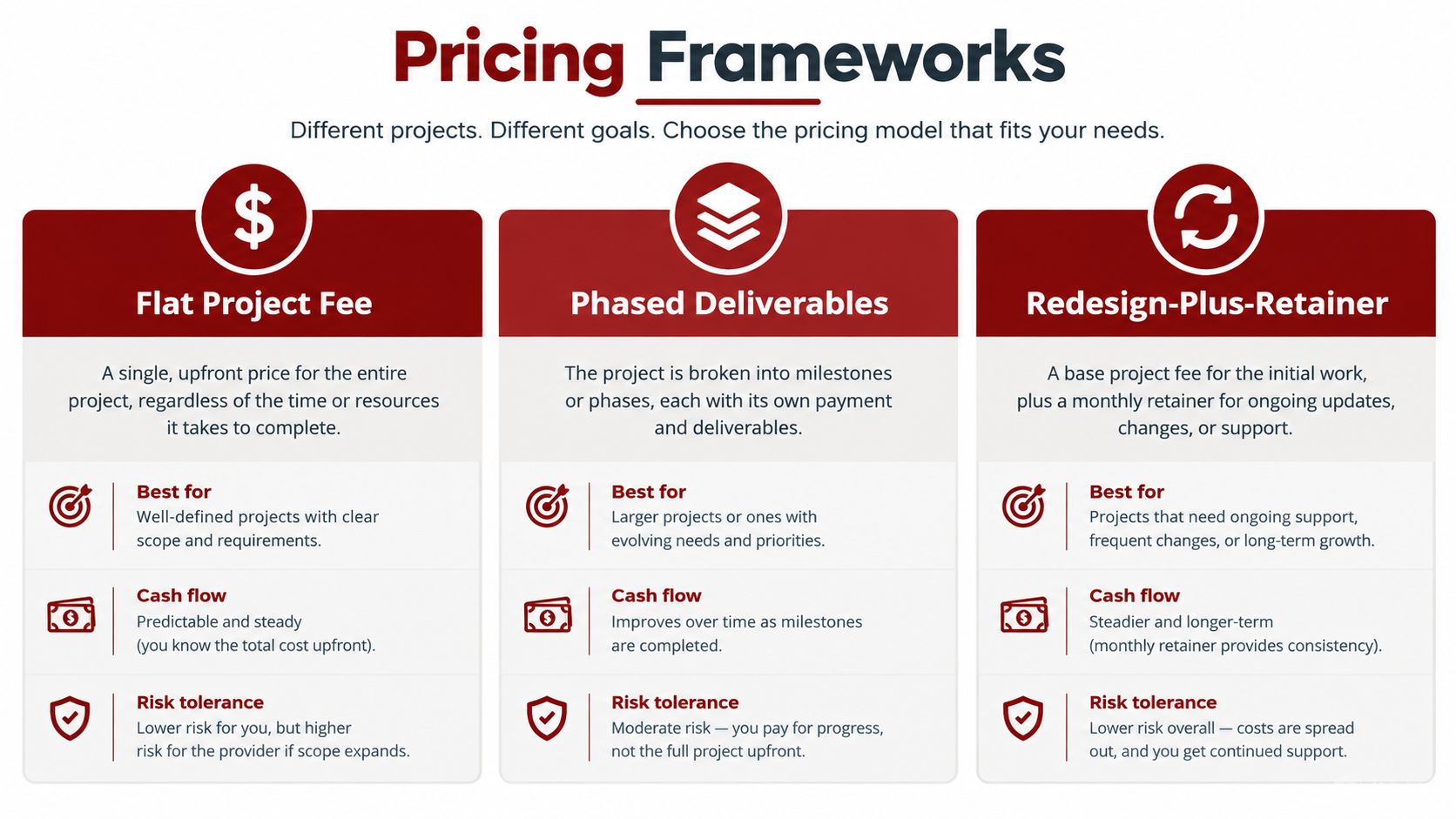
Pricing Frameworks That Match the Engagement - Flat project fee - Phased deliverables - Redesign-plus-retainer
Sample Copy for the Sections Clients Actually Read - Executive summary - Scope and timeline
The Acceptance Scorecard That Protects the Client - Put proof beside each requirement
The 30/60/90 Ownership Plan and Negotiation Tips - Make the first months operational
Client-Ready Checklist Before You Send the Proposal - How long does a local-business redesign take? - What should I have ready before the project starts? - How do I compare two redesign quotes fairly? - What are red flags in a redesign proposal?
Why Local Businesses Need a Smarter Redesign Proposal
Two proposals can describe similar-looking websites and still represent very different projects. One might cover only design and development. The other might include content planning, SEO migration, form testing, accessibility checks, analytics validation, and post-launch support. If the proposals list only page counts, price, and a target launch date, a local business owner can't tell which risks each agency has accounted for.
That matters especially for call-driven businesses. A Prescott contractor may rely on phone calls and quote requests, while a service business serving Prescott Valley or Chino Valley may also need location pages that explain where it works. A redesign that makes those paths harder to find, misroutes inquiries, or drops important URLs can undermine the very outcomes the new site was supposed to support.
Ask what happens after approval
A strong proposal doesn't stop at “the website will be ready.” It spells out how the client will decide the work is acceptable, what evidence the agency will provide, and how defects will be handled. It also makes post-launch responsibilities visible instead of leaving hosting, backups, updates, and support for a later conversation.
That distinction is useful when comparing a low-priced proposal with a more detailed one. A lower quote may be reasonable if the scope is smaller. But if it excludes content migration, redirect mapping, integration checks, or ongoing maintenance, the client should understand those exclusions before signing.
Practical rule: Compare proposals by the business risks they cover, not just by the number at the bottom.
Silva Marketing built its approach around the needs of local service firms that depend on qualified leads, not merely a visual refresh. The aim is to help a Prescott-area business owner see what's included, what's not, and what must be proven before launch. That clarity can prevent a familiar project problem: everyone agrees the site looks finished, but no one has confirmed that the forms, tracking, and search-critical pages work as intended.
The Eight Sections Every Proposal Must Include
A proposal should read in the order a client needs information: first the outcome, then the work and investment, and finally the controls that govern delivery and approval. For an owner reviewing a document between jobs on a phone, a clear summary and price shouldn't be buried beneath technical detail.
Section | Purpose | What to Include |
|---|---|---|
Executive summary | State the recommendation quickly. | Business context, primary goals, approach, investment summary |
Problem statement | Explain why the current site needs work. | Pain points, customer needs, business constraints |
Proposed solution | Describe the strategy behind the redesign. | User journeys, content structure, design and technical approach |
Scope of work | Set the boundaries of the engagement. | Research, design, development, SEO, migration, testing |
Deliverables and exclusions | Make the handoff tangible. | Files, page templates, content responsibilities, excluded tasks |
Timeline and milestones | Show how decisions and work are sequenced. | Discovery, reviews, build, QA, client approvals, launch |
Pricing and payment terms | Clarify the commercial agreement. | Fee structure, payment schedule, optional work, change-order process |
Acceptance criteria | Define what “ready” means. | Tests, evidence, approvers, defect handling, launch conditions |
The executive summary should name the client's business problem and the intended outcome. The problem statement should distinguish symptoms, such as low-quality inquiries, from the underlying issue, such as unclear service information or a difficult contact path. The proposed solution explains how the strategy addresses that problem rather than promising a generic modern look.
The scope describes the work; deliverables and exclusions tell the client what they'll receive and what remains their responsibility. The timeline shows decision points as well as build phases, so client feedback and content aren't treated as invisible dependencies. The pricing section connects fees to scope, while acceptance criteria establish how both sides will confirm the site is ready.
For a related example of structuring a service-business plan, AurenWell's cleaning business plan help offers context on presenting a business clearly. For redesigns, a visual website design mockup can also help clients discuss layout and user flow before development begins.
Pricing Frameworks That Match the Engagement
There isn't one pricing structure that fits every redesign. The right model depends on how clearly the work is defined, how much budget flexibility the client needs, and whether the business wants help beyond launch. A proposal should explain that logic instead of presenting a fee without context.
Flat project fee
A flat fee works well when the site's requirements are stable and the client can agree on the scope before work begins. A Prescott contractor with a clear service offering, known page requirements, and a straightforward lead-generation goal may prefer a defined project fee because it makes the investment easier to assess.
The trade-off is that unclear requirements don't disappear just because the proposal has a fixed price. If integrations, content writing, or migration work are uncertain, the agreement needs assumptions and a change-order process. Otherwise, the agency may absorb unplanned work or the client may face unexpected charges.
Phased deliverables
Phased pricing separates work into agreed stages, such as discovery, design, build, and launch. It can suit a multi-location business that wants to make decisions as the information architecture and content needs become clearer. The client can review progress and manage cash flow by stage, while both parties can address new requirements through an explicit decision rather than expanding scope.
This model requires careful handoffs. Each phase should say what must be approved before the next begins and whether a change affects the budget or schedule.
Redesign-plus-retainer
A redesign paired with ongoing support can suit an established business that expects to keep improving content, SEO, or conversion paths after launch. The proposal should separate one-time redesign work from recurring services, so the client can see what each fee covers and can choose ongoing work based on need.
A lower initial commitment isn't automatically the lower-risk option if no one has agreed who will maintain the site afterward.
For a closer look at the factors that shape project investment, see Silva Marketing's guide to website redesign cost. Choose the model that fits the actual uncertainty and ongoing workload, not the one that makes the first quote appear smaller.
Sample Copy for the Sections Clients Actually Read
Clients often skim proposals for four answers: what will change, what the agency will do, when decisions are needed, and what the project costs. Sample copy should answer those questions plainly. The language below uses a fictional Prescott contractor serving Prescott and Prescott Valley. Adapt it to a real business only after confirming its services and coverage.
Executive summary
“Your current website makes it difficult for homeowners to distinguish your core services and request an estimate. We recommend restructuring the service pages, clarifying the contact path, and rebuilding the site around mobile use. The project includes design, development, content planning, search migration, and launch testing. The proposed investment and exclusions appear in the pricing and scope sections.”
This wording ties the redesign to a business problem without promising a particular result. It also signals that SEO migration and testing are planned work, not last-minute extras.
Scope and timeline
“The project includes an agreed page inventory, page layouts, development, and form integration with the client's selected email or CRM system. The client will provide approved brand assets and service-area details. Copywriting, photography, and third-party integration fees are included only where listed in the deliverables.”
Then set review expectations directly:
“The client may request revisions within the review rounds described in the schedule. New page types, functionality, or integration requirements will be reviewed through a written change order before work begins.”
A timeline sample might read:
“Discovery begins after access and project materials are received. Design review, content approval, development, and quality assurance follow in sequence. The launch date depends on timely client feedback, approved content, and access to required third-party accounts.”
That last sentence protects both sides. It makes dependencies visible without blaming the client for delays that haven't happened. If the project involves estimating workflows or industry-specific tools, a resource such as Exayard concrete estimating software can help a contractor assess what operational details may need to connect with the website.
The Acceptance Scorecard That Protects the Client
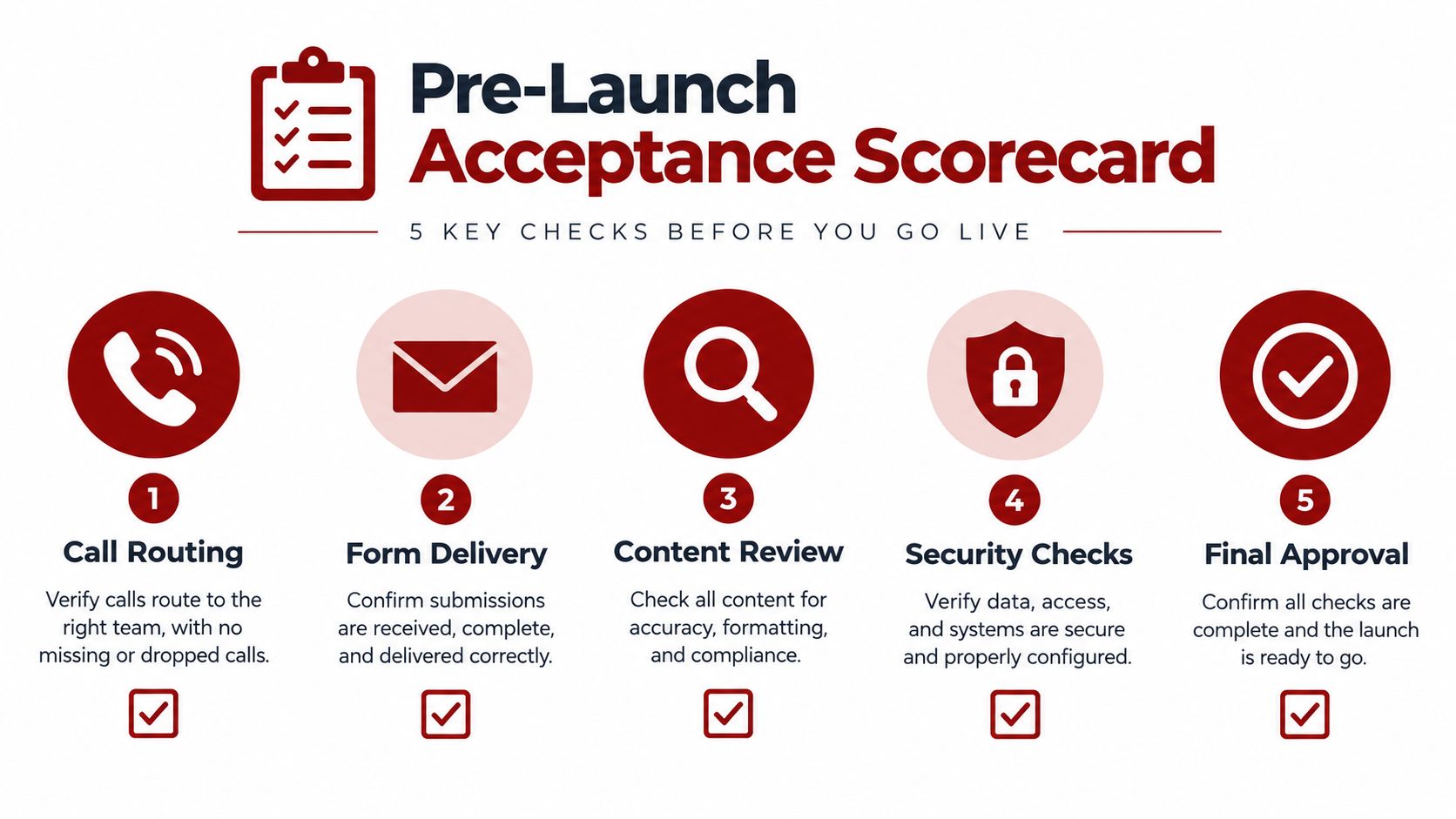
A launch date is not proof that a redesign is ready. The site may be live while calls go to the wrong number, forms disappear into an unmonitored inbox, or important search pages return errors. For call-driven businesses in Prescott and Northern Arizona, acceptance should mean that key business functions have been tested and the results recorded.
Put proof beside each requirement
Copy this scorecard into the proposal and assign a tester, evidence, and a defect path to every item:
Test | Who tests it | Evidence of acceptance |
|---|---|---|
Phone-call routing | Client and agency | Test call reaches the intended team or tracking destination |
Form and CRM or email delivery | Agency, confirmed by client | Test submission arrives at the correct destination and is recorded |
Analytics events | Agency | Test conversions appear in the agreed analytics setup |
Mobile and desktop performance | Agency | Core Web Vitals and page checks are reviewed on representative templates |
Redirects and search checks | Agency | URL mapping is validated, priority redirects work, and crawl/indexation checks are reviewed |
Accessibility | Agency, with user testing where scoped | Keyboard use, contrast, labels, focus, and declared WCAG target are checked |
Business Profile consistency | Client and agency | Website business details are compared with the verified Google Business Profile |
W3C's accessibility guidance describes testable success criteria and recommends usability testing with people who understand how users with different disabilities interact with the web. A proposal can name a target such as WCAG 2.2 Level AA, specify the tests, and say how defects will be recorded and fixed. The level matters because AA conformance requires meeting all Level A and AA criteria. See the W3C introduction to WCAG understanding for the standard's testing principles.
The acceptance process should also state what happens when a check fails: the team records the issue and its severity, assigns an owner, fixes it, and repeats the test before approval. For practical agency selection questions, Silva Marketing's guide on how to choose a web design agency can help clients evaluate the proposed process as well as the portfolio.
The 30/60/90 Ownership Plan and Negotiation Tips
A signed proposal should say who controls the site after launch. The ownership matrix needs to identify responsibility for the domain, hosting, CMS, analytics, ad accounts, Google Business Profile, content, credentials, and backups. If the client can't tell who can access an account or who responds when a form stops working, the handoff is incomplete.

Make the first months operational
A written operating plan can set a useful rhythm without implying that every business needs the same maintenance package:
First month: Monitor the launch, review forms and call paths, resolve agreed launch defects, and confirm backups and access.
Second month: Review conversion paths and analytics events, then prioritize practical adjustments based on observed customer behavior.
Third month: Hold a growth review, document recommendations, and agree whether further SEO, content, advertising, or development work is needed.
The exact work and support response expectations belong in the agreement. So do recurring costs, maintenance tasks, incident responsibilities, and the process for handing over credentials or ending support. A redesign fee and an ongoing operating fee serve different purposes; keep them separate so the client can make an informed decision.
For negotiations, anchor each discussion in scope and responsibility. If a client asks for additional functionality, explain the effect on work and schedule, then document options in a change order. Set revision limits that allow meaningful feedback while clarifying that new direction or new deliverables may change the scope.
The video below offers another visual point of reference for discussing ownership and project planning.
Don't use post-launch support as pressure to keep a client. Explain what the agency can maintain, what the client can own, and how a clean handoff works. A confident proposal makes the choice clear without making independence difficult.
Client-Ready Checklist Before You Send the Proposal
Run this final check before sending the document. It should look professional, but a client should be able to understand the work, approve it, and know what happens next.
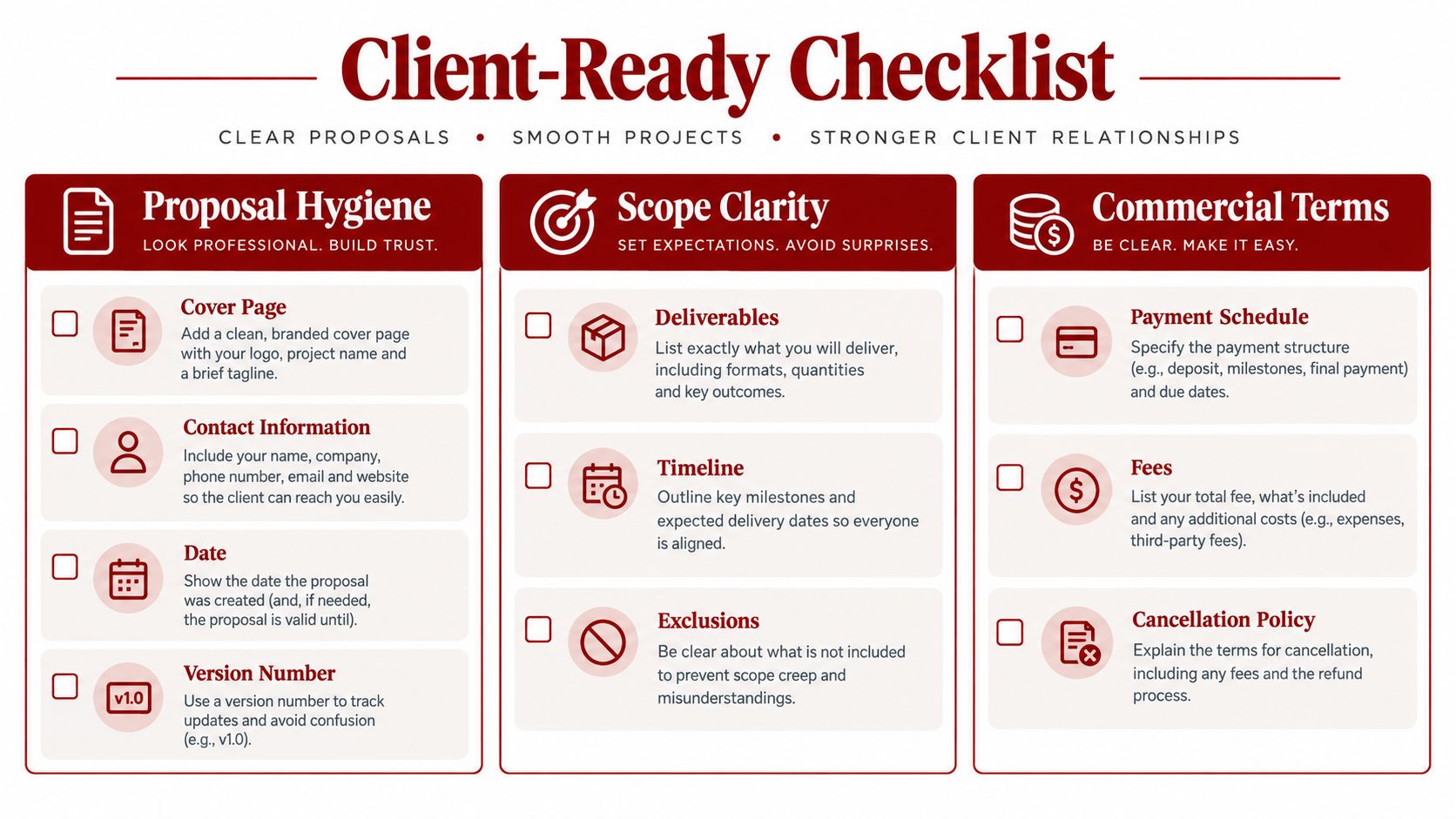
Proposal hygiene: Confirm the cover page, client and agency contact details, date, and version number.
Scope clarity: List deliverables, exclusions, assumptions, client responsibilities, and approval milestones.
Commercial clarity: State the price, payment schedule, optional work, and change-order process.
Post-launch clarity: Include the ownership matrix, support terms, and the 30/60/90-day plan.
Acceptance: Name each test, its owner, acceptable evidence, and how defects will be resolved.
A client preparing a formal project document may find it useful to browse Word to PDF tool options for sharing a consistent final file. The format doesn't replace clear terms, but it can make the proposal easier to distribute and review.
How long does a local-business redesign take?
The schedule depends on scope, approvals, content readiness, and integrations. Ask the agency to show milestones and client review windows rather than relying on a single launch date.
What should I have ready before the project starts?
Gather your logo and brand assets, current content, service-area details, and access to your Google Business Profile and relevant website or analytics accounts. Tell the agency what you have and what still needs to be created.
How do I compare two redesign quotes fairly?
Compare scope, exclusions, migration and testing responsibilities, acceptance criteria, payment terms, and post-launch ownership. A lower fee may reflect less work, so ask what each proposal leaves out.
What are red flags in a redesign proposal?
Watch for vague deliverables, no named exclusions, no redirect or lead-routing checks, unclear account ownership, and no process for defects or scope changes. Promises about appearance alone don't establish that the site will work for customers.
For Prescott Valley, a dedicated local page can be more useful than folding the community into a generic Northern Arizona label. The U.S. Census Bureau's QuickFacts lists the town's estimated population as 52,423 as of July 1, 2025 (Census Bureau QuickFacts). That's a planning input, not proof of demand or ranking potential; any location page should offer accurate, original service-area information.
A redesign also needs to preserve the connection between the website and the business's local identity. Google identifies relevance, distance, and prominence as primary local ranking factors in its Business Profile guidance. Its LocalBusiness structured data documentation explains how businesses can describe details such as hours and location in a standardized format, while its business details guidance covers managing information through a verified Business Profile. A proposal can make consistency and structured-data checks explicit without promising rankings.
For a complete proposal, use Silva Marketing's guidance on website redesign and SEO to keep search considerations connected to the rebuild.
Silva Marketing plans and builds custom website redesigns, SEO, and Google Ads for service businesses that need clearer paths from search to calls and qualified inquiries. If you're comparing proposals in Prescott or Northern Arizona, visit Silva Marketing to discuss your scope, acceptance checks, and post-launch ownership plan.
Comments