
Google Ads Cost: A Practical Prescott Guide for 2026

Google Ads averaged approximately $5.26 per click in 2025, while a separate national benchmark put average cost per lead at $70.11, useful starting points for planning a 2026 Prescott campaign, not guaranteed local prices. Your actual Google Ads cost depends on competition, relevance, and conversion performance, not the bid you enter.
You're running a roofing, HVAC, or electrical business, and an advertising proposal lands in your inbox. Before you approve it, you need to know how much goes to Google, what counts as a lead, and whether those inquiries can turn into profitable jobs.
Prescott-based Silva Marketing helps local service businesses turn advertising traffic into customers through Google Ads management and conversion-focused websites. For contractors serving Prescott, Prescott Valley, Chino Valley, and Dewey-Humboldt, the problem isn't just getting clicks. It's connecting advertising spend to qualified calls and completed work.
Table of Contents
What Google Ads Cost Looks Like for Prescott Businesses Right Now - Is a contractor's monthly advertising quote reasonable?
How the Google Ads Auction Sets the Price You Actually Pay - What actually determines your ad's position? - Does an impression mean you paid for a click?
CPC, CPM, and CPA Bidding Models Compared - Should you use manual or automated bidding? - Why does Google Ads terminology feel inconsistent?
Northern Arizona CPC and Cost Per Lead Benchmarks - Why can nearby service areas perform differently? - How often should you revisit your benchmark?
Sample Monthly Budgets and Expected Lead Volume - What changes when the landing page converts better? - Which budget approach fits your business? - Can Google spend more than my daily budget?
Why a Higher CPL Can Still Be a Win for Prescott Service Businesses - Which acquisition costs should you track? - Will automated campaigns lower my customer acquisition cost?
Practical Moves That Actually Lower Your Cost Per Lead - What should you fix first? - How should geography and scheduling work? - What should happen after the call?
How Silva Marketing Plans and Optimizes Prescott Campaigns - What should campaign planning include? - How should you compare management proposals?
What Google Ads Cost Looks Like for Prescott Businesses Right Now
There isn't a fixed Prescott price list for Google Ads. Google runs an auction for each search, and the results change with competition, location, device, intent, and other contextual factors, as explained in Google's overview of how the advertising auction works.
That matters when you're comparing proposals. A contractor advertising a tightly defined service in Prescott isn't buying the same opportunity as a business promoting several services across Northern Arizona.
My recommendation is straightforward: don't accept a monthly budget without a lead forecast and a clear definition of “qualified.” Ask the strategist to explain the assumptions behind the forecast, including expected click costs, landing-page performance, service-area coverage, and how inquiries will be evaluated.
Is a contractor's monthly advertising quote reasonable?
It can be, but the total alone doesn't tell you enough. You need to separate the money spent delivering ads from the money spent managing the campaign and supporting the customer journey.
Ask for a written breakdown:
Media spend is the budget allocated to Google's advertising auctions.
Management covers campaign planning, setup, monitoring, optimization, and reporting.
Website or landing-page work covers the destination where visitors decide whether to call.
Tracking connects inquiries to advertising activity and helps distinguish useful leads from irrelevant ones.
A proposal that combines everything into an unexplained total makes accountability harder. You should be able to tell whether the proposed investment buys advertising reach, professional execution, or both.
Budget rule: Approve the assumptions behind the forecast, not just the monthly total.
For a Prescott contractor, service coverage belongs in that discussion from the start. If your crews won't travel beyond your normal operating area, the campaign shouldn't pursue those inquiries merely because they're available.
The right starting budget supports a focused test you can afford to evaluate. It shouldn't depend on filling your calendar with every possible search across Yavapai County.
How the Google Ads Auction Sets the Price You Actually Pay
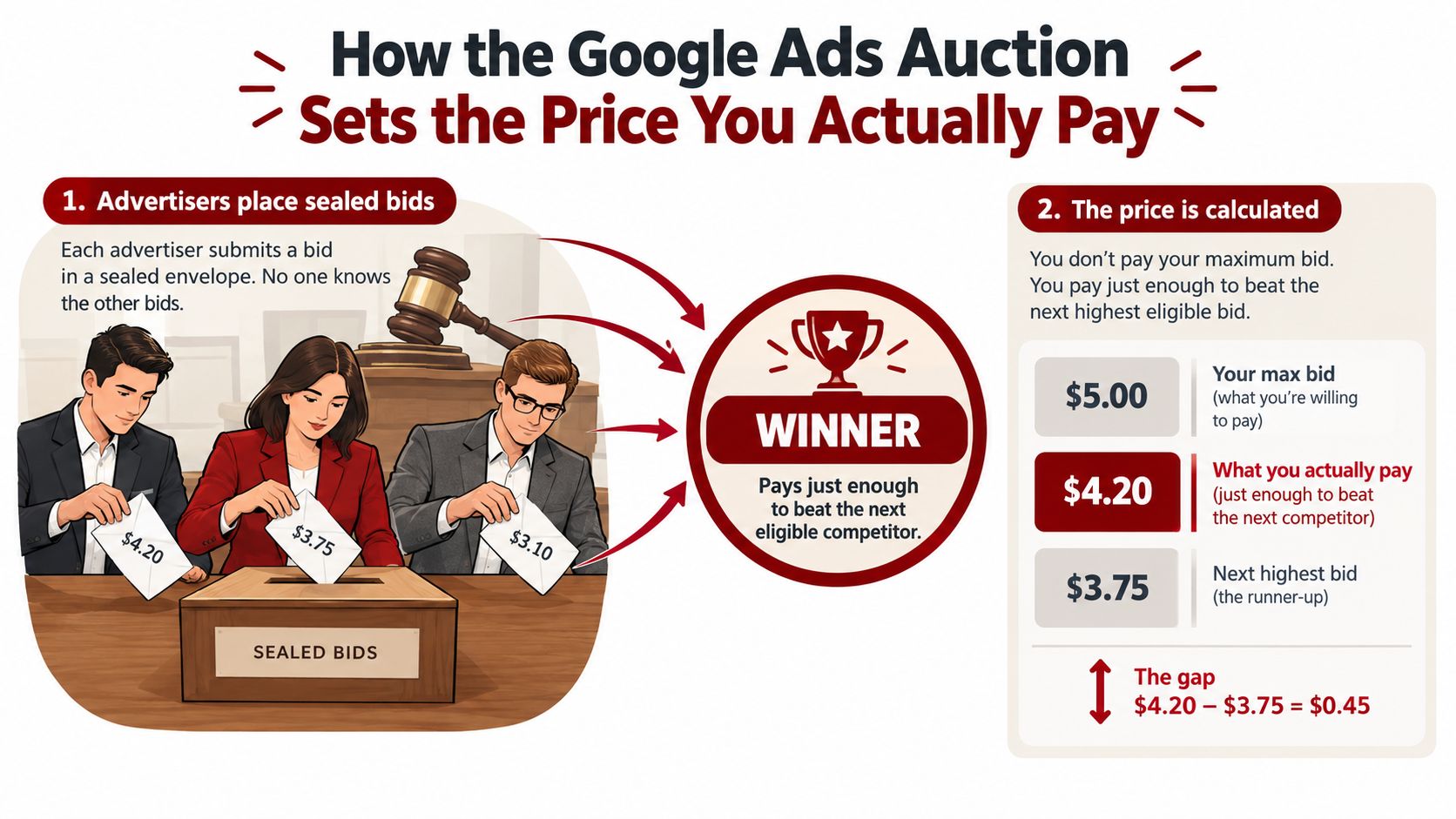
Your maximum CPC bid isn't automatically your click charge. Google generally charges the minimum needed to clear the applicable Ad Rank thresholds and beat the next eligible competitor, with reserve-price considerations when relevant, according to Google's explanation of actual cost per click.
Think of a sealed-bid auction, but with an important difference: Google doesn't rank advertisers by money alone. It also evaluates whether the advertisement is useful for that particular search.
The illustration below separates the amount you're willing to bid from the amount the auction determines.
What actually determines your ad's position?
Google considers the bid, auction-time quality, minimum thresholds, competition, search context, and expected impact of ad assets. Its Quality Score is a 1–10 diagnostic, based on expected click-through rate, ad relevance, and landing-page experience, but the score itself isn't a direct auction input, as described in Google's Ad Rank documentation.
That distinction prevents an expensive misunderstanding. You're not purchasing a position by raising a dashboard score, and a higher bid doesn't guarantee a better outcome.
For a Prescott HVAC company, the practical work is matching the search, advertisement, and destination. An ad about heating repair should take the visitor to a page that clearly addresses heating repair, rather than making them hunt through a general services website.
Match the message to the service the customer needs.
Make the destination useful with clear service details and an obvious contact action.
Use relevant assets that help the searcher understand the business and take the next step.
The guide to Google Ads Quality Score provides a useful follow-up for reviewing that alignment.
Does an impression mean you paid for a click?
No. Visibility and clicking are different events, and you should keep them separate when discussing campaign performance.
If a proposal emphasizes exposure, Otter A/B's explanation of what impressions mean in marketing is a useful terminology resource. For a lead-generation campaign, I'd still ask what happened after the customer saw the ad.
CPC, CPM, and CPA Bidding Models Compared
For a contractor seeking calls, start with the business outcome and choose the bidding approach around it. Don't select a strategy because it sounds complex or because another business uses it.
CPC describes click-based pricing. CPM describes impression-based pricing, while CPA describes acquisition cost and, in target CPA bidding, the outcome the bidding strategy aims to achieve.
The distinction between a billing model and a bidding objective matters. A target CPA should be treated as a performance target, not a promise that you'll only ever pay for a successful customer.
Google Ads Bidding Models for Local Service Businesses
Pricing Model | When to Use It | Typical Prescott Service Business Fit |
|---|---|---|
CPC | When evaluating traffic intended to generate inquiries | A plumber advertising a specific repair service |
CPM | When exposure is the primary objective | A contractor introducing a brand or service offering |
CPA or target CPA | When acquisition measurement is reliable enough to guide decisions | A service business optimizing toward meaningful tracked inquiries |
Should you use manual or automated bidding?
Use manual bidding when direct bid control is important to the campaign plan. Consider automated bidding when the account has a clearly defined objective and dependable measurement.
With manual CPC, advertisers can set bids at the ad-group level and assign individual keyword or placement bids where needed. Automated strategies can bid on the advertiser's behalf toward clicks or conversions within the campaign budget, according to Google's explanation of CPC bidding controls.
Neither approach removes the need for supervision. If your conversion settings treat every form submission as valuable, you haven't given the campaign a useful business standard.
Choose bidding around the result you can verify, not the result that looks easiest to report.
Why does Google Ads terminology feel inconsistent?
The platform evolved from exposure-based advertising into click-based auctions. Google launched AdWords in October 2000 with approximately 350 advertisers, then announced AdWords Select's CPC transition on February 20, 2002, as documented in this history of Google AdWords pricing.
For your proposal, the useful question is simpler than the history: what are we paying for, and what are we optimizing toward?
Northern Arizona CPC and Cost Per Lead Benchmarks
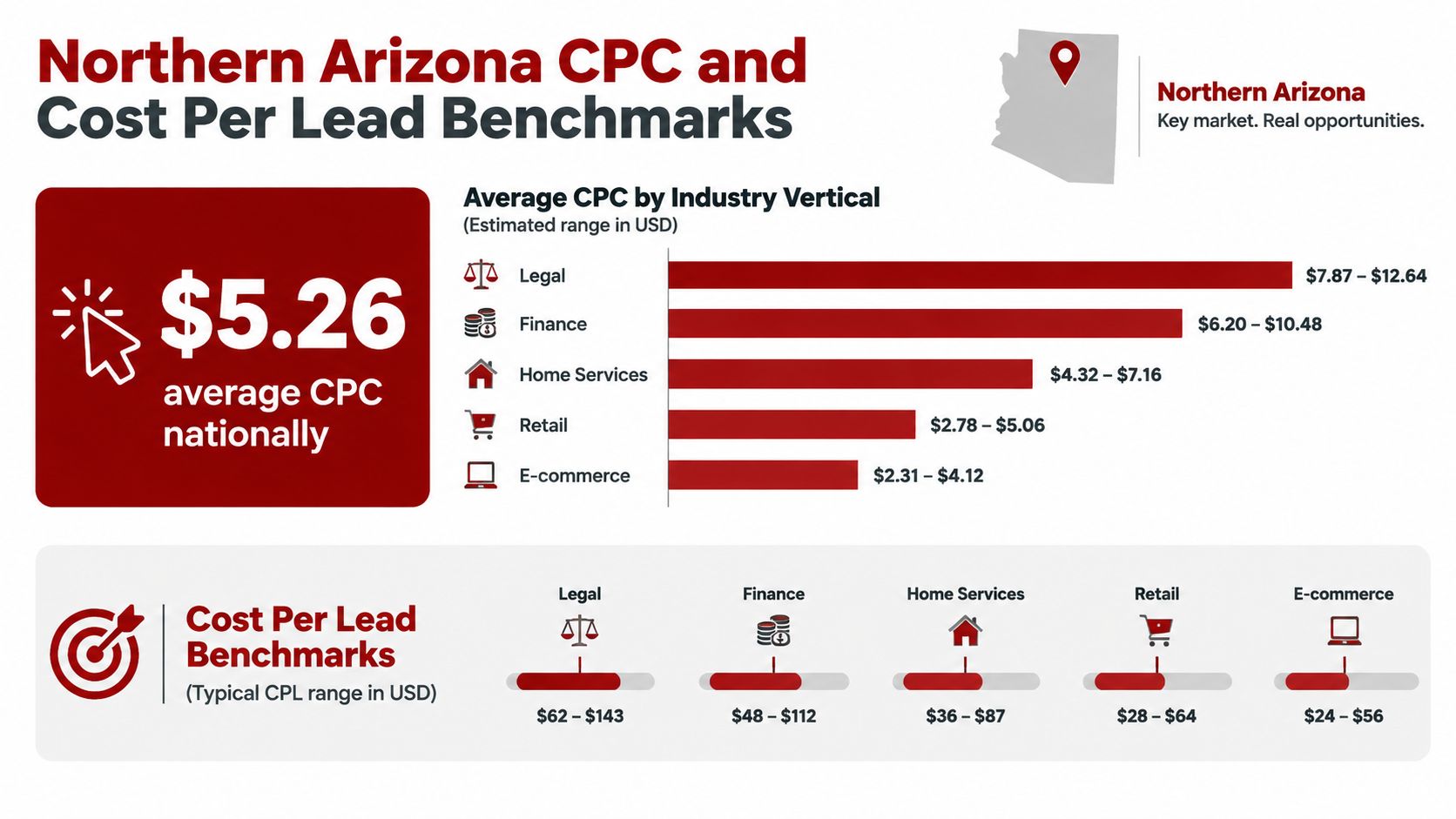
Use national benchmarks as a reference, then build your Prescott forecast from local campaign evidence. There isn't a verified local dataset here that supports a universal Prescott discount relative to Phoenix or an industry-by-industry Northern Arizona price range.
The national average CPC reached approximately $5.26 in 2025, compared with $4.66 in 2024, and legal services averaged about $8.58, according to Search Engine Land's coverage of rising Google Ads costs.
Those figures establish context. They don't tell an electrician in Chino Valley what a qualified service call will cost.
Business category | What the benchmark supports | How to use it locally |
|---|---|---|
Cross-industry search | A national reference point | Compare against actual search-term performance |
Legal services | Higher click costs in the cited dataset | Don't transfer legal pricing to a contractor account |
Home improvement and finance | Higher-cost categories qualitatively | Forecast around the specific service and customer value |
Prescott-area contractors | No verified category-specific local range | Use account results and qualified-lead records |
Treat the visual below as directional context, not a verified local rate card. Any local or category-specific estimates shown need validation before they become budget assumptions.
Why can nearby service areas perform differently?
A useful local forecast separates Prescott from surrounding service areas rather than assuming every location produces equally valuable work. Review geography alongside the search term, device, timing, and actual inquiry outcome.
I'd also include your operating constraints. A job that's attractive inside your normal route may be less attractive when it requires extra travel or falls outside your preferred service mix.
For electrical contractors, HomeProBadge's guide to how electricians win more jobs offers a related marketing resource. Keep your advertising forecast tied to your own service economics rather than another trade's averages.
How often should you revisit your benchmark?
Review it quarterly, and investigate sooner when lead quality or service demand changes. Compare qualified inquiries and booked work, not just a blended account CPC.
A lower average click price isn't useful if the campaign starts attracting searches for services you don't provide. Local relevance should remain the standard throughout Northern Arizona coverage.
Sample Monthly Budgets and Expected Lead Volume
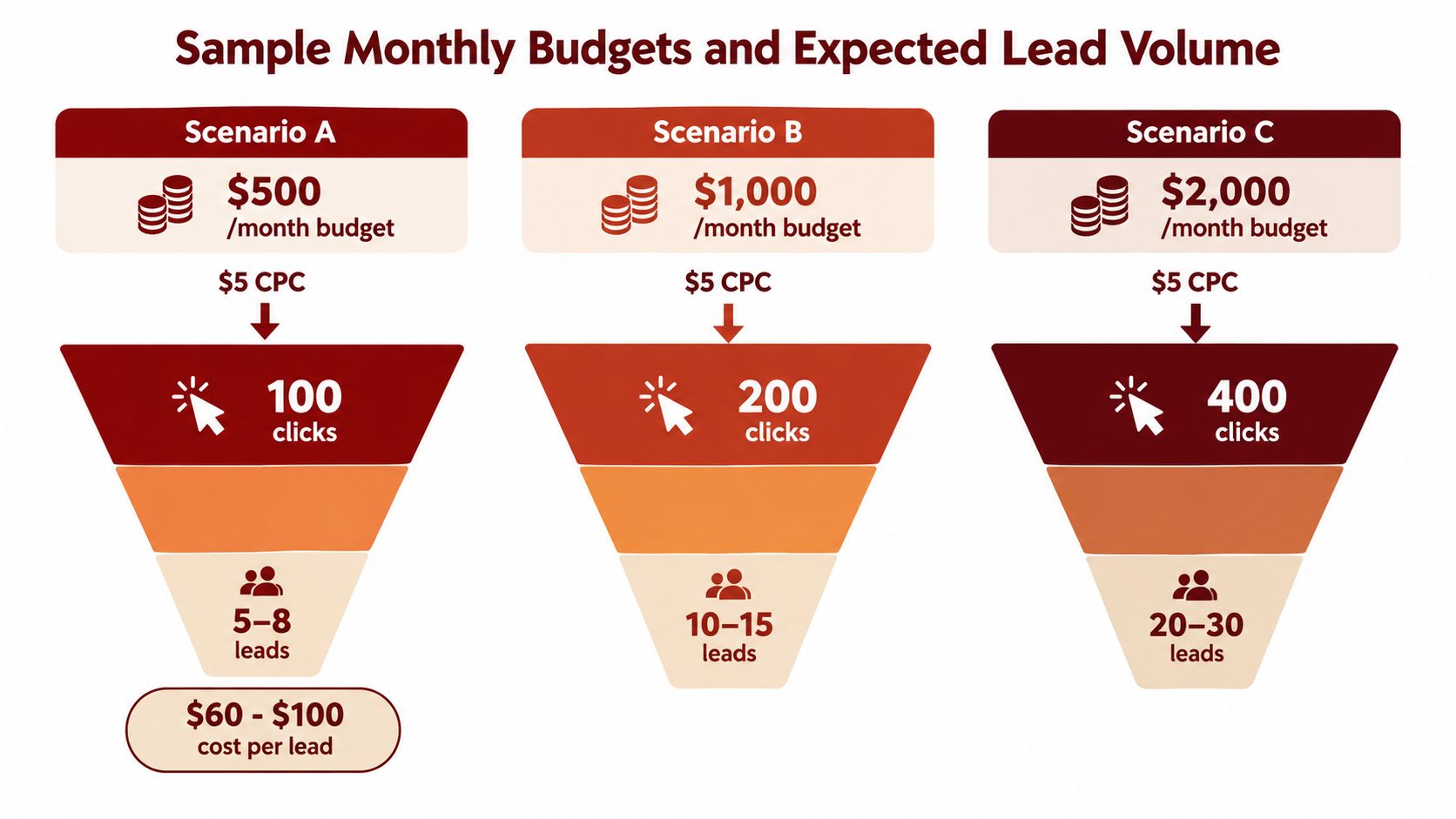
A useful budget forecast shows its math and labels its assumptions. It doesn't present projected inquiries as guaranteed qualified calls.
The basic relationships are straightforward:
Expected clicks equal media budget divided by average CPC.
Expected inquiries equal clicks multiplied by conversion rate.
Estimated media CPL equals media spend divided by inquiries.
These are planning equations, not promises. They describe what could happen under the stated assumptions, before you evaluate whether the inquiries are serviceable and commercially useful.
The budget visual illustrates that relationship. Its preset scenarios are hypothetical illustrations, not verified Prescott results or established local minimum budgets.
What changes when the landing page converts better?
The same spend can produce more inquiries without requiring cheaper clicks. In the planning example accompanying the earlier national cost analysis, the operational priority is to verify conversion measurement before relying on projected lead volume.
For the previously cited national planning calculation, a media budget can generate very different outcomes when conversion performance improves. The important takeaway isn't a promised result for Prescott, it's that landing-page effectiveness deserves as much attention as bid adjustments.
A visitor should understand the service, recognize that you cover their location, and know exactly how to contact you. If the advertisement promises a specific repair but the page leads with unrelated services, fix that mismatch before increasing spend.
Which budget approach fits your business?
Budget approach | Recommended scope | What to evaluate |
|---|---|---|
Focused test | A priority service in a tightly defined area | Whether searches produce useful inquiries |
Steady lead generation | Proven services within normal coverage | Qualified-lead consistency and sales follow-through |
Expansion | Additional services or locations | Whether incremental work remains profitable |
Don't spread a limited budget across every service your company offers. Start where demand, job value, and your ability to fulfill the work align.
The video below is a companion resource for considering campaign setup and lead generation.
Can Google spend more than my daily budget?
Yes. Google says spending can reach twice the average daily budget, with the monthly charging limit generally calculated using 30.4; its example of $50 daily allows $100 on an individual day and generally $1,520 monthly, as explained in Google's daily-budget and monthly-limit guidance.
Plan cash flow around those mechanics, not an assumed hard daily ceiling.
Why a Higher CPL Can Still Be a Win for Prescott Service Businesses
A higher cost per lead can be acceptable when those leads produce more profitable customers. Comparing CPL without considering qualification and close rate is an incomplete business decision.
The national benchmark analyzed 16,446 U.S. search campaigns and reported average CPL of $70.11, but the customer-economics example uses $1,500 gross profit per completed job and a 30% qualified-lead close rate to calculate theoretical break-even CPL of $450, as summarized in Search Engine Land's search-advertising benchmark analysis.
That's a planning example, not a Prescott roofer's documented result. Its value is the method:
Theoretical break-even CPL = average gross profit per customer × qualified-lead close rate.
Your operating target should sit below theoretical break-even. Leave room for management expenses, overhead, uncertainty, and the profit you intend to retain.
Which acquisition costs should you track?
Track the customer journey at distinct stages. Otherwise, a low-cost inquiry can look successful even when it never becomes a viable job.
Metric | What it measures | Business question |
|---|---|---|
Cost per platform conversion | Spend relative to recorded conversion events | Did the campaign produce the measured action? |
Cost per qualified lead | Spend relative to legitimate, serviceable inquiries | Did prospective customers actually contact us? |
Cost per acquired customer | Spend relative to customers won | Did we acquire work at an acceptable cost? |
Keep the cost basis consistent when comparing these figures. Media-only reporting and fully loaded acquisition reporting answer different questions.
Will automated campaigns lower my customer acquisition cost?
Not necessarily. Automation can optimize toward the events you provide, so the quality of those events matters.
Google reported an average 26% year-over-year increase in conversions per dollar for Demand Gen advertisers using purchase and lead goals, but that's an average, not a guarantee of profitable local jobs, according to Google's Marketing Live update.
For local services, I recommend feeding back qualified calls, booked work, and relevant revenue values where practical. Don't treat a duplicate form, job-seeker inquiry, or out-of-area call as equivalent to a customer you can serve.
Practical Moves That Actually Lower Your Cost Per Lead
Fix wasted traffic and conversion friction before asking for more budget. A campaign that attracts the wrong searches won't become well targeted because you spend more.
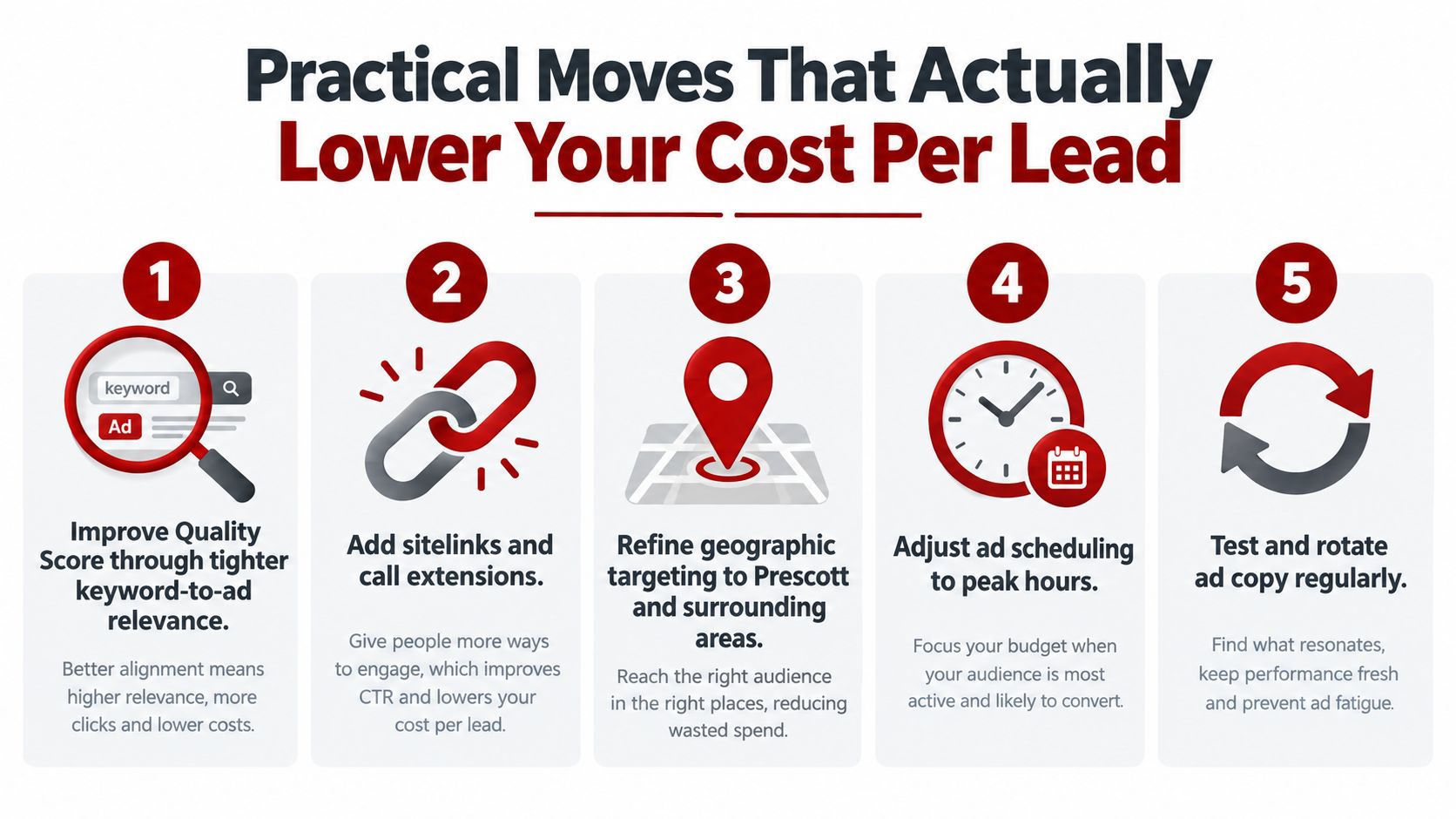
The priorities below are recommendations for auditing a local account, not guaranteed performance lifts. Apply them according to the bidding strategy, service coverage, and actual search results.
The visual provides a quick checklist, while the operating details determine whether each change makes sense.
What should you fix first?
Review search intent. Inspect the queries behind the clicks. Add appropriate negatives for employment, training, DIY, or unrelated services, using the Google Ads negative keywords guide as a practical reference.
Tighten service alignment. Keep keywords, ad copy, and landing-page content focused on the same customer need. Review the underlying relevance issues rather than chasing a diagnostic score.
Make contacting you easy. Use relevant sitelinks and call assets, then check that the destination supports the action the ad invites.
I wouldn't tighten every broad-match keyword automatically. Review the traffic first, then test phrase and exact match where they provide useful control without cutting off valuable searches.
How should geography and scheduling work?
Prioritize the areas your crews can serve profitably. Prescott, Prescott Valley, Chino Valley, and Dewey-Humboldt should be deliberate targeting decisions, not an accidental radius around an address.
Review geography by outcome. Evaluate serviceability, booked work, and travel requirements before making adjustments.
Match scheduling to response capacity. If you can't answer calls during certain periods, decide whether an alternative response process justifies advertising then.
Check strategy compatibility. Don't assume every manual bid adjustment operates the same way under automated bidding.
What should happen after the call?
Record qualification outcomes consistently. If you use call recording, handle consent and privacy appropriately, and keep the review focused on whether the inquiry represents work you can accept.
For landing pages, choose a primary conversion action and make it obvious. Avoid competing offers and unnecessary navigation that distract from the service the customer searched for.
More traffic should follow a cleaner customer journey, not substitute for one.
How Silva Marketing Plans and Optimizes Prescott Campaigns
Silva Marketing's local-first process connects campaign decisions to business outcomes through analysis, implementation, and ongoing authority building. The useful measure is whether a contractor can identify the inquiries and customers produced by the investment.
The agency offers Google Ads, custom websites, website redesign, and SEO. For a Prescott service business, those capabilities belong in one practical discussion: can customers find you, understand what you offer, and contact you confidently?
What should campaign planning include?
Analyze and strategize. Review service priorities, coverage, customer economics, current traffic, and measurement gaps.
Initiate the plan with proven tools. Launch a clear campaign structure with relevant destinations and dependable conversion tracking.
Build market authority. Improve the supporting website and search presence while evaluating advertising against qualified inquiries and booked jobs.
A website count or revenue-influence claim doesn't replace a campaign forecast. Ask for an explanation of the proposed scope, reporting standards, and how your business will participate in lead qualification.
How should you compare management proposals?
Separate advertising spend from professional services, and confirm what setup, optimization, tracking, and reporting include. The Google Ads management pricing guide is a useful starting point for that conversation.
Lead handling deserves attention too. The Voicedial.ai lead response playbook is an adjacent resource to consider when reviewing response processes, though its insurance context shouldn't be mistaken for contractor-specific evidence.
Consistent service-area information and a clear response process help keep the advertising promise aligned with actual operations. That's the standard I'd use for a Prescott campaign: transparent costs, useful inquiries, and an honest connection to completed work.
Silva Marketing offers Google Ads management and conversion-focused website services for Prescott-area businesses seeking more qualified calls. Visit Silva Marketing to arrange a free, no-pressure consultation and discuss your service area, customer economics, and campaign budget without a long-term contract.
Comments