
7 Website Redesign Case Study Examples: What Worked

A redesign announcement often celebrates a large percentage without explaining what changed, where the number came from, or whether it produced better customers. A useful website redesign case study takes a more careful route. It shows the starting baseline, the site changes, the measurement window, and the business goal.
This list reviews seven published redesign cases from agencies and evaluates each against four questions: What business problem did the redesign target? What changed on the site? What did the reported metrics measure? Which lessons transfer to a Prescott-area service business?
Silva Marketing is a Prescott-based digital marketing agency that designs custom websites, runs Google Ads, and manages local SEO for businesses in Prescott and Northern Arizona. Its clients typically judge success by calls, form submissions, booked appointments, and qualified leads, not by attractive screenshots alone. The short version is simple: a redesign should make important actions easier to complete, preserve search visibility, and create a measurement system that continues after launch.
Table of Contents
1. Conversion Rate Experts
Conversion Rate Experts took a research-led approach with Churnet Valley Railway, a UK attraction whose website needed to support bookings while improving the visitor experience. The agency used user testing, surveys, and analytics to identify friction before changing the interface. That sequence matters because a redesign can damage a working booking path if the team replaces familiar patterns without testing them.
The work focused on the booking journey, including clearer access to availability and an embedded calendar in the hero area. Rather than replacing everything at once, the team tested changes through controlled A/B experiments and rolled successful patterns out progressively. The case study reports the client's best year and sold-out peak events, but it doesn't disclose an exact percentage lift, so the outcome is directional rather than a precise benchmark.
For a local service company, the same logic applies. A contractor might test a prominent estimate request, a service-area selector, or a click-to-call action before committing to a full visual rebuild.
Practical rule: Test the highest-value customer journey before redesigning every page.
A Prescott business can adapt the method without copying the railway context. Start with a few actions, such as finding a phone number, requesting an estimate, or confirming service coverage. Silva Marketing explains the broader discipline in its guide to conversion rate optimization, which is useful when a business needs evidence before making expensive layout changes.
2. Orbit Media Studios
Orbit Media Studios presents a broader B2B redesign for Access, a records-management company. The project connected website structure, content strategy, customer journeys, and conversion optimization instead of treating design as an isolated visual exercise. That combination is important for service businesses with several audiences, industries, or decision stages.
The published case reports a 32% increase in organic traffic and a 42% increase in conversions during the measured period, as presented by Orbit Media in the case study. Those figures are useful because they connect visibility with action, but they still need context. The example is enterprise B2B, not a Prescott contractor, and the public page doesn't provide project pricing or a local lead-quality analysis.
Orbit's stronger lesson is what happened after the build. The agency treats launch as the beginning of an optimization cadence, with ongoing attention to performance rather than a one-time handoff. That model fits a local business when the team continues reviewing landing pages, search queries, forms, and calls after the new site goes live.
What transfers to local service websites
A local company can borrow the structure without adopting enterprise complexity:
Map customer journeys: Separate visitors looking for emergency help from those researching a planned project.
Build supporting content: Create service and location pages that answer real customer questions.
Track meaningful conversions: Distinguish a qualified estimate request from a low-intent contact.
Keep improving after launch: Use data to revise pages instead of assuming the first version is final.
Silva Marketing outlines this type of website redesign process, including the relationship between structure, messaging, SEO, and conversion paths.
3. WebFX
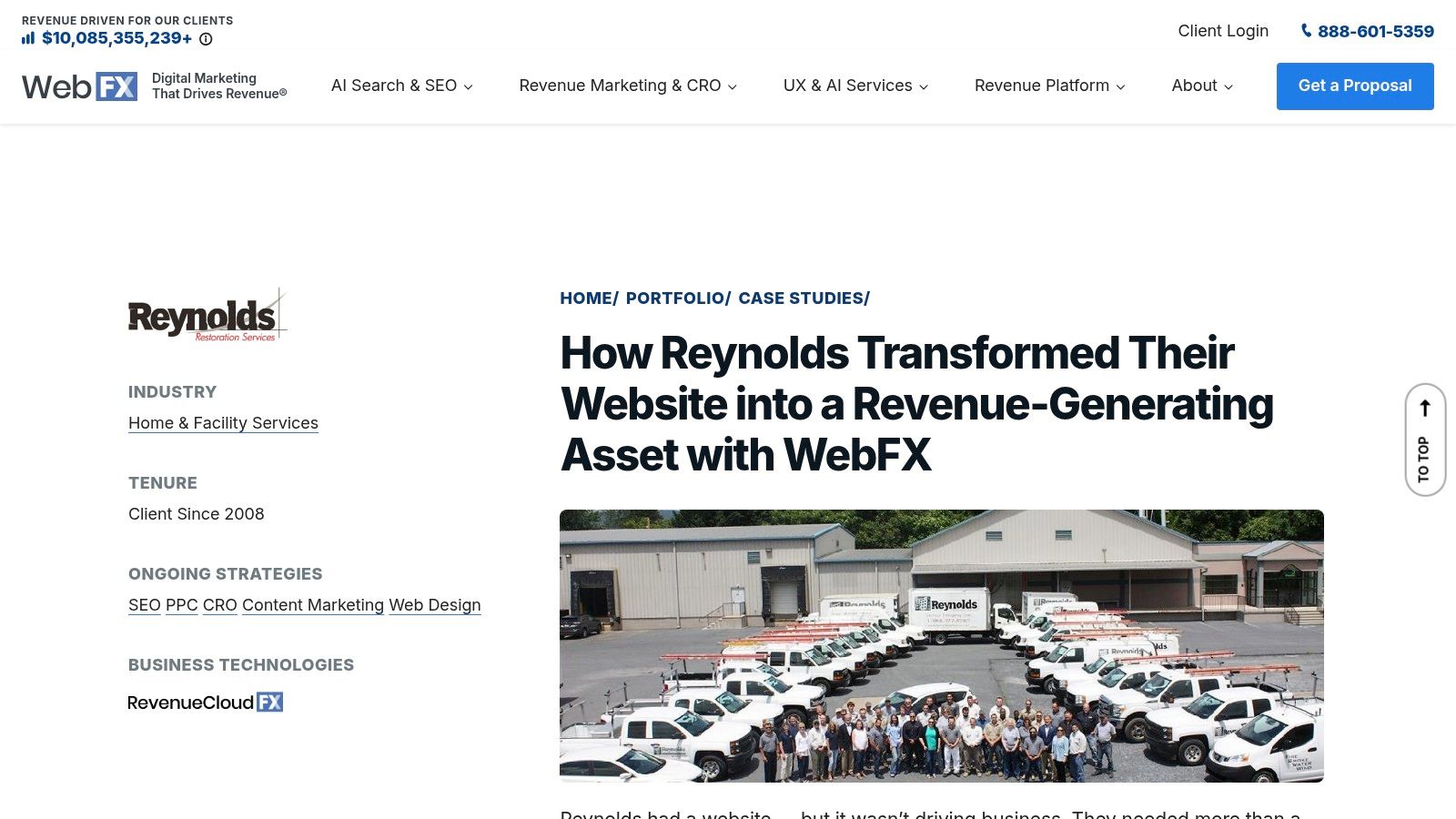
WebFX's Reynolds Building Solutions case study is especially relevant to service companies because it combines a custom website with SEO, PPC, analytics, and conversion optimization. The redesign aligned messaging and information architecture with service buyers, then used heatmaps and analytics to refine important pages after launch.
The case reports a 71% year-over-year increase in organic contact-form submissions and a 43% year-over-year increase in organic traffic. Both figures come from the published case study. They show that the redesigned site attracted more organic visits and generated more form activity, but they don't establish whether phone calls, qualified leads, or cost per lead improved by the same amount.
That limitation is commercially important. A local company could receive more forms while sales quality stays flat, or more traffic while the most valuable service pages lose visibility. A proper evaluation should connect the landing page and source to the eventual lead outcome.
Where the model fits Prescott
The multi-channel structure suits businesses that rely on both organic search and paid campaigns. A Prescott HVAC company, roofing firm, or professional service provider might need different pages for branded searches, service searches, and Google Ads traffic. Each page should make the offer, service area, proof, and next action clear.
The approach is not automatically low-cost, and the case study doesn't list project pricing. Silva Marketing's overview of website redesign services is a useful reference for comparing scope, messaging, SEO structure, and conversion requirements before selecting a provider.
4. Work & Co
Work & Co's Virgin America case study takes an enterprise approach to responsive design, performance, and the booking funnel. The team focused on reducing decision friction across a high-volume transaction path, with information architecture designed to help travelers move from intent to purchase more clearly.
The lesson isn't that a local company should build an airline-scale platform. It's that speed and clarity are conversion features. When a visitor lands on a service page, they shouldn't need to decode the navigation, search for the service area, or guess what happens after submitting a form. Responsive layouts also need to support real mobile behavior, not just shrink the desktop design.
Work & Co's published material includes performance and page-weight considerations, along with industry recognition. Those signals support the quality of the work, but the airline context limits direct comparison with a local lead-generation site. Enterprise budgets and operational requirements are implied, and the case doesn't provide a directly comparable calls-or-leads result for a Prescott business.
A local redesign should borrow the discipline, not the scale.
For a service company, the practical version might be a focused mobile quote path, a simpler service menu, compressed images, and a form that asks only for information the sales team needs. Performance work should also be validated with field data and real devices, because a polished desktop presentation can still create a poor mobile experience.
5. SmartBug Media
SmartBug Media's VectorUSA case study combines inbound marketing, HubSpot, analytics, and a later redesign. The sequence is notable. Rather than treating the new website as the first answer to every problem, the approach uses content and inbound activity to understand what attracts visitors, then improves the site around those behaviors.
The case reports that sessions increased by approximately 40%, according to the published case study. That is an engagement measure, not proof of better lead quality, lower cost per lead, or stronger revenue. The example therefore works best as a lesson in sequencing and analytics visibility, not as a universal performance forecast.
SmartBug's HubSpot-centered model can fit professional service firms that need CRM-connected forms, lead routing, email follow-up, and content tracking. It may be excessive for a small business whose main conversion is a phone call and whose team doesn't have time to maintain a complex marketing system.
When should a business redesign
A business should redesign when the current site blocks important actions, misrepresents the company, creates technical limitations, or makes measurement unreliable. It shouldn't redesign only because a competitor has a newer color palette.
A growth-driven sequence can be sensible when the company already has enough inbound activity to reveal which pages and topics matter. A redesign-first project can make more sense when the existing site is slow, inaccessible, difficult to update, or structurally incapable of supporting the business's services and locations.
For a Prescott firm, the decision should reflect staff capacity. A simple, fast site with clear service pages and reliable call tracking can be more useful than an elaborate CRM build that nobody maintains.
6. Blue Corona
Blue Corona's PVI case study focuses on a regional office-furniture company and takes a measurement-centered view of redesign. The work connected the website with ongoing SEO and PPC, while tracking goal completions in the company's service area.
The published case reports a 223% year-over-year increase in web-form submissions. That metric is easy to understand and closely related to lead generation, which makes the example more relevant to contractors and other local service companies than a case that reports only engagement or page views. It still doesn't tell us whether every submission was qualified, whether calls changed, or what happened to cost per lead.
The case is older, so some technical details and marketing practices may no longer map neatly to a current Prescott website. Its durable lesson is measurement discipline. Before launch, define the conversion event, verify analytics and call tracking, record the baseline, and compare equivalent periods after launch.
What to measure on a local redesign
A practical measurement plan can include:
Form submissions: Record the landing page, traffic source, service requested, and qualification outcome.
Phone calls: Track calls from organic search, Google Ads, Google Business Profile, and direct visitors separately where possible.
Search visibility: Monitor important service and location queries, while avoiding the assumption that rankings alone equal revenue.
Lead quality: Ask whether the enquiry fits the service area, project type, budget, and schedule.
A local agency must be precise at that point. More activity is useful only when the business can connect it to genuine opportunities. A redesigned site should make that connection easier, not hide it behind a single headline metric.
7. Collaborada
Collaborada's website redesign case study presents a practical example for small and midsize companies. Its stated goal was to improve the site's structure, content, search visibility, and measurement without treating the project like an enterprise rebuild.
The case reports a 205% year-over-year increase in users from the first quarter of 2022 to the first quarter of 2023 Collaborada, with improvements described as lasting for two years before external changes affected the trend. The comparison is useful because it looks beyond the launch period.
The metric still needs limits. Users measure traffic, not calls, qualified forms, booked projects, or revenue. The result supports a claim of sustained organic growth for this case, but it does not prove the same pattern for every local business.
The transferable work is practical: clearer page organization, stronger content, better internal linking, and consistent measurement. Those changes can support growth over time, provided the business tracks outcomes beyond visits. For a small-budget scope comparison, see Silva Marketing's overview of website redesign options.
The Prescott application
A Prescott business serving Northern Arizona should make its services and coverage easy to understand. Google identifies relevance, distance, and prominence as major local visibility factors in its guidance on how local results work. The site should therefore present services, locations, contact details, and business information consistently with the Google Business Profile.
Trust supports the traffic a redesign creates. A 2025 BrightLocal survey found that 42% of U.S. adults trusted online reviews as much as personal recommendations, compared with the publication's 79% result in 2020. Reviews remain one signal, so the site should also show project examples, credentials, service areas, and a clear process.
A separate BrightLocal-reported survey found that 89% of respondents were more likely to shop with a business that responds to all reviews, including positive and negative feedback. Review management sits outside the redesign itself, but the site can make legitimate review profiles and business information easier to verify.
Website Redesign Case Study: 7-Agency Comparison
Case | Complexity & Process (🔄) | Resources & Speed (⚡) | Expected Outcomes & Impact (📊⭐) | Ideal Use Cases (💡) | Key Advantages / Trade-offs |
|---|---|---|---|---|---|
Conversion Rate Experts | High 🔄🔄🔄🔄, research‑first, incremental A/B workflow | Moderate ⚡⚡, intensive research and testing; slower rollouts | Validated conversion gains; low‑risk preservation of revenue 📊⭐⭐⭐⭐ | Rigorous CRO needs; low‑risk redesigns for booking flows 💡 | Advantage: transparent hypotheses & rollout. Trade‑off: directional metrics only; UK example. |
Orbit Media Studios | Moderate 🔄🔄🔄, full redesign + content + CRO | Moderate ⚡⚡⚡, requires post‑launch optimization cadence | Clear KPI lifts reported (e.g., +32% organic, +42% conversions) 📊⭐⭐⭐⭐ | Businesses wanting continuous growth and SMB retainers 💡 | Advantage: measurable before/after metrics. Trade‑off: enterprise B2B example; custom pricing. |
WebFX | High 🔄🔄🔄🔄, full‑site + multi‑channel CRO loop | Moderate ⚡⚡, multi‑channel work needs ongoing effort and coordination | Strong YoY gains (+71% contacts; +43% organic traffic) 📊⭐⭐⭐⭐ | Local and midmarket service firms needing SEO/PPC + forms/calls integration 💡 | Advantage: concrete lead KPIs. Trade‑off: lacks CPL/call volume breakdown; variable pricing. |
Work & Co | Very high 🔄🔄🔄🔄🔄, enterprise, performance‑first redesign | High resource needs ⚡⚡, enterprise budgets; performance optimization focus | Awarded work; speed/clarity drive large‑scale transactions 📊⭐⭐⭐⭐ | Enterprise booking/transaction platforms prioritizing speed and scale 💡 | Advantage: performance and reduced decision overhead. Trade‑off: enterprise scope, not right‑sized for SMBs. |
SmartBug Media | Moderate 🔄🔄🔄, inbound then redesign (HubSpot‑led) | Moderate ⚡⚡, requires HubSpot/CRM and content investment | Engagement uplift (~+40% sessions); site becomes lead generator 📊⭐⭐⭐ | B2B firms proving inbound traction before redesign; HubSpot adopters 💡 | Advantage: growth‑driven sequencing. Trade‑off: focuses on engagement over CPL; retainer pricing. |
Blue Corona | Moderate 🔄🔄🔄, data/tracking focused redesign | Moderate ⚡⚡⚡, integrates SEO/PPC; needs analytics setup | Large conversion lift (223% YoY web form submissions) 📊⭐⭐⭐⭐⭐ | Contractors and local services measuring calls/forms as success metrics 💡 | Advantage: clear, tied redesign lift. Trade‑off: older case study; pricing unspecified. |
Collaborada | Low 🔄🔄, small‑agency, SEO fundamentals and right‑sized tweaks | Fast & lean ⚡⚡⚡⚡, suitable for smaller budgets and quicker wins | Durable organic growth (≈205% YoY users; sustained over quarters) 📊⭐⭐⭐⭐ | SMBs seeking sustained organic growth on limited budgets 💡 | Advantage: relatable, persistent results. Trade‑off: focuses on traffic rather than call/lead quality. |
Turning a Case Study Into Your Own Redesign Plan
These seven examples work best as a checklist, not a scorecard. The strongest cases connect a specific business problem to a specific change and then show what the measurement captured. Some focus on bookings, some on organic traffic, some on forms, and some on engagement. Those outcomes aren't interchangeable.
Before a redesign, define the one action that matters most. It might be a phone call, a form submission, a booked appointment, or an estimate request. Record the baseline and document how the business currently attributes that action. If calls aren't tracked today, a new design can improve performance without making the improvement visible.
Track traffic and enquiries separately. A rise in visits doesn't necessarily mean a rise in customers, and a higher conversion rate doesn't prove that lead quality improved. For local companies, the useful chain is source, landing page, enquiry, qualification, sale, and revenue.
The redesign also needs a post-launch period. Review technical issues, redirects, forms, mobile behavior, search visibility, and service-page performance after launch rather than treating go-live as the finish line. Content migration, accessibility, and maintenance deserve attention too. Cost data published by Folyo identifies content migration at $5,000 to $15,000 when hundreds or thousands of pages move between systems, and ongoing maintenance at $5,000 to $20,000 annually. These figures are planning references, not universal quotes, and the website redesign cost discussion explains the distinction.
Accessibility is another risk that visual case studies often understate. WebAIM's 2025 analysis found automatically detectable WCAG failures on 94.8% of the top one million homepages. A smaller redesign with sound information architecture, accessible interactions, technical cleanup, and reliable tracking may serve a local company better than a visually ambitious rebuild that breaks URLs or creates an unmanageable maintenance burden.
If you'd like to discuss how these lessons apply to a business in Prescott or the surrounding region, Silva Marketing offers free consultations with no long-term contracts. The agency works on custom websites, website redesign, SEO, and Google Ads, with a focus on turning clicks into calls and qualified leads. You can learn more about its work at Silva Marketing whenever the timing suits you. A practical UX design process guide can also help your team organize discovery, structure, testing, and launch decisions.
Silva Marketing can review your current website, identify friction in your service and contact paths, and build a custom redesign supported by SEO and conversion tracking. Visit Silva Marketing to discuss a Prescott or Northern Arizona website project through a free, no-pressure consultation.
Comments