
Why Keyword Research Is Important for Local Growth

A Prescott contractor can invest in a website and Google Ads, then still wonder why the phone isn't ringing with the right jobs. The site may attract visitors outside the service area, while ads appear for searches that don't signal a need to hire. The gap often isn't a lack of marketing activity. It's a mismatch between what customers search for and what the business is offering them.
Silva Marketing helps service businesses and growing companies in Prescott, Prescott Valley, Chino Valley, Sedona, Flagstaff, and the broader Northern Arizona corridor connect customer searches to useful pages and campaigns. Keyword research helps identify where that connection is missing, whether in organic search, paid ads, or the structure of a website. The goal isn't traffic for its own sake. It's to make it easier for nearby, relevant customers to find the service they need and take a meaningful next step.
Table of Contents
Why It Matters for SEO, Ads, Content, and Site Structure - Organic visibility and paid media - Content and site structure
Putting It Together and Frequently Asked Questions - How often should a business refresh its keyword research? - Does keyword research matter for a one-location business? - How does keyword research affect Google Ads performance?
A Prescott Business Owner and the Search Bar
A local business owner might describe a service one way, while a potential customer searches for it another way. A roofing contractor may call a job “exterior envelope remediation.” A homeowner with water coming through the ceiling is more likely to search for roof leak repair, emergency roofer, or an estimate for roof replacement. If the contractor's page speaks only in industry language, it can miss customers who are ready to call.
That mismatch can be hard to spot by looking at the website alone. A page can sound polished and still fail to address the phrases people use, the locations they want to serve, or the decisions they need help making before they contact a provider. Ads can have the same problem. They may draw clicks from broad searches without distinguishing people looking for a nearby service from people who are only gathering general information.
Keyword research makes the gap visible. It shows what language people use and helps a business decide which searches deserve a service page, an educational article, or a targeted ad. For a Prescott dentist, that might mean separating searches for a particular treatment from searches for a dentist accepting new patients nearby. For a home services company, urgency and location may matter more than a broad category term.
Prescott businesses also have to make clear where they work. A company serving Prescott Valley, Chino Valley, Sedona, and Flagstaff needs to distinguish that regional coverage from a general claim to serve Northern Arizona. The right approach depends on the business's actual capacity and the searches customers use in each place.
The practical question isn't, "How many people search this phrase?" It's, "Could this search lead to the kind of customer we can serve, and does our website give that person a clear next step?"
What Keyword Research Actually Is
Keyword research is intent mapping, not phrase collection. It identifies the words customers use, groups searches according to what people are trying to accomplish, and matches each group to an appropriate page, ad, or other content. A list of terms without that mapping can leave a business with lots of possible topics and no clear plan for what to publish or promote.
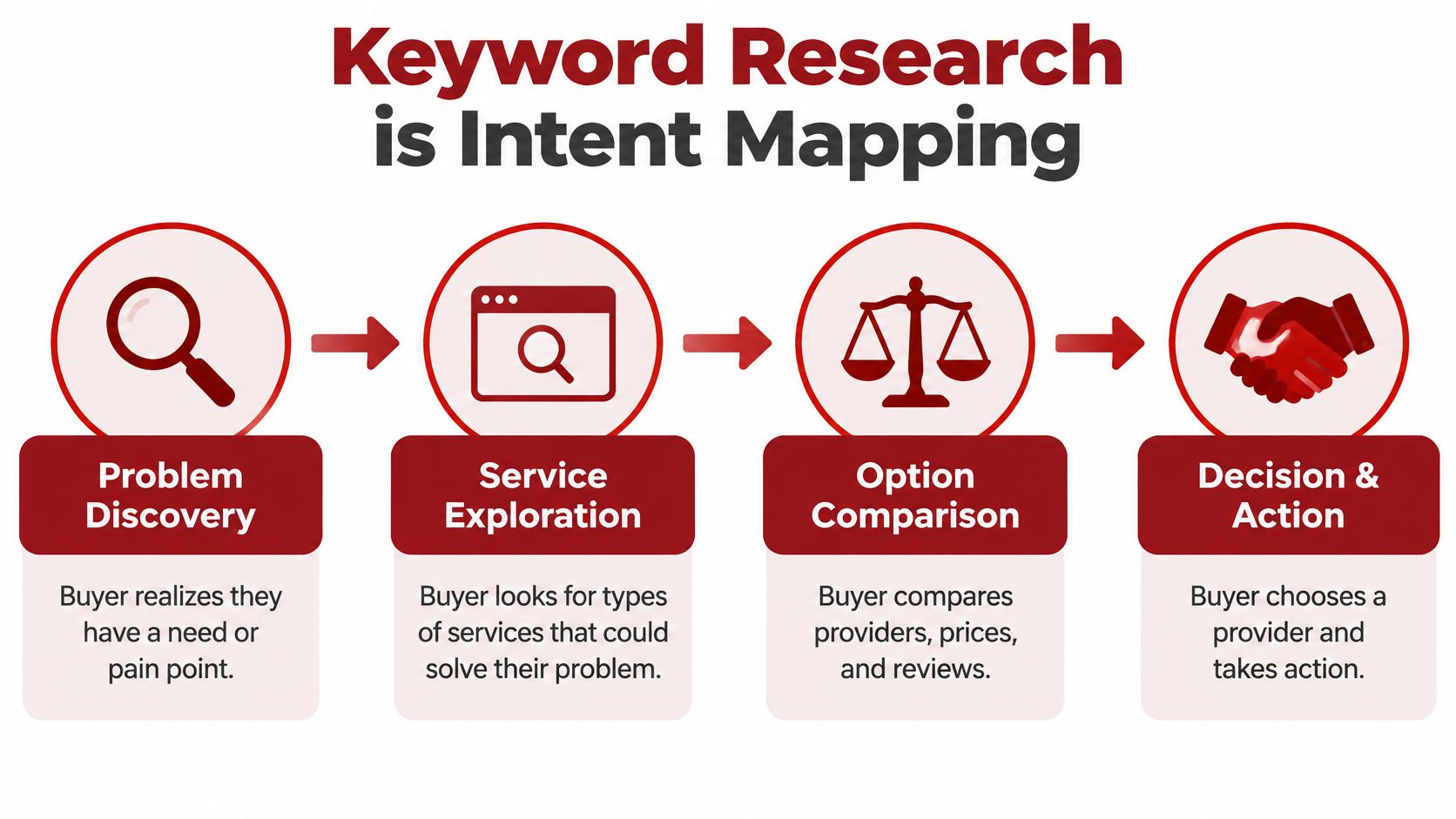
A useful starting point is to follow the tasks a buyer moves through:
Problem discovery: The person is working out what's wrong. A homeowner might search for signs of a roof leak or why water is coming through a ceiling.
Service exploration: The person considers possible solutions. They may look for roof repair, roof replacement, or a contractor who can assess the damage.
Provider selection: The person compares options, reviews, estimates, and qualifications. Searches can include a specific service and a location.
Local conversion: The person is ready to contact a provider, request an estimate, call, or get directions. “Roof repair Prescott” is more locally specific than “roof repair.”
People don't always move through these tasks in order, and they don't always describe the same need with the same words. A large-scale analysis of 964,780 web-search sessions containing 1,523,072 queries found that roughly 45% of query reformulations were associated with users seeking reformulation or assistance, showing that people often change their wording when a search doesn't express their need or produce a satisfactory result (analysis of query reformulation in web search).
That's why an agency shouldn't build a page around an internal label just because it sounds precise. A Prescott web design firm might use “conversion architecture” in its planning, but local customers may search for website redesign, a website designer, or help getting more calls from a business website. Research helps connect the firm's expertise to the customer's language.
Once intent is clear, assign each meaningful group of searches a job. A service page should support provider selection and contact. An educational article can answer a problem-discovery question. An ad can focus on a service people are ready to buy. For practical guidance on writing naturally around a target topic, see these tips for consistently ranking SEO content.
Why It Matters for SEO, Ads, Content, and Site Structure
Keyword research changes more than what goes into a blog post. It helps determine which pages a business needs, what its ads should target, and how customers move through the website. When those decisions start with real search language and intent, the site is more likely to answer the questions a visitor has.
Business outcome | Keyword input | Deliverable |
|---|---|---|
Organic visibility | Service, problem, and provider searches | Focused pages that match a customer's need |
Paid media efficiency | Commercial intent, match approach, and irrelevant searches | Ad groups, negative keywords, and relevant landing pages |
Content planning | Informational questions and related needs | Articles and topic groups that support decisions |
Site structure | Distinct services and geographic intent | Connected service hubs, location pages, and supporting content |
Organic visibility and paid media
For organic search, keyword research helps decide which pages should exist and what each page should say. If one page tries to target unrelated services and every location, it can be unclear to both visitors and search engines. A focused service page can explain what the business does, where it works, and how customers can get an estimate.
For Google Ads, research helps build a campaign around the searches that are relevant to the service. It also informs negative-keyword planning, which can help limit ads for searches that don't fit the business. The trade-off is reach versus control: broad targeting can find useful variations, but a campaign still needs monitoring so the budget doesn't drift toward irrelevant intent.
Content and site structure
Content planning benefits when the questions people ask are tied to the services the business offers. An educational article about a common roofing problem can help a reader understand the issue, while a service page can explain how to arrange an inspection. Those pages should support each other rather than compete to answer the same query.
Site structure connects that content into a useful path. A service hub can link to relevant service pages and supporting articles, giving customers a way to move from learning about a problem to evaluating a solution. For ideas on organizing these relationships, Silva Marketing's guide to site structure for SEO covers how pages can be arranged to support search and navigation.
Local relevance matters here, too. Google explains that search-result relevance can depend on a user's location, language, and device. Its example notes that a bicycle repair search can return different results in Paris and Hong Kong, a reminder that a broad national term may not represent demand for a nearby business (Google's guidance on search relevance). For a local service company, location and service context should be part of planning, not added as an afterthought.
The Hidden Problem with Chasing Search Volume
A high-volume keyword can look like an obvious target. But if people searching it don't need the business's service, or if the results page answers their question before they visit a site, that popularity may not translate into leads. Search volume is a demand signal, not a business outcome.
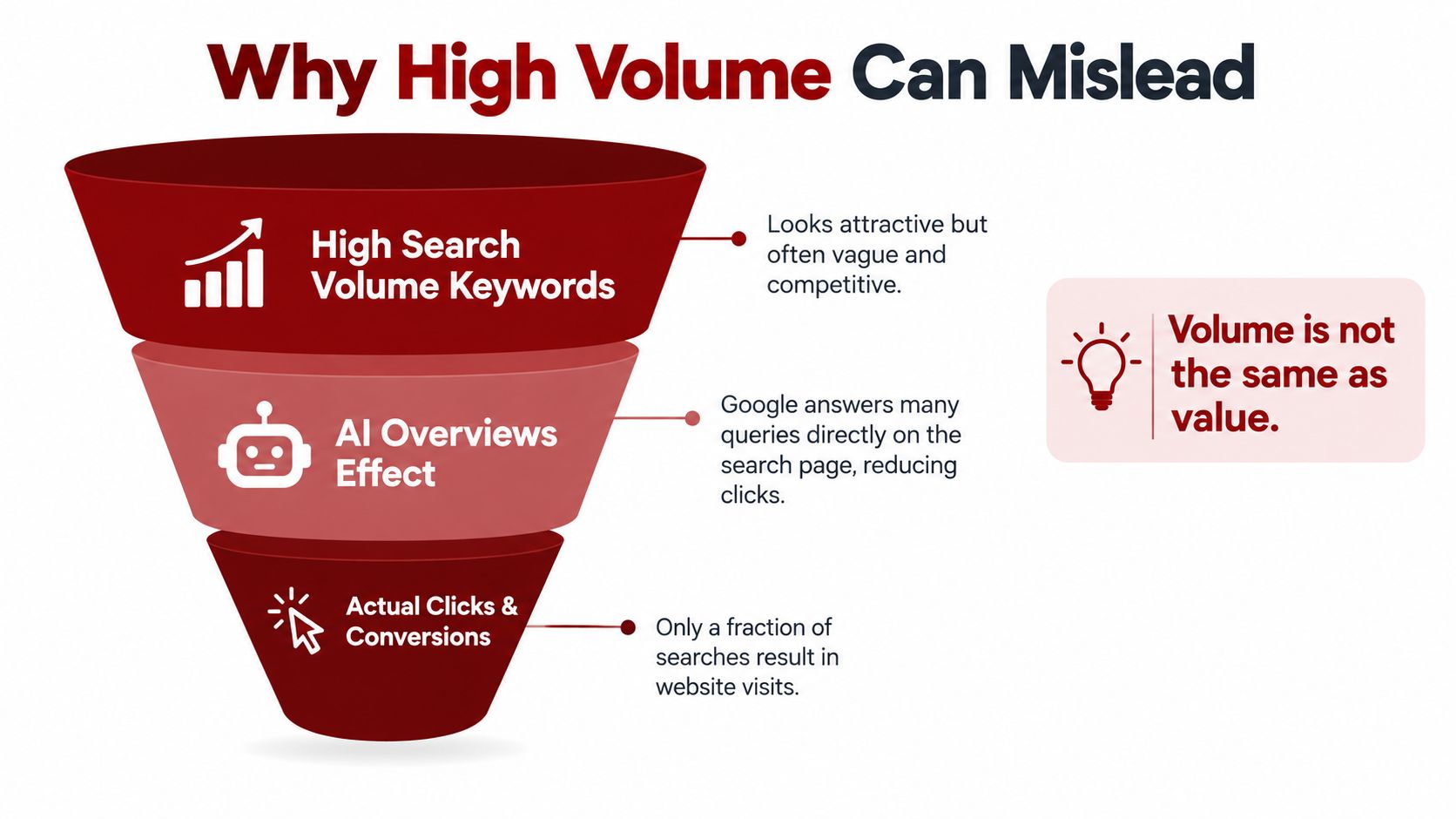
Google's AI Overviews make click potential especially important to consider. Pew Research Center analyzed 68,879 Google searches from 900 U.S. adults in March 2025. Users clicked a traditional result on 8% of visits when an AI Overview appeared, compared with 15% when it didn't, and 1% clicked a source link inside the summary (Pew Research Center's analysis of clicks when AI Overviews appear).
That doesn't mean informational content has no value. A useful article can demonstrate expertise, answer customer questions, and support the rest of a site's content. But a business seeking calls or estimate requests shouldn't assume that a broad informational phrase will bring a visitor ready to hire.
A more practical comparison is between “what is roof maintenance” and “roof repair estimate Prescott.” The first may be useful for education, but the second more directly signals a local service need. The right investment depends on the business goal, the likely visitor, and whether the search result creates an opportunity to reach the business.
Practical rule: Prioritize the search that can lead to a relevant call, form submission, or directions request, not simply the term with the most impressive volume chart.
For each target, ask whether Google is likely to satisfy the need on the results page, whether the searcher has a reason to visit, and what action the page should encourage. This is the core of search intent in SEO: match the content to what the searcher is trying to do, then measure whether the visit supports a business objective.
Local Keyword Research for Prescott and Northern Arizona

A local search is valuable when the person's need, location, and the business's coverage line up. BrightLocal's 2025 Consumer Search Behavior research, based on a survey of 1,000 U.S. adults, found that 39% of consumers estimated at least 41% of their searches were devoted to finding information about local businesses (BrightLocal's consumer search behavior research). That makes local language worth investigating, but the number of searches alone doesn't tell a business which ones can become qualified leads.
Consider a company offering website design and SEO. “SEO agency Prescott” signals a local provider search. “Website design Northern Arizona” suggests broader geographic intent. A phrase without a place name may still be relevant, but it gives less direct evidence that the searcher wants a provider within the company's service area. The landing page, local listings, and service description need to make that fit clear.
For a contractor working in Prescott, Prescott Valley, and Chino Valley, one service hub can explain the work offered and the overall coverage area. A dedicated location page may make sense when the company serves a community and can provide useful, distinct information there. Creating separate pages that merely swap city names does not make the business more relevant. It risks producing repetitive content that offers little to someone deciding whom to call.
A rural or multi-location business can segment research by service, place, and the customer's likely task. “Emergency roof leak repair” suggests urgency; “roof replacement estimate” suggests evaluating a major project; “roof repair Prescott Valley” makes the geographic match explicit. Those phrases may map to a service page, a location page with real local details, or an ad, depending on what the business can deliver and how it wants to reach customers.
Silva Marketing serves Prescott and the Northern Arizona corridor, including Prescott Valley, Chino Valley, Sedona, Flagstaff, and surrounding communities. Any local page should reflect actual coverage, explain the service clearly, and offer an appropriate next step. Before adding a new page, ask whether it gives a customer in that place a more useful answer than the existing service page.
This video offers another perspective on local search planning and how businesses present themselves online.
Scoring Keywords and Feeding Google Ads
A useful keyword scorecard looks beyond volume. For each search, assess service urgency, geographic fit, proof requirements, and measurable action. Those dimensions help a business decide whether to build a page, run an ad, or leave a phrase off the priority list.
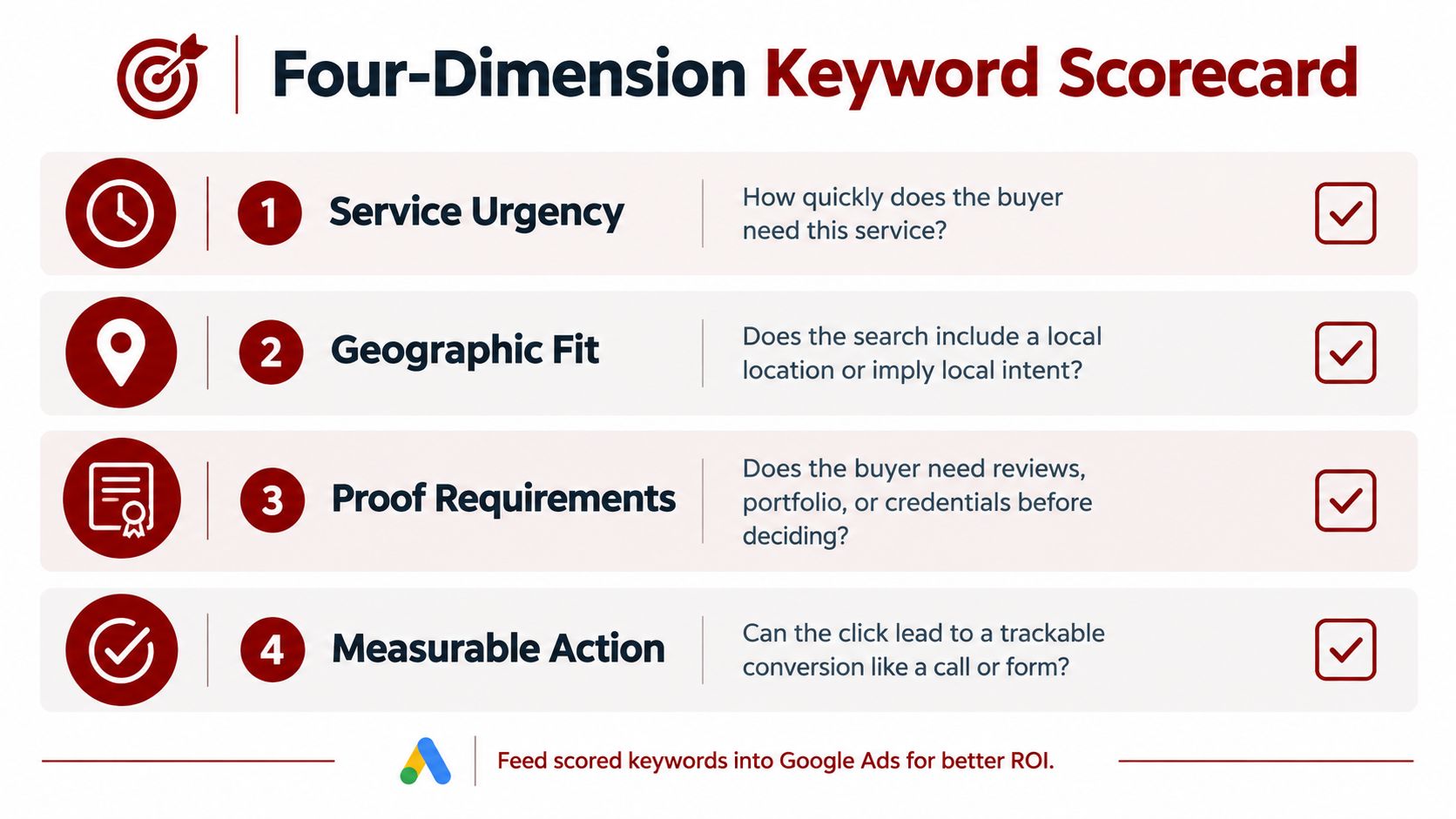
Service urgency: Does the search suggest an immediate need, such as an active roof leak, or a general interest in maintenance?
Geographic fit: Does the phrase name Prescott or another covered community, or otherwise suggest the searcher wants a local provider?
Proof requirements: Will the person need reviews, examples of past work, qualifications, or a clear estimate process before deciding?
Measurable action: Can the visit lead to a trackable call, form submission, or other meaningful contact?
Suppose a Prescott roofing contractor wants to advertise for urgent repair work. A tightly relevant search such as “emergency roof leak repair Prescott” could lead to a dedicated page that states the service area and makes calling straightforward. A broader search about causes of roof leaks might be better suited to educational content or a campaign designed to discover which related searches are useful, rather than being treated as an automatic lead.
Google Ads offers broad match, phrase match, and exact match. Broad match reaches the widest range of related searches. Phrase match allows a more constrained relationship to the keyword's meaning, while exact match gives more control and generally reaches fewer searches. Google also says close variants are eligible by default for all match types and can't be disabled, so advertisers don't need to create exhaustive lists of every small wording variation (Google Ads guidance on keyword matching options).
Research informs where each keyword belongs, which searches should be excluded, and what landing page an ad should send people to. Reviewing ad performance against the search terms that triggered ads helps reveal mismatches that a keyword list alone can't show. A rank tracker can also help monitor how target terms perform in organic search over time. For the paid side, Silva Marketing's guide to Google Ads Quality Score discusses the relationship between an ad, its keywords, and its landing page.
Using Local Keywords Without Crossing Into Spam
Local keywords help a page explain whom a business serves, but repeating place names doesn't make a page more useful. Google Search Central describes keyword stuffing as filling a page with keywords or numbers in an attempt to manipulate rankings. Its examples include artificial blocks of city and region names created to rank for locations (Google's spam policies on keyword stuffing).
The distinction is straightforward: mention locations where they clarify real service coverage, and write the rest of the page for a person who needs that service. A Prescott contractor can explain which nearby communities they serve, describe the work they do, and set expectations about requesting an estimate. The city name should support that explanation, not be inserted into every sentence.
A practical editing check is to read a local page aloud. If it sounds like a list of keywords rather than a clear explanation of the service, revise it. Then check that every location claim is accurate and that each page offers information relevant to the customer in that area.
Avoid publishing near-identical pages that change only the city name. Instead, create a page when the business can answer a real local question, such as whether the service is available there, what the work involves, or how a customer should get started. Keyword research should guide that decision, not dictate a repetition count.
Putting It Together and Frequently Asked Questions
Keyword research is really a click-likelihood call. Every query on a list represents a person with a certain probability of becoming a lead, and the job is to route the highest-probability searches to the page, ad, or content piece built to answer them. Search volume is one input. Lead probability is the filter.
Getting found is only half of the equation. BrightLocal's 2025 Local Consumer Review Survey, based on a representative panel of 1,026 U.S. adults, reported that 81% of consumers used Google to find reviews in the measured period (BrightLocal's Local Consumer Review Survey). Search relevance earns the discovery; credible information carries the evaluation.
To organize topics and priorities once the research is done, this content strategy template provides a working structure.
How often should a business refresh its keyword research?
Review it when services, coverage, customer questions, or campaign results change. Search-query data and conversations with prospective customers can reveal new wording or mismatches worth addressing.
Does keyword research matter for a one-location business?
Yes. A single-location business still needs to separate local provider searches from broad informational searches, then make its services, location, and contact options clear. A Prescott plumber gains little from ranking nationally for "how to fix a leaky faucet" but a great deal from searches that signal someone nearby needs help now.
How does keyword research affect Google Ads performance?
It shapes which searches you bid on, how tightly you match them, which terms you exclude, and which landing pages receive the click. Reviewing actual search terms shows where targeting needs tightening.
Silva Marketing provides keyword research, SEO strategy, website optimization, and Google Ads support for businesses serving Prescott and Northern Arizona. If you want to connect search intent to clearer pages and more relevant campaign decisions, we are glad to talk through your goals.
Silva Marketing can map the searches that fit your services and service area, then turn that map into page, ad, and measurement decisions. Request a free consultation and we will walk through your current keyword coverage together.
Comments