
How to Hire a Contractor Web Design Agency

If you're losing estimates to a competitor whose site explains the job better, the fix isn't a prettier homepage. It's a site that works like a lead desk, with clear services, real towns, proof, and tracked calls.
We help owners of roofing, electrical, plumbing, HVAC, and remodeling companies in Prescott, Prescott Valley, Chino Valley, and nearby Northern Arizona turn searches into quote requests. A good contractor web design agency should prove it can do that on a live site before you talk about price.
Table of Contents
What a Contractor Website Must Include - Why does a generic template fail a trade - Must-have features on a contractor website
How to Evaluate a Contractor Web Design Agency - A six-step check you can finish this week
Questions Worth Asking Before You Sign - What should I ask about past contractor work - How will you prove the site is fast enough - Who owns everything if we part ways
Pricing Timelines and Sample Deliverables - Contractor website pricing in 2026 - What does a calm build calendar look like - What should be in your hands at launch
Keeping Leads Flowing After Launch - Keep one set of facts everywhere - Review, respond, and add proof monthly - Lead problems, causes, and fixes
Book a Strategy Call in Prescott - Should ads and SEO start with the site - What does month to month mean - Which towns are in scope
What a Contractor Website Must Include
In 2024, 86% of U.S. homeowners surveyed by Tinuiti said they began searching online when actively looking for a home-services company, according to the Tinuiti home services marketing study. That first search is where you're compared, often on a phone, often in under a minute.
Silva Marketing builds conversion-focused, mobile-ready, SEO-friendly websites built for speed and trust for that moment, and we have launched more than 500 websites. Website design services are offered in Prescott, Prescott Valley, and Chino Valley, for crews whose next job depends on being clear, not clever.
Why does a generic template fail a trade
A template usually gives you one services blob, no town coverage, slow galleries, and a form that sends no confirmation. A homeowner can't tell if you replace roofs or only repair them, whether you'll drive to their street, or whether their request went through.
Use the scorecard below before any budget talk. Open a live contractor site the agency built, run each pass test on your phone, and mark pass or fail. If a proposal can't show these items live, don't sign on a promise.
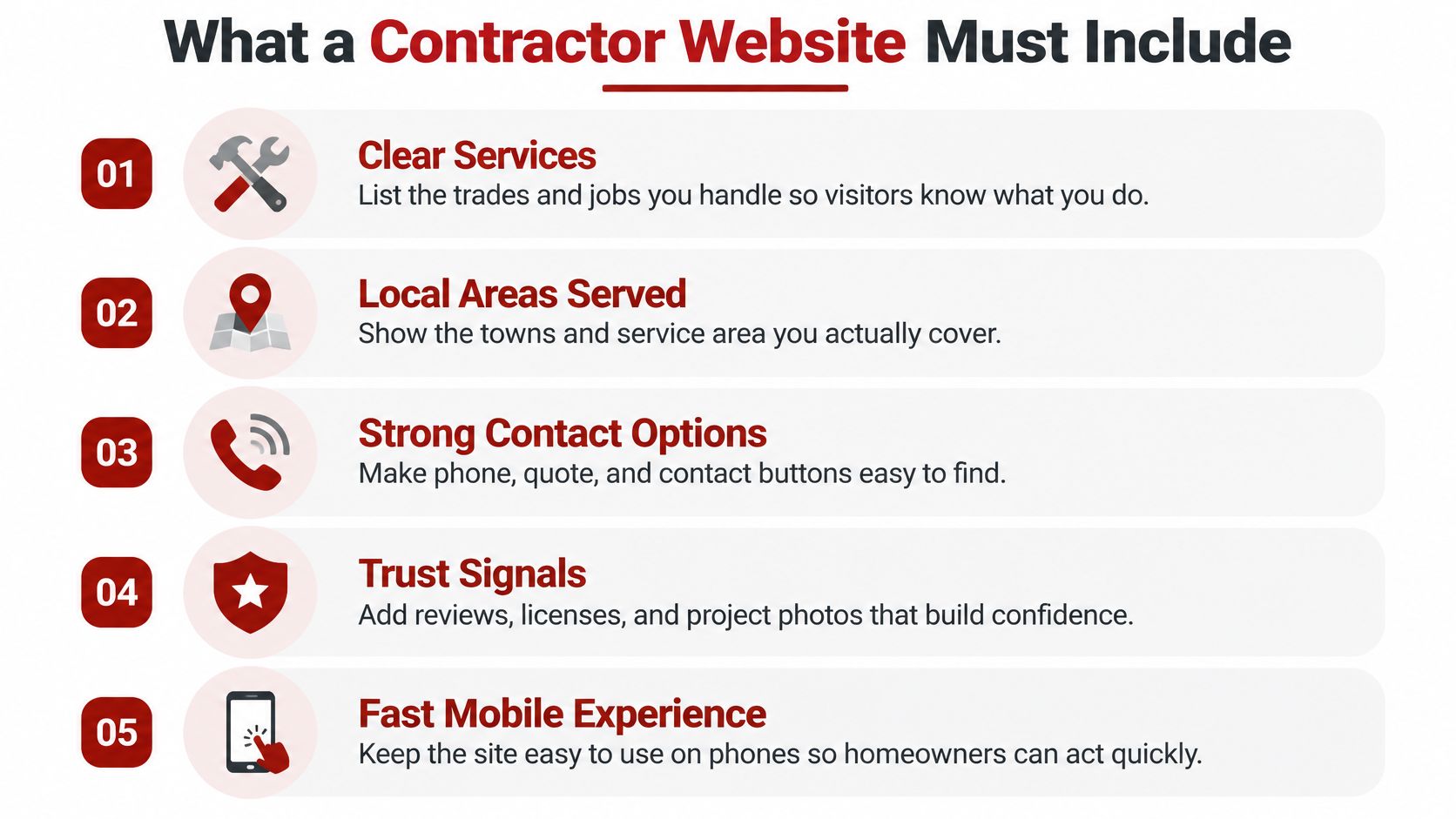
Must-have features on a contractor website
Must-have | Why it matters | Pass test |
|---|---|---|
Trade portfolio | Homeowners hire the crew that has done their job | Photos and outcomes grouped by roofing, HVAC, electric, plumbing, or remodel |
Separate service pages | Vague branding does not match a specific search | One page per core service with scope, proof, and a quote path |
Service-area coverage | Distance decides local results | Prescott, Prescott Valley, Chino Valley, and real drive towns named plainly |
Call and quote paths | Most leads start on a phone | Tap-to-call above the fold and a short form with a confirmation |
Field speed | Slow galleries lose emergency and estimate traffic | Mobile LCP within 2.5s, INP under 200ms, CLS under 0.1 on real users |
Local SEO structure | Relevance needs the trade and the place | Clear headings, service copy, and internal links a crawler can read |
Ads landing alignment | Paid clicks die on a generic homepage | A page whose offer matches the ad and tracks the lead |
Review proof | Prominence rises with real ratings | Unedited testimonials tied to the same business name |
Listing consistency | AI and maps repeat conflicting facts | Same name, hours, services, and area on the site and directories |
For after-hours questions that shouldn't wait until morning, some owners add 24/7 AI chat support as a backup to the phone and form. Treat it as a supplement, not a replacement for a working call path. You can see how these elements come together in real contractor website examples.
Practical rule: A trade specialist beats a general designer when it builds one page per core service, names each drive town, and wires phone calls and quote forms to tracking. A general template rarely does all three.
How to Evaluate a Contractor Web Design Agency
Google states that local search results are primarily determined by relevance, distance, and prominence, as explained in Google's guidance on local ranking. Relevance is how closely your profile and site match the search. Distance is how far you are from the searcher. Prominence reflects how well known you are across the web, including links, directories, review count, and review score, and Google says more reviews and positive ratings can improve local ranking.
That gives you a plain test for any agency. If they can't explain those three ideas without jargon, they can't build for them.
The six-step routine below turns that test into checks you can finish before signing.
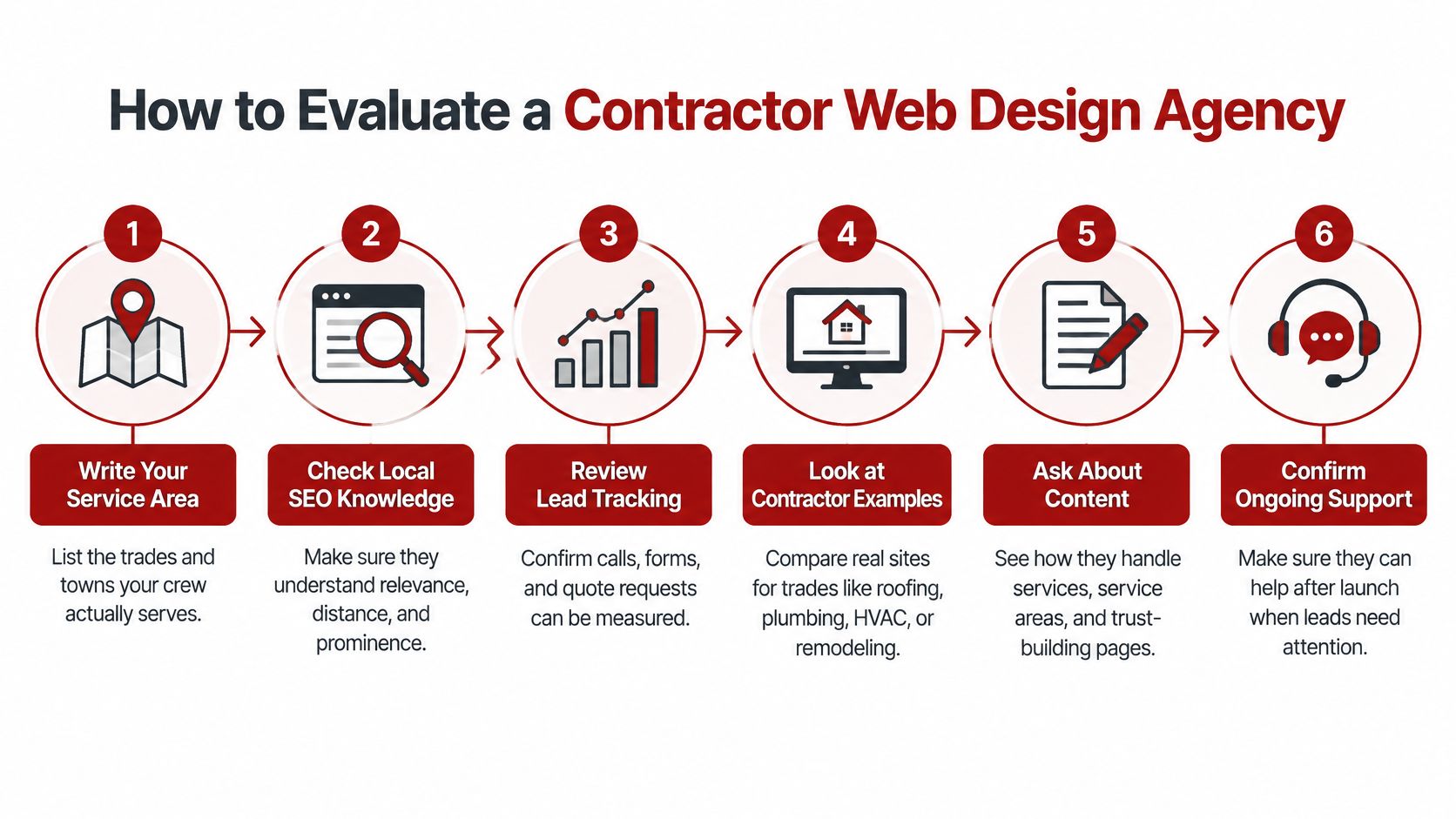
A six-step check you can finish this week
Write your trades and towns first. List what your crew does and where trucks go, including Prescott Valley and Dewey-Humboldt if you serve them. Fail sign: the agency wants to start with colors and a slogan, which matches none of Google's three factors.
Ask for three live sites in a similar trade. Check that each core service has its own page, job proof sits near the service it proves, and a call button appears above the fold. Fail sign: one combined services page and stock photos.
Open those sites on your phone on cellular data. Note whether the first screen settles quickly and buttons stay put instead of jumping as images load. Fail sign: you tap call and hit a photo because the layout shifted.
Read the proposal for research, not a theme name. Look for keyword research, competitor notes, and technical fixes tied to your services and towns. A look at what goes into a website design mockup helps you judge whether structure comes before decoration. Fail sign: the plan is a theme demo with your logo dropped in.
Confirm tracking through to the thank-you step. Calls, forms, and quote requests should each fire a named event you can see in a report. Fail sign: they promise leads but can't name how a lead is recorded.
Score two agencies on the same checklist. Use the must-have table, not charm or a pitch deck, and score live work only. Fail sign: an agency asks you to trust that the finished site will include what its examples don't.
This short walkthrough shows what that kind of review looks like in practice.
A polished layout alone does not create Map Pack visibility. Your site, Google Business Profile, reviews, and citations have to tell the same story about trade and territory. I'd keep looking if an agency can't say, in plain language, how its build supports relevance, distance, and prominence for your specific towns.
Questions Worth Asking Before You Sign
Turn the sales call into a working interview. Ask each question the way you'd say it to a subcontractor, then listen for a specific answer.
What should I ask about past contractor work
Ask who wrote the last three contractor sites and whether those clients still get quote requests through the same forms. A pass sounds like named trades, live URLs, and a form you can test yourself. A theme demo is not proof.
Ask which pages they'd build for a roofer versus an HVAC company, and which Prescott-area towns would get their own mention. A roofer needs repair, replacement, and storm work separated. An HVAC firm needs repair, install, and maintenance separated. If both answers sound identical, you're buying a template.
How will you prove the site is fast enough
Ask how launch quality will be measured with real-user data. Google identifies Largest Contentful Paint, Interaction to Next Paint, and Cumulative Layout Shift as its field metrics, with recommended thresholds of LCP within 2.5 seconds, INP below 200 milliseconds, and CLS below 0.1, per Google's Core Web Vitals guidance.
A pass includes a mobile baseline in Search Console and PageSpeed Insights, compressed and correctly sized hero images, deferred noncritical scripts, and fixed dimensions for galleries and embeds. Then they retest and confirm the phone button, form, tracking events, and thank-you page still work after each optimization. A one-time desktop score is a weak answer, because field data comes from actual users on actual phones.
Who owns everything if we part ways
Ask who owns the domain, hosting, Google Business Profile manager access, and analytics accounts, and whether you keep every login if the contract ends. Also ask how listings stay consistent on Google and Apple Maps, what's included in the build versus a later monthly plan, and who you talk to after launch.
Weak answers are easy to spot. The agency holds accounts in its own name, says ownership is handled later, promises a ranking, or can't name a single tracking event. Before the meeting, decide how you'll get client approval on staging sites so page approval is documented instead of buried in email threads.
Paste this into an email before the meeting: "Please bring three live contractor sites, the service and town pages you'd build for us, how you'll track calls and forms, your field speed targets, and confirmation that we own the domain, hosting, profile access, and analytics."
Pricing Timelines and Sample Deliverables
Price only means something next to what's included. Start with the ranges, then place any quote inside them and check which row includes tracking and which gives each trade and town its own page. A lower number usually means fewer services and areas get a page, which thins the local record a homeowner or map app checks before calling.
Contractor website pricing in 2026
Package | Typical range | Included | Still separate |
|---|---|---|---|
Simple local site | $2,000 to $4,000 | 5 to 8 pages, mobile layout, basic on-page SEO | Photography, ads, monthly care |
Custom contractor site | $4,000 to $12,000 | Trade pages, service areas, forms, speed, call tracking | Ongoing ads or SEO |
Website redesign | $3,000 to $8,000 | New layout, persuasive copy, SEO-ready structure | Content the client will not supply |
Maintenance | $150 per month | Backups, updates, security, performance | New landing pages and campaigns |
Ads or SEO support | $1,000 to $3,500 per month | Campaigns or content, reporting, optimization | The one-time website build |
Our Custom Website Design starts at $3,998, which sits at the entry point of a custom trade build rather than a brochure site. Website Maintenance costs $150 per month and includes backups, updates, security, and performance. Keep ads or SEO retainers as a separate line from the build so you can judge each bill on its own results.
One warning on packaging. We waive the setup fee when a package includes a custom website, while standalone Google Ads or SEO can carry a one-time setup fee. Either way, ask what the monthly amount covers, what it doesn't, and what reporting you'll see. If you're comparing redesign quotes, a written website redesign proposal template shows the level of itemization to expect.
What does a calm build calendar look like
We work in four stages: Free Strategy Call, Custom Plan, Build & Launch, and Optimize & Grow. On the free 30-minute call we align on goals and budget, then confirm your time and send a quick intake form. The Custom Plan arrives as an itemized proposal within 48 hours, so you see which pages, tracking, and extras are priced before anything is built.
After your strategy session, we start work within 5 to 7 business days. Build & Launch covers the pages, quote form, and tracking events, and the site goes live once those pieces check out on a phone. Optimize & Grow is the monthly rhythm: a performance dashboard and report, a next-step roadmap, direct contact with your marketer, and measurable KPIs.
What should be in your hands at launch
Ask for the deliverables by name.
You should receive the page list, service and area copy, mobile layouts, quote form with confirmation, analytics events, a speed check, and a short handoff explaining how to request edits. That list is also your check that the services and towns on the site match what your profile and listings already say.
Match your budget to the row that includes tracking, not the cheapest page count. A site that can't tell you which page produced a call can't tell you what to do next.
I'd rather see an owner buy fewer extras and keep tracking intact. Galleries, chat widgets, and animations can wait. A tracked call button can't.
Keeping Leads Flowing After Launch
Launch is the start of operating the site, not the end of the project. The first 90 days set the habits that keep calls coming.
In month one, call every tracking number and submit a test quote from your phone. You should be able to say which page produced each lead. If you can't, fix tracking before you spend on traffic.

Keep one set of facts everywhere
Keep your name, hours, services, and coverage for Prescott, Prescott Valley, Chino Valley, and Dewey-Humboldt identical on your site, Google Business Profile, and major directories. Assistants and map apps repeat whatever conflicts they find. A BusinessWire report on local search notes that 84% of U.S. consumers reportedly search for local businesses daily, 31% frequently use Apple Maps, 60% click Google AI-generated overviews, and 53% are unlikely to visit a business with incorrect listings, according to BusinessWire's 2025 local search report.
Publish your trade type, credentials, project types, and hours in plain sentences so a recommendation can name the right trade and town. That doesn't replace conventional local SEO. Google and maps stay central. It means your site acts as the local record everything else copies. If you want to go deeper on the directory side, this guide can help you boost your contractor website's local visibility.
Review, respond, and add proof monthly
Each month, our clients receive a performance dashboard and report, a next-step roadmap, direct communication with their marketer, and clear measurable KPIs. Review calls, form fills, and branded searches, then pick one fix. Plans are month-to-month with no contracts, and clients can cancel anytime with 30 days' notice, so you judge results without a lock-in.
Add new job photos within a week of completion and answer reviews on the profile. Google review scores use a five-star scale and the displayed score is the average of all ratings, and a newly submitted review may take up to two weeks to appear in an updated score, as Google's review score guidance explains. Don't judge a review push after three days. For the bigger picture on turning this routine into pipeline, see our notes on lead generation for contractors.
Lead problems, causes, and fixes
Symptom | Likely cause | Fix |
|---|---|---|
Site feels slow on a phone | Oversized galleries and extra scripts | Compress images, defer chat, retest real mobile data |
Form leads never arrive | Unlabeled fields or no confirmation | Name each field, show errors, track the thank-you step |
Map results miss the trade | Vague copy and mismatched categories | State the service and Northern Arizona towns on site and profile |
Star rating seems stuck | New reviews can take up to 14 days | Use the real profile and judge the average after two weeks |
Calls cannot be credited | No event on the phone button | Track tap-to-call separately from form fills |
Close each quarter with one new proof page or service update, one listing check, and one look at which town is calling. That's enough rhythm to catch drift before it costs you a season.
Book a Strategy Call in Prescott
If the scorecard, the interview, and the price band already point to a specialist, the next step is a conversation, not a commitment. We offer a free 30-minute call to talk through your trades, towns, and current site.
After you book a time, we confirm the time and send a quick intake form. Then we meet to align on goals and budget before the proposal, so numbers come after scope. New clients receive an itemized proposal within 48 hours, and work starts within 5 to 7 business days of that session.
Should ads and SEO start with the site
Start them when call and form tracking is live, not before. Paid or organic traffic sent to untracked pages produces spend you can't judge. Once tracking runs, each month brings a performance dashboard and report, a next-step roadmap, direct communication with your marketer, and clear KPIs you can check against the calls coming in.
What does month to month mean
Plans are month-to-month with no contracts, and you can cancel anytime with 30 days' notice. That structure keeps the pressure on the work: the calls, forms, and rankings have to justify the next month, and a seasonal trade can scale spend up in summer and down in winter without penalty.
Which towns are in scope
Prescott, Prescott Valley, and Chino Valley, plus the surrounding Northern Arizona towns your crew serves. Name only where you'll regularly drive, because that's what homeowners and search results check. A town listed on the site but absent from your Google profile reads as a mismatch, so the service area should stay consistent everywhere it appears.
Bring one current site link and the services you want more calls for. The call is free, and the goal is a straight answer on fit, not a hard sell.
Silva Marketing helps Prescott and Northern Arizona contractors turn a website into a tracked source of calls and quote requests, with clear service pages, honest town coverage, and facts that match across Google and directories. If you'd like that kind of plain, measurable plan for your roofing, HVAC, plumbing, electrical, or remodeling company, visit Silva Marketing and book a free call to talk through your next build.
Comments