
How to Set Up Google Business Profile for Contractors

A homeowner in Prescott searches for roof repair on a phone and chooses a contractor from the map results before opening a website. Your crew may be ready to work, but calls for jobs you don't take or towns you can't reach profitably waste time. A Google Business Profile for contractors should help the right homeowners find you and decide to call.
Silva Marketing provides custom websites, Google Ads, and SEO for local businesses, and this guide explains how a contractor can set up a profile that works alongside that online presence.
Your profile is the business record customers see on Google Search and Maps, including your name, phone number, hours, services, photos, and reviews. Treat it as a dispatch and proof asset: show the work you do and list only service areas where the crew can profitably take jobs. Judge its value by booked estimates, not views or review totals.
Table of Contents
What the Map Pack Uses to Rank a Contractor - Why doesn't a complete profile guarantee a Map Pack spot? - What should a Prescott contractor prioritize?
How to Claim and Verify the Profile - What should you prepare before claiming the listing? - What makes verification easier to manage?
Service Area Rules for Crews That Travel - Which towns should you include? - When does another location justify another profile?
Categories Services Photos and Posts - How should you describe contractor services? - Which photos help homeowners judge the work? - What should a contractor post?
Review Requests and Replies That Build Trust - How do you ask without manipulating the review? - What should you say in a review reply?
Which Calls and Quotes Become Paid Jobs - What belongs in the inquiry log? - What records protect the profile?
Frequently Asked Questions About Google Business Profile for Contractors - Is a Google Business Profile free for contractors? - Does a Google Business Profile replace a website? - Do reviews affect Map Pack position? - What should I do if Google suspends the profile? - How often should a contractor post? - What should I bring to a profile review?
What the Map Pack Uses to Rank a Contractor
Google's local results depend primarily on relevance, distance, and prominence, according to its local ranking guidance. Those factors explain why a precise, credible profile is more useful than a description packed with city names.
Relevance means matching the work to the search. A homeowner looking for concrete driveway installation in Prescott Valley needs to recognize that service immediately. A vague builder description leaves more uncertainty than a clear category, service list, and matching project evidence.
Distance concerns where the business is relative to the searcher or the place named in the search. Adding Chino Valley to a description doesn't move your operating base there. Honest coverage matters, but it isn't a substitute for location.
Why doesn't a complete profile guarantee a Map Pack spot?
Prominence reflects how well-known the business is, including its reviews and information across websites, articles, links, and directories. Your profile competes with other businesses for each search, so completing every field doesn't guarantee a particular position.
A roofing contractor may appear differently for roof leak repair in Prescott than for roof replacement in Dewey-Humboldt. The customer's location and the wording of the search change the comparison. Google doesn't promise a Map Pack spot, and a marketing provider shouldn't either.
This homeowner journey shows why the listing needs to make sense before the website visit.
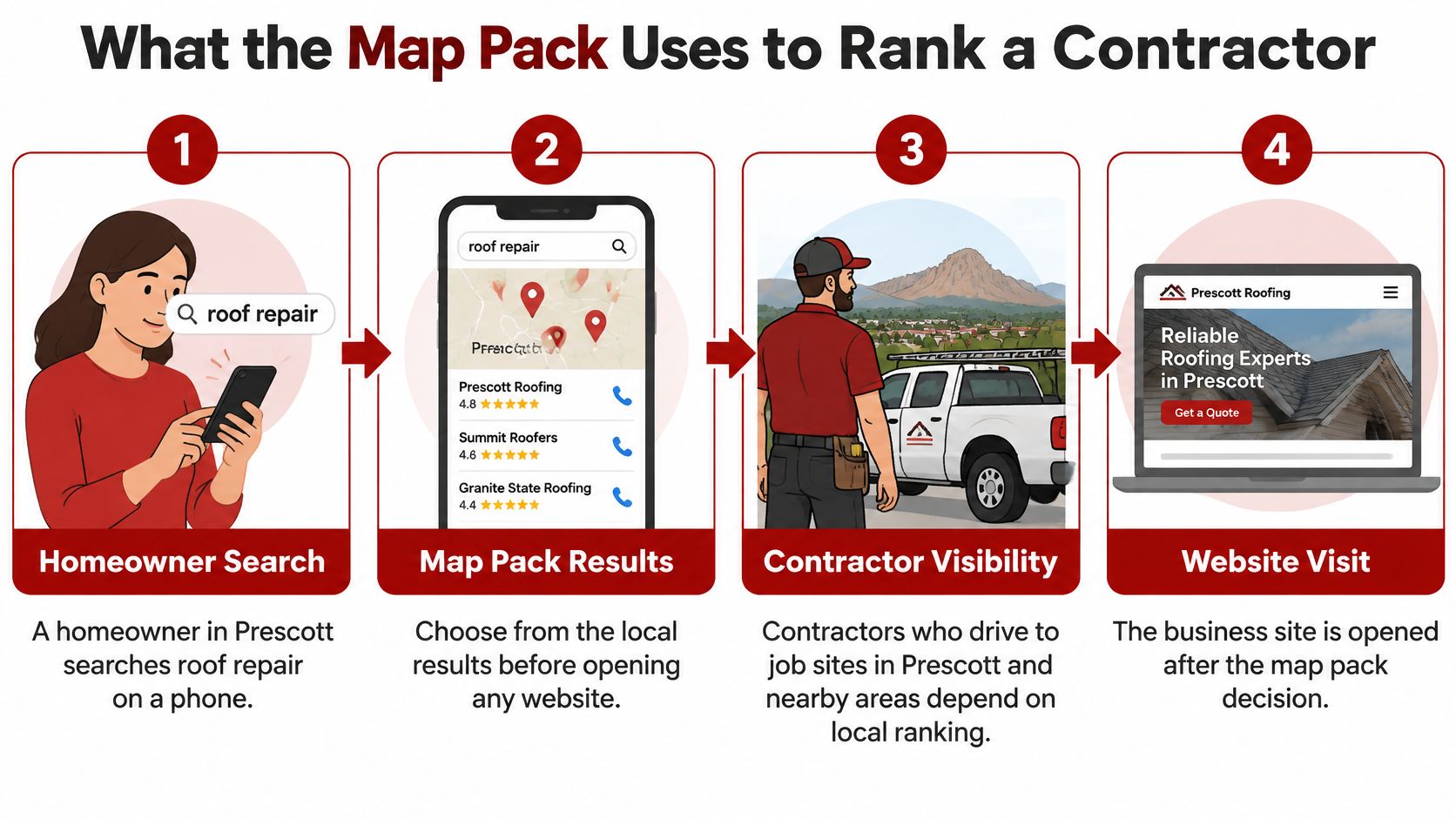
What should a Prescott contractor prioritize?
Start with the service you want to sell and the proof a homeowner needs to choose it. Roof repair should lead to roof repair information, not a general construction page that makes someone search again.
Match the service language. Use concrete installation, bathroom remodeling, or roofing repair when those accurately describe the work.
Keep the business recognizable. Your name, phone number, and website should identify the same company wherever customers find it.
Evaluate real searches. Compare results for the work and towns you serve, rather than judging visibility from your own office alone.
Our office is at 8101 E Pecos Dr., Prescott Valley, AZ 86314, USA, and Silva Marketing has launched more than 500 websites. That website work reinforces a practical distinction: the profile helps someone choose whom to investigate, while the site helps them evaluate the job. Our explanation of local search results gives contractors more context for that difference.
How to Claim and Verify the Profile
Claiming a profile means taking responsibility for a real business identity. Verification should demonstrate where the company operates, what it does, and why the person submitting the information has authority to manage it.
What should you prepare before claiming the listing?
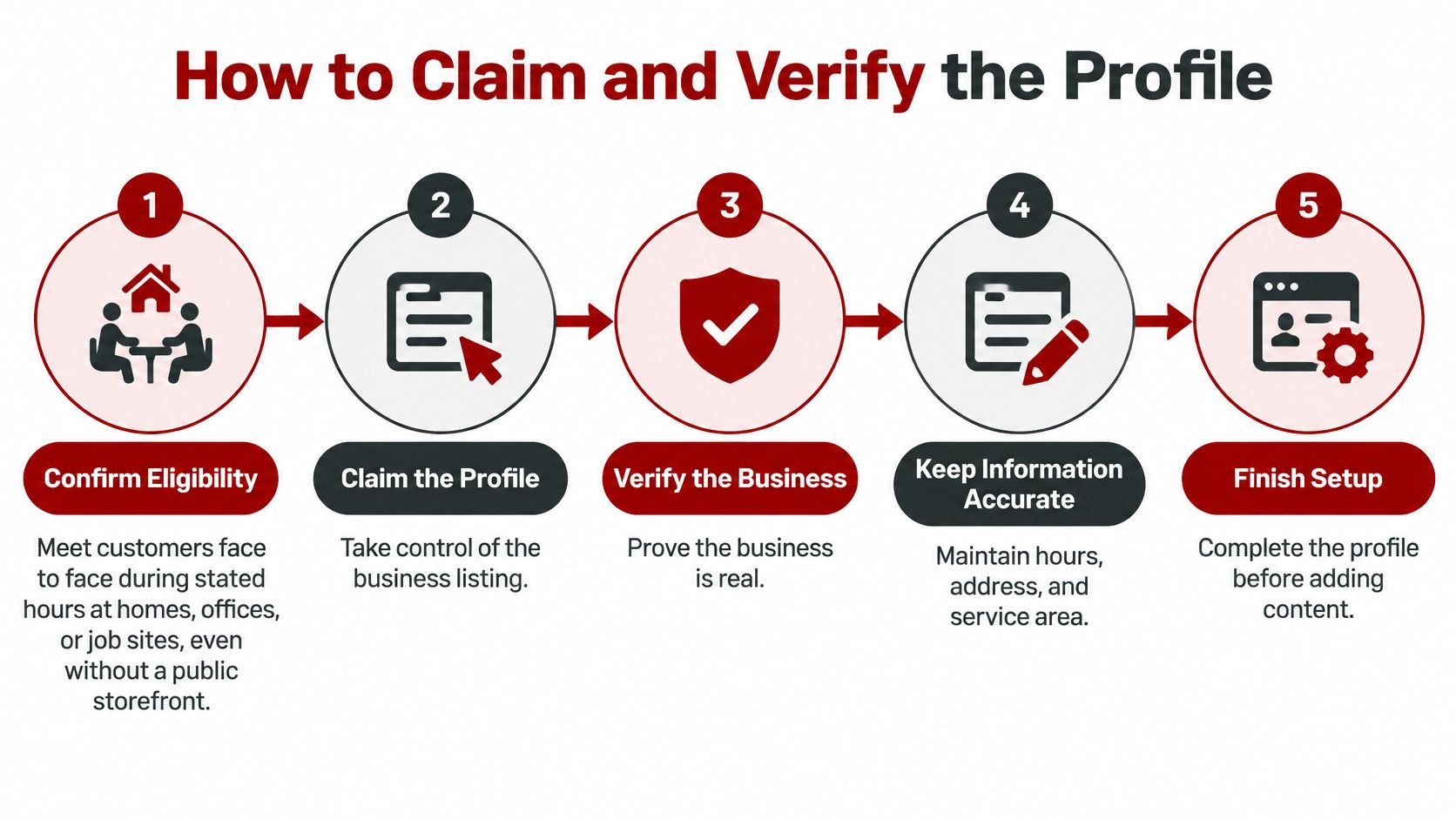
Confirm eligibility and ownership. Google's Business Profile eligibility guidance requires in-person customer contact during stated business hours. Working at homes, offices, and job sites can qualify even without a public storefront. Use an owner-controlled account and authorize managers deliberately, rather than leaving control with a former employee.
Search for the existing business first. Check Search and Maps for your company name and phone number before creating anything. Claim the existing record when appropriate, use the business name, and identify whether customers visit your premises, you travel to them, or both. Creating another listing because you can't access the original can create a duplicate problem instead of solving ownership.
Prepare the verification evidence. For video verification, Google's video recording guidance calls for a unique, continuous, unedited mobile recording of at least 30 seconds showing the location, genuine operations, and management authority. Plan a route from a recognizable street sign or landmark to the truck, tools, workspace, and evidence of access. Useful footage might show the owner opening equipment storage, loading materials, and handling business documents.
Submit through the Business Profile workflow. Follow the verification method presented in your account and check its status there. Keep the recording focused on evidence rather than producing a polished advertisement. An edited montage of completed projects doesn't establish control of the operating location.
Finish the customer-facing information after approval. Review the phone number, website, hours, services, coverage, and project photos. Assign someone responsibility for updates when staffing or availability changes. Approval isn't the finish line if the listing still sends customers to an unanswered phone.
The process works best when you gather evidence before starting the recording.
What makes verification easier to manage?
Prepare the truck, keys, equipment, and supporting records so you can show them naturally in a continuous take. Don't expose customer information unnecessarily, and don't substitute branding alone for evidence that you manage the operation.
Practical rule: Film the business you actually run, not the business you think a verification reviewer wants to see.
Keep account access organized after approval. The owner should know who can edit the profile, which account controls it, and where verification records are stored.
Service Area Rules for Crews That Travel
A homeowner in Prescott Valley may need a repair today, while a remodel across the area may justify more travel. Set service areas around where your crew can reliably do profitable work. Treat the profile as a dispatch and proof asset, not a list of towns to collect views. Success is booked estimates from suitable jobs, not a larger coverage map.
Hide the public street address when customers aren't served there. A contractor dispatching from a home, warehouse, shop, or yard should not present that location as a walk-in business.
Under Google's business representation guidelines, service-area businesses should generally maintain a profile for their central operating location and name the areas they serve rather than setting a radius. Google permits up to 20 service areas, but that is a limit, not a target. Include only places the crew can serve reliably.
Which towns should you include?
Prescott, Prescott Valley, Chino Valley, and Dewey-Humboldt may fit a Prescott-area service list when the crew can take work there. Add other Northern Arizona communities only after considering travel, licensing, staffing, and which jobs you will accept. A bathroom remodel may support more travel than a small repair, so match the territory to the work you can deliver consistently.
Decision | Compliant choice | Avoid |
|---|---|---|
Business type | Service-area business when customers are not served at the address | Showing a home or warehouse nobody can visit |
Street address | Hide it when there is no customer-facing location | A virtual office or unstaffed coworking address |
Service areas | Named cities, postal codes, or areas the crew can serve | A radius or towns added regardless of dispatch |
Extra profiles | A separate profile only for a legitimate location with its own staff and service area | One duplicate profile per town |
Primary category | The most specific trade the business can accurately represent | A generic contractor label plus unrelated categories |
The profile cannot describe every dispatch exception. Choose areas that represent the company's normal offer, not the farthest job someone might occasionally consider. This also makes the coverage credible to homeowners comparing contractors.
When does another location justify another profile?
A town on the route is not a separate operating location. Another profile requires a legitimate location with its own staff and distinct service area, not a borrowed address or a place where the truck occasionally parks. Virtual offices, unstaffed coworking addresses, and town-by-town duplicates can create verification or suspension problems.
Before changing the listing, check whether the address reflects a real operation and whether the team can serve that area reliably. Keep a record of the business name, category, address visibility, and selected towns so dispatch and the profile stay aligned.
A larger service area isn't automatically better. List places where you can deliver the work responsibly and profitably.
For help connecting these coverage choices with the rest of a contractor's local presence, see this guide to local SEO for contractors.
Categories Services Photos and Posts
Choose the most specific primary category that accurately describes the business. Roofing contractor fits a roofing specialist better than a broad construction label. Concrete contractor and Bathroom remodeler are useful choices when those describe the operation.
A secondary category should represent work you sell and can staff. Don't add categories because a subcontractor might be available someday or because an unrelated search looks attractive.
How should you describe contractor services?
Write service names the way homeowners ask for them: roof leak repair, concrete driveway installation, and bathroom remodeling. Give each service enough explanation to distinguish its scope without turning the field into a sales pitch.
For roofing, separate leak repair from full replacement if you offer both. For concrete, explain whether you install driveways, patios, or other flatwork. For remodeling, distinguish a complete bathroom renovation from fixture replacement if that affects which inquiries you'll accept.
Your business description should explain the work, customer type, and real coverage. Include certifications, experience, community involvement, or faith-based values only when they're true and relevant. A documented trade credential helps someone evaluate qualifications; an unsupported badge doesn't.
Which photos help homeowners judge the work?
Use recent project evidence rather than stock images. A useful set includes before-and-after views, readable truck branding, the crew working safely, tools in use, and a clear company logo.
The same principle applies to planning and coordination. Show the actual people and work behind the business.
Ask permission before sharing identifiable customer property, and keep private details out of the frame. Pair before-and-after shots from similar angles so a homeowner can understand what changed. Don't rely on old projects that no longer represent your offer.
What should a contractor post?
Publish when there's something useful to show: a finished local project, a service explanation, or a seasonal maintenance note. Name the service and property type, explain the outcome plainly, and send the reader to the matching website page to request an estimate.
I'd choose occasional substantive updates over empty weekly posts. Posting frequency isn't a substitute for an accurate category or convincing photos. Likewise, list emergency availability only when someone can answer and arrange service.
Build a short publishing queue:
Primary category. Confirm the trade that best describes the core operation.
Service language. Publish the work homeowners ask you to quote.
Photo selection. Queue a completed project, a branded vehicle, and the crew performing relevant work.
Review Requests and Replies That Build Trust
In BrightLocal's 2025 survey of 1,026 U.S. adults, 83% used Google to read local business reviews, and 89% expected businesses to respond to both positive and negative reviews, according to SearchLab's coverage of the survey. For expensive or urgent contractor work, that makes the review process part of the buying decision, not just profile maintenance.
A homeowner comparing Prescott roofers wants to understand both workmanship and how the contractor handles problems. Authentic feedback and measured replies give that homeowner something concrete to assess.
The review process should connect completed work with an honest invitation to comment.
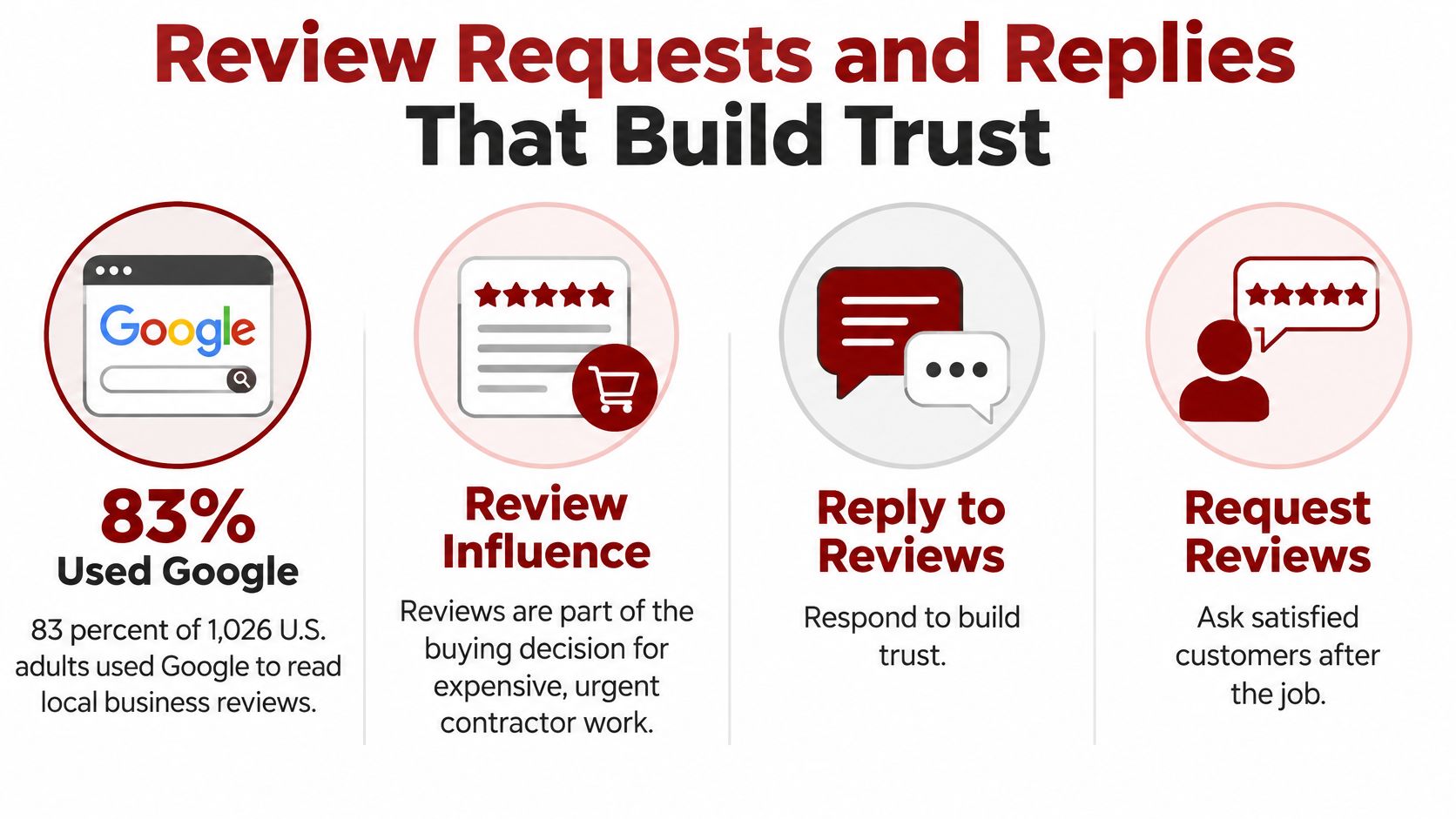
How do you ask without manipulating the review?
Send Google's review link after a completed job with neutral wording. Ask the customer to share how the project went, without prescribing a rating, mentioning a reward, or dictating service keywords.
Make the request part of normal job closeout rather than deciding who gets asked based on whether you expect praise. Don't offer discounts, gifts, or drawing entries, and don't hand customers a shared device already open to the review form.
How to handle each review situation
Situation | What to do | What to avoid |
|---|---|---|
Happy customer after a finished job | Send the Google review link with neutral wording | A discount, gift, or on-site review station |
Positive review already published | Thank them and name the service and town | Stuffing extra city or service keywords into the reply |
Complaint about schedule or workmanship | Acknowledge it and take the detail offline | Arguing or sharing private job details in public |
Review from someone who was never a customer | Flag it in the profile tools | Trading insults or asking friends to bury it with fake praise |
What should you say in a review reply?
Thank a satisfied customer specifically, but only mention the service or town when appropriate and without disclosing private information. For complaints, acknowledge the concern and explain how to contact the person responsible for resolving it. Don't litigate the project in public.
If you can't identify the reviewer, check your records before assuming the review is fake. Flag content you believe violates policy, understanding that disagreement alone isn't a reason for removal.
For organizing ownership and follow-up, Recepta.ai's review management strategies provide an additional resource. Our review management strategy also addresses making responses a repeatable business task.
This video provides another way to explore review management.
Keep the reputation consistent with the offer. Whether someone reads individual reviews or an automated summary, the feedback should describe work your business performs.
Which Calls and Quotes Become Paid Jobs
An out-of-area caller can make the profile look busy without adding useful work. Say a Prescott Valley roofer receives repeated inquiries from a distant town the crew won't serve. Those calls aren't successful leads because someone tapped the phone button.
Track service, town, time of day, inquiry type, and outcome. Record whether the conversation produced a booked estimate, an accepted quote, and paid work. Attribute website inquiries with tagged links where practical, and ask callers how they found you when attribution is unclear.
What belongs in the inquiry log?
Which inquiries to count and how to log them
Inquiry type | What it looks like | Action | Log field |
|---|---|---|---|
Emergency call | Urgent repair with a crew free soon | Book same day if the drive fits | Service, town, and hour |
Quote request | Homeowner asks for an estimate on a named service | Book the estimate and track it to a paid job | Service and town |
Job seeker | Person asking about hiring or openings | Route to hiring, not sales | Separate tag so it does not skew leads |
Spam or non-customer | Unrelated or fake inquiry | Ignore and flag | Excluded from lead count |
Out-of-area inquiry | Town beyond the profitable drive | Decline or refer | Repeat count by town for the monthly review |
An estimate also needs a clear scope. For a homeowner-side example outside Arizona, Alex Trend Painters' Dublin contractor quote comparison is a useful companion when thinking about how customers compare proposals.
Use call tracking metrics to distinguish activity from outcomes. Review the log monthly and adjust coverage or services when they repeatedly attract work you won't book.
What records protect the profile?
Keep business details consistent across your website and public directories, then preserve evidence of actual operations. The Google Business Profile suspension guide explains that appeals may require documentation supporting the business's legitimacy and eligibility.
Business records. Keep registration and relevant operating documents accessible.
Operational evidence. Preserve current vehicle, equipment, and job-site photographs.
Location records. Document which premises have staff and what happens there.
Measure the handoff: A booked estimate is more useful than a profile view, and a profitable completed job is more useful than an unqualified call.
Frequently Asked Questions About Google Business Profile for Contractors
Is a Google Business Profile free for contractors?
Yes. Creating and managing the listing doesn't require an advertising budget, and paid advertising is a separate choice. You'll still need time to maintain the information, handle inquiries, and manage customer feedback.
Does a Google Business Profile replace a website?
No. The profile helps customers assess the business quickly, while the website gives them room to evaluate project scope, qualifications, and how to request an estimate. Make sure visitors reach a relevant page rather than having to hunt for the service they need.
Do reviews affect Map Pack position?
Reviews contribute to prominence, but they don't determine every result. Don't chase an arbitrary review total as a shortcut to a guaranteed position.
What should I do if Google suspends the profile?
Read the stated issue, check the business's eligibility and representation, and prepare evidence supporting an appeal. Avoid creating a replacement listing as a workaround, which can complicate the situation.
How often should a contractor post?
Post when a completed job, service update, or seasonal note is useful to a prospective customer. A modest monthly schedule is a practical starting point, not a ranking requirement.
What should I bring to a profile review?
Bring the live listing, your actual service list, and the towns your crew will drive to. Include a sample of recent inquiry outcomes so the discussion can focus on work you want to book.
Silva Marketing's process has four stages: Free Strategy Call, Custom Plan, Build & Launch, and Optimize & Grow. New clients receive an itemized proposal within 48 hours, so the scope and responsibilities are clear before work begins.
Silva Marketing offers a free 30-minute call to discuss your contractor profile, service coverage, and the path from an inquiry to a booked estimate. Bring your listing, service list, and practical travel boundaries, and visit Silva Marketing to arrange a conversation about what needs attention.
Comments