
Google Ads Campaign Optimization for Local Leads

Your Prescott HVAC or roofing ads show clicks, impressions, and conversions, but the phone still isn't producing enough worthwhile work. Before you raise the budget, check what those conversions represent. Google Ads campaign optimization improves the path from a local search to a qualified call, booked estimate, or signed job, not just the bid.
Silva Marketing helps contractors, home-service companies, and professional practices in Prescott and Northern Arizona reduce wasted advertising spend and connect campaigns to business outcomes. That starts with separating potential customers from job seekers, existing-customer inquiries, spam, and people outside the service area.
Table of Contents
Start With Qualified Leads Not Click Volume - What should count as the primary conversion?
Read the Right Signal Before You Change Bids - What does a weak quality component tell you? - When is the problem measurement rather than messaging?
How to Optimize a Google Ads Campaign - What order should you follow? - How should you adapt this for different services?
Choose a Bid Strategy That Matches Your Data - How does auction-time bidding affect lead quality? - How long should you leave a strategy alone?
Keep Campaigns Inside the Real Service Area - Which Northern Arizona communities should you target? - Are Business Profile service areas the same as ad targeting?
Fix Campaigns When Automation Chases Bad Leads - Should I accept every recommendation to raise optimization score? - Why did results drop after I cleaned conversions? - When should I turn Smart Bidding off? - What is the recovery order?
Review Your Account Before the Next Budget Change - What should you review weekly? - What belongs in the monthly decision?
Start With Qualified Leads Not Click Volume
Say a Prescott roofer receives a mix of repair requests, supplier calls, and employment inquiries. If every conversation counts as a conversion, the account gives the bidding system no reason to distinguish a roof replacement opportunity from someone asking about a job.
A qualified lead needs a business definition before it needs a tracking tag. Use these checks:
Service fit: The customer needs work you perform.
Service area: The property is somewhere your team will travel profitably.
Real urgency: The customer has a genuine need and a workable timeline.
Job value: The opportunity can support its acquisition cost after labor, materials, and overhead.
Google's conversion-tracking guidance supports connecting online activity to offline outcomes, including signed contracts and purchases. Enhanced conversions for leads can help connect submitted customer information to later transactions using hashed first-party data, where eligible.
What should count as the primary conversion?
Choose the deepest reliable outcome you can measure consistently, such as a qualified call or booked estimate. Keep page views, button clicks, and preliminary inquiries available for observation without treating them as equally valuable bidding goals.
For form design, AgentStack's guide to turn website traffic into qualified leads is a useful companion. Ask for the service and location information needed to qualify the inquiry without turning the form into an interrogation.
Then connect that form to the ad's promise using Silva Marketing's Google Ads landing-page optimization guidance. Remove irrelevant searches, align the ad and page, and only then reconsider bids.
Practical rule: A higher reported cost per conversion can be acceptable after junk leads stop counting. Judge the change by booked work and acquisition cost, not by how busy the dashboard looks.
Read the Right Signal Before You Change Bids
What to change first by campaign signal
Signal | What it means | Change first | Do not do yet |
|---|---|---|---|
Below-average expected CTR | The ad promise may be weak versus the query | Rewrite the specific service and location offer | Raise the bid to buy the click |
Below-average ad relevance | The ad group theme may be too broad | Split keywords into a tight search theme | Add more assets to hide the mismatch |
Below-average landing-page experience | The page may miss the promised service, proof, phone, or speed | Match the headline, form, and call button to the ad | Judge the ad by CTR alone |
Under 30 conversions in the window | Too little evidence for a confident Smart Bidding evaluation | Keep or return to simpler bid control while validating data | Switch strategies based on an incomplete sample |
Target ROAS with under 50 conversions | The value target isn't yet meaningfully evaluated | Collect values on qualified jobs first | Treat early ROAS as final |
Conversions still inside a 90-day window | Reported CPA and ROAS may be incomplete | Evaluate a range ending at least 30 days ago, longer when needed | Pause a campaign after a quiet week |
Spam, short, or duplicate calls | The primary conversion may count junk | Review qualification and import valid outcomes | Let automation optimize to all calls |
Out-of-area searches | Location targeting may exceed actual coverage | Name cities and postal codes you serve | Default to a broad radius around Prescott |
The table gives you a diagnostic starting point, not proof of a single cause. A below-average expected click-through rate can indicate an unclear offer, but it can also reflect a mismatch between the search and the message. Read actual search terms before rewriting everything.
Google's Quality Score documentation describes expected CTR, ad relevance, and landing-page experience as components rated against other advertisers appearing for the same searches during the previous 90 days. The same documentation identifies the 1–10 Quality Score as a diagnostic tool, not a direct auction input.
What does a weak quality component tell you?
A weak expected CTR points you toward the promise. A generic heating-service headline gives a homeowner less reason to click than an accurate message about furnace repair in Prescott.
Weak ad relevance points toward organization. Emergency furnace repair, commercial maintenance, and new-system installation shouldn't all depend on the same generic ad.
A weak landing-page experience warrants a mobile inspection. Open the page from the ad, check whether the promised service appears immediately, and try the phone button and form yourself. Don't assume a page works because it looks polished on a desktop.
When is the problem measurement rather than messaging?
Open the conversion-action settings before deciding that bids are wrong. Check which actions are primary, whether repeat submissions count again, and whether calls are being qualified rather than merely timed.
Silva Marketing's conversion-tracking setup guide provides a practical reference for that inspection. A short call deserves review, but duration alone doesn't prove it's worthless. A customer can book quickly, while an unsuitable inquiry can last much longer.
Google recalculates Ad Rank when an ad becomes eligible and again when it competes in an auction. That makes relevance and usability worth fixing before assuming visibility requires more money.
Fix the weakest component, recheck the outcome, and leave the numerical Quality Score out of your business goals.
How to Optimize a Google Ads Campaign
Work from the customer outcome backward to the keyword, not from a keyword list forward to whatever traffic it produces. Google's quality guidance supports improving relevance and the post-click experience rather than treating higher bids as the universal fix.
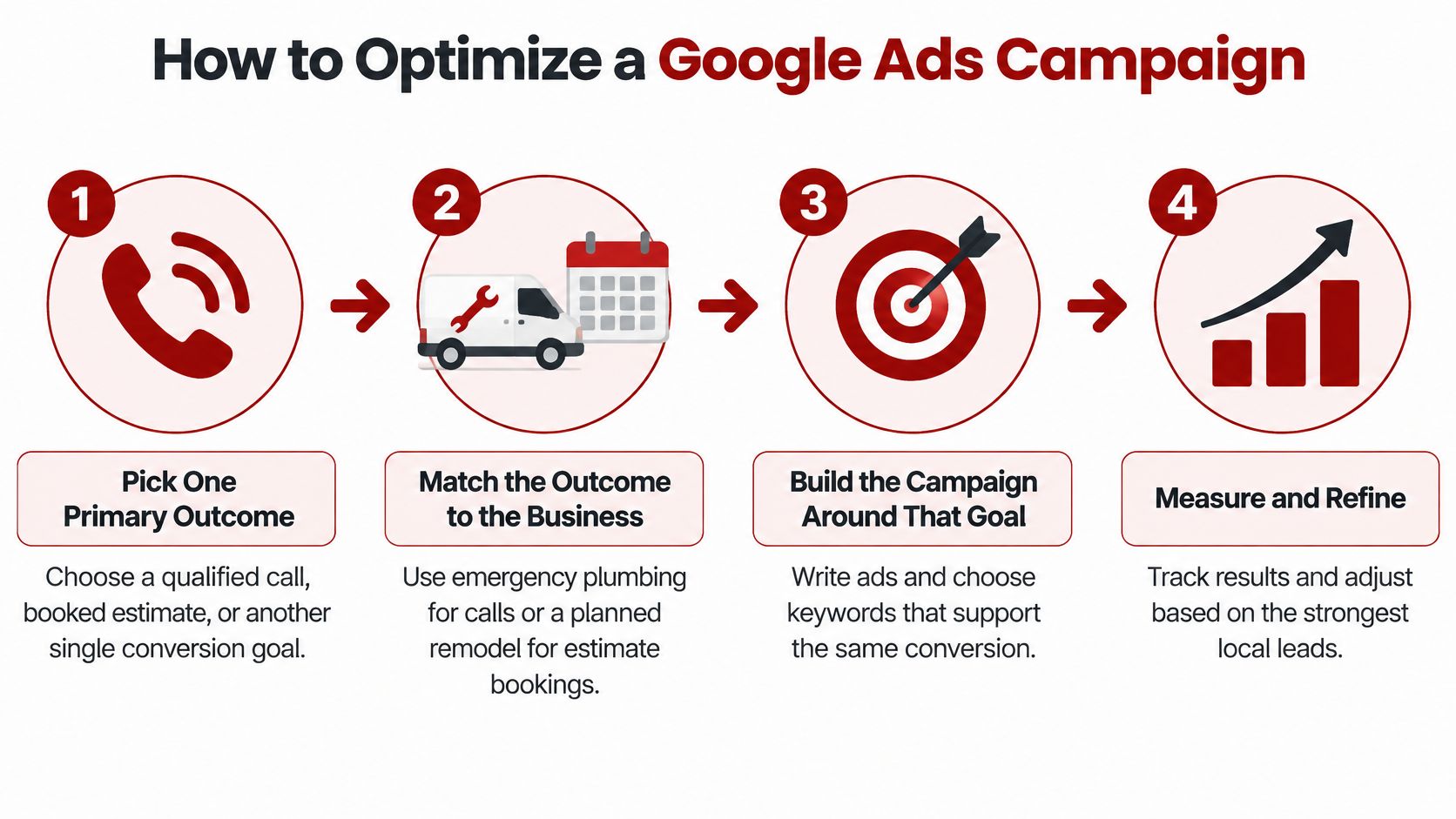
The visual summarizes the goal-to-measurement loop.
What order should you follow?
Pick the primary outcome. Choose a qualified call, booked estimate, or closed job, with clicks and page views secondary. For emergency plumbing in Prescott, a qualified call is more useful than a visit to the contact page.
Install and test tracking. Use gtag.js or Google Tag Manager, enable Enhanced Conversions where eligible, and verify that a real call and form submission each record correctly without duplication. Test the Prescott Valley estimate form on a phone, not just in preview mode.
Connect offline stages. Import CRM outcomes and remove spam and duplicates from the bidding signal. A signed roofing contract in Chino Valley should be distinguishable from an unanswered inquiry.
Separate intent and meaningful geographic differences. Don't mix emergency work with long-planning-cycle projects. A Prescott leak-repair campaign needs different messaging and budget decisions from a planned bathroom remodel in Dewey-Humboldt.
Build tightly themed ad groups. Start with exact match for proven job terms and phrase match for controlled exploration; consider broad match only with dependable conversion feedback and negatives. Keep furnace repair separate from air-conditioning installation even when both services share a crew.
Review search terms weekly. Exclude careers, DIY, free, wholesale, and unserved locations when they don't fit the offer. A Prescott contractor selling installation services shouldn't pay for searches seeking wholesale equipment.
Write specific, supportable ads. Repeat the service intent, name the place, and include a genuine proof point. A Prescott Valley electrician can mention verified licensing or an actual service capability, but shouldn't promise arrival times the schedule can't support.
Add useful assets. Use call, location, sitelink, and callout assets where applicable. A Prescott HVAC ad can link separately to repair and replacement pages without sending both visitors through the homepage.
Match the landing page. Keep the headline, visible phone number, short form, and call-to-action consistent with the ad. For a Chino Valley roofing estimate, show relevant roofing proof and explain what happens after submission.
Adjust bids or budget last. Expand what produces qualified opportunities within operating capacity. If Prescott repair work books profitably but a neighboring-town campaign doesn't, investigate that campaign before raising the whole account's spend.
How should you adapt this for different services?
The intent changes even when the mechanics don't. Estimatty's Google Ads strategies for cleaning companies offers a useful service-specific comparison: recurring cleaning inquiries and urgent plumbing calls shouldn't use identical qualification criteria.
For another walkthrough of campaign optimization, use the video alongside your account review.
Don't mistake a tracking repair for newly created demand. If previously missed inquiries start appearing in reports, reconcile them with booking records before claiming that advertising performance improved.
Choose a Bid Strategy That Matches Your Data
A Prescott service company can get plenty of form submissions and still have few booked jobs. Choose bidding based on qualified opportunities and revenue, not click volume or raw lead counts.
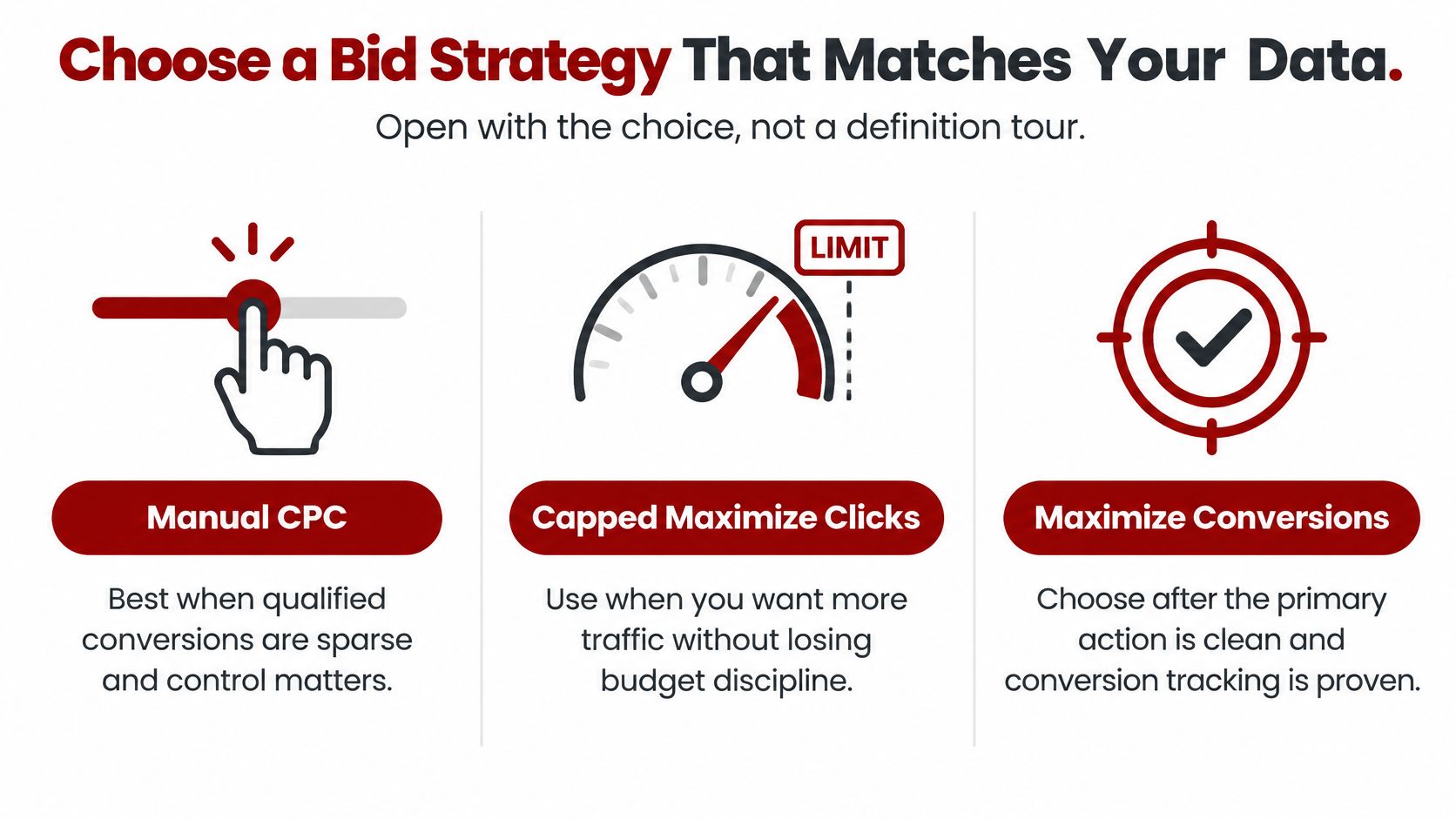
When tracking is new or qualified conversions are sparse, manual CPC or capped Maximize Clicks can preserve control while you check whether the signal is useful. Neither approach filters out poor-fit inquiries, and a click cap does not guarantee good traffic.
Google's Smart Bidding guidance recommends evaluation periods that include at least 30 conversions, such as a month or longer, and generally at least 50 conversions for Target ROAS. These are evaluation guidelines, not universal activation requirements.
Bid strategy by conversion data
Strategy | Use it when | Watch for | Avoid it when |
|---|---|---|---|
Manual CPC or capped clicks | Tracking is new or monthly jobs are few | Lost impression share on proven terms | Stable qualified volume supports conversion bidding |
Maximize Conversions | The primary action is clean and sufficient conversion history exists | Cheap, low-fit leads entering the goal | Spam calls remain primary |
Target CPA | Qualified-lead CPA has been steady through a meaningful evaluation period | A target below what the account can achieve | The qualified sample remains too small |
Target ROAS | Closed-job values are imported with enough outcomes to evaluate | A large job distorting the target | Only form fills have arbitrary values |
Portfolio bidding or shared budget | Services have compatible goals, margins, and geography | A town or service absorbing disproportionate spend | Emergency and planned work need separate controls |
Portfolio bidding coordinates bids across campaigns; a shared budget changes how spend is allocated. Treat them as separate choices. Group services only when they have compatible goals, margins, and geography.
This visual compares the simpler starting options.
How does auction-time bidding affect lead quality?
Google sets a bid for each auction using signals and the conversion objectives you supply. If the primary action counts junk inquiries as success, automation can become efficient at finding more of them. Keep conversion-based automation off until the primary action reliably represents qualified opportunities.
Silva Marketing explains the available approaches in its guide to Smart Bidding in Google Ads. Set acquisition limits using cost per qualified opportunity, close rate, and job contribution, rather than a generic CTR target. A relatively expensive click may be worthwhile if it leads to profitable work; a cheap click is still wasted spend when the customer is a poor fit.
How long should you leave a strategy alone?
Change one bidding lever at a time and allow delayed outcomes to arrive. Google notes that conversions can be recorded up to 90 days after a click, depending on the conversion window, and recommends reviewing ranges ending at least 30 days earlier, or longer when appropriate. A planned remodeling customer may take longer to decide than someone with a burst pipe.
Keep paid acquisition reporting separate from other visibility measures. OGTool's discussion of keyword visibility for brands in AI search addresses a different measurement problem. Visibility in AI search does not show whether paid campaigns generate profitable booked jobs.
Shared spending across unlike services can hide which service or campaign is producing value. Preserve enough reporting separation to judge each against its own qualified-lead and job economics.
Keep Campaigns Inside the Real Service Area
Name the communities your team will drive to before choosing targeting settings. A wide circle around Prescott can include work you don't want, while excluding a town along a practical route.
Use the map as an operating decision, not a claim that your business serves every place nearby.

Which Northern Arizona communities should you target?
Start with Prescott, Prescott Valley, Chino Valley, and Dewey-Humboldt if those communities fit your actual coverage. Add selected Verde Valley towns only when travel time, crew availability, and job economics make sense.
A replacement project may justify a drive that a small repair doesn't. Define coverage by service when necessary, rather than assuming every crew and offer can support the same geography.
Target presence: In Google Ads, choose the presence-based option for local campaigns rather than presence-or-interest when you want people physically in or regularly in the target area.
Inspect actual locations: Compare user-location reporting and customer addresses with your intended boundaries.
Exclude unsuitable demand: Remove Phoenix-only searches when your business won't serve those properties.
Avoid overfragmentation: Create separate town campaigns when budgets, offers, or economics justify them, not merely to produce more campaigns.
Are Business Profile service areas the same as ad targeting?
No. Business Profile service areas describe coverage; Google Ads location settings control paid targeting. A radius can be used in Ads, but it doesn't replace careful geographic review.
Google's Business Profile guidelines generally call for a service-area business to maintain a single profile for its central location, specify coverage using named places rather than a radius, and keep the overall area within about two hours of driving time, with up to 20 service areas. A virtual office doesn't qualify unless it meets Google's staffing requirements during business hours.
Keep business identity, phone details, and service descriptions consistent. Don't invent branch offices or location-specific proof to make a town page look more established.
For a legitimate Prescott Valley page, name the service and town, show a relevant local project when you have permission and evidence, and put the call button within easy reach on mobile. If you don't have local project proof, use accurate business-wide proof instead.
Test promises such as same-day availability or financing only when you can fulfill them. Compare qualified calls and booked jobs by town against your own account history, and review vendor and applicant calls before including them in bidding outcomes.
Fix Campaigns When Automation Chases Bad Leads
Should I accept every recommendation to raise optimization score?
No. Google describes optimization score as an estimate of how well an account is configured to perform. It isn't a substitute for checking whether the recommended change fits your business objective.
A recommendation to expand reach can be reasonable for a capacity-ready business and unsuitable for a Prescott contractor already struggling with low-fit inquiries. Accept the change only when you can explain how you'll judge its effect on qualified opportunities.
Why did results drop after I cleaned conversions?
Reported volume can fall because you stopped counting duplicates, spam, or preliminary interactions. That isn't automatically a demand decline, and it doesn't automatically prove profitability improved either.
Reconcile the account with CRM stages, booking records, and completed-job value. Compare periods using consistent definitions wherever possible, and label the measurement change so nobody mistakes it for a marketing event.
When should I turn Smart Bidding off?
Temporarily use simpler controls when a broken primary action, missing consent-dependent signals, or tag failures make conversion feedback unreliable. Investigate when unsuitable calls dominate a small sample or lead quality changes sharply by location.
Keep automation when tracking is sound and the issue is poor value differentiation. In that case, improve the outcome or value signals instead of abandoning a functioning system.
Google's enhanced-conversion guidance explains the role of first-party measurement and describes May 2025 developments including data-source diagnostics and the Google tag gateway. Treat those tools as reasons to inspect measurement health, not as switches that guarantee better leads.
What is the recovery order?
Use a controlled recovery rather than changing every setting together:
Repair the signal. Verify the primary action, consent handling, tags, and deduplication.
Remove unsuitable traffic. Check queries and geography using a deliberate Google Ads negative-keyword process.
Rerun the message test. Compare the actual search with the ad and landing page.
Restore appropriate bidding. Reintroduce automation only after dependable outcomes resume.
For material budget decisions, test incrementality rather than relying solely on attributed conversions. Google's attribution and lift guidance describes test-versus-control measurement and recommends accounting for conversion lag, with a 7–56-day measurement window when appropriate.
Attribution tells you where credit was assigned. A well-designed holdout helps test whether advertising caused additional outcomes.
Review Your Account Before the Next Budget Change
Don't increase spending until you can explain what the primary conversion means, which searches produced it, and whether those customers can become profitable jobs. More budget magnifies both useful targeting and preventable waste.
A Prescott owner doesn't need to inspect every setting every morning. You need a review rhythm that catches operational problems promptly without rewriting the campaign whenever a quiet day makes the numbers uncomfortable.
What should you review weekly?
Check search terms, call qualification, and the landing pages receiving paid traffic. Look for broken forms, unanswered calls, misleading promises, and searches related to careers, DIY, free services, wholesale products, or unserved cities.
Record the issue: Note the query, location, page, or conversion action involved.
Choose the smallest useful change: Add a negative, repair a form, or correct an inaccurate promise.
Keep a change log: Document what changed and what outcome would justify keeping it.
Don't exclude a search just because it contains a word you dislike. Read the whole query and consider whether it represents a customer your business wants.
What belongs in the monthly decision?
Review cost per qualified call, cost per booked job, and closed-job value alongside close rate and operating capacity. Separate tracking cleanup from changes in actual demand, then choose a single meaningful test.
Silva Marketing's Google Ads Management provides full-funnel campaigns with daily optimization and clear ROI tracking. Clients receive a monthly performance dashboard and report, a next-step roadmap, direct communication with their marketer, and measurable KPIs.
For a useful consultation, bring account access, the last 90 days of calls, and a short list of jobs worth winning. The free 30-minute strategy session reviews goals, audits current marketing and the website, and maps a plan without pressure or obligation.
We align on goals and budget before preparing an itemized proposal, which follows within 48 hours. Work starts within 5 to 7 business days after the strategy session, so the next step is a defined plan rather than an unexplained budget increase.
Silva Marketing offers a free 30-minute call to review your ads, website, and the outcomes your campaign should prioritize. Visit Silva Marketing to book a consultation and build a practical plan for more qualified calls and booked work in Prescott and Northern Arizona, with no pressure or obligation.
Comments