
10 Conversion Rate Optimization Strategies

The average website converts at about 2.9%, while top performers reach 11%+ and the top 10% hit 11.45%. The strongest conversion rate optimization strategies for service websites close that gap by making the page relevant, trustworthy, fast, and easy to contact.
That matters in Prescott and across Northern Arizona because traffic alone doesn't create customers. Local service businesses need qualified calls, form submissions, consultation bookings, and lower cost per lead. If someone lands on your site looking for a contractor, plumber, HVAC company, attorney, clinic, or local specialist, they should understand what you do, where you serve, why you're credible, and how to contact you within seconds.
Silva Marketing helps Prescott and surrounding Northern Arizona businesses do exactly that through custom websites, redesigns, SEO, Google Ads, testing, and measurable execution. The work isn't about chasing cosmetic tweaks. It's about improving the full path from click to conversation so more visitors become real leads.
Remove uncertainty and friction at every step.
The benchmark gap is wider than most business owners expect. The median website conversion rate across industries is 2.35%, the top 25% reach 5.31%, and the top 10% reach 11.45%, which is why serious CRO work usually means fixing structural bottlenecks instead of making random design edits (industry CRO benchmark ranges).
Table of Contents
1. A/B Testing and Multivariate Testing - What makes A/B testing reliable
2. Landing Page Optimization and Relevance - What high-converting landing pages usually do
3. Persuasive Copywriting and Value Proposition Clarity - Where weak copy usually breaks down
10. Analytics, Measurement, and Continuous Optimization - How to keep optimization disciplined
Which CRO tactic should a service business start with? - Frequently asked questions - How long does CRO take to show results? - Should a local service business prioritize phone calls or forms? - Are landing pages better than homepages for Google Ads traffic? - How important is speed for lead generation? - What trust signals matter most for local businesses?
What are conversion rate optimization strategies?
Conversion rate optimization strategies are the methods used to increase the percentage of website visitors who take a valuable action, such as calling, submitting a form, or booking a consultation. For local service businesses in Prescott, Prescott Valley, Chino Valley, Dewey-Humboldt, Cottonwood, Sedona, and the broader Northern Arizona region, that usually means improving message clarity, mobile usability, page speed, trust signals, contact paths, and measurement so more existing traffic turns into leads.
1. A/B Testing and Multivariate Testing
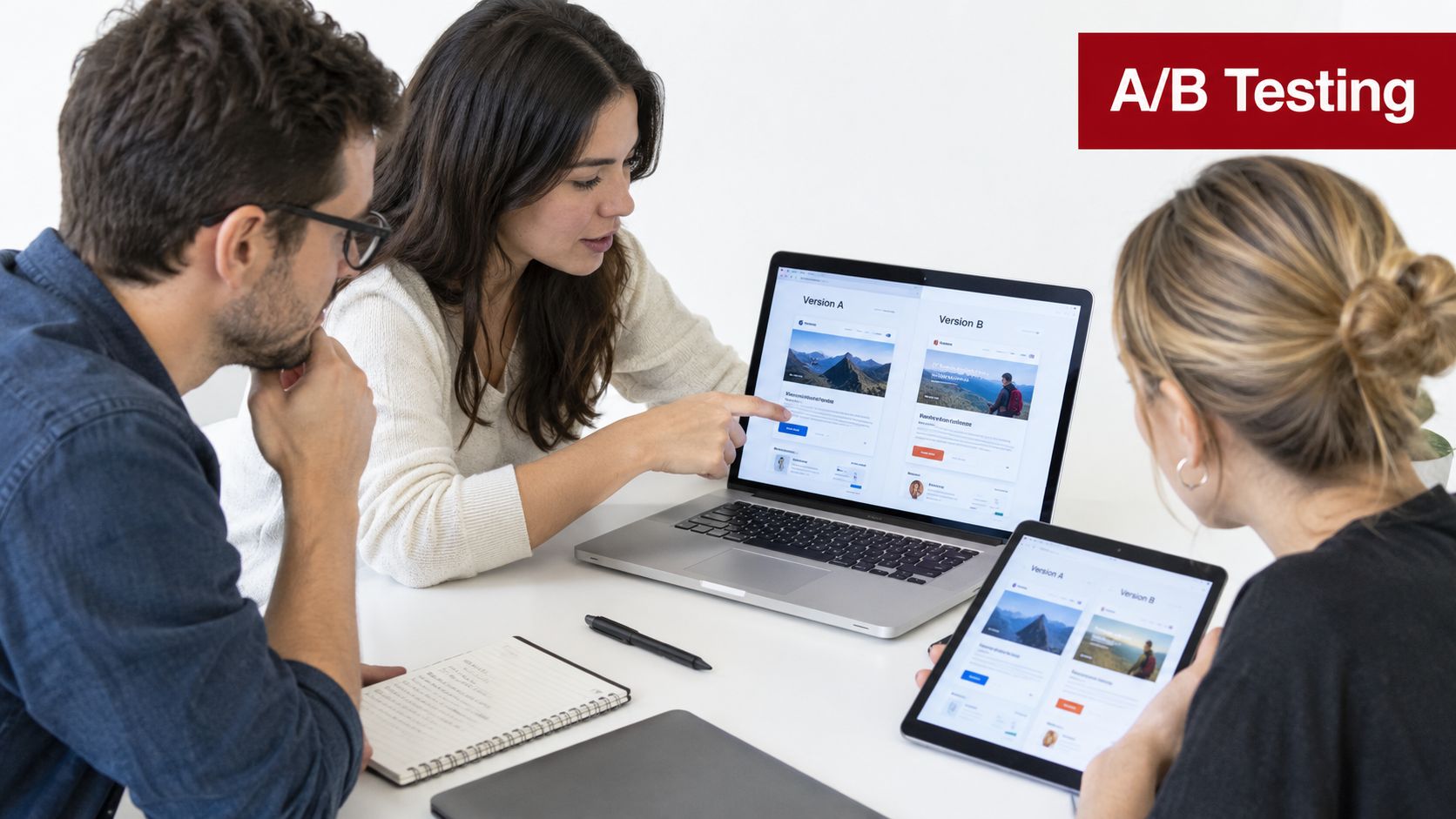
A/B testing is useful when you already know which page matters and you need evidence before changing it. For service businesses, that usually means testing a headline, CTA, phone placement, form layout, or trust section on a high-intent page. Multivariate testing can help on larger sites, but most local businesses don't have enough traffic to run it well.
Silva Marketing uses testing to settle arguments quickly. If a Prescott roofing page gets steady paid or organic traffic, the right question isn't which version the team likes more. The question is which version produces more calls and better form submissions.
What makes A/B testing reliable
A test only helps if the result is trustworthy. One published calculator example shows that at a 5% baseline conversion rate and a 10% minimum detectable effect, you need roughly 31,000 visitors per variation at 95% significance and 80% power (A/B test sample size example).
That is why many Northern Arizona service businesses should avoid overcomplicated testing programs. A lower-traffic site often learns more from sequential testing on one major friction point at a time than from trying to test several elements at once.
Start with a single variable: Change one important element, such as the hero headline or CTA text, so you can attribute the outcome clearly.
Prioritize high-intent pages: Test service pages, landing pages, and quote-request pages before low-value blog traffic.
Log every test: Keep a running record of what changed, what metric moved, and whether the result held.
Practical rule: Don't treat a small sample as proof. Low-volume sites need patience, not faster opinions.
2. Landing Page Optimization and Relevance
Landing pages decide whether paid traffic turns into calls or gets wasted.
For a local service business, relevance is not a cosmetic detail. It is the difference between a visitor feeling confident enough to call now or backing out because the page feels generic. If someone clicks an ad for emergency HVAC repair in Prescott, the page should confirm that exact service, in that exact area, within seconds.
What high-converting landing pages usually do
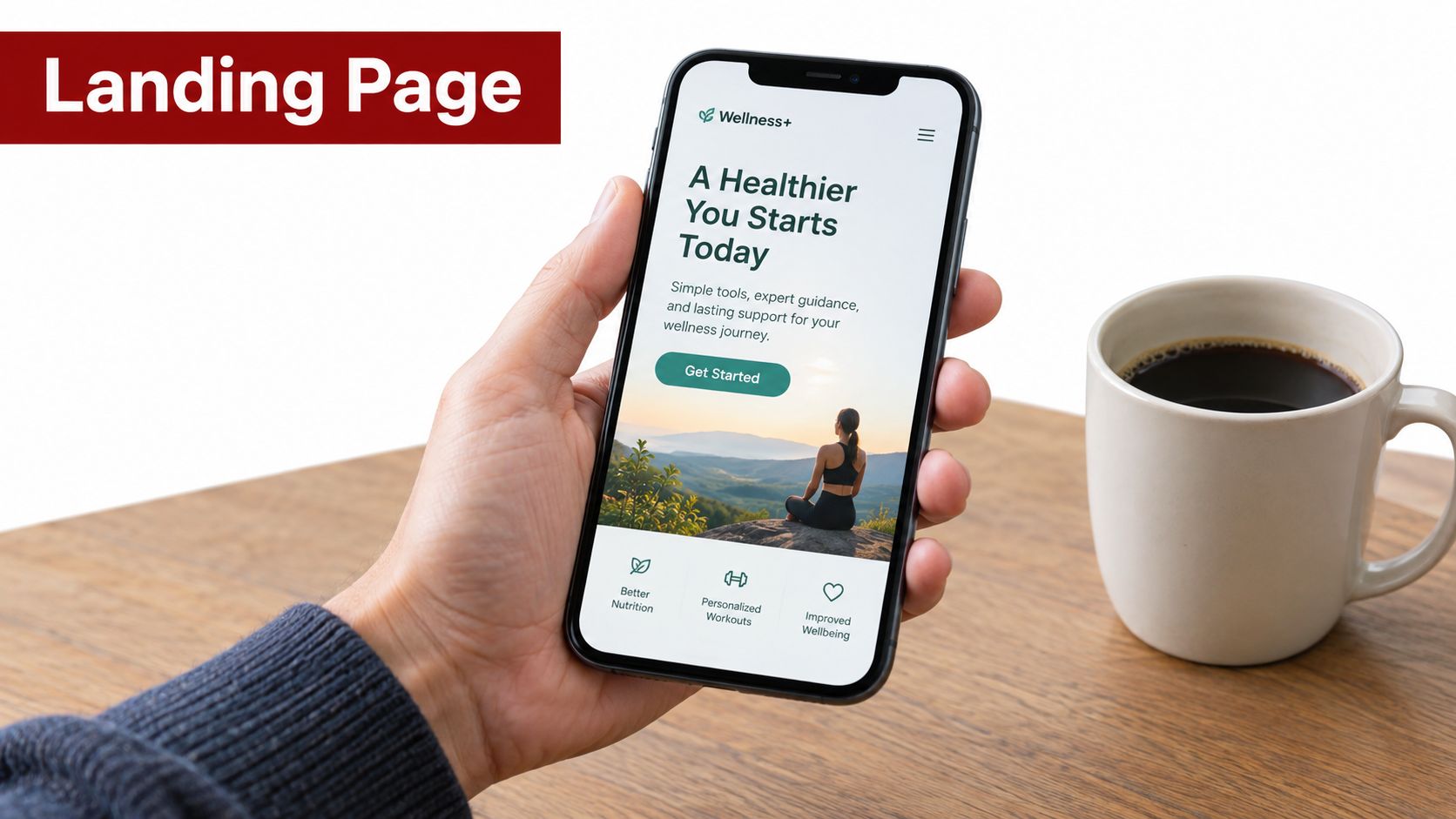
A strong landing page keeps the decision path short. One offer. One audience. One next step. Pages lose leads when they mix too many services, too many CTAs, or vague copy that could apply to any market.
That matters even more for phone-first campaigns. A homeowner looking for a roofer, plumber, attorney, or med spa in Northern Arizona often wants fast confirmation before they call. They check whether the business serves their area, whether the service matches their problem, and whether the company looks credible enough to contact.
A practical page structure often includes:
A headline that matches the click: Repeat the service and local intent clearly so the visitor knows they landed in the right place.
A single primary conversion action: For service businesses, that usually means call now, request an estimate, or book a consultation.
Trust near the top of the page: Reviews, licensing, service-area references, and real project or team photos reduce hesitation early.
Supporting details without clutter: Answer the main objections, but keep the page focused on the conversion goal.
There is a trade-off here. Shorter pages usually convert better for urgent, high-intent traffic. More considered services often need more proof, process details, and FAQs before someone is ready to reach out. The right structure depends on the offer, traffic source, and how much risk the buyer feels.
Silva Marketing builds service and campaign pages around that full journey, from ad message to phone call to form tracking, because local CRO works best when relevance, trust, and measurement are connected. If you want to compare page structures that keep attention on the offer, these landing page design examples show how focused layouts reduce friction without stripping out the proof people need.
3. Persuasive Copywriting and Value Proposition Clarity
Clear copy increases qualified calls. For local service businesses, that usually matters more than sounding polished.
A visitor gives your page a fast credibility check. Can this company solve my problem? Do they work in my area? Will I waste time if I call? If the copy delays those answers and fills the space with generic claims about quality or commitment, conversion rate drops before design or CTA placement gets a fair shot.
Strong value proposition work is really message discipline. Each section of the page should reduce one piece of hesitation and move the visitor closer to a call or consultation. That means naming the service plainly, setting expectations about who you help, and showing why your business is the safer choice in this market.
For Prescott and Northern Arizona companies, local specificity does real work here. "Roof repair" is broad. "Roof repair for storm damage and leak issues in Prescott, Prescott Valley, and Chino Valley" gives the visitor a quicker yes or no. That kind of copy also helps align the page with search intent, ad intent, and phone intent, which is the part many CRO discussions miss.
Where weak copy usually breaks down
Weak service-page copy often fails in one of three places:
The headline is vague: It talks about results or reputation without naming the actual service.
The body copy stays abstract: It describes values instead of explaining problems solved, process, timeline, or next steps.
The proof is disconnected from the claim: The page says the business is trusted, but the copy does not support that with reviews, credentials, project examples, or local experience.
Silva Marketing rewrites pages with the call path in mind, not just the read path. A page has to answer enough questions to earn the contact, then make the next action feel straightforward. That same approach shapes how service pages, SEO targeting, and Google Ads traffic work together for Prescott-area businesses. For a practical example of page messaging structure, this guide on how to create high-converting landing pages shows how offer clarity and CTA clarity support each other.
One more trade-off matters. Detailed copy can improve lead quality for higher-consideration services, but too much explanation near the top can slow down urgent callers who are ready now. The better approach is usually layered messaging: clear service promise first, proof and specifics next, then deeper detail for people who need more confidence before they reach out.
4. Form Field Optimization and Lead Capture Strategy
A local service form should do one job well. Start the conversation fast enough that a prospect doesn't leave and call a competitor instead.
That changes how form strategy works for phone-first businesses. The form is not the full sales process. It is the handoff into a call, text, or consultation. Silva Marketing builds around that reality for Prescott and Northern Arizona companies, especially when SEO and Google Ads traffic bring in a mix of urgent leads and higher-consideration prospects.
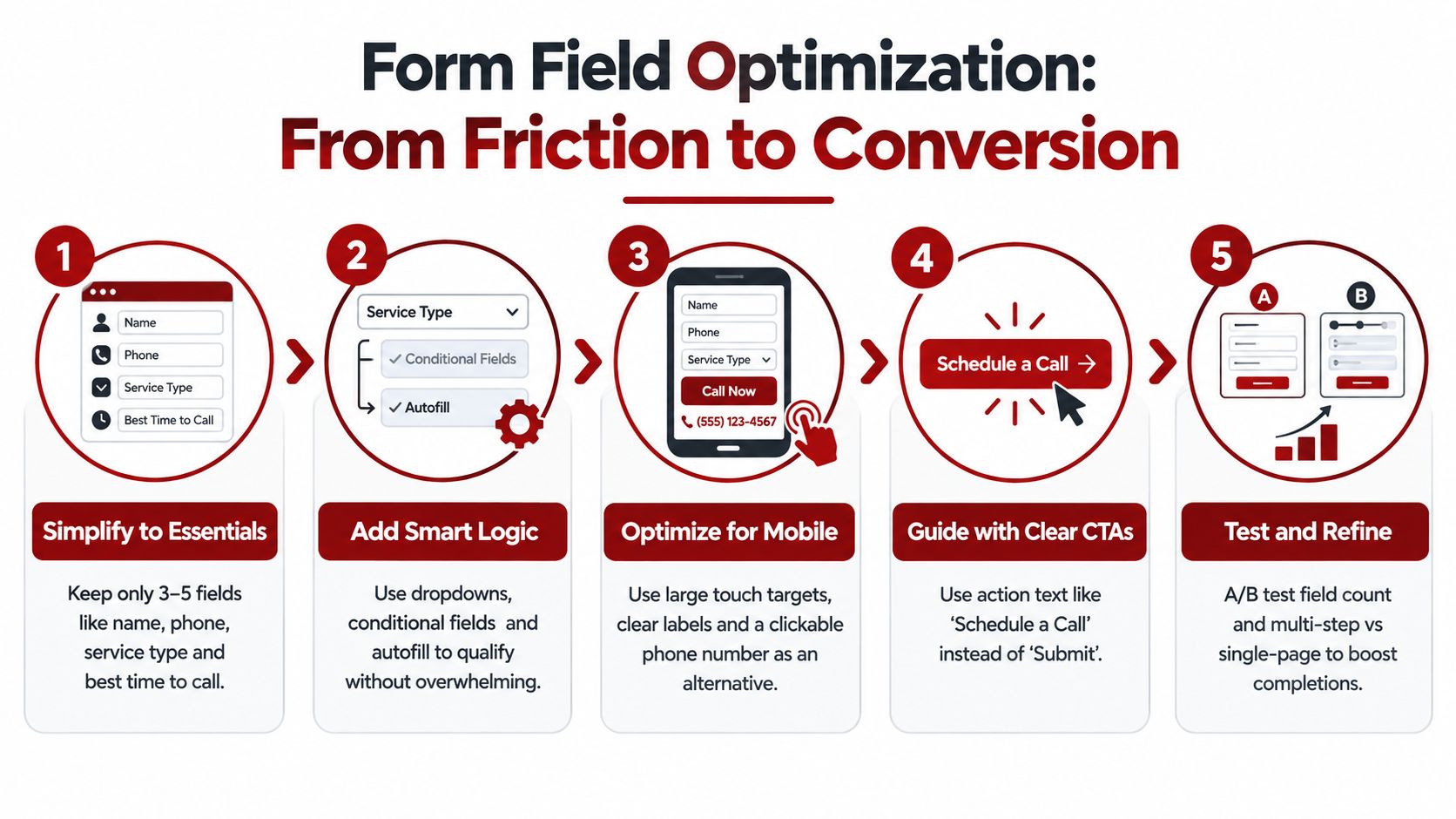
A good starting point is simple: collect only what the team will use in the first follow-up. For many service businesses, that means name, phone, service type, and a short message. If the office calls back within minutes, that is usually enough to qualify the lead properly.
The trade-off is operational, not theoretical. More fields can help routing and screening, but they also slow down submissions from people on mobile who are comparing options quickly. For an HVAC company, dentist, attorney, or contractor, a short form plus a strong phone follow-up often produces more real conversations than a long intake form built for internal convenience.
A few field choices tend to matter more than the rest:
Require a phone number if calls are the sales path: If consultations are booked by phone, the form should support that process directly.
Use a service dropdown only if the labels are obvious: Confusing categories create hesitation and bad lead routing.
Add a preferred contact time when response timing matters: That small field can reduce missed calls and improve connect rates.
Avoid asking for details you can get on the first call: Full addresses, budget ranges, and long project descriptions often create friction too early.
The confirmation step matters too. After submission, show what happens next, how quickly the business responds, and whether the prospect should call now for urgent needs. That keeps the page aligned with the customer journey instead of treating the form submit as the finish line.
For teams reviewing layouts, field order, and friction points, these effective lead form examples are useful for comparing how different structures shape lead capture.
5. Page Speed and Technical Performance Optimization
A slow page wastes paid clicks, weakens SEO traffic, and reduces call volume before a prospect even decides whether to trust the business.
That problem shows up fast on local-service sites. Someone searching for a roofer in Prescott, an emergency plumber in Prescott Valley, or a family law attorney in Northern Arizona is often on a phone, often in a hurry, and often ready to call if the page loads cleanly. If it stalls, they back out and pick the next option.
Google's published research found that even small improvements in load time can affect conversion behavior in measurable ways (Google load-time research). For service businesses, speed is tied directly to lead quality because the highest-intent visitors usually have the least patience.
I usually treat technical performance as part of the conversion path itself. If the header loads late, the phone number shifts, the call button lags, or a form stalls after someone taps it, the problem is not "technical" in any practical sense. It is a CRO leak.
Silva Marketing applies that lens on website rebuilds, SEO campaigns, and Google Ads landing pages for Prescott and Northern Arizona companies. The goal is not just a better score in a testing tool. The goal is a page that loads fast enough for the message, trust signals, and contact actions to do their job. Teams that need that foundation can review Silva Marketing's approach to Core Web Vitals optimization.
Three checks usually expose the biggest issues:
Test the mobile experience first. Desktop scores can look acceptable while the actual phone experience is slow on cellular data.
Cut script weight aggressively. Chat tools, tag stacks, sliders, maps, and third-party widgets often create more delay than owners expect.
Verify contact actions under imperfect conditions. Tap-to-call, sticky headers, and short forms should work quickly even on older phones and weaker connections.
There is a trade-off here. Extra plugins and visual effects can add polish, but local-service pages do not get paid for polish alone. They get paid when someone can read the offer, trust the business, and call without friction.
6. Strategic Call-to-Action Design and Placement
Strong CTAs shorten the distance between interest and contact. On local service pages, that usually means making the next step obvious on a phone, not just making a button more prominent.
A homeowner in Prescott who needs help now is often deciding between calling, checking service-area fit, or leaving the page. The CTA has to support that decision path. If the page asks for too much commitment too early, calls drop. If every option looks equal, people hesitate and postpone.
The best-performing setup is usually tiered.
Put the primary action where high-intent visitors can act immediately. Keep the phone number visible in the header and near the top of the page. On mobile, a tap-to-call button earns its place because many service leads still prefer a quick conversation over a longer form. Then give lower-intent visitors a second path, such as "Request an Estimate" or "Ask About Availability," especially on SEO pages where research behavior is more common.
Instead of treating CTA placement like a design preference, map it to the questions visitors ask as they scroll:
At the top, answer whether they can contact you now.
After service details, offer the next step once they understand what you do.
After pricing context, FAQs, or service-area information, place another CTA for visitors who needed one more piece of reassurance.
Button copy matters, but intent match matters more. "Call Now" works for urgent services. "Schedule a Consultation" fits higher-consideration work. "Get a Quote" can work well if the page has already explained what the quote covers. Generic labels like "Submit" waste useful space and give people no reason to act.
This is one area where Silva Marketing's phone-first approach changes the build. On websites, SEO landing pages, and Google Ads campaigns for Prescott and Northern Arizona businesses, CTA decisions are tied to traffic source, service urgency, and lead type. A plumbing ad click may need one dominant call action. A custom home builder page usually needs a call option plus a form for prospects who are still comparing timelines and budgets.
More CTA options do not always improve conversion. They can lower it by scattering attention. One clear primary action, one sensible backup action, and repeated placement at decision points usually does more for lead flow than adding extra buttons across the page.
7. Trust Signals, Social Proof, and Credibility Elements
Credibility changes conversion rates fast on local service sites. A visitor may like the offer, understand the service, and still hold back if the business does not feel proven.
For Prescott and Northern Arizona companies, trust usually comes from specifics, not decoration. People want evidence that the company is real, active, qualified, and familiar with the area they serve. That evidence needs to appear on the page before a prospect decides whether to call, fill out a form, or keep comparing options.

A strong trust section does not try to impress everyone equally. It reduces the specific doubts a local prospect has. Can this company do the job? Have they done it nearby? Will someone answer the phone? Are they licensed, insured, established, and accountable if something goes wrong?
The highest-impact credibility elements are usually practical:
Reviews tied to the service and city: A roofing review from Prescott Valley carries more weight on a roofing page than a vague five-star quote with no context.
Licensing, insurance, and certifications: These matter because they lower perceived risk, especially for contractors, legal services, healthcare, and home services.
Real project photos and team photos: Original images help visitors judge legitimacy faster than stock photography.
Visible business details: A local phone number, service-area references, office location if relevant, and clear hours all support confidence.
Proof of process: Short explanations of what happens after a call or form submission make the business feel more reliable.
Placement matters as much as the assets themselves. Reviews buried on a testimonials page do less work than a short, relevant quote near the form, service summary, or phone CTA. The same goes for badges and certifications. If they only appear in the footer, many prospects will never use them in the decision.
Accessibility supports trust too. Clear contrast, readable text, labeled form fields, and keyboard-friendly navigation make the site easier to use and make the business look more careful and credible. That benefit shows up in lead flow because fewer visitors get stuck before reaching the call or consultation step.
At Silva Marketing, this work is usually tied to the full journey, not added as a design extra at the end. On websites, SEO landing pages, and Google Ads traffic for local businesses, credibility elements are matched to visitor intent. A homeowner looking for an emergency repair may need fast reassurance with reviews, service area, and tap-to-call access. A higher-ticket prospect comparing providers may need case photos, process clarity, and stronger qualification proof before booking a consultation.
8. User Experience Design and Navigation Simplification
A lot of local service sites do not have a traffic problem first. They have a path problem.
Someone lands on the page ready to call, but the page makes them work to figure out whether the business handles their job, serves their area, or offers the right next step. That friction shows up fast on mobile, where a confused visitor usually leaves instead of hunting through menus.
For Prescott and Northern Arizona service businesses, navigation has to do more than look organized. It has to sort visitors by need quickly. A roofing company may need separate paths for repairs, replacements, storm damage, and commercial work. A home services company may need to split emergency jobs from estimate-based projects. If those paths blur together, lead quality drops and call volume suffers because the wrong visitors click through while qualified prospects stall.
A useful example of mobile-first UX thinking is below.
Analysts cited in these device conversion gap benchmarks found that desktop users still convert at much higher rates than mobile users. For service businesses, that gap usually points to practical usability issues. Menus get crowded. Service pages bury the phone number. Important actions sit too low on the screen. Forms feel longer on a phone than they did during desktop design.
The fix is rarely a visual redesign by itself. The fix is reducing decisions.
Here is what that usually looks like in practice:
Cut top-level menu choices: Keep primary navigation focused on core services, service areas if they matter, and contact paths.
Build obvious service groupings: Visitors should know within seconds whether they need repair, installation, maintenance, or consultation.
Keep the phone path visible: On mobile, tap-to-call access should stay easy to reach without forcing a scroll back to the header.
Use page layouts that support scanning: Strong headings, short sections, and clear next steps help visitors move without rereading.
Match navigation to buying urgency: Emergency visitors need speed. Higher-consideration visitors need comparison and process clarity before they contact you.
I see this mistake often on local service websites. The homepage tries to send every visitor everywhere at once. That feels thorough to the business owner, but it creates hesitation for the prospect. A better structure gives each visitor the shortest reasonable path to a call, form, or consultation request.
At Silva Marketing, UX simplification is tied to how leads come in from SEO pages, service pages, and Google Ads traffic. If a page gets search traffic for a high-intent service, the design should support that intent immediately with a clear message, a direct action path, and navigation that does not pull attention into less relevant pages. That is how page messaging, call behavior, and site structure start working together instead of fighting each other.
A cleaner journey gets more calls.
9. Targeted Content Strategy and Intent Alignment
Strong CRO content closes the gap between why someone searched and what the page asks them to do next.
For a local service business, that means building content around service intent, urgency, and location. A homeowner in Prescott searching for AC repair during a heat wave needs a very different page experience than someone comparing roof replacement timelines for a planned project. If both visitors land on generic advice, conversions drop. Calls get delayed. Form submissions get weaker.
The pages that drive leads usually answer the question behind the search, then remove doubt fast. Cost, timing, warning signs, repair versus replacement, insurance questions, service area fit, and what happens after contact all influence whether a prospect calls now or keeps looking. In Northern Arizona, local conditions matter too. Weather, elevation, seasonal wear, rural access, and older housing stock often change what people need to know before they book.
I usually separate content planning into buying situations rather than blog categories:
Ready-to-hire intent: service pages, emergency pages, city pages, and consultation pages that make the next step obvious
Comparison intent: repair versus replacement pages, process pages, pricing approach pages, and "what to expect" content
Early research intent: articles that help visitors identify a problem before they are ready to contact anyone
That structure matters because content does more than attract traffic. It qualifies traffic.
Recent CRO coverage has put more attention on the full customer journey, including micro-conversions and cross-device behavior (CRO in 2025 and micro-conversions). For local businesses with limited traffic volume, that is a practical shift. A call click from a service page, a visit to a financing page, or a form start after reading an FAQ can reveal intent long before a completed lead shows up in the CRM.
At Silva Marketing, content planning ties directly to authority-first websites, SEO targets, and Google Ads traffic for Prescott and Northern Arizona service businesses. If an ad group targets water heater replacement, the landing experience should continue that exact conversation. If SEO brings in traffic for "signs your furnace is failing," the page should guide the visitor toward inspection, repair, or replacement based on likely next questions. That connection between keyword intent, page message, and contact path is where content starts improving lead quality, not just visit counts.
10. Analytics, Measurement, and Continuous Optimization
If you don't measure the path, you can't improve the path. Good CRO isn't a one-time redesign. It's a repeatable system for spotting friction, making a change, and verifying whether the change improved lead flow.
That means tracking more than one final conversion. For a local service business, the path might include ad click, landing-page engagement, phone click, form start, form completion, consultation booking, and closed lead review later. Silva Marketing builds measurement around those practical business steps, not vanity metrics.
How to keep optimization disciplined
Statistical significance in A/B testing is commonly set at 0.05, which means there's a 5% chance of making a type I error, and 95% confidence doesn't mean the result is large or important by itself (statistical significance in A/B testing). That distinction matters because many teams stop at "the test won" without asking whether the lift was meaningful for calls, lead quality, or cost per lead.
Silva Marketing uses reporting to connect design, traffic, and lead outcomes over time. A clean dashboard helps, but the discipline matters more than the software. This overview of dashboard reporting tools is relevant if you're trying to centralize form, call, and campaign visibility.
For broader context on how benchmarks vary by market, conversion rate data by sector can help frame expectations qualitatively, but your own baseline should still drive decisions.
10-Point Conversion Rate Optimization Strategy Comparison
Strategy | Implementation Complexity 🔄 | Resource Requirements ⚡ | Expected Outcomes ⭐📊 | Ideal Use Cases 💡 | Key Advantages |
|---|---|---|---|---|---|
A/B Testing and Multivariate Testing | Medium–High 🔄, setup, stats, monitoring | Moderate–High ⚡, traffic, testing tool, analyst | ⭐ Evidence-based lifts; 📊 incremental CR gains (typically 10–30%) | High-traffic pages, ads, iterative optimization | Validates changes before rollout; reduces marketing waste |
Landing Page Optimization and Relevance | Medium 🔄, design + alignment to intent | Moderate ⚡, builder/design, targeted copy, assets | ⭐ Higher conversion rates (often 2–3x); 📊 improved Quality Score | PPC campaigns, location-specific offers, ad landing pages | Focused funnels with clear measurement and relevance |
Persuasive Copywriting & Value Proposition Clarity | Low–Medium 🔄, research + writing | Low–Moderate ⚡, copywriter, discovery time | ⭐ Strong CR lift (20–40% common); 📊 better lead quality | Homepages, service pages, ad creatives | Increases conversions without increasing traffic; builds trust |
Form Field Optimization & Lead Capture Strategy | Low–Medium 🔄, design + logic testing | Low–Moderate ⚡, form tool, UX testing, light dev | ⭐↑ Submissions (20–40% possible); 📊 improved qualification | Contact forms, quote requests, local lead capture | Reduces friction and spam; improves lead qualification |
Page Speed & Technical Performance Optimization | High 🔄, audits, dev fixes, monitoring | High ⚡, dev time, hosting/CDN, optimization tools | ⭐ Better UX & SEO; 📊 conversion lift (20–35%) | Slow sites, mobile-heavy traffic, poor Core Web Vitals | Improves rankings, reduces bounce, faster mobile UX |
Strategic CTA Design & Placement | Low 🔄, design + placement + quick tests | Low ⚡, design, minor dev, A/B testing | ⭐ Quick conversion gains (10–30%); 📊 higher clicks/calls | Hero sections, mobile headers, high-visibility areas | Easy, high-impact wins; phone-first CTAs for local biz |
Trust Signals, Social Proof & Credibility | Low 🔄, collect and display assets | Low–Moderate ⚡, review collection, photos, badges | ⭐ Increased trust and conversions; 📊 better lead quality | Service businesses, high-trust purchases, contractors | Reduces buyer hesitation; powerful for local services |
UX Design & Navigation Simplification | Medium–High 🔄, research, prototyping, testing | Moderate–High ⚡, UX designer, user tests, dev | ⭐ Lower bounce, higher engagement; 📊 CR improvements (25–40%) | Complex sites, multi-service firms, mobile-first needs | Removes friction, improves accessibility and findability |
Targeted Content Strategy & Intent Alignment | Medium 🔄, keyword & intent research + content | Moderate ⚡, SEO tools, writers, ongoing effort | ⭐ Long-term organic traffic growth; 📊 sustainable leads (3–6+ months) | SEO, authority building, multi-location businesses | Compounding organic gains; lower long-term CAC |
Analytics, Measurement & Continuous Optimization | Medium 🔄, tracking, dashboards, statistical rigor | Moderate ⚡, analytics tools, analyst, reporting setup | ⭐ Data-driven decisions; 📊 measurable ROI and prioritized wins | Ongoing CRO programs, multi-channel campaigns | Ensures repeatable, validated improvements and accountability |
Build a Conversion System That Keeps Improving
The practical sequence is straightforward. First, establish your baseline for calls, form submissions, conversion rate, and cost per lead. Then fix the most obvious relevance and friction problems before testing deeper changes. On most service-business websites, that means checking message clarity, service-area fit, phone visibility, form friction, mobile usability, and speed before spending time on minor design preferences.
Which CRO tactic should a service business start with?
Start with a measurement-backed review of the page, message, contact path, and mobile experience. Random design changes rarely solve the problem. A page might underperform because the traffic is mismatched, the page loads slowly, the CTA is weak, the form asks too much, or trust signals are missing.
The baseline matters because average and top performance are far apart. Across all industries, the average conversion rate is about 2.9%, with ecommerce slightly lower at 2.7%, while top-performing sites and landing pages can reach 11%+ (CRO benchmark overview). For local businesses in Prescott and across Northern Arizona, that gap shows why better execution can create a meaningful lead advantage without needing more traffic first.
A practical rollout often looks like this:
Fix relevance first: Match each service page or landing page to the actual query, ad, and local intent.
Reduce friction next: Shorten forms, improve contact visibility, and simplify navigation.
Strengthen proof: Add reviews, certifications, project examples, and clear local service-area language.
Test key elements: Headlines, CTA wording, trust placement, and page structure.
Expand into system work: Deeper UX, content alignment, micro-conversions, and ongoing reporting.
Silva Marketing is well positioned for this kind of work because the business already operates at the intersection of custom websites, redesigns, SEO, and Google Ads. That combination matters. CRO isn't separate from acquisition. A better landing page improves ad efficiency. Better technical performance supports SEO. Better local messaging improves both rankings and lead quality. Silva Marketing has launched 500+ websites and influenced $50M+ in client revenue, which gives the team a practical view of how these parts work together for real businesses in Prescott, Northern Arizona, and surrounding service areas.
Another useful shift is to stop thinking about CRO as isolated page tweaks. The more durable wins usually happen across the full customer journey. Recent guidance on AI and personalization points in that direction too, but with an important caution around trust, first-party data, and measurement discipline (privacy-conscious CRO and AI guardrails). Used selectively, better testing and targeting can help. Used carelessly, they can create noisy results and weak decisions.
Page speed deserves one more practical note because it often gets delayed while teams focus on copy or layout. Research summaries report that a 1-second delay can reduce conversion rates by 7%, and a 3-second delay can cause a 20% drop (load-time impact on conversion). On a local service site, that can mean fewer calls and form submissions before your expertise even has a chance to show.
Frequently asked questions
How long does CRO take to show results?
Simple fixes can improve the user experience quickly, but reliable test conclusions take longer than many owners expect. The timeline depends on traffic volume, the page being tested, and whether you're measuring calls, form submissions, or both.
Should a local service business prioritize phone calls or forms?
Usually both, but phone calls often deserve first priority on high-intent pages. Many Prescott and Northern Arizona service searches happen when the prospect wants a quick answer, so the site should support immediate calling while still offering a short form for people who prefer not to call yet.
Are landing pages better than homepages for Google Ads traffic?
Usually yes, if the landing page matches the ad and search intent closely. A focused page with one main action usually converts better than a broad homepage because it removes competing paths.
How important is speed for lead generation?
Very important. Slow pages reduce the chance that visitors stay long enough to call, fill out a form, or book a consultation.
What trust signals matter most for local businesses?
Reviews, real project photos, licensing or certifications where relevant, service-area clarity, team credibility, and visible contact details usually matter most. Local proof is often stronger than generic branding claims.
If you want a broader industry example set, these conversion strategies for plumbing companies are useful because they show how service-business conversion thinking often centers on urgency, contact paths, and trust.
If your site already gets traffic but doesn't turn enough of it into qualified conversations, the next step isn't guessing. It's reviewing the highest-friction points and improving them in order.
Silva Marketing builds custom websites, redesigns existing sites, manages SEO, and runs Google Ads with conversion performance in mind for businesses in Prescott and across Northern Arizona. If you want a practical review of where your site is losing calls and leads, visit Silva Marketing and start with a free consultation about the next measurable improvement.
Comments