
Local SEO for Landscapers: How to Get More Nearby Calls

You rank first when you type your company name into Google from the shop. Then you drive twenty minutes to an estimate in the next town, search landscaping near me from the customer's driveway, and you're not in the first three. A competitor with fewer years in the trade sits above you.
That gap between where your truck is parked and where your customers live is the problem local SEO solves. It's rarely a writing problem and it's usually not a website speed problem. Most of the time it comes down to what your Google Business Profile says about your work and your territory, what your reviews prove, and whether your service pages describe jobs you perform.
Silva Marketing is a Prescott-based digital marketing firm, and this guide is written for the owners and office managers of landscaping, lawn care, irrigation and tree and shrub businesses in Prescott, Prescott Valley, Chino Valley and the communities around them. It covers how nearby searches turn into calls, and how to pursue that visibility without a suspension or a listing that promises more than the crew can deliver.
Table of Contents
How Google Chooses Which Landscapers Appear Nearby - What Relevance, Distance and Prominence Mean in Practice - What Follows From Those Three
How to Set Up Your Google Business Profile for Landscaping - What a Complete Profile Looks Like to a Searcher
Service Area Rules That Keep Your Profile Compliant - Make Location Content Answer Operational Questions
How to Write Service Pages That Answer Real Questions - What Goes on Each Service Page
Listing Accuracy and Results Landscapers Should Track - How Often Should I Check My Listing - Do I Need a Blog to Rank in Maps - Does AI Search Matter Yet
Landscaping Local SEO FAQs - How Long Does Local SEO Take for a Landscaper - Why Do I Rank in One Town but Not the Next - Do Younger Homeowners Search Differently - Should I Open a Second Location to Rank in Another City
Why Local Search Decides Which Landscapers Get Called
A homeowner in Prescott Valley stands in a wet flowerbed on a Saturday morning, types irrigation repair near me into a phone, and scrolls three map results. On a phone, nobody reads past that block. They tap the name with recent photos, a phone number one tap away, and reviews that mention the same repair, and then they call. Everything in local search happens in the seconds before that call.
Local SEO for yard care pros is the work that puts a company into those nearby results. It covers the map pack above the regular listings, the local results underneath, and the accuracy of the profile that feeds both. Profile correctness, service clarity, honest service areas, steady reviews and pages that prove the work happens where you claim all feed the same outcome.
The market makes the effort worth it. The U.S. Census Bureau's 2024 industry profile counted 117,969 employer establishments in landscaping services and about $123.63 billion in revenue for employer firms in the category. The field is wider still: the Census Bureau's 2024 Nonemployer Statistics listed 537,970 U.S. landscaping services establishments with no paid employees, including 131,262 reporting receipts under $5,000. Many names in your local map pack are one-truck operations, and many are companies with marketing staff. Credibility has to land fast.
Your guide to that work runs through five things: a priority list, profile setup, the service-area rules that keep a listing compliant, a service-page plan, and a review routine you can run every month. If natural lawn care is part of your offer, look at how a regional company frames it in natural lawn care from Barefoot Organics and notice how much service detail sits on one page. That level of specificity is what a service page has to beat.
Local SEO Priorities for Landscapers at a Glance
Seven actions drive most of the result for a landscaping business, and they aren't equal. Work them in this order rather than in the order they're easiest.
Priority | Action | Why it matters | Check how often |
|---|---|---|---|
1 | Claim and verify the Google Business Profile | Required before the business can appear in Maps | Once, then monthly review |
2 | Set accurate categories, services and service areas | Matches the profile to searches such as lawn maintenance or irrigation repair | Quarterly |
3 | Keep name, address and phone identical across listings | Inconsistent details weaken trust and confuse search engines | Monthly |
4 | Request reviews after completed projects | Reviews shape prominence and help customers choose | After every job |
5 | Reply to every review within 24 hours | Consumers expect a fast response and trust businesses that reply | Weekly |
6 | Build service pages for work you actually perform | Gives search engines and customers proof of real services | Quarterly |
7 | Add current photos of finished projects | Shows recent, real work in the profile | Monthly |
Read the table from the top. Rows one through three are structural. Without a verified, accurate profile there's nothing for Google to rank, and no amount of content work reaches the map pack. Rows four through seven are routines that reward consistency rather than effort, which suits a company whose crews are already booked through the week.
Reply speed sits in that routine group for a reason. The window customers give you is short, and a reply that lands four days late reads as a company too busy to call back, whatever the rating says.
Practical rule: If rows one to three aren't true for your business today, that's this month's work. Don't start a blog until they are.
How Google Chooses Which Landscapers Appear Nearby
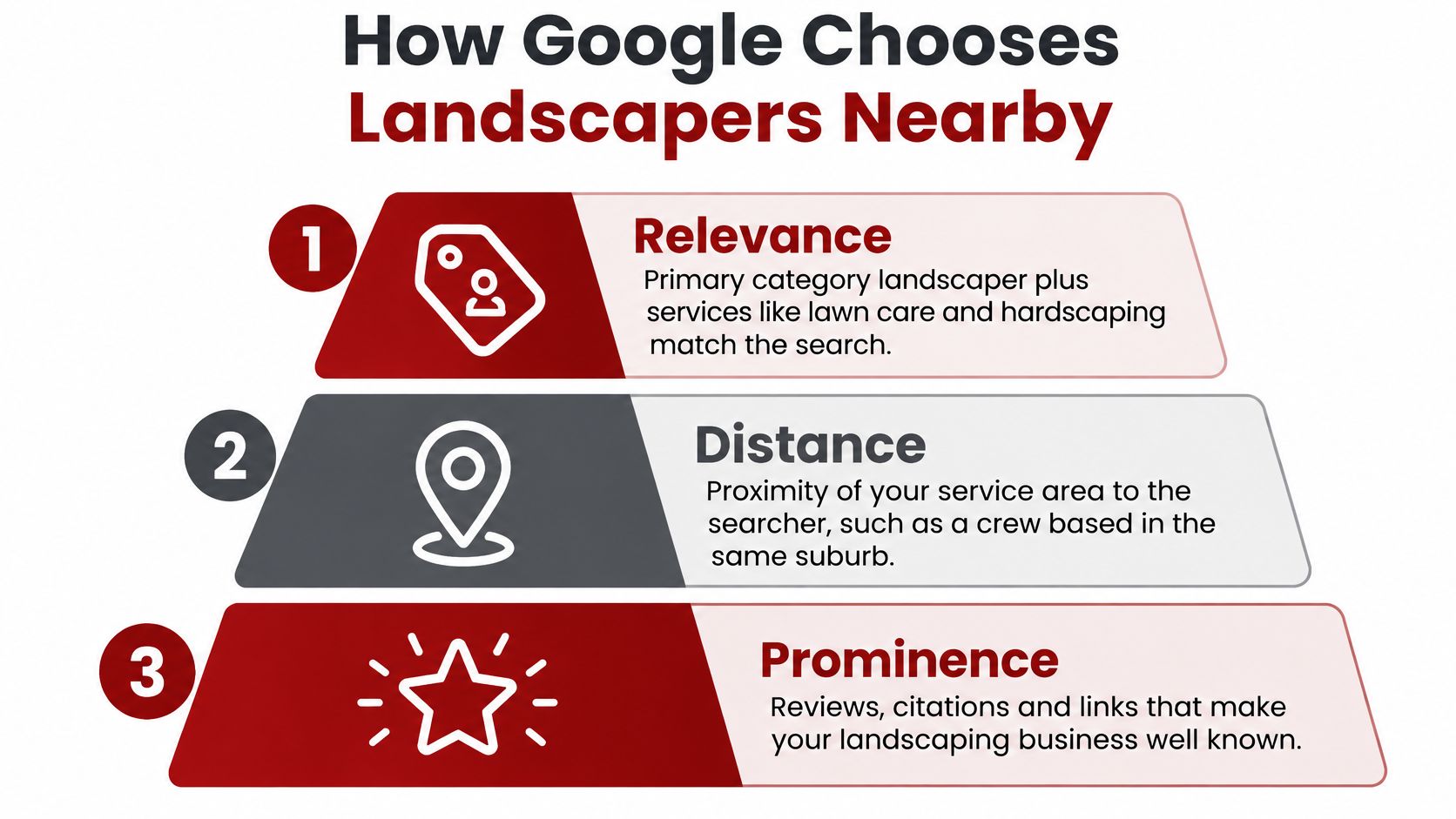
Google's guidance on improving local ranking names three factors it weighs for local results: relevance, distance and prominence. Yard care professionals tend to pour effort into the first, ignore the second, and underestimate the third.
What Relevance, Distance and Prominence Mean in Practice
Relevance is whether your profile and site describe the work someone searched for. A profile whose primary category is landscaper and whose services include lawn maintenance, irrigation repair and garden design matches more searches than one that says landscaping and stops there.
Distance is measured from the searcher, not from your shop. Someone standing in Chino Valley who searches without naming a town sees businesses near Chino Valley. No keyword combination, service-area entry or content push changes that estimate, and no profile setting overrides it.
Prominence is reputation and authority rolled together: reviews, ratings, links, directory presence, local press, and where your site ranks in regular organic results. It's the only one of the three you can build steadily from a single base.
Think of it this way: relevance is having the right tool on the truck, distance is how far the truck has to drive, and prominence is whether the homeowner trusts the name on the door enough to open it.
What Follows From Those Three
Keyword stuffing into the business name doesn't fix distance, and a second profile at a borrowed address buys a small proximity advantage in exchange for real suspension risk. The sequence that works is dull and repeatable: one accurate profile, service-area pages for towns where crews work, reviews collected after real jobs, then consistent local citations and links that back the whole thing up.
How to Set Up Your Google Business Profile for Landscaping
The profile is the asset everything else points at, and a half-finished one caps your ceiling no matter how good the website gets. Work these steps in order.
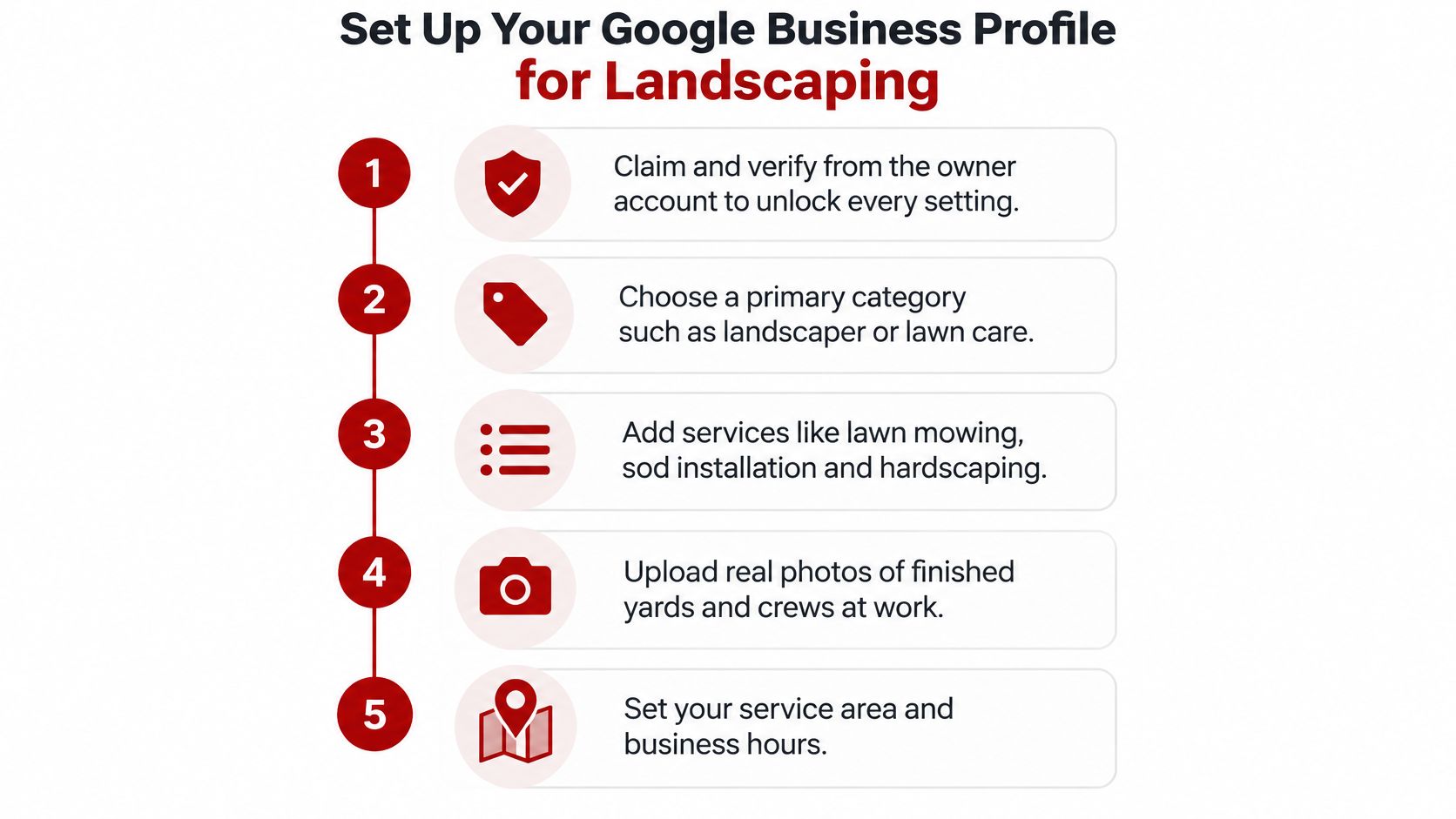
Claim and verify from an account the business controls. Verification enables every other setting, so use an owner account that stays with the company rather than a former employee's login.
Choose a primary category that matches your core work. Lawn care service or garden design service, whichever describes the bulk of your schedule. Add secondary categories only for services you sell, since a profile claiming everything matches nothing well.
List services with a short description each. Lawn maintenance, garden design, irrigation repair, tree and shrub planting, seasonal cleanup. Two sentences per service is enough. The goal is to use the words customers type.
Set hours, including seasonal changes. Northern Arizona schedules shift with the season, so update closing times and holiday closures instead of leaving January hours up in June.
Define the service area by named cities or postal codes. There is no radius setting, so the list itself is the definition. Keep it to places your crews reach.
Hide the street address if you work from a home base. Service-area businesses can keep the address private. What stays visible is the name, the phone number and the service area, and those three have to match everywhere else online.
Upload photos of finished projects, your logo and your crews. Recent work beats stock imagery in the only test that matters, which is whether a homeowner believes you've solved this before.
Review the profile every month. Wrong hours, unanswered questions and stale photos each cost calls, and each takes minutes to correct.
What a Complete Profile Looks Like to a Searcher
A finished profile answers four questions without a click: what you do, where you do it, how to reach you, and what your recent work looks like. Specific services, one phone number, a service area that matches your routes, and photos from this season. Nothing in that list requires cleverness. It requires someone to sit down and finish it.
Service Area Rules That Keep Your Profile Compliant
The common advice is to publish a page and a listing for every town within an hour's drive. For a business that travels to customers, that advice collides with Google's rules for service-area businesses and rarely earns the calls it promises.
Rule | What Google allows | Prescott-area example |
|---|---|---|
Business base | One profile for the central office | One profile for the base in Prescott, not one per town |
Service areas per profile | Up to 20 cities, postal codes or defined areas | Prescott, Prescott Valley, Chino Valley where crews deliver |
Radius setting | Not available | Name cities or ZIP codes instead |
Total driving reach | Generally within about two hours of driving time | Keep outlying communities only when crews actually serve them |
Multiple profiles for one operation | Not allowed | Use one accurate profile for the whole business |
The table explains why a separate profile per small town fails. Google explicitly warns against multiple listings for the same operation, and a suspended profile takes your reviews and history with it. One base, one profile, named areas.
Deciding which towns to include is an operational question, not a marketing one. Map the service area to your actual crews, your route economics and jobs you can point to from the last year. Include a rural community when a truck runs there, and leave it out when the drive eats the margin.
Make Location Content Answer Operational Questions
A page that repeats a town name eleven times helps nobody. A page that states minimum project size, travel fees, irrigation or xeriscaping expertise, seasonal availability and typical response time gives a homeowner what they need to decide. Use real project details from that town, not swapped place names. For the profile side of this, the walkthrough on Google Business Profiles for contractors covers the settings that matter most.
A check worth running: if a town appears in your profile and you can't name recent work there, remove it. A smaller, accurate territory produces better leads than a wide one you can't service.
How to Write Service Pages That Answer Real Questions
One services page listing twelve things tells Google almost nothing and tells a customer even less. Searches for irrigation repair, lawn maintenance and garden design get matched to pages that describe that specific work, which is why each service the crews perform needs its own page.
Lawn maintenance: mowing frequency through the season, edging, cleanup scope, minimum visit size.
Design services: what the process includes, whether you install your own plans, how revisions work.
Irrigation repair: diagnostics, valve and head repair, controller upgrades, seasonal start-up and blowout.
Tree and shrub planting: species that hold up in high-desert conditions, staking, watering schedules for the first year.
Seasonal cleanup: spring and fall scope, debris hauling, when the schedule fills.
What Goes on Each Service Page
Open with a short heading naming the service, then use H3 subheadings that mirror questions a homeowner asks out loud. Something like how often should a lawn be mowed in Prescott during summer works better than a heading called "Overview." Follow each question with a direct answer of two or three sentences covering what's included, minimum project size, seasonal timing and typical response time. Then add proof from a named town.
Those pages have to agree with the categories and service areas in your profile. Copying one page across five towns with the place name changed is the fastest way to look automated to both readers and search engines.
Choosing which services to build first is a keyword question, and the approach in this guide to local SEO keyword research keeps that decision tied to revenue rather than search volume alone. For a sense of how a well-built service page reads, this Modern Yard Landscapes service guide shows the level of detail customers expect before they pick up the phone.
Build one page for each service the crews perform, then review those pages once a quarter as your offer changes.
Reviews That Build Trust Without Breaking Google's Rules
Google prohibits rating manipulation, including incentivized or biased reviews, and says that content isn't allowed and may be removed from Maps. For a landscaping company, that means every completed job gets the same short request, with no discount, gift card, or “only if you were happy” filter.
A steady routine beats a blast after a slow month. Send the request within a few days, while the new gravel, clean bed lines, or repaired irrigation are still easy to remember, and make the wording specific: “If you have a minute, a note about the spring cleanup helps other homeowners in your area know what to expect.” Ask once, follow up once at most, then stop.
Give the same review link to every finished customer, not a chosen few.
Reply to every review. Thank happy customers by naming the service, and answer criticism with facts, a calm tone, and an offline way to resolve it.
Keep reviews tied to real work. A note that mentions sod, drainage, or weekly maintenance tells neighbors what the crews did.
Reviews that mention real services do double work. They help a homeowner decide, and they help search engines understand the business beyond a category label. Timing, templates, and response examples are laid out in this guide to review management strategy.
The ownership line is simple. Silva Marketing's SEO work can help with accurate service descriptions on your site, but the landscaping business remains responsible for earning and collecting authentic customer feedback. Nobody can outsource honesty.
Listing Accuracy and Results Landscapers Should Track
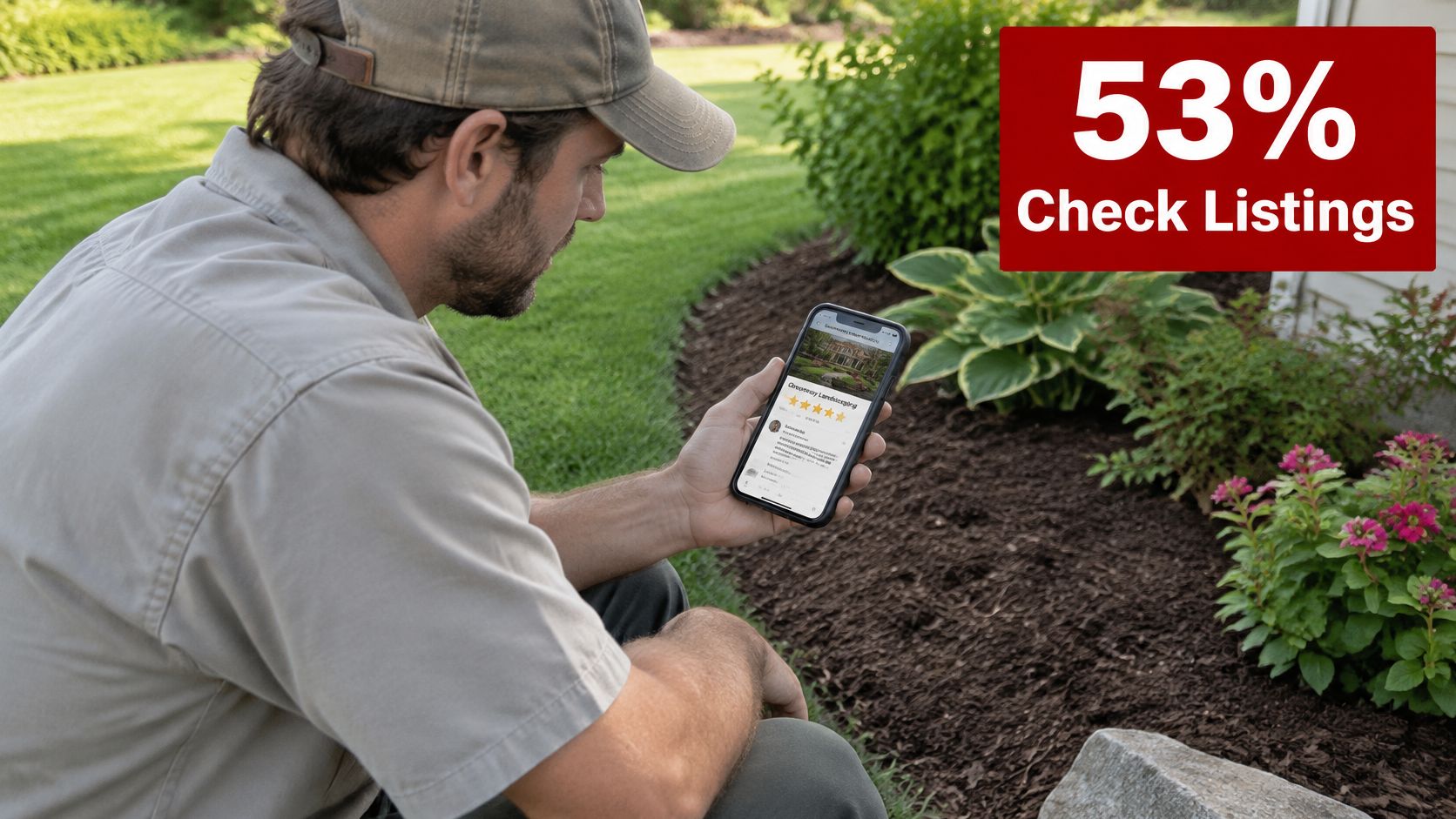
Accuracy is not housekeeping, it's revenue. A 2025 U.S. local-search study reported that 53% of consumers may avoid a business with inaccurate listing information, and 75% read at least four reviews before deciding, as summarized in the report on AI, accuracy and reputation in local search. An old service area or a closed-hours notice left over from last winter sends a homeowner to a competitor before anyone answers the phone.
Watch five numbers each month: calls from the profile, direction requests, website quote requests and form fills, review count, and average rating. Tag your forms and phone lines so a call from Maps is distinguishable from a call from the website, using the setup described in this guide to call tracking metrics.
A monthly report with a clear next-step list and measurable goals is a reasonable expectation of any local SEO provider, and the owner should keep direct access to the profile either way. Silva Marketing's routine reflects that standard. Clients receive a performance dashboard and report, a next-step roadmap, direct communication with their marketer, and clear measurable KPIs each month.
How Often Should I Check My Listing
Monthly, plus immediately after any change in hours, crew size or service area. Those are the moments when a listing drifts out of step with reality.
Do I Need a Blog to Rank in Maps
Not first. Accurate listings and a working review routine come before extra posts, and most outdoor service providers who feel invisible in the map pack have a profile problem rather than a content shortage.
A short walk through the dashboard makes the point better than a page of explanation.
Does AI Search Matter Yet
As a secondary layer, yes. The same 2025 survey found 93.2% of respondents trusted Google over AI for local discovery, and 56.7% had never used an AI assistant for that purpose. Structure your site so machines can read it accurately anyway, starting with LocalBusiness structured data, which Google recommends for hours, location and service context. It supports clear page content rather than replacing it.
Landscaping Local SEO FAQs
How Long Does Local SEO Take for a Landscaper
Longer than a paid campaign and shorter than a reputation gets built by accident. Expect movement over a season or more, and measure monthly rather than weekly. A company that checks results every Friday will quit a strategy that's working.
Why Do I Rank in One Town but Not the Next
Usually a competitor there has more reviews, a stronger page for that town, or a closer base. Sometimes it's your own site, with a thin service-area page or a profile that never listed the town. Distance plays a part, but it's one factor among several.
Do Younger Homeowners Search Differently
For some categories, yes. In 2024, 67% of U.S. consumers aged 18 to 24 preferred Instagram for local-business searches, compared with 61% who preferred Google Search, according to SOCi's Consumer Behavior Index reported by Marketing Dive. Keep the profile excellent first. If a meaningful share of your work comes from younger homeowners, your finished-project photos are worth posting in both places.
Should I Open a Second Location to Rank in Another City
Not for search visibility alone. A service-area page, reviews from that town and a few local links do the job at a fraction of the cost, and a location where nobody works is a listing waiting to be removed.
Choose One Local SEO Step to Start This Month
Find the first unfinished row in the priorities table and finish it this week. That's the whole assignment. Local search moves gradually, so consistency across months beats a burst of activity followed by six quiet ones.
Run the three-part test before you spend anything on content:
Is the Google Business Profile claimed, verified and accurate for categories, services and hours?
Does the service area reflect work the crews perform, city by city?
Does every completed job end with a review request, sent without an incentive?
Two noes mean profile and territory work. All three yeses mean you've earned the right to build service pages and content.
This is shared work, not handed-off work. The owner keeps control of the profile, the reviews and the crew details, because those come from the business. The organizing, checking and reporting can sit with a marketing team. Keep the review of a single row under an hour so the habit survives a busy week.
If you'd rather talk it through than guess at it, Silva Marketing offers a free 30-minute call. Bring your city list and your service mix, and we'll point you to the row that will move first.
Silva Marketing builds the profile, service-area structure, service pages and review routine that put a landscaping company in front of nearby customers in Prescott, Prescott Valley, Chino Valley and the surrounding communities. If your map results don't match the territory your crews cover, that's a fixable gap, and it's usually a short conversation to find where it starts. Visit Silva Marketing when you're ready to work through it.
Comments