
What Is Local SEO for Northern Arizona

Local SEO improves a business's visibility for products or services in a specific geographic area on Google Search and Maps. According to SOCi's 2024 Consumer Behavior Index, 80% of U.S. consumers searched online for local businesses at least weekly, and 32% searched daily or multiple times a day.
A homeowner in Prescott Valley needs a roofer. She searches on her phone and compares three nearby options before calling. If your business serves Prescott, Chino Valley, or other Northern Arizona communities, Silva Marketing helps you win that comparison with accurate local listings, useful service pages, and trustworthy signals that support the decision to call.
Local SEO connects what you offer, where you work, and why a customer should trust you. The Map Pack is the busiest corner in town. A profile with the wrong phone number or outdated service area sends nearby customers to a competitor before they ever reach your website.
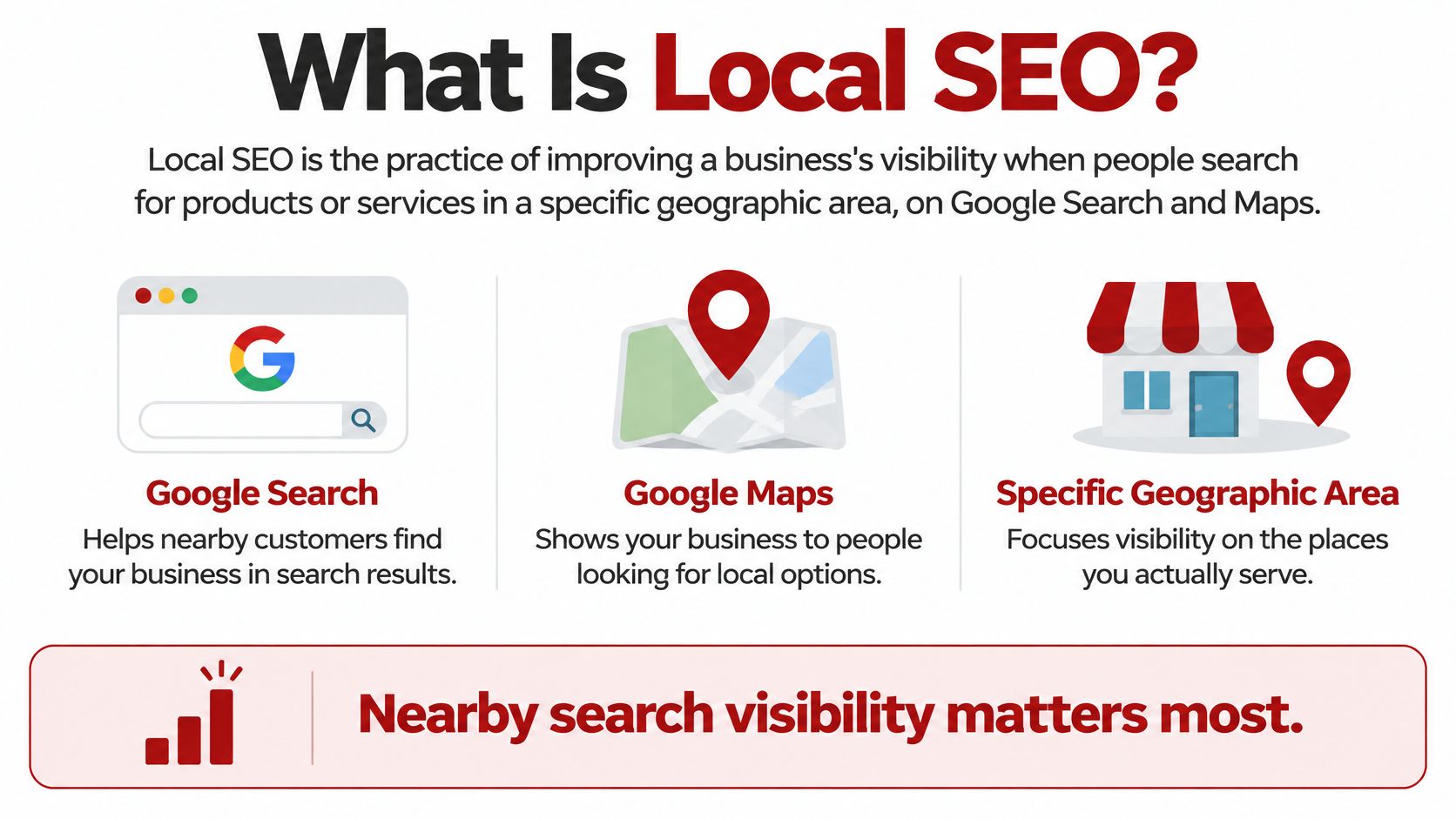
Table of Contents
How Does Google Decide Which Local Business Ranks First? - Relevance helps Google match the service - Distance sets a geographic limit - Prominence reflects public recognition
The Assets That Feed the Map Pack - Why reviews change the decision to call
Metrics That Show Calls, Not Just Rank - Track trust and qualified work
Questions to Settle Before You Start - How is local SEO different from regular SEO? - How soon can calls change? - Do I need both a website and a profile? - Should I buy links or reviews?
What Is Local SEO?
Local SEO is the practice of improving a business's visibility to people looking for products or services in a specific geographic area. It helps relevant customers find a business through Google Search, Google Maps, and other location-based search results. According to SOCi's 2024 Consumer Behavior Index, 80% of U.S. consumers searched online for local businesses at least weekly, while 32% searched daily or multiple times daily.
For a Prescott contractor, a search such as “roof repair near me” can lead to a quick comparison of local listings. A homeowner may check the service description, location, reviews, hours, and photos before deciding whether to call. If the contractor's listing is incomplete, the phone number differs from the website, or the profile doesn't make clear which towns the crew serves, the homeowner has less reason to choose that business.
Silva Marketing helps contractors and other service businesses in Prescott, Prescott Valley, Chino Valley, and across Northern Arizona improve their local visibility and turn searches into calls. The problem we solve is practical: a homeowner searching on a phone needs to understand what you do, where you work, and how to contact you before a competitor wins the job.
What does local SEO include?
A useful local SEO program connects several parts of a business's public presence:
A verified Google Business Profile: Keep the business category, services, hours, phone number, photos, and service area accurate.
Consistent business details: Use the same business name, address, phone number, and website information across the profile, website, and trusted directories.
Clear service pages: Explain the work you do in language customers understand, and make the pages easy to use on a phone.
Genuine reviews: Make it easy for real customers to share their experiences, then respond professionally.
Real geographic coverage: Name the communities you serve instead of claiming a broad area the business can't reliably cover.
These elements help customers decide whether a business is a good fit. They also give search systems clearer information about the company and its service area.
Google's local results rely on three signals: relevance, distance, and prominence. The three don't offer an instant route to the top. Accurate details can help your business match a search, but location and reputation still matter. A short checklist at the end will help you spot gaps without trying to fix everything at once.
How Does Google Decide Which Local Business Ranks First?
Google says local search rankings are primarily based on relevance, distance, and prominence. The Google Business Profile ranking guidance explains what those factors mean and notes that businesses can't pay for a better organic local ranking.
Factor | What Google measures | What you can improve | Hard limit |
|---|---|---|---|
Relevance | How closely the Business Profile matches the query | Primary category, services, and description | Copy can't invent a service you don't offer |
Distance | Proximity to the searcher or the place named in the query | Accurate base location and named service areas | You can't move the searcher or buy proximity |
Prominence | How well known the business is online | Reviews, links, directories, articles, and organic rankings | Ads don't purchase a better organic local rank |
Relevance helps Google match the service
If a homeowner searches for a plumber, Google needs information that shows which businesses provide plumbing services. A complete profile with accurate categories and a detailed service list makes the company's offer easier to understand. The website should reinforce that information with pages that describe the services clearly, not with vague copy or a list of keywords.
Relevance depends on accuracy as much as completeness. A Prescott business shouldn't claim emergency plumbing, roofing, or remodeling services just because those phrases might attract searches. If a customer calls expecting work the business doesn't do, the listing has created the wrong match.
Distance sets a geographic limit
Google considers how far the business is from the searcher or the place named in the query. That means the same Prescott company may appear differently when someone searches from Prescott Valley or Chino Valley. Strong service copy can improve relevance, but it can't erase a competitor that's materially closer to the searcher.
Track visibility from the towns where you take jobs. One search from the office won't show how the listing looks to customers across the service area. A rank check centered on Prescott may not represent the view from a search centered on another community.
Prominence reflects public recognition
Prominence describes how well known a business is. Google identifies signals such as links from other websites, articles, directories, review count, review score, and the business's position in standard web results. These signals take steady, legitimate work. A paid ad may bring a visitor, but it doesn't purchase an organic local position.
Before changing the website: Mark the weakest row in the table. If the profile doesn't explain the services, start with relevance. If customers rarely see the business outside its base town, check distance. If the public record is thin, work on prominence and trust.
For help building a genuine review process, Silva Marketing's review management strategy covers how to treat feedback as part of the customer experience, not just a ranking task.
The Assets That Feed the Map Pack
A Prescott plumber can win the click in Prescott Valley for one reason. The listing answers the search and looks like a safe call. That result comes from five assets working together. Each one covers a part of discovery or decision-making that the others cannot replace.
Asset | Main job | Supports | Practical standard |
|---|---|---|---|
Google Business Profile | Be the business Google shows on Maps | Relevance and distance | Verified, correct category, services, hours, phone, and photos |
Citations | Repeat the same identity across the web | Prominence and trust | Identical name, address, phone, and URL on major directories |
On-page pages and markup | Explain services in crawlable pages | Relevance and organic prominence | One indexable page per real location, matching NAP, valid LocalBusiness markup |
Reviews | Prove recent customer experience | Prominence and the decision to call | Genuine reviews, public replies, no gating or incentives |
Local content | Show work in named communities | Relevance and credibility | Specific projects and service pages, not doorway pages |
Start with the Google Business Profile. It is the listing itself. Claim and verify it, then keep categories, services, hours, phone, photos, and service area current. A customer should not have to compare the listing against the website to learn whether the shop is open or serves their town. Silva Marketing's guide to setting up a Google Business Profile walks through establishing and maintaining that listing.
Citations repeat those same details on directories and reference sites. Check the important listings for a mismatched name, phone number, address, or website URL. Small inconsistencies confuse customers and weaken trust in the record.
On the website, make services easy to find and keep business details consistent with the profile. LocalBusiness structured data helps Google interpret that information. It does not replace useful pages and it does not guarantee a search feature. A real, staffed location deserves its own indexable page when appropriate. For a service-area company with one base, state the towns served clearly. Thin pages that swap one town name for another add little and invite quality problems.
Why reviews change the decision to call
Reviews settle the second question. The business appeared in search. Now does it look dependable?
BrightLocal's 2024 local consumer review survey reports that reading reviews remains a normal step before choosing a local business, that shoppers consult multiple reviews before they trust what they see, and that a low star rating stops many people from calling. Recency matters here. A steady stream of specific, genuine feedback tells a homeowner in Chino Valley or Dewey what the work feels like. Old praise helps less.
Reply in public. Thank customers who describe good work. Address concerns directly and briefly.
Ask after the job is complete. Keep the request simple. No pressure, no incentive, no filtering for happy customers only. If a code on a follow-up card or invoice would help customers reach the right page, HolaQR offers a Google review QR code for that purpose. Pick the weakest row in the table and fix that asset first. One complete asset beats five half finished ones.
Service Areas That Match Real Jobs
A crew based in Prescott Valley that regularly works in Prescott, Chino Valley, Dewey-Humboldt, and Paulden should list those towns and stop there. If a town is on the profile, the business should be able to take a job there this month.
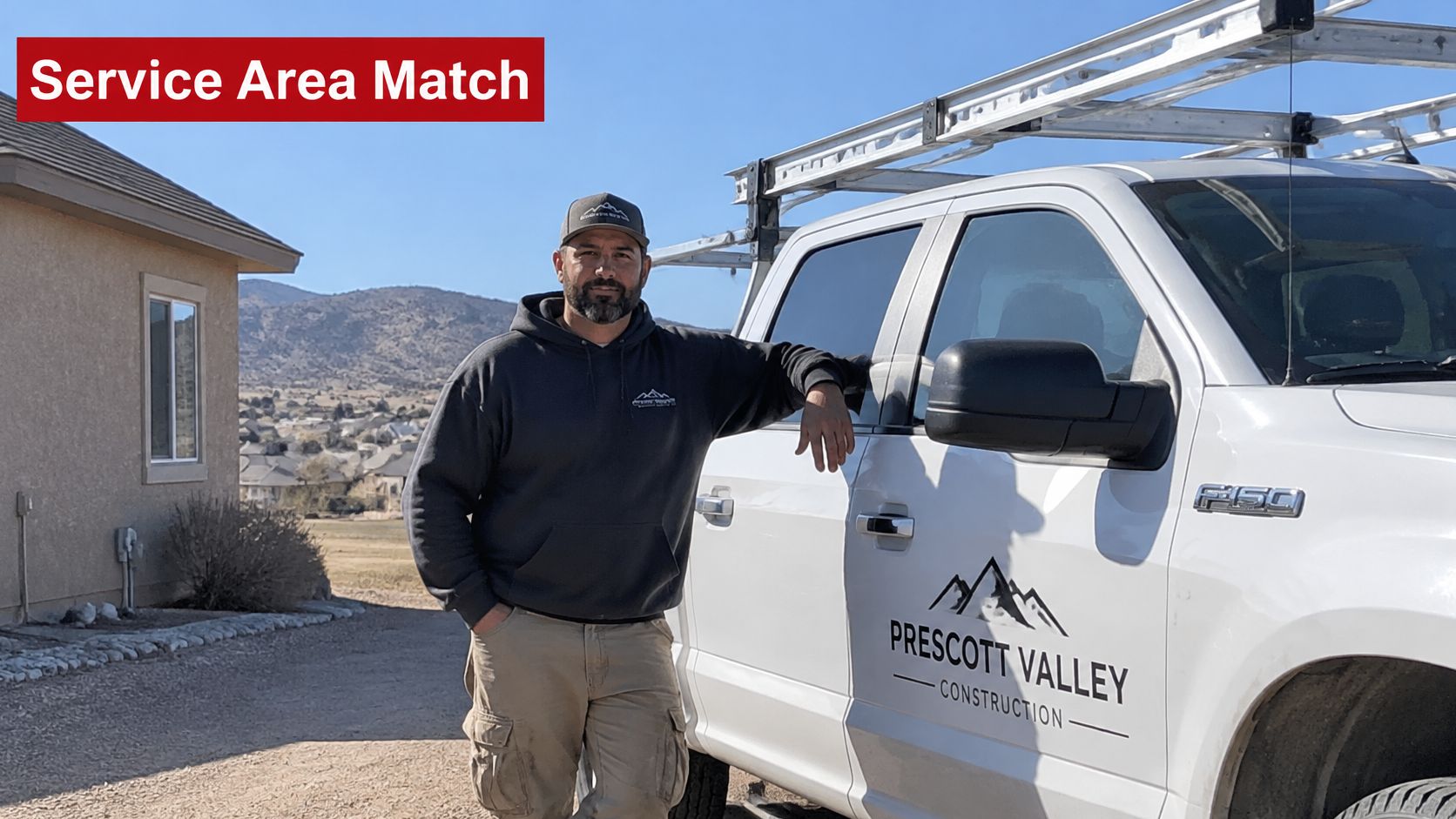
A service-area business operates from one central base and specifies where it will travel for work. Padding that list with distant cities makes the map look impressive for a day and creates problems later. Callers from outside the actual operating area get turned away, reviews mention slow response, and the service information looks unclear.
Rule | What it means for a Northern Arizona business |
|---|---|
One profile per staffed location | Use the central office or staffed base with a defined service area |
Coverage honesty | List only towns the crew can serve reliably this month |
Area format | Name the cities or postal codes served, not a radius around the shop |
Separate profiles | Use them only when each location has its own service area and staff |
Website match | Describe the same towns on the site with useful local pages |
Cleanup habit | Remove towns the business can no longer serve reliably |
On the website, each staffed location should have its own indexable location page. A service-area business should describe the towns it serves on useful pages, not create near-identical pages for every town or use a made-up address. Silva Marketing's office is in Prescott Valley, and the same principle applies: publish where the team can show up.
For a useful example of how a service business can organize its coverage, see locations served by Professional Window Cleaning. Clear coverage helps a caller in Prescott or Chino Valley confirm fast that this company comes to their street. That confirmation lifts calls.
Here's a short video on choosing practical service areas and making them clear online.
A simple coverage check: Match the profile towns, the website pages, and the dispatch board. Silva Marketing's guide to local SEO keywords for service areas can also help you connect the services you offer with the places you genuinely serve.
Metrics That Show Calls, Not Just Rank
Measure local SEO as a funnel. Search visibility matters, but it isn't the result if it doesn't help the right customer take a next step.
Stage | Metric | Where to look | Question it answers |
|---|---|---|---|
Visibility | Impressions and rankings by town | Business Profile and rank tracking | Are nearby searches seeing you? |
Profile actions | Calls, direction requests, website clicks | Business Profile performance | Did the listing earn a next step? |
Website | Visits to the matching service page | Analytics on local landing pages | Does the page back up the listing? |
Reputation | Review count, rating, and replies | Google reviews | Would a skeptical searcher trust you? |
Leads | Qualified calls and booked jobs | Call tracking or the job book | Did visibility become revenue? |
Check town-level visibility from Prescott, Prescott Valley, and the other places the business serves. A single rank screenshot can't show how distance changes results for searchers in different locations. Profile actions matter too: calls, direction requests, and website clicks tell you whether the listing prompted a next step, even if a keyword report hasn't changed much.
Then compare the landing page with what the customer saw in the listing. Does it confirm the same services, hours, and phone number? Does it provide proof that supports the business's claims? That alignment matters when a customer clicks through after seeing a listing or an AI-generated summary.
Track trust and qualified work
Reviews are a conversion signal because they affect how people evaluate a business. Recent U.S. survey reporting summarized by Vendasta's Google Business ranking guide found that 91% of consumers use reviews to evaluate local businesses, while 65% are more likely to choose a business that responds to reviews. The same source reports that a 2025 survey found 75% of consumers read at least four reviews before deciding, and 60% clicked AI-generated overviews in Google Search.
For a contractor, a click isn't the same as a qualified lead. A call about a service you don't offer or a location you don't cover shouldn't be counted as a successful outcome. Track calls that match your services and territory, then compare them with booked work. Silva Marketing's guide to call tracking metrics can help you distinguish activity from leads worth following up.
Pick one baseline this week for calls and one for Business Profile actions. Review those measures against the next 90 days, rather than judging the entire effort by a single keyword position.
Which Local SEO Myths Waste a Season?
The most common mistake in this region is adding Prescott, Prescott Valley, and Chino Valley to every paragraph and calling it local SEO. City names don't replace a matching profile, a real service area, or accurate business details.
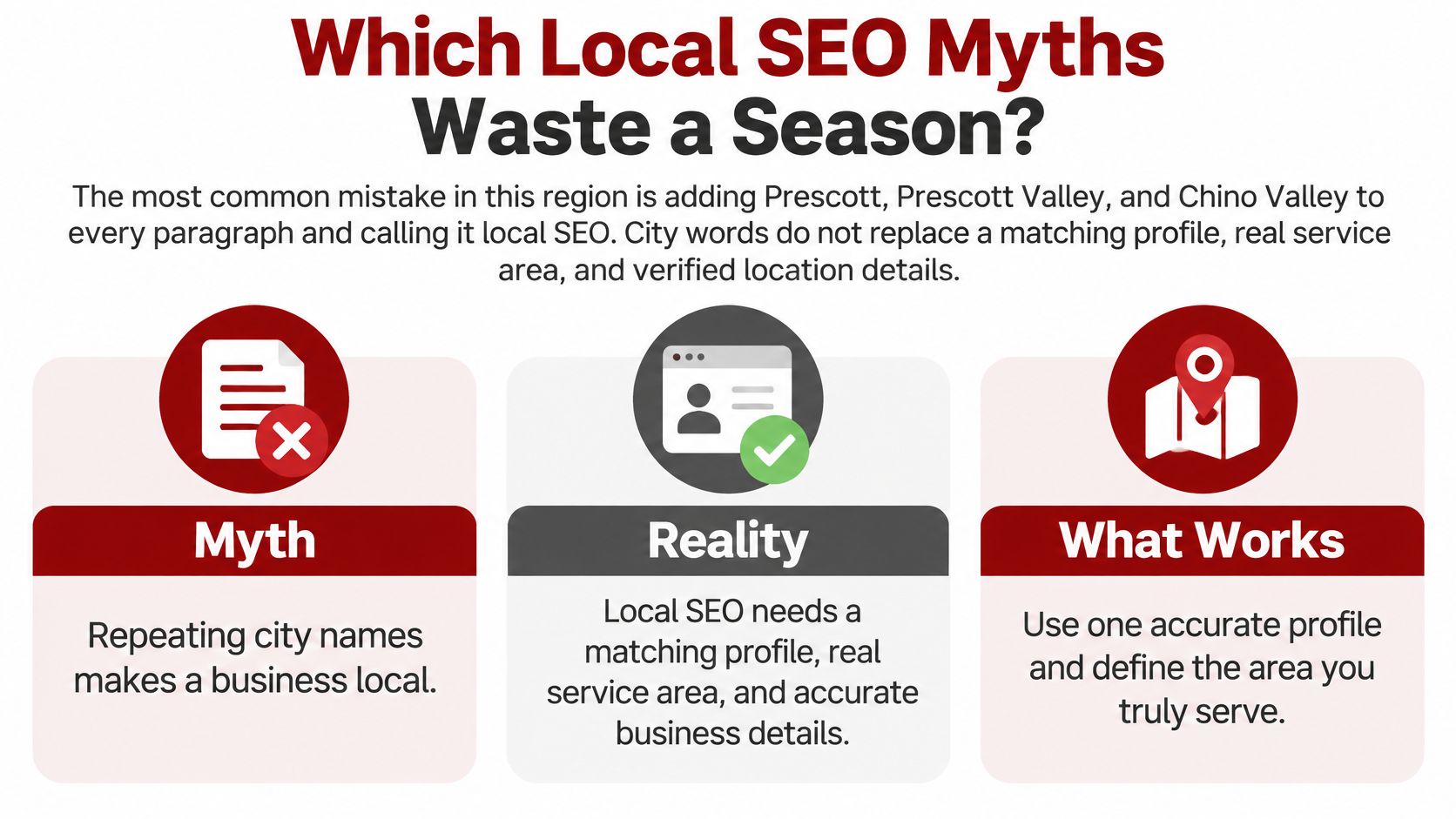
Here are common mistakes and the practical replacement for each:
Myth: Repeating town names improves visibility. Write useful service pages, use accurate categories, and define the towns where you work.
Myth: A profile only needs attention at setup. Review the hours, categories, phone number, photos, and service area when business details change. Keep them aligned with the website.
Myth: Review shortcuts save time. Don't buy reviews or filter out unhappy customers. Ask customers to leave honest feedback after completed work, and respond professionally.
Myth: More citations are always better. Prioritize trustworthy directories and correct mismatched business details instead of spreading inconsistent information.
Myth: A rank improvement proves the campaign worked. Check qualified calls and booked jobs alongside visibility and profile actions.
A business that serves Prescott Valley but lists an address in another town can confuse customers about where it operates. Likewise, service pages that make identical claims about every community can fail to show what the business does there. Local content should give readers real information about the services available in that town, not just repeat the town name.
Review the ranking factors and service-area rules explained above before making changes. The practical correction is usually straightforward: make the profile accurate, list only real service areas, request genuine reviews, and check whether calls are turning into work.
Questions to Settle Before You Start
How is local SEO different from regular SEO?
Regular SEO focuses on whether a page is relevant and useful for a search. Local SEO also considers distance, a Google Business Profile, and whether a nearby searcher finds the business credible enough to contact.
How soon can calls change?
A correction to a phone number, business category, or hours can quickly change what customers see. Reviews, links, and useful local content tend to build over time, and no timeline guarantees a particular result.
Do I need both a website and a profile?
Yes, if your service business wants calls. The profile is the record customers see in Maps and local search; the website should confirm the same services, hours, and contact details and provide evidence that supports the listing.
Should I buy links or reviews?
No. Build prominence with real customer feedback and legitimate mentions from relevant websites. Paid or fabricated signals can mislead customers and don't replace a credible public record.
Silva Marketing offers a free 30-minute call to review your goals, audit your current marketing, and map a plan, with no pressure and no obligation. Bring your current profile, the towns you serve, and last month's call count. Silva Marketing's office is at 8101 E Pecos Dr., Prescott Valley, AZ 86314.
If your Prescott or Northern Arizona business needs clearer service pages, stronger local search visibility, or a website that turns visits into calls, Silva Marketing can help you assess the next practical steps. Visit Silva Marketing to arrange a free 30-minute strategy call and discuss a plan that fits your business.
Comments