
What Is Seo Audit

An SEO audit is a structured check of how well a website can be found, crawled, indexed, and understood, then improved according to what matters most. For local businesses, it also reviews Google Business Profile signals that help turn local searches into calls.
A Prescott business can have strong services, a professional website, and years of experience, yet still receive fewer inquiries than expected because Google can't reach an important page, understand its location, or present the business clearly to nearby searchers. Silva Marketing helps service businesses in Prescott, Northern Arizona, and surrounding communities identify those obstacles and turn them into a practical roadmap for more qualified calls and leads.
Table of Contents
The Four Core Areas Every Audit Covers - Technical health - On-page optimization - Content quality - Backlinks and authority
Technical Checks That Decide Whether Google Sees Your Site - The crawl-to-index checks
Page Experience and Core Web Vitals Explained - What each failure can reveal
Why Local Visibility Deserves Its Own Audit Section - Local checks that affect calls
Turning Audit Findings Into a Local Action Plan - A sensible priority sequence
Your Next Steps and Local FAQs - How often should you do an SEO audit? - What does an SEO audit include? - Is an SEO audit worth it for a small business?
What an SEO Audit Is
A Prescott service business may have a polished website and strong word-of-mouth, yet its phone stays quiet because Google cannot clearly find, interpret, or trust the pages that should generate calls. An SEO audit identifies those obstacles and ranks the fixes by their likely effect on revenue pages, local visibility, and customer action.
An SEO audit examines whether search engines can discover important pages, request them, interpret their content, and show them to people seeking the services offered. Google describes Search as a three-stage system: crawling, when automated programs download a page's text, images, and videos; indexing, when Google analyzes and stores that information; and serving, when its systems select relevant, high-quality results (Google's explanation of how Search works).
The building-inspection comparison helps explain the process. An inspector checks the foundation, wiring, access points, visible damage, and repairs that deserve attention first. An SEO audit applies the same order of thinking to a website, then connects each finding to a business outcome.
For a Prescott contractor, home-service company, professional practice, or other local provider, the commercial question is whether the pages that produce calls can be found and trusted. The review may include service pages, contact pages, city pages, mobile experiences, and Google Business Profile information. Silva Marketing serves businesses across Prescott and Northern Arizona by connecting technical SEO with the customer journey, from a local search to a phone call or form submission.
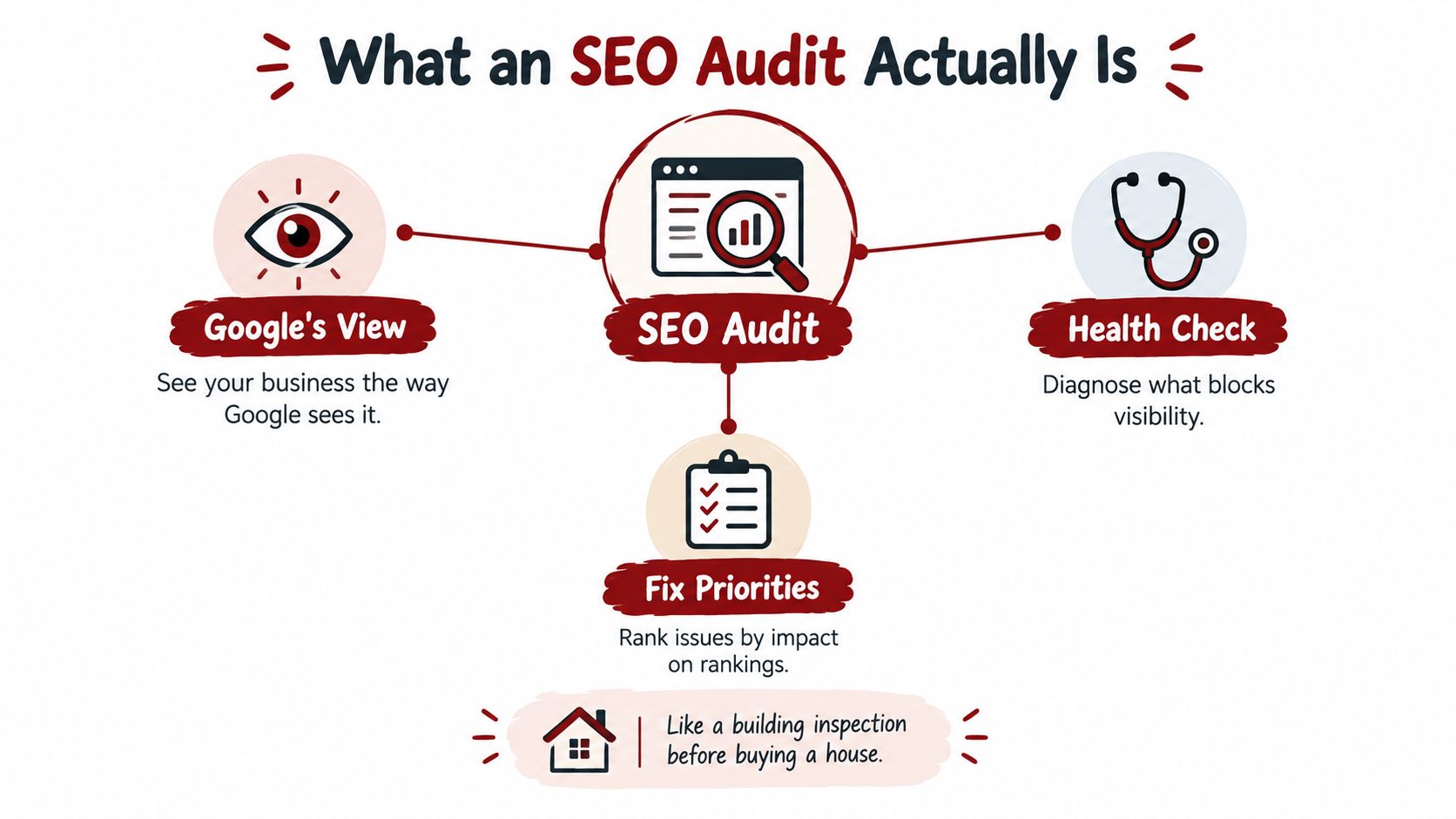
What an audit examines
A useful audit brings several views together:
Technical access: Can Google reach, render, and index the pages that matter?
Page clarity: Do titles, headings, links, images, and structured data explain each page accurately?
Content and intent: Does each page answer what a Prescott customer is trying to find?
Local visibility: Does the website support an accurate, complete, relevant Google Business Profile?
Authority: Do legitimate links, reviews, and local references support the business's reputation?
A report may identify a broken link, but its business value depends on where that link leads. A broken link on a revenue page can obstruct a call or form submission, while one in an old archive may have little effect. The audit should therefore produce a prioritized conversion roadmap, not a long collection of warnings.
For a broader look at evaluating online store performance, the Shopify Plus performance assessment shows how performance reviews can organize technical observations into actionable findings. Local service websites benefit from the same approach: every finding should lead to a clear decision.
An audit is not a one-click score, a ranking guarantee, or a one-time repair. Google says that meeting its technical requirements, spam policies, and best practices does not guarantee crawling, indexing, or ranking. Its purpose is to reveal risks, opportunities, and the order in which the business should address them.
The Four Core Areas Every Audit Covers
A complete audit usually examines technical health, on-page optimization, content quality, and backlink authority. Local businesses need a fifth lens across all four areas, their Google Business Profile and broader local presence.
Technical health
This is the access layer. It checks whether important URLs return successful responses, whether crawlers can reach them, whether redirects work, and whether search engines receive consistent instructions. A service page that customers can open but Google can't crawl is a business problem, not merely a coding issue.
On-page optimization
On-page review looks at the signals visible on each page, including the title, headings, URL, internal links, image alternative text, and calls to action. A Prescott plumbing page should make its service and location clear without forcing readers or search engines to guess what the company does.
Content quality
Content review asks whether pages satisfy the reason behind a search. A page can contain the right phrase and still fail if it doesn't explain the service, service area, process, qualifications, or next step clearly. A content gap analysis from Silva Marketing can help identify useful topics and customer questions that competitors address more effectively.
Backlinks and authority
Backlinks are links from other websites, but the audit should focus on relevance and trust rather than raw volume. Local organizations, trade publications, community resources, partners, and credible directories may help reinforce the connection between a business and its market.
The local layer connects these pillars to visibility in Google's local results. A website can be technically sound yet fail to attract calls if its service pages don't match local intent, its business details are inconsistent, or its profile doesn't communicate the services it provides. No single score captures all of those conditions.
Technical Checks That Decide Whether Google Sees Your Site
Technical SEO follows a page through the same path a search engine uses. The first question is whether Google can discover the URL. The next is whether the server responds, whether the page can be rendered, and whether Google receives consistent signals about which version belongs in its index.
An audit checks important Prescott service, city, and contact pages for successful HTTP responses. It also reviews broken links, redirect chains, redirect loops, duplicate URL variants, and orphan pages that have no useful internal path leading to them. If a location page exists but is linked only from an obscure footer, it may be harder for users and crawlers to find.
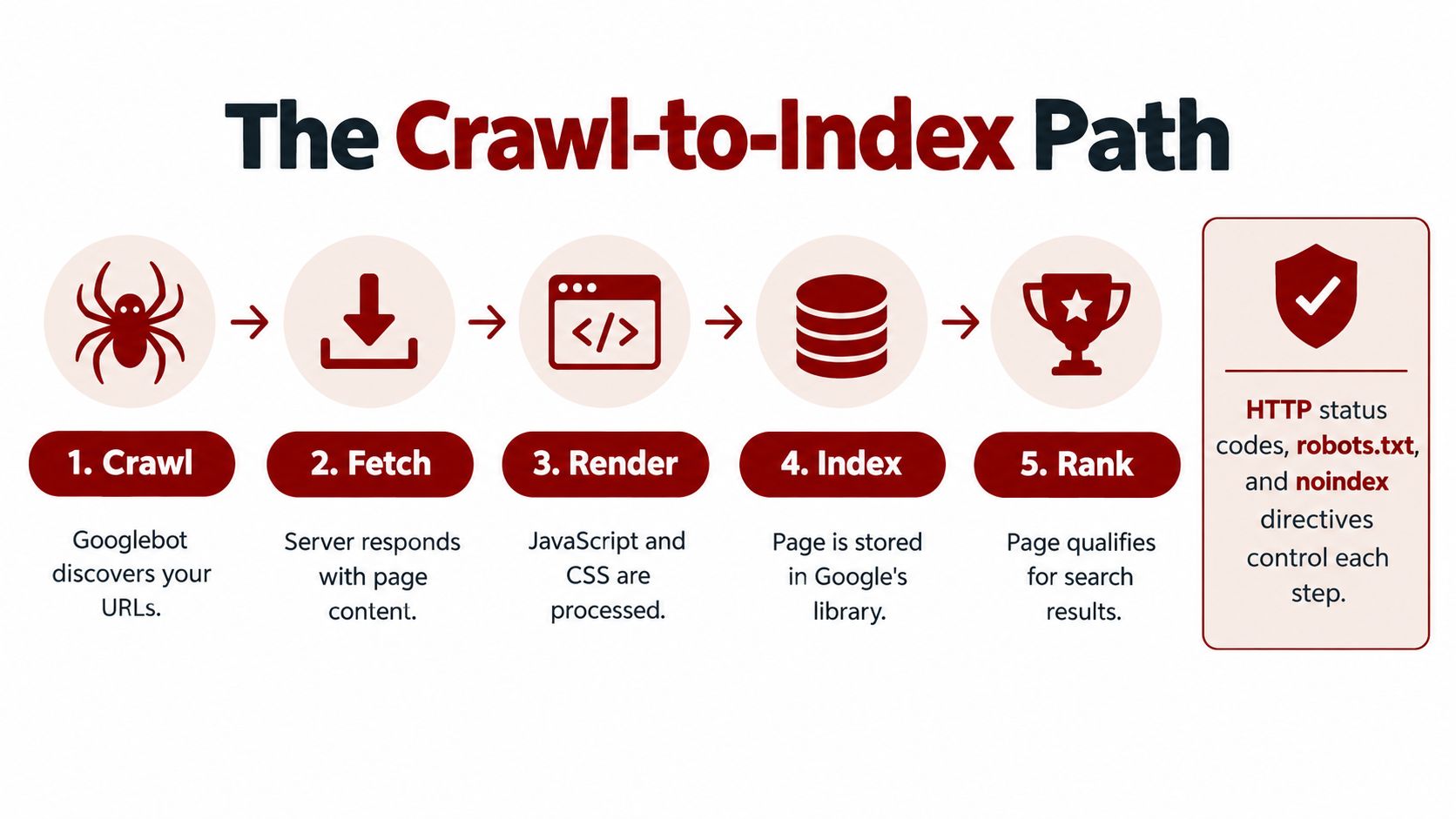
The crawl-to-index checks
Robots.txt: This file can control whether crawlers request parts of a site. An accidental rule could block a valuable service section.
Noindex directives: A page can be crawled but specifically excluded from indexing. An accidental noindex on a revenue page deserves immediate attention.
XML sitemaps: Sitemaps help identify important or updated pages, especially when a site contains media or a complex structure.
Canonical URLs: Canonical signals help Google understand which URL should represent a duplicate or near-duplicate group.
Internal links: Crawlable links connect related services, cities, and supporting information while helping users explore.
JavaScript rendering: If critical text or navigation appears only after scripts run, the audit checks whether Google can process it reliably.
Structured data: Markup can provide explicit clues about the meaning of a page, provided it matches visible content and uses supported properties.
Google distinguishes robots.txt, which controls crawling, from noindex, which controls indexing. Using robots.txt to hide a page from search results can create unintended outcomes, so the audit must verify that each instruction is being used for the right purpose (Google's technical SEO guidance).
Consider two versions of a Prescott location page, one with a trailing variation or alternate URL path. If both remain accessible without clear canonical or redirect signals, Google may need to decide which version represents the business. The audit identifies that conflict and recommends the cleanest resolution.
Practical rule: Fix anything that prevents Google from reaching or indexing a revenue page before polishing minor metadata warnings.
A technical audit can be performed with a crawler, Search Console, URL inspection, sitemap review, and structured-data validation. The technical SEO audit checklist from Silva Marketing provides a practical reference for organizing those checks.
Page Experience and Core Web Vitals Explained
Page experience turns a vague complaint such as “the site feels slow” into measurable signals. Google uses three Core Web Vitals: Largest Contentful Paint, which reflects loading performance; Interaction to Next Paint, which measures responsiveness; and Cumulative Layout Shift, which measures visual stability.
Google's good-experience thresholds are LCP within 2.5 seconds, INP below 200 milliseconds, and CLS below 0.1 (Google's Core Web Vitals guidance). These are not promises of ranking, but they give an audit concrete benchmarks for important page templates.
Metric | Good | Needs Improvement | Poor |
|---|---|---|---|
Largest Contentful Paint | Up to 2.5 seconds | Above 2.5 through 4 seconds | Above 4 seconds |
Interaction to Next Paint | Up to 200 milliseconds | Above 200 through 500 milliseconds | Above 500 milliseconds |
Cumulative Layout Shift | Up to 0.1 | Above 0.1 through 0.25 | Above 0.25 |
What each failure can reveal
A high LCP may point to an oversized hero image, slow server response, render-blocking resources, or inefficient third-party code. A high INP often indicates that JavaScript keeps the main thread busy when a visitor tries to tap a menu, phone link, or form field. A high CLS can occur when images, embeds, or dynamically inserted elements don't reserve space before loading.
Mobile testing deserves special attention for local businesses. A cited 2026 benchmark reports that 66% of mobile origins pass the LCP threshold, 80% pass INP, and 83% pass CLS, while only 53% pass all three simultaneously (Core Web Vitals benchmark data). That means nearly half of the measured mobile origins fail to meet all three standards.
For a Prescott contractor, the practical concern isn't a score by itself. A visitor comparing providers may reach a page while standing in a driveway or using a phone between appointments. If the phone number shifts below an unstable image, or a form responds slowly, the website creates friction at the moment a lead is ready to act.
Field data from real users should be considered alongside controlled testing. Search Console shows how indexed URL groups perform in the field, while lab tools help isolate the scripts, images, and layout patterns causing problems. The Core Web Vitals optimization guidance from Silva Marketing can help connect those measurements to practical improvements.
Why Local Visibility Deserves Its Own Audit Section
A standard website audit can miss the reason a local business appears for one search but not another. Google says local results depend primarily on relevance, distance, and prominence (Google's explanation of local ranking).
Relevance asks whether the business matches the search. An audit reviews the Google Business Profile category, services, description, hours, photos, and contact information, then compares those details with the website. If a business provides roof repair, inspections, and replacement but its profile and service pages mention only “contracting,” Google and customers receive an incomplete picture.
Distance reflects the relationship between the business and the searcher or location term. Copywriting can't move a physical business closer to a searcher, but accurate address and service-area information help Google interpret where the business operates. A Prescott company serving nearby Northern Arizona communities should represent those areas accurately rather than creating thin pages for places it doesn't serve.
Prominence reflects how well-known the business appears to be. Reviews, links, consistent references across the web, community involvement, and credible local mentions can all contribute to that broader picture. The audit looks for inconsistencies in the business name, address, phone number, hours, and service descriptions across important platforms.
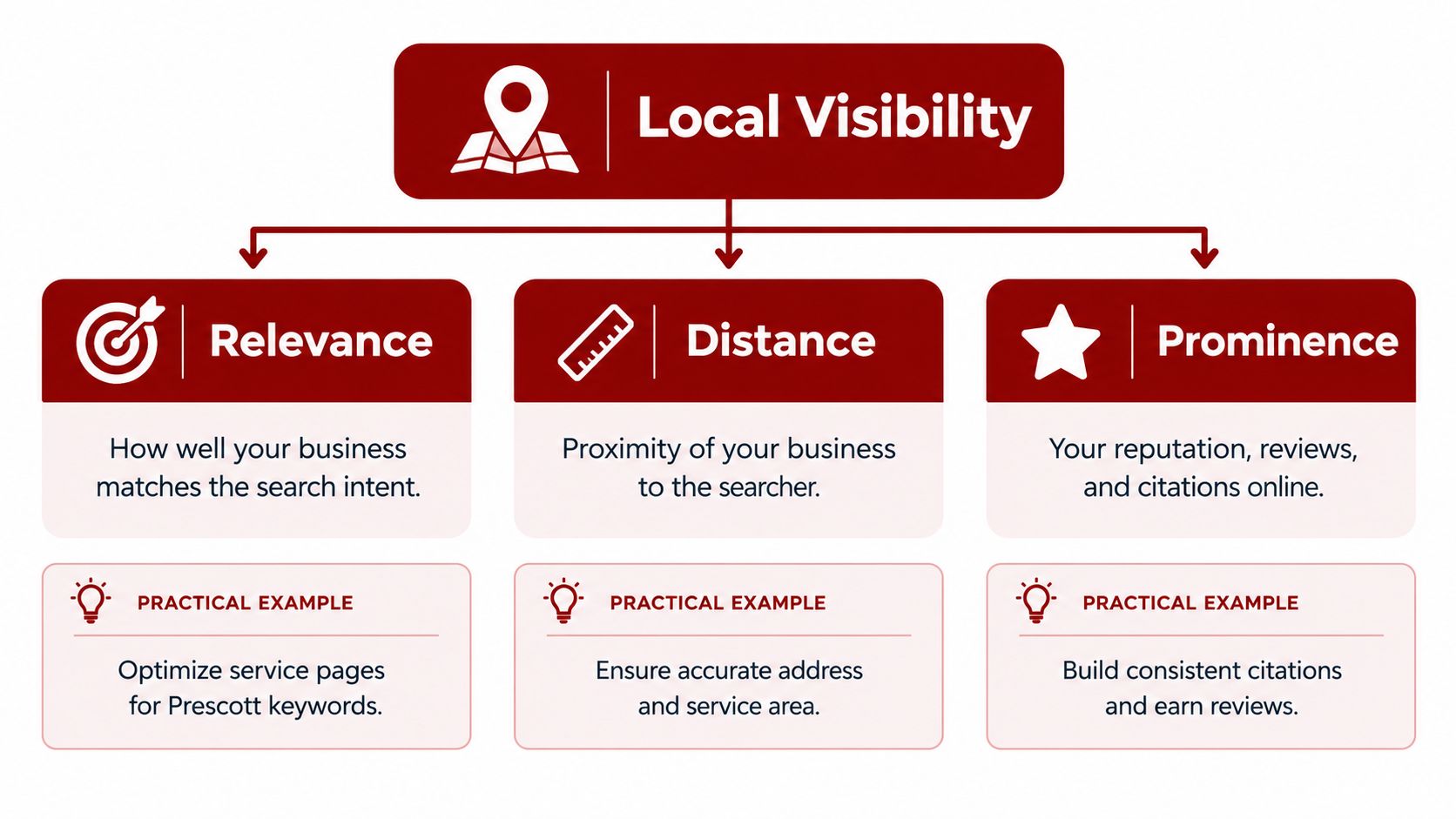
Local checks that affect calls
A useful audit separates different search situations:
Branded searches: Can customers find the correct business information when they already know the company name?
Service-plus-city searches: Does the business clearly match searches for a service in Prescott or another served community?
Broader service-area searches: Does the website explain coverage across Northern Arizona without making unsupported promises?
A business owner can use a tool such as Bragly's Google Business Profile audit to review profile completeness and local listing signals. That kind of check is useful, but it shouldn't replace human review of service accuracy, website consistency, lead tracking, and customer experience.
The local SEO audit guidance from Silva Marketing treats the profile and website as connected parts of the same local presence. The result should be a realistic visibility plan, not a promise that one business will hold the same position in every town.
Distance sets a boundary, but relevance and prominence provide areas where a business can improve. Clear service descriptions, accurate profile information, useful local content, legitimate mentions, and a consistent customer experience all strengthen the signals customers and search engines use.
Turning Audit Findings Into a Local Action Plan
Suppose a Prescott contractor's audit finds several issues at once. The homepage looks polished, but the primary service page has a noindex directive, the Google Business Profile uses an incomplete service description, the mobile hero image loads slowly, and the contact form is difficult to use.
Those findings shouldn't become four equal tasks. They need an order based on access, commercial value, evidence, and implementation effort.

A sensible priority sequence
Remove blocking problems. Correct the noindex directive and confirm that the service page is crawlable, internally linked, and eligible for indexing.
Strengthen revenue pages. Make the service page answer the customer's main questions, explain the service area, show a clear next step, and connect naturally to related services.
Align local signals. Review the Google Business Profile category, services, hours, phone number, website link, and service-area representation.
Improve the path to contact. Compress oversized images, reduce unnecessary scripts, and make phone links and forms easy to use on mobile.
Handle lower-impact refinements. Clean up minor metadata inconsistencies, improve supporting content, and pursue relevant local authority opportunities.
This approach challenges the idea that a technically clean website automatically performs well. A site can have valid code and no obvious crawl errors while still attracting the wrong searches, failing to explain its services, or hiding the phone number behind a weak conversion path.
The useful audit question is not “How many errors are there?” It is “Which change is most likely to help a qualified customer find, trust, and contact this business?”
The timeline should be treated as a working measurement window, not a guarantee. Over the next 30 to 90 days, a business can compare calls, form submissions, relevant impressions, clicks, landing-page behavior, and profile activity against the pages and fixes being prioritized. Google recommends combining Search Console and Analytics data for better decision-making, so rankings and clicks shouldn't be evaluated separately from what visitors do afterward (Google's guidance on combining Search Console and Analytics).
The audit becomes valuable when every recommendation has an owner, a reason, a business page, and a measurement plan.
Tools an SEO Audit Relies On
No single tool can explain a local website completely. Each tool sees a different part of the journey, and professional judgment is needed to connect those views to calls and leads.
Tool category | What it reveals | What it doesn't explain alone |
|---|---|---|
Crawling tools | Status codes, redirects, internal links, titles, canonical signals, and crawl structure | Whether a warning affects revenue or customer intent |
Search Console | Indexing status, queries, impressions, clicks, and field performance | The full reason a visitor did or didn't contact the business |
Performance testing | Loading, responsiveness, layout stability, and technical opportunities | How a speed issue affects a specific service funnel without conversion context |
Analytics | Landing-page behavior, engagement, forms, and tracked actions | Whether the traffic represents the right local audience |
Local listing tools | Profile completeness, citation consistency, and business information | The quality of the service explanation or customer experience |
Backlink analysis | Referring websites, relevant mentions, and authority gaps | Whether a link is commercially meaningful or genuinely trusted |
Structured-data testing | Whether markup validates and describes visible page content accurately | Whether the page itself is useful enough to earn attention |
Search Console is particularly important because it reflects Google's view of indexed pages and real-user performance. Crawlers are useful for examining the site as a connected system, while lab tests help reproduce technical problems under controlled conditions.
Tools can also overstate the importance of minor warnings. A report may flag a noncritical metadata issue while missing the fact that a high-value service page has weak internal links or an unclear call to action. That's why Silva Marketing combines keyword research, on-site technical review, content strategy, competitor analysis, and conversion context rather than treating one automated score as the final answer.
For a business owner, the best toolset is the one that produces decisions. If a report doesn't identify which page needs attention, why it matters in Prescott, and how success will be measured, it hasn't finished the audit.
Your Next Steps and Local FAQs
After an audit, assign the findings to a practical work plan. A full review makes sense after a major redesign, platform migration, or significant change in services. Lighter monitoring should continue as new pages, redirects, tracking changes, and technical updates are introduced.
A small Prescott business can perform a basic review with Search Console, Analytics, page-speed testing, and a careful check of its Google Business Profile. A professional audit becomes more useful when the site has many service-area pages, several conversion paths, inconsistent local listings, or technical issues that require development work.
How often should you do an SEO audit?
Run a full audit when the website, platform, services, or market position changes significantly. Review important technical and local signals regularly so problems don't remain hidden until calls decline.
What does an SEO audit include?
It includes technical accessibility, crawl and index controls, page experience, on-page elements, content intent, internal links, structured data, local profile signals, authority, and conversion paths.
Is an SEO audit worth it for a small business?
Yes, when it connects findings to revenue pages and customer actions. A small business doesn't need to fix every warning, but it does need to know which problems can prevent qualified local visitors from calling or submitting a form.
Silva Marketing offers a free local consultation for businesses in Prescott and Northern Arizona that want to understand which SEO findings deserve attention first. Bring your most important service pages, current lead sources, and local visibility concerns, and the discussion can stay focused on practical next steps.
Silva Marketing evaluates websites through technical SEO, content, local search, competitor analysis, and conversion performance, then turns the findings into a clear action plan for more qualified calls and leads. Visit Silva Marketing to explore a local SEO consultation for your Prescott or Northern Arizona business.
Comments