
How Much Does Logo Design Cost? a Prescott Pricing Guide

A logo alone usually costs $50 to $500 from a marketplace or contest, $500 to $2,500 from a freelance designer, and $1,500 to $15,000 from agencies. What changes across that wide range isn't just the artwork. It's the research, concepts, revisions, files, and usage rights included with the mark.
That's the point many owners miss when they ask how much does logo design cost. Two quotes can use the same words and describe very different purchases. One may deliver a single image file, while another delivers a system you can use on trucks, signs, uniforms, invoices, and a website for years.
Table of Contents
What a Logo Costs in 2026 at a Glance - Logo Cost by Provider Type in 2026
Why Logo Prices Differ So Much - Labor Cost Examples for a Logo Project
What Your Logo Price Should Include - What Each Logo Package Typically Includes - Rights Are Part of the Purchase
Which Option Fits Your Business - How Do I Choose Between DIY, Freelance, and Agency Work
When a Higher Logo Price Pays Off - Does a Better Logo Improve Local Rankings
Logo Design Cost Questions Answered - Is a $50 Logo Worth It - Do I Need a Written Quote - How Long Does a Logo Project Take - Does a New Logo Improve Google Rankings - Do You Serve Prescott and Nearby Communities
What a Logo Costs in 2026 at a Glance
A logo quote can land anywhere between $50 and $15,000 depending on who does the work. For owners who want a clear starting point, Silva Marketing works with local service businesses across Prescott, Prescott Valley, and Chino Valley. The same comparison method applies whether you hire a freelancer, an agency, or a local team: check what each price includes, watch where a low price creates later costs, and weigh value without sales pressure.
Collected quotes tend to land in the ranges below. The spans look wide because the word "logo" covers two different purchases, and each provider type packages them differently.
Logo Cost by Provider Type in 2026
Provider type | Logo only | Full brand identity |
|---|---|---|
Marketplace or contest | $50 to $500 | Logo file only, no full identity included |
Freelance designer | $500 to $2,500 | $2,500 to $5,000 |
Boutique agency | $1,500 to $5,000 | $5,000 to $15,000 |
Mid-to-large agency | $5,000 to $15,000 | $15,000 to $50,000 |
The table separates two products that owners often confuse. A logo only purchase usually means a finished mark, a limited number of revisions, and the basic files needed to place that mark on a website, a social profile, or a business card. A full brand identity adds discovery, competitive research, typography decisions, color specifications, production-ready files, and brand guidelines that tell other people how to use the mark correctly. Those guidelines matter once a sign shop, a web developer, and a uniform printer each need the artwork in a different format.
So when you read a quote, you are really reading a scope list and a set of file rights. Two proposals at the same price can deliver very different amounts of usable material.
A solo cleaner who needs a clean mark for a website, a vehicle door, and a social profile can often work from a focused logo package. A roofing company running several crews faces different math. Wrapped trucks, yard signs, uniforms, and print ads all pull from the same artwork, and each vendor asks for specific formats. That company needs the identity package, because buying the missing files later usually costs more than including them up front.
Before you compare two numbers, check whether each quote covers the mark alone or the whole identity around it.
That single check prevents most unfair comparisons. If one proposal includes research, multiple directions, and guidelines while another includes one file and limited edits, the two proposals describe different scopes. The lower price may leave work for you to buy later.
Why Logo Prices Differ So Much
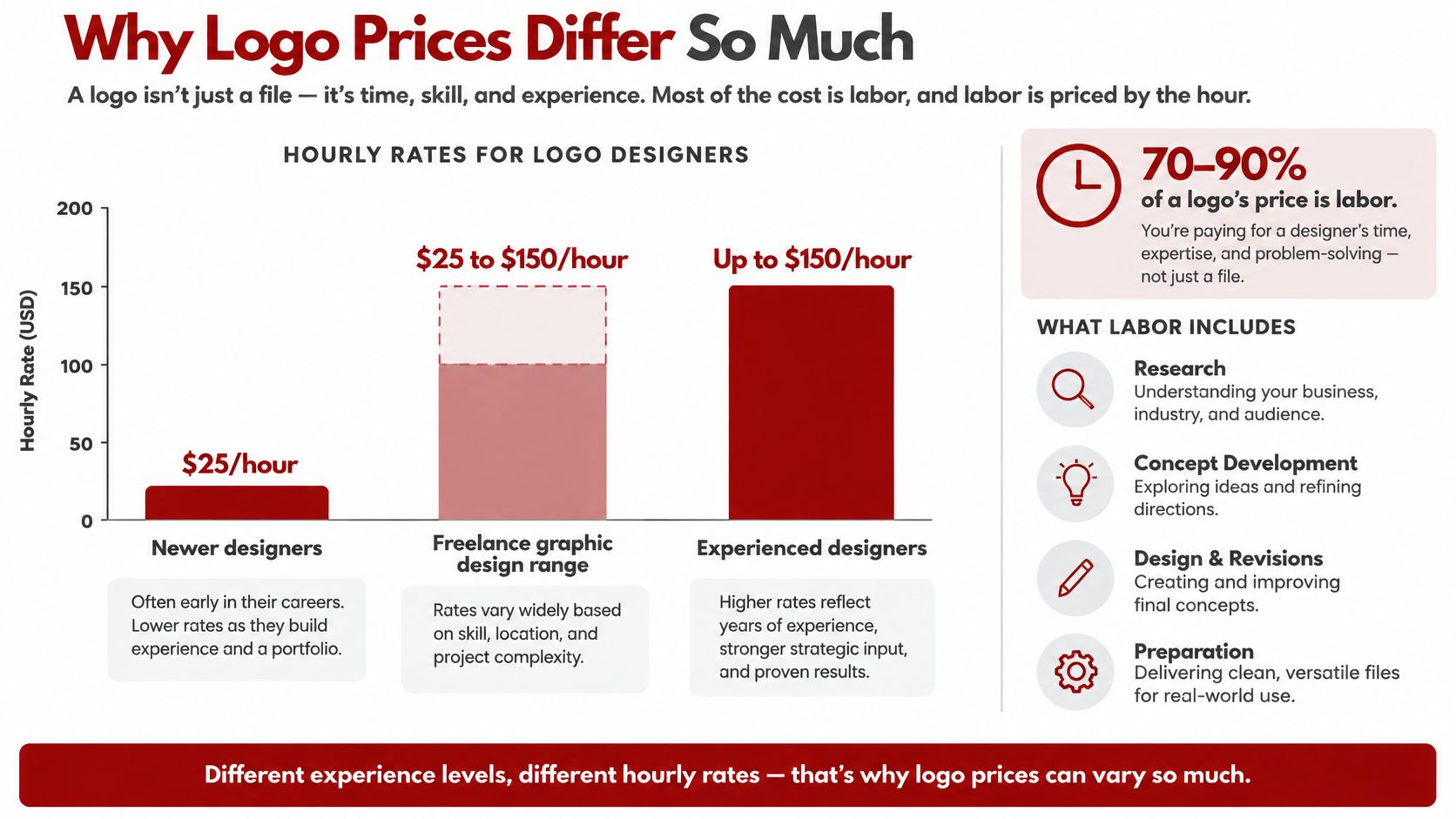
Most of a logo price is labor, and designers price that labor by experience and time. Published estimates placed freelance graphic-design pricing at roughly $25 to $150 per hour, with newer designers commonly in the $25 to $45 range and senior specialists around $85 to $150 per hour, according to Zarla's guide to graphic design pricing.
The chart below shows why experience changes the math so quickly.
Labor Cost Examples for a Logo Project
Scenario | Hours | Hourly rate | Labor estimate |
|---|---|---|---|
Short brief, newer designer | 15 | $25 | $375 |
Full process, senior designer (low end) | 20 | $85 | $1,700 |
Full process, senior specialist | 30 | $150 | $4,500 |
Treat the hour counts as dials, not a fixed standard. Fifteen hours multiplied by $25 equals $375, before project management, software, business overhead, rush delivery, or extra brand assets. Raise the experience or the number of decisions and the same line item changes fast, which is why a researched mark from a specialist can reach several thousand dollars without mystery markup.
A logo quote works like a contractor bid: same job title, different scope. Hours rise when decisions multiply. A single-van electrician in Prescott with one decision maker and a clear name may need only a few strong directions. A contractor with trucks, job signs, uniforms, estimates, and several people approving the work needs research, stakeholder review, and testing at sign and shirt sizes. If apparel is part of the launch, a t-shirt cost breakdown from Custom Mark helps separate garment and printing costs from the design work itself.
Owners often ask why a simple-looking mark takes hours. The visible simplicity usually comes at the end of the work, after weak ideas are rejected and spacing is tested, and our guide to what makes a business logo work in real use explains the readability and flexibility checks behind that result. Sketching, comparing directions, and rebuilding the chosen mark as clean vector artwork all take time.
Practical rule: A quote far below the hourly math usually buys fewer concepts, less research, fewer revisions, narrower usage rights, or a smaller file package.
A lower number can still be honest. It should tell you exactly which parts of the scope shrank and what rights follow the artwork when the invoice is paid.
What Your Logo Price Should Include
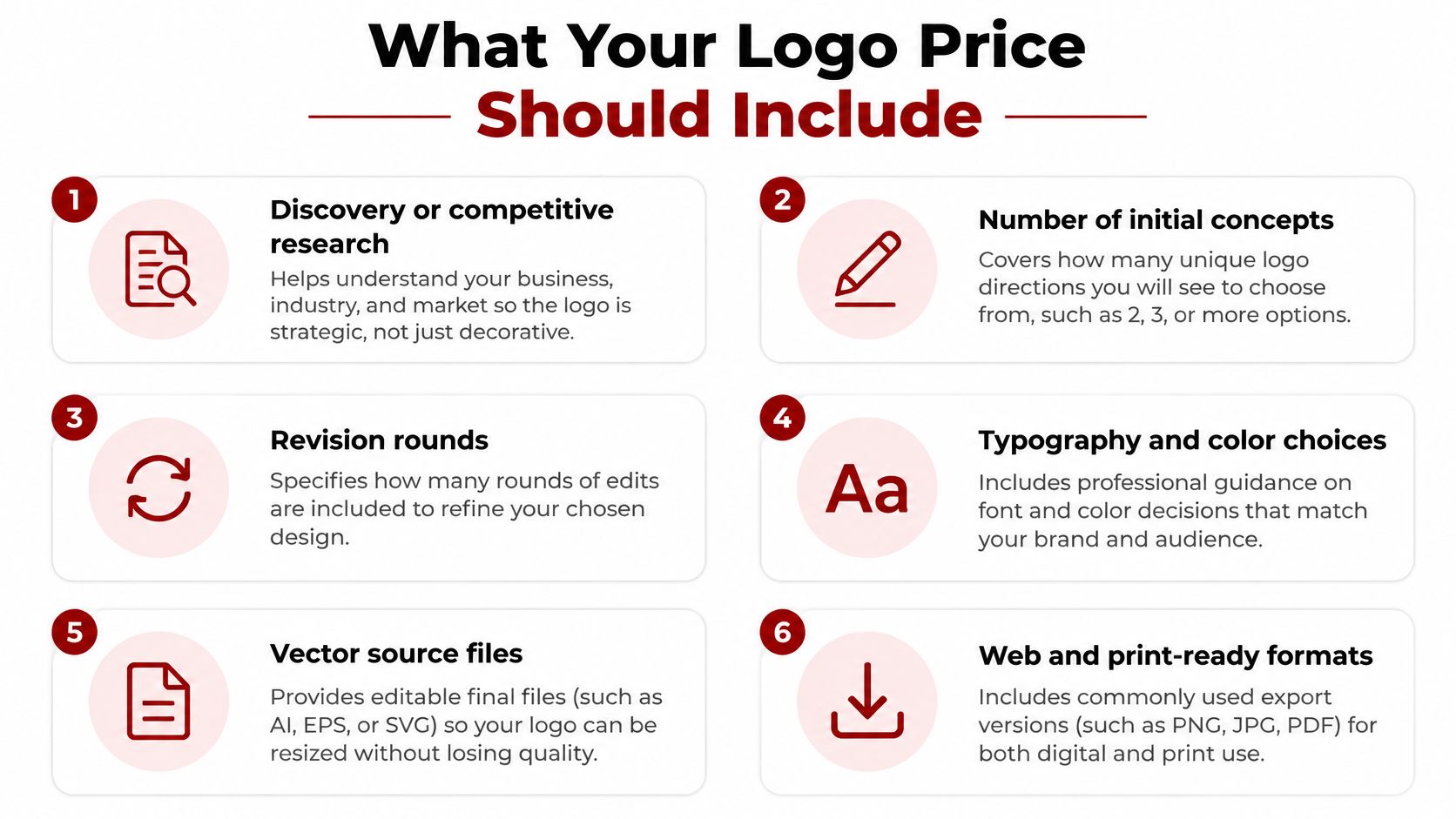
Start with a checklist, not a price. A clear proposal should name the discovery or competitive research, the number of initial concepts, the included revision rounds, the typography and color decisions, the vector source files, and the web and print formats you'll receive. It should also include basic usage guidance, such as clear space around the mark, minimum size, approved color versions, and backgrounds to avoid.
This checklist visual sums up the core items to look for before you sign.
What Each Logo Package Typically Includes
Package | Typical deliverables | Revision rounds | Files to confirm in writing |
|---|---|---|---|
Marketplace or contest | One finished logo file | Limited; confirm the number | Vector source file, web and print formats, font license |
Freelance designer | Discovery, three concepts, typography and color choices | Two rounds is typical for professional scope | Editable vector files, web and print formats, usage guidance |
Agency, boutique or larger | Competitive research, multiple concepts, brand guidelines | Confirm the number in the proposal | Vector files, production assets, trademark-use permission |
DIY logo maker | Templates you customize yourself | Set by the tool | Check license terms before download |
Files matter because each use asks for something different. A sign shop needs scalable vector artwork, a website needs web-ready exports, an embroiderer may need a simplified version, and a social profile needs a mark that stays readable when it's small. Our step-by-step guide to creating a complete brand identity shows how those pieces fit together beyond the logo file itself. If you later animate the mark for video, outside motion graphics services also need clean, editable source files, which is another reason to secure them at the start.
Rights Are Part of the Purchase
Published pricing guidance notes that lower-cost packages may include limited usage rights, leave copyright with the designer, or omit transferable typeface licenses, according to DesignElite's logo design cost guidance. That means a cheap mark can create a second bill when you want to trademark it, put it on franchise materials, or hand the font files to a printer. The logo isn't only artwork. It's an intellectual-property and asset-delivery purchase.
Say a Prescott Valley contractor starts with a website and one truck, then adds uniforms, a shop sign, proposal folders, and a Google Business Profile. If the original package didn't transfer ownership or include production files, every new use can turn into a permission request, a re-licensing fee, or a redraw. A higher quote with complete ownership and production-ready assets can cost less across the life of the brand.
Confirm five items in writing before you pay a deposit:
Copyright ownership: State who owns the final mark after full payment.
Trademark-use permission: Confirm you may use and register the mark for your business.
Editable vector files: Name the source formats you'll receive.
Web and print formats: List the exports for screens, signs, and print.
Font licensing: Confirm the typefaces can be used and transferred as your vendors require.
Which Option Fits Your Business
Four questions decide most logo purchases. How much can you spend now without straining the business? How many places must the logo appear in the next few years? Will it carry vehicles, signage, or uniforms where mistakes are expensive to replace? How much time can you give to briefing, reviewing concepts, and giving clear feedback?
Your answers point to a provider type. They also reveal hidden costs, because a low cash price can demand a lot of your own time, while a higher price often buys process and guidance.
How Do I Choose Between DIY, Freelance, and Agency Work
A DIY logo maker fits a temporary mark, an early test, or a short-lived project where speed matters more than distinctiveness. You do the design work yourself, choose from templates, and must check the license terms before download. It's a reasonable placeholder, but it's a weak foundation for a truck wrap or a permanent sign.
A freelance designer often fits a single-location business with a clear brief and one or two decision makers. You get a custom process without agency overhead, provided the proposal names concepts, revisions, files, and ownership. The risk sits in unclear scope, so judge the written package as carefully as the portfolio.
An agency fits multi-location brands, established companies, and owners who need strategy, guidelines, and several related assets to stay consistent. Examples of how digital marketing agency logos handle that consistency can help you see the difference between a mark and a managed identity. Agency work costs more because more people research, design, review, and document the result.
Our own fit is specific. The Logo Design Consult is listed as free and includes a unique brand identity, an impactful and memorable logo, and a personalized design process. We meet with you to align on goals and budget before the proposal is written, so you see the scope before you commit to design work.
Contrast makes the choice clearer. A single-van electrician in Prescott may need a strong mark, truck-ready files, and basic color guidance. A restaurant group with three sites needs menus, signs, packaging, staff apparel, and rules that keep every location aligned. Both owners say they need a logo, but they don't need the same package.
Choose the lowest package that still covers every use on your list, including the uses you expect next year.
That rule protects your budget without forcing a redesign at the first sign of growth. If an option can't cover a planned use, it isn't cheaper. It's incomplete.
Does AI Make a Logo Cheaper?
AI lowers production time, and production time is only one line on a real quote. Recent market reporting says logo and brand identity represented approximately $17.27 billion, or 31.35%, of the graphic-design market in 2025, according to Mordor Intelligence's graphic design market report. AI use is now normal, so the price question has shifted from who drew the mark to what scope and rights come with it.
The photo below reflects the part AI doesn't replace: people discussing fit, audience, and use before they approve a mark.

AI does one job well. It generates many concepts quickly, so you can explore directions faster and test rough ideas before a designer refines them. That speed can reduce early labor, especially when you already know your name, audience, and style preferences.
A generated draft works like a rough sketch from a very fast hand. The paid work is confirming the sketch can actually be built into something your business owns.
Speed doesn't settle the harder questions. AI output still needs checks for positioning, distinctiveness, trademark risk, and accessibility, plus testing at small icon sizes and on vehicle graphics, signs, and search profiles. A mark that looks sharp on a large screen may turn muddy on a uniform chest or a phone-sized profile image.
The short video below adds useful context on that gap between generation and validation.
Ask one buying question: What human strategy and validation are included after AI-assisted production? A durable answer names an originality check, scalable vector construction, monochrome variants, and written rules for consistent use. You're paying for scope and file rights, so the answer should describe what you own at the end. If the answer is only faster image generation, you're buying drafts, not an identity.
An AI-made mark can suit a temporary experiment or a concept test. A business that will rely on the mark for years on signage, vehicles, and paid ads needs those human checks included in the price, because that is where the value of the quote sits.
When a Higher Logo Price Pays Off
Count the uses before you judge the price. List vehicles, signs, uniforms, the website, a Google Business Profile, invoices, estimates, proposal documents, social profiles, and paid ads. A mark used in ten places earns its cost differently from a mark used only on one website, because every placement either builds recognition or exposes weak files and inconsistent colors.
Use simple lifetime math. For example, a $4,500 identity used on signs, vans, uniforms, and a website for five years works out to about $900 a year before production costs. A low-cost mark that must be redrawn after two years can cost more over time once redesign, re-licensing, new signs, and replacement graphics enter the picture. The same lifetime thinking applies to printed materials, including packaging that delivers a luxury promise, where the design must stay consistent every time a customer handles the product.
Does a Better Logo Improve Local Rankings
Not on its own. Google states that local ranking is based primarily on relevance, distance, and prominence, and prominence can be influenced by links, articles, directories, review count, and review score, according to Google's guidance on local ranking. A professional logo supports recognition and consistency, but it doesn't replace accurate profile information, clear service descriptions, local authority, or genuine customer reviews.
That boundary matters for budgeting. If your profile lists the wrong hours, thin services, or an unclear service area, a new logo won't fix the visibility problem. Our guide to building a brand online treats the identity as one part of a wider presence that includes accurate listings and useful service content. Branding helps customers recognize and remember you once they find you.
Service-area accuracy also protects that investment. Google says a business must make in-person contact with customers during its stated hours to qualify for a Business Profile, online-only businesses aren't eligible, and a service area should generally not extend beyond about two hours of driving time from the business base, according to Google's Business Profile eligibility guidance. A Prescott-area contractor should list the area it serves consistently, such as Prescott, Prescott Valley, Chino Valley, and nearby Northern Arizona communities it can reach.
Ask three questions before approving a higher quote. Where will the logo be used, how long must it last, and what would it cost to change later? If the mark will sit on durable signs, vehicles, and uniforms for years, paying for research, clean files, and clear rights usually pays off. If the use is temporary and digital only, a smaller scope may be the honest fit.
Logo Design Cost Questions Answered
Is a $50 Logo Worth It
It can be, for a temporary profile, a short-term test, or a simple sign you expect to replace. The catch is rarely the mark itself but the rights attached to it. Confirm the file formats, copyright ownership, and font license before paying, because limited rights can make a small purchase expensive later. A cheap logo you cannot legally put on a van or a sign costs more than a fair one that comes with clear ownership.
Do I Need a Written Quote
Yes. A written scope lists concepts, revision rounds, files, timeline, and ownership, so you can compare providers on the same terms. Without one, two quotes that look similar on price may cover very different amounts of work. It also prevents disputes after payment when you request a format the seller never promised.
How Long Does a Logo Project Take
It depends on scope. A single mark moves faster than a full identity with research and guidelines. Ask for dates for concepts, revisions, and final files in the proposal, and ask what feedback the designer needs from you at each stage. Slow answers from the client stretch timelines just as often as slow work from the designer.
Does a New Logo Improve Google Rankings
Not by itself. Local visibility depends on relevance, distance, and prominence, so accurate profile details, clear services, and genuine reviews do work a logo can't do. The logo supports recognition after customers find and compare your business.
Do You Serve Prescott and Nearby Communities
Yes. Silva Marketing is based in Prescott and serves Prescott, Prescott Valley, and Chino Valley. Your proposal should still state the service area and deliverables in writing, so the identity matches the markets where you'll use it.
Get a Written Quote Before You Commit
Bring the same checklist to every provider, and you'll compare scope instead of sales language. The steps are plain, and they work whether you choose a freelancer, an agency, or a local Prescott team.
List every use: Write down vehicles, signs, uniforms, the website, the Google Business Profile, invoices, estimates, and paid ads.
Set a budget range: Match the range to that usage list, using the opening price table as a reference rather than a target.
Shortlist by type: Pick two or three providers whose scope fits a single-location business or a multi-location brand, as your case requires.
Request a written proposal: Require concepts, revision rounds, file formats, font licensing, copyright ownership, and trademark-use permission in writing.
Compare line by line: Start with rights and files, then review research and concepts, and judge price last.
Our process follows that same paper-first logic. We work through four stages, Free Strategy Call, Custom Plan, Build & Launch, and Optimize & Grow. The free 30-minute call and an itemized proposal within 48 hours let you compare scope on paper before deciding, with no pressure to move forward.
Take the checklist to any provider you're considering. Ask each one to fill the same lines, then choose the quote that covers your uses, transfers the rights you need, and leaves no file question unanswered. That's how a fair logo price becomes clear.
If you'd like help comparing logo options for your Prescott or Northern Arizona business, we can review your usage list, clarify the files and rights you need, and outline a scope that fits your goals and budget. You're welcome to visit Silva Marketing to start with a free strategy call and see an itemized proposal before you commit.
Comments