
How to Improve Google Ads Quality Score in Prescott

Chasing a Quality Score of 10 is the most popular advice on this topic, and it's the wrong goal. A high number that doesn't produce calls won't help a local business. What works is treating the score as a diagnostic map, fixing the one weak component, and judging the result by qualified leads.
Silva Marketing is a Prescott based team serving Prescott and surrounding Northern Arizona communities. We help local service businesses learn how to improve Google Ads Quality Score so clicks turn into customers, not just prettier reports.
Table of Contents
Find the Weak Component Dragging Your Score - Quality Score Components and First Fixes - How Do You Read the Rating Columns
How to Tighten Keywords and Match Types - What Is the Step by Step Process - Why Does a Generic Keyword Hurt Relevance
Write Ads That Match Intent and Earn Clicks - What Does a Stronger Ad Look Like - Which Ad Changes Lift Expected CTR
Make Landing Pages Match Every Ad Group - How Do You Improve Landing-Page Experience - What Is the Most Common Landing Page Mistake
Negative Keywords, Structure and Testing Routine - Which Searches Should You Block - How Long Should You Wait Before Judging a Change
Frequently Asked Questions About Quality Score - How Long Does It Take to See Quality Score Change - Does Changing Match Type Raise Quality Score - Is a Score of 10 the Goal - Which Component Should I Fix First - Do I Need a Local Agency to Do This
Confirm Your Score Improves Qualified Leads - When Should You Stop Chasing a Higher Score
Find the Weak Component Dragging Your Score
Start by finding one weak component, not by rebuilding the whole account. According to Google's Quality Score components guide, Google calculates Quality Score from expected click-through rate, ad relevance, and landing-page experience, each rated "Above average," "Average," or "Below average" against advertisers whose ads appeared for the exact same search during the previous 90 days. The score sits on a 1 to 10 scale at the keyword level, so there's no single campaign grade to fix.
That comparison is relative and query specific. Your rating can shift because competitors in Prescott, Prescott Valley, or Chino Valley improve, even if you don't change anything. That's why the component ratings matter more than the headline number.
Quality Score Components and First Fixes
Component | What It Measures | Below Average Usually Means | First Fix |
|---|---|---|---|
Expected CTR | How likely people are to click your ad | Generic headline with no reason to choose you | Test a benefit-led headline that names the service and city |
Ad relevance | How closely the ad matches the search intent | The ad group mixes unrelated service searches | Split the ad group so each service theme has its own ad |
Landing-page experience | How useful the page is after the click | A homepage instead of a service page, or a slow mobile load | Send the ad to a page built for that exact service |
How Do You Read the Rating Columns
Open the Keywords view and add the three component columns. Sort by impressions, then mark the weakest component for each of your top spend keywords.
Say a Prescott plumbing keyword sends emergency and installation searches to one generic services page. You'll often see Below average ad relevance first. Split those intents, and the rating can improve without any bid change.
Segmenting by intent works the same way it does in other channels. Arlo's customer segmentation examples for DTC show how grouping people by need sharpens messaging, and your ad groups need that same discipline.
Pick one component to fix across your three highest spend keywords. Log the date so you can check results against the 90 day window.
How to Tighten Keywords and Match Types
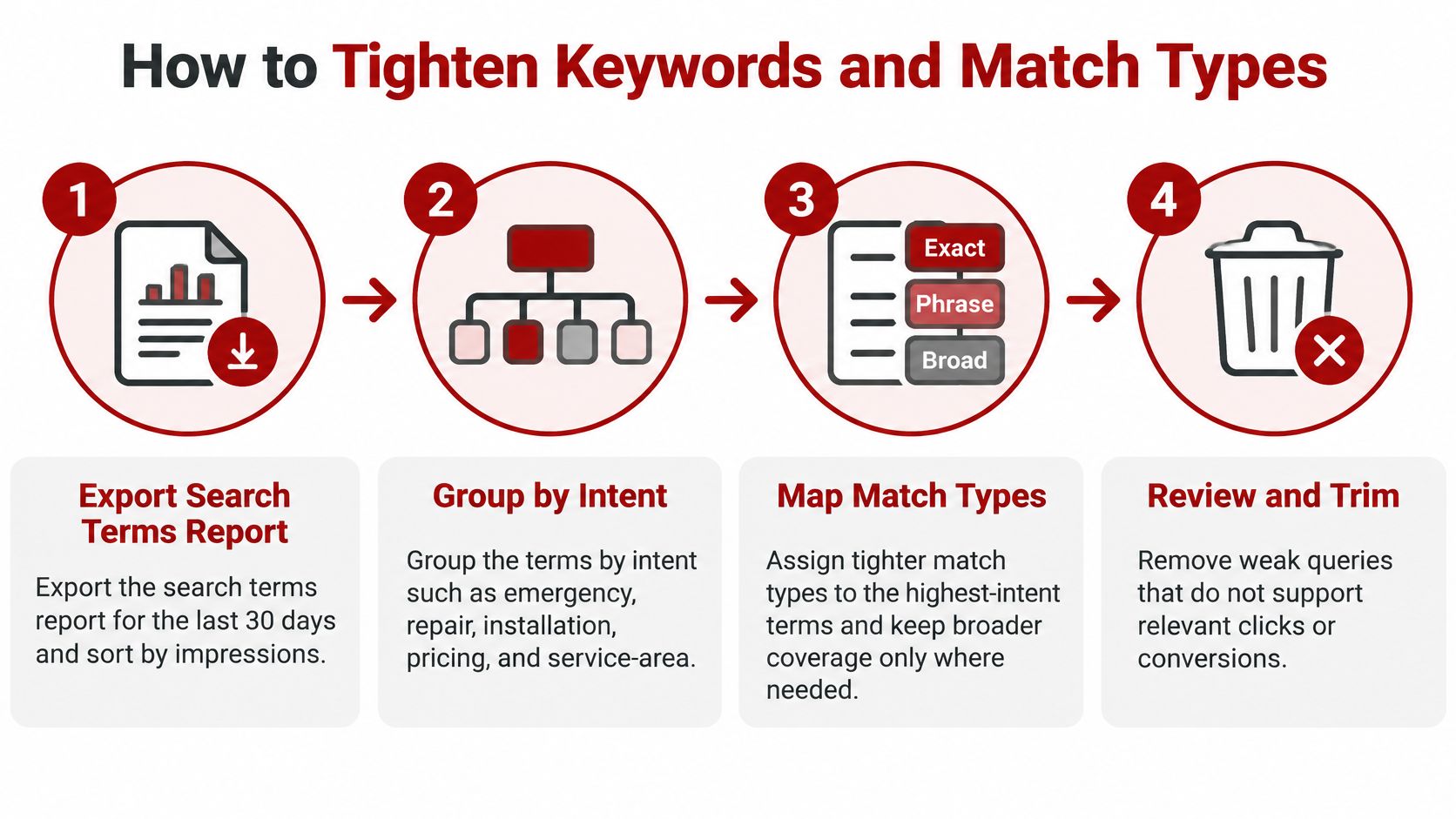
Tight structure comes before new copy. If one ad group holds emergency, repair, and pricing searches, no single ad can match them all.
What Is the Step by Step Process
Export the search terms report: Pull the last 30 days and sort by impressions so you're working from real searches, not guesses.
Group terms by intent: Separate emergency, repair, installation, pricing, and service area queries into their own buckets.
Build one ad group per intent: Keep three to six closely related keywords in each group so one ad and one page can serve them all.
Choose match types deliberately: Use phrase or exact for core service terms. Use broad only when it's paired with a tight negative list.
Add negative keywords: Block job seekers, DIY questions, and cities you don't serve.
Check after four weeks: Look at whether the component ratings moved, not just whether clicks rose.
Step 4 needs one clear warning. Google's explanation of Quality Score calculation states that Quality Score is based on historical impressions for the exact searches associated with a keyword, and changing a keyword's match type does not change the Quality Score. Switching from broad to exact changes which searches trigger your ad. It doesn't erase the history.
Why Does a Generic Keyword Hurt Relevance
A broad term like "plumber" can pull searches from several cities and several customer needs into one ad group. Relevance becomes almost impossible because the searcher in Dewey Humboldt with a burst pipe doesn't want the same page as someone planning a remodel in Prescott.
Separate "plumber Prescott" from "plumber near Prescott Valley" when their landing pages, service areas, or offers differ. If the page would be identical, keep them together. Structure should follow the destination, not habit.
Our guide to keyword research for Google Ads campaigns walks through building those intent groups from search terms data.
Simple test: Every ad group should point to one landing page the searcher could reasonably land on. If you need two pages, you need two ad groups.
Write Ads That Match Intent and Earn Clicks
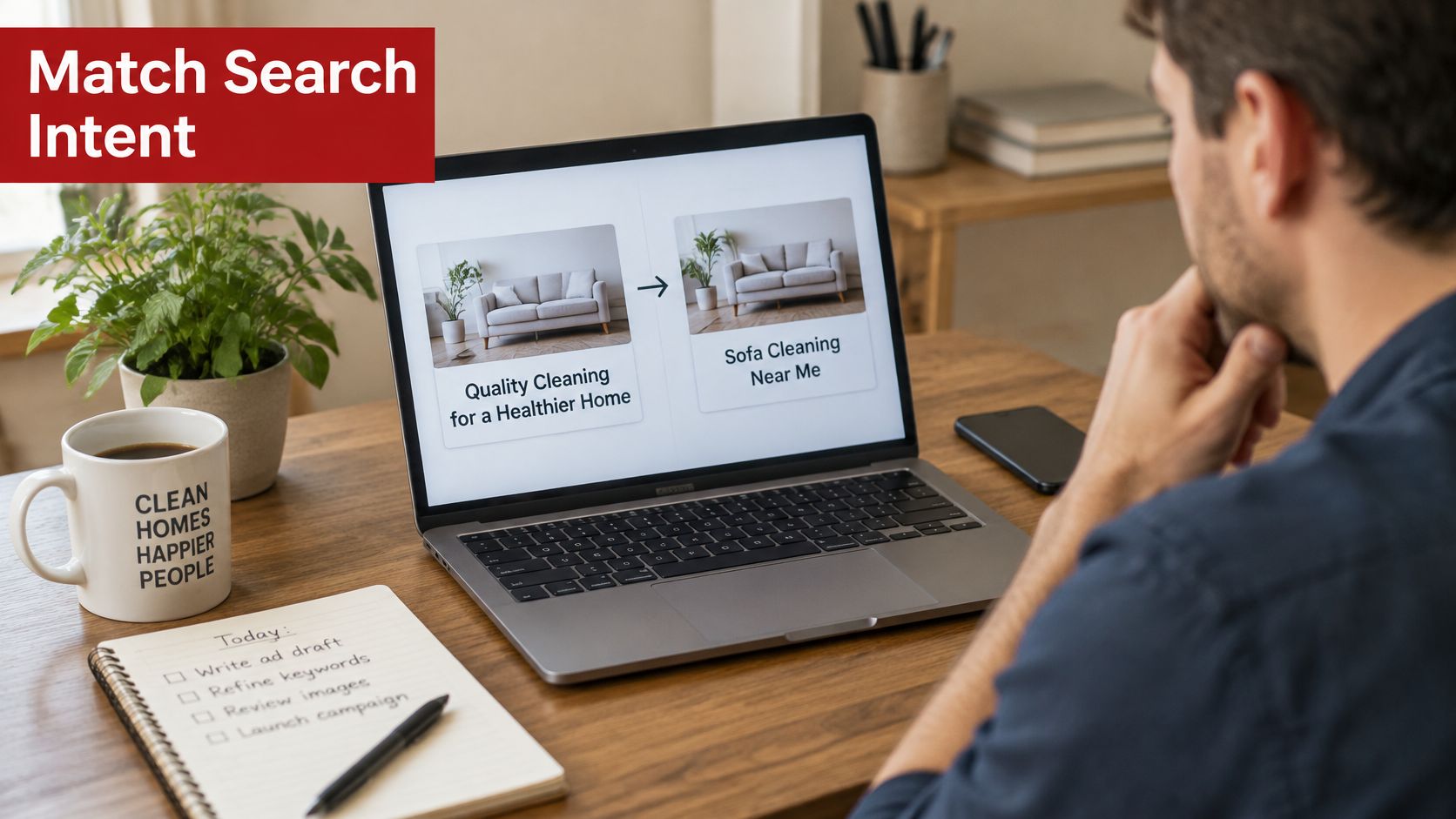
Relevance is judged against the searcher's intent, not keyword stuffing. Use the searcher's own words, then give them one true reason to click.
What Does a Stronger Ad Look Like
Say a Prescott water heater repair ad group runs the headline "Best Plumbing Services." It says nothing about the problem, the place, or why you're credible. A stronger version reads "Water Heater Repair in Prescott," with a description that states one proof point you can back up, such as licensed technicians or same day availability if that is true.
Benchmarks help you read CTR, but they aren't targets for every keyword. Databox's Google Ads statistics reported that the median Google Ads click-through rate for all companies was 4.6% in September 2023. Semrush's Google Ads statistics reported the average Google Ads click-through rate was 6.42% in 2024, compared with 6.11% in 2023. Compare each keyword with both reference points, with its own history, and with competing ads for the same search before you judge it.
Which Ad Changes Lift Expected CTR
Include one true qualifier: Mention a free estimate only if you offer one. A claim you can't honor costs trust and calls.
Match the call to action to intent: Emergency searches get "Call now." Project searches in Northern Arizona get "Request an estimate."
Test two or three variants: Pause the weakest only after each version has enough impressions for a fair comparison.
Our resource on how to improve click-through rates in Google Ads covers headline and description testing in more detail.
Inserting keywords into every headline without changing the offer won't lift a Below average expected CTR rating. I would fix the offer and the specificity first, then worry about word order.
Make Landing Pages Match Every Ad Group
Your page has to deliver what the ad promised, quickly and on a phone. For local service businesses, many visitors call within moments of landing, so a buried phone number is a conversion problem, not a design preference.
Google's mobile speed guidance reports that, in retail, a one-second mobile load delay can reduce conversions by up to 20%, and its mobile speed score uses a 1 to 10 scale, where 1 is very slow and 10 is extremely fast. Google also emphasizes useful, relevant content and fast loading, not speed alone.
How Do You Improve Landing-Page Experience
Record the baseline: Note the three component ratings, mobile speed score, phone click rate, form completion rate, and qualified leads.
Fix template problems first: Compress oversized images, remove render blocking scripts and redirects, and move the phone number where a thumb can reach it.
Repeat the ad promise above the fold: Show the service, the city, and a clear call button before the visitor scrolls.
Add proof visitors can check: Use reviews, licensing details, a service area list covering Prescott and nearby communities, and photos from local jobs.
Build separate pages where intent differs: Emergency plumbing, roof replacement, and commercial roofing shouldn't share one generic homepage.
Compare over the same traffic window: Split results by device so mobile gains don't hide behind desktop traffic.
If you're unsure where visitors stall, there are practical ways to improve conversions through usability testing before you rebuild a page. Watching a real person try to find your call button on a phone tells you more than a speed score does.
Our guide to Google Ads landing page optimization for local campaigns covers page structure and trust signals in depth.
What Is the Most Common Landing Page Mistake
Removing proof, service details, or financing information to chase a higher speed score often lowers qualified leads. You want faster access to persuasive, intent matched information, not a fast page with nothing on it. Keep the content that helps a Prescott homeowner decide, and make it load cleanly.
Negative Keywords, Structure and Testing Routine
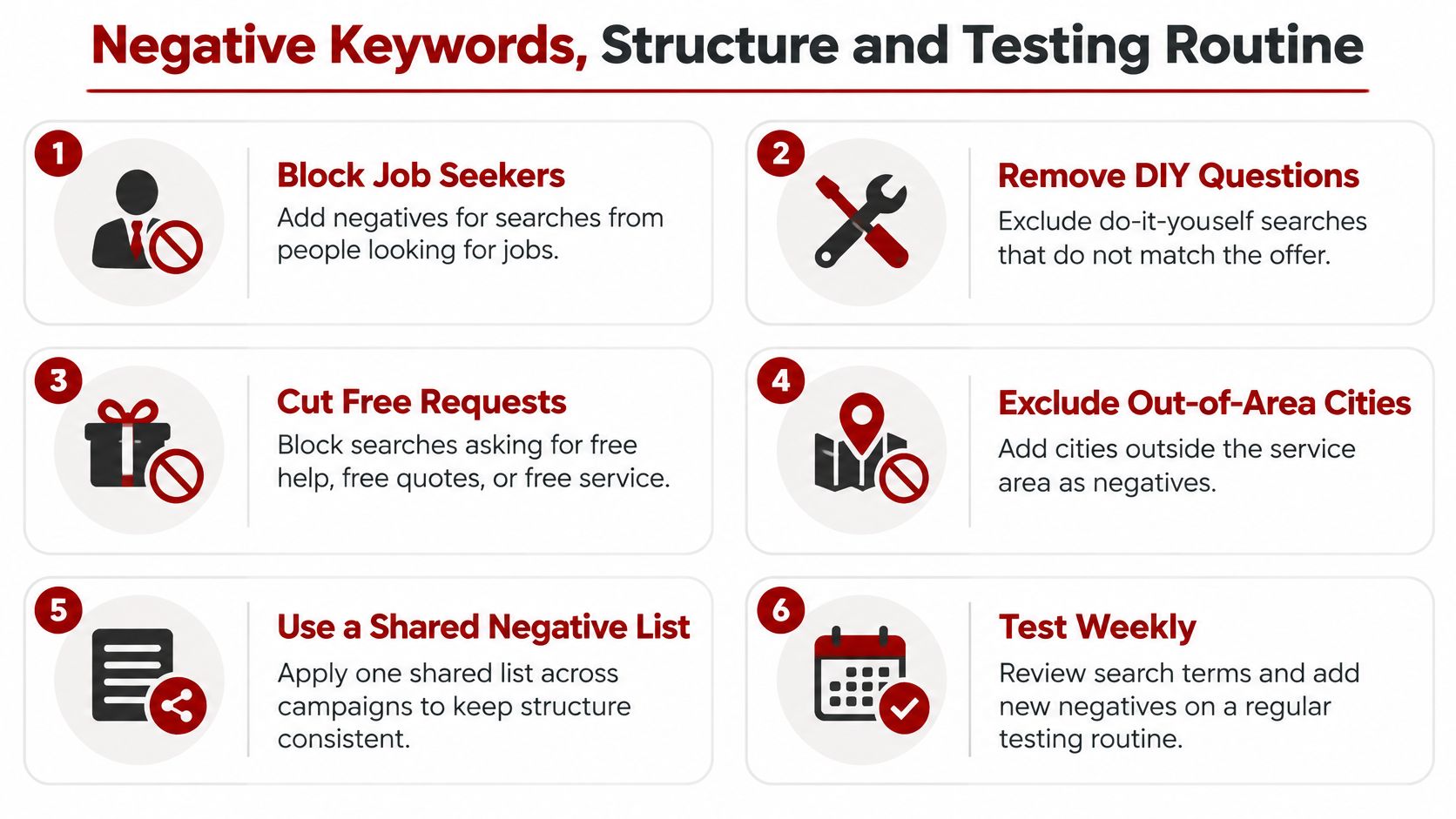
Negative keywords protect relevance by keeping your ads away from searches they'll never satisfy. Every wasted impression on a job seeker or DIY searcher dilutes the signal your ad group sends.
Which Searches Should You Block
Job seekers: Terms like hiring, careers, and salary don't come from customers.
DIY questions: "How to fix it yourself" searches rarely convert into booked work.
Free requests: Searches asking for free service mismatch a paid offer.
Out of area cities: If you serve Prescott and Northern Arizona, block Phoenix suburbs you won't drive to.
Keep one shared negative list across campaigns. Review it weekly during the first month, then monthly once query patterns settle. Our guide to Google Ads negative keywords and shared lists explains how to build and maintain that list.
How Long Should You Wait Before Judging a Change
Set the read window before you make the change. Allow about four to six weeks for a landing page rebuild, measured across a full set of visits. Give an ad group split a full four weeks so the relevance rating can reflect current competing advertisers. Judge a negative list by the drop in wasted clicks over the same traffic window.
Change one variable at a time, keep budgets equal, and log each change with its date. Don't judge results on a single volatile day. The same discipline applies across channels, which is why structured programs like Advisor Momentum's social advertising services also rely on planned testing windows rather than daily reactions.
Weekly checklist: Review negatives, log every change, compare ratings after the read window, and stop any test that hasn't gathered enough impressions to mean anything.
Frequently Asked Questions About Quality Score
How Long Does It Take to See Quality Score Change
Plan on the comparison window and read component ratings after four to six weeks of stable changes. Ratings also shift when competitors change their ads, so short term movement doesn't always reflect your edits.
Does Changing Match Type Raise Quality Score
No. A match type change alters which searches trigger your ad, but it doesn't erase the existing diagnostic data. Fix the ad and page behind the keyword instead.
Is a Score of 10 the Goal
No. Aim for Above average on the weakest component while keeping qualified leads steady at an acceptable cost per lead.
Which Component Should I Fix First
The one rated Below average on your highest spend keywords. That's where you're most likely losing clicks or leads right now.
Do I Need a Local Agency to Do This
A Prescott based team can check Prescott and Northern Arizona search patterns directly, but the same three component diagnosis works for any account.
Confirm Your Score Improves Qualified Leads
Here's the contrarian point most advice skips. According to Google's Quality Score diagnostic guidance, the 1 to 10 score is calculated at the keyword level, but the aggregate Quality Score itself is not used at auction time to determine Ad Rank. The displayed number is a benchmark for finding weaknesses, not the lever itself.

When Should You Stop Chasing a Higher Score
Use this decision rule. If qualified calls and cost per qualified lead are steady or improving, a score of 6 with strong economics beats a score of 9 that produces no leads. If the score rises but cost per lead climbs, check the landing page before changing anything else.
Review these monthly by keyword group:
Qualified call rate: Are calls turning into real service requests?
Form conversion rate: Do visitors complete the form after clicking?
Cost per qualified lead: What does each real opportunity cost?
Revenue by keyword group: Which themes book profitable jobs?
That monthly discipline is how we work too. Each month, our clients receive a performance dashboard and report, a next step roadmap, direct communication with their marketer, and clear measurable KPIs.
This week, list your ten highest spend keywords with their three component ratings. Fix the weakest component on the top three and log the change. If you'd like a second set of eyes, our free strategy session reviews your goals, audits your current marketing, and maps a plan, with no pressure and no obligation.
If your Prescott or Northern Arizona campaigns are spending without producing steady qualified calls, we can review your component ratings, ad groups, and landing pages and show you exactly where relevance is breaking down. Visit Silva Marketing to book a calm, no pressure strategy session and get a clear plan for turning your Google Ads spend into booked work.
Comments