
How to Do SEO Keyword Research That Drives Local Calls

A local business owner often reaches the same frustrating point: the website looks professional, Google Ads generate visits, and the phone still stays quiet. The problem usually isn't a lack of keywords. It's targeting phrases that describe what a business sells without matching what nearby customers actually need, ask, and do next.
Silva Marketing helps service-based businesses in Prescott, Prescott Valley, Chino Valley, the Quad Cities, and Northern Arizona research keywords around one practical outcome, qualified local calls and leads. This guide shows how to do SEO keyword research so your website, Google Business Profile, content, and Google Ads support the same customer journey instead of competing for disconnected traffic.
Table of Contents
Why Keyword Research Sets the Foundation for Every Local Campaign
Building a Seed List That Reflects Real Customer Language - A practical seed-list exercise
Validating Demand With Google Trends the Right Way - A roofing example
Mapping Intent and Deciding What Each Keyword Deserves - One page or several?
Why AI Overviews Change How Local Keywords Are Valued - Measure influence alongside clicks
Why Keyword Research Sets the Foundation for Every Local Campaign
Keyword research connects the parts of a local marketing campaign that are often managed separately. Your website needs service language that matches real searches. Your Google Business Profile needs clear categories and service descriptions. Your content needs to answer customer questions. Your Google Ads need terms that signal a credible buying opportunity.
A beautiful Prescott web design project can still underperform if the site targets broad or inaccurate phrases. A contractor might rank for “home improvement” while customers search for “roof repair Prescott,” “emergency electrician near me,” or “contractor website design Prescott.” The design isn't the issue. The language and page-to-intent match are.
Practical rule: A keyword isn't valuable because it looks popular. It's valuable when the business can satisfy the search and the searcher has a realistic path to contact.
Google defines keyword research as identifying the words and phrases people use to find information a business offers. Its recommended starting point is practical: begin with terms closely related to the company's products or services, then examine search interest, geographic relevance, related topics, and related queries through Google's Trends workflow.
For a local campaign, the working list should answer four questions:
What service is needed? Repair, replacement, installation, design, maintenance, or consultation.
Where is it needed? Prescott, Prescott Valley, Chino Valley, another Quad Cities community, or a broader Northern Arizona territory.
How urgent is it? Emergency, same-day, scheduled, or research-stage.
What action is likely? Call, request a quote, get directions, compare providers, or learn how to solve a problem.
This is also where operational follow-up matters. If a campaign produces inquiries but the business struggles to respond consistently, resources such as Lathire appointment setters can help teams think through appointment-setting support without confusing lead generation with lead handling.
Silva Marketing's local SEO keyword guidance follows the same principle: build the list around services, locations, and intent before deciding which pages or campaigns deserve investment. Research is the foundation, not a spreadsheet exercise added after the website is built.
Building a Seed List That Reflects Real Customer Language
Start with the language your business already hears. Review phone recordings, estimate requests, invoices, service-truck lettering, sales notes, and questions employees answer repeatedly. Customers may not use the same terminology found in your navigation menu, and that difference can reveal the highest-value opportunities.
A roofing company might organize its first list like this:
Group | Example candidates |
|---|---|
Core services | roof repair, roof replacement, roof inspection |
Problems | roof leak repair, storm damage roof, missing shingles |
Locations | Prescott, Prescott Valley, Chino Valley, Quad Cities |
Urgency | emergency roof repair, same-day inspection |
Audience language | roofing contractor, residential roofer, commercial roofing |
Google's SEO Starter Guide recommends considering the words different users might search for, including experienced searchers and people who are new to a topic. That means a professional may search for “SEO for contractors,” while a business owner may search for “contractor website design Prescott.” Both phrases can describe a legitimate audience, but they shouldn't automatically receive the same page.
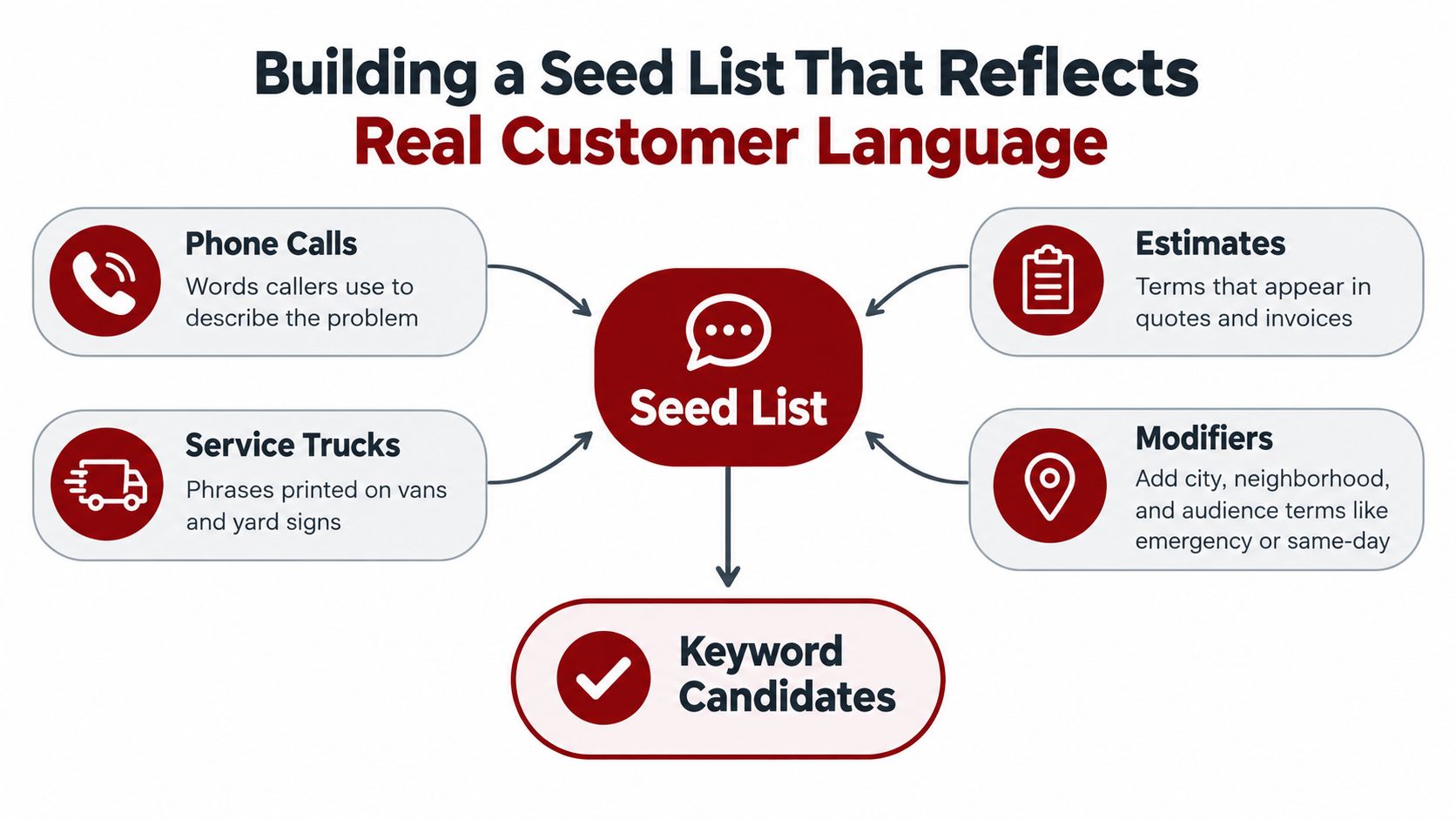
A practical seed-list exercise
Set aside a short working session and create five columns:
The service you provide
The problem the customer describes
The words your team uses internally
The location or service area
The action the customer wants
Then add every phrase that sounds natural, including terms with no obvious tool data. If a Prescott homeowner repeatedly says “water coming through the ceiling,” that wording may inspire a question page, even if the formal service is “roof leak assessment.”
The next pass adds variations, not repetitions. Combine service terms with Prescott, Prescott Valley, Chino Valley, and Quad Cities only where the business serves those communities. Add audience modifiers such as residential, commercial, contractor, emergency, or same-day when they change the customer need.
For additional topic development, a resource on how to find content ideas that resonate can help turn recurring customer questions into useful editorial candidates. The important filter remains local usefulness. A phrase belongs on the list because it reflects a real customer problem, service, location, or decision, not because it creates another variation to repeat.
Validating Demand With Google Trends the Right Way
Google Trends is useful when you treat it as a directional research tool, not a search-volume report. You can compare up to five terms at one time, set a consistent country, region, category, and date range, and review how interest changes over time and across locations. Google Trends uses a sample of aggregated, anonymized, and categorized Google and YouTube searches, so its index helps reveal relative interest and seasonality rather than an absolute number of searches.
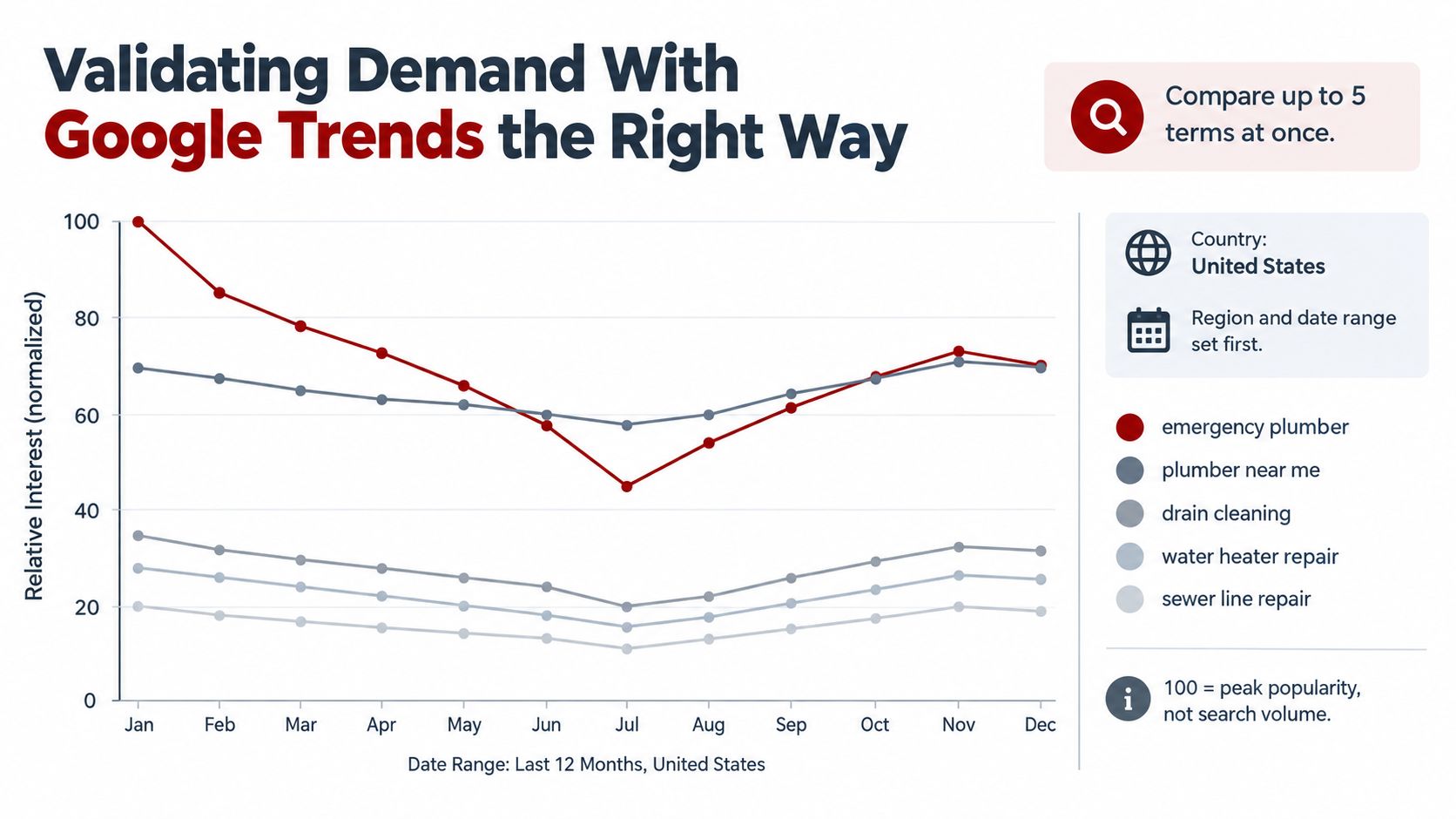
The scale runs from 0 to 100, with 100 representing the highest relative popularity for the selected comparison, time, and location. A score of 50 does not mean 50 searches, 50 percent of searches, or a fixed number of visits. Google explains this normalization in its Trends data documentation.
A roofing example
Suppose you compare “roof repair,” “roof replacement,” and “roof repair Prescott.” Start with the United States to understand broader language, then repeat the comparison for Arizona or the relevant local area. “Roof repair” may appear more popular nationally, but that doesn't establish that it will produce better Prescott leads. National interest can include unrelated markets, different climates, and searchers outside the company's service territory.
Keyword | U.S. Interest (0-100) | Arizona Interest (0-100) | Status | Local Takeaway |
|---|---|---|---|---|
Roof repair | Relative score from the selected comparison | Relative score from the selected comparison | Compare direction and seasonality | Broad demand requires local validation |
Roof replacement | Relative score from the selected comparison | Relative score from the selected comparison | Compare direction and seasonality | May reflect a different decision stage |
Roof repair Prescott | Relative score from the selected comparison | Relative score from the selected comparison | Compare local fit | Stronger geographic specificity may support qualified intent |
The table deliberately uses relative placeholders rather than invented scores. Enter the three terms into Trends with the same settings and record the displayed values from your own comparison. The research question isn't “Which number is largest?” It is “Which phrase shows local relevance, useful direction, and a service need the business can fulfill?”
Look at Rising queries for terms showing the greatest growth compared with the previous period. A Breakout label means the increase is greater than 5,000%, according to Google's explanation of Trends features. That signal can reveal emerging customer language, but it still needs an intent and service-fit review before it becomes a page or ad group.
Research discipline: Use Trends to identify direction and seasonality. Use intent, local fit, conversion readiness, and competitor review to assign priority.
Google's BigQuery Trends dataset shows that U.S. analysis can be examined across 210 designated market areas, with daily data across a rolling 5-year window and hourly data across a rolling 1-year window. International coverage includes approximately 50 additional countries, which reinforces the need to separate broad popularity from demand in Prescott, Northern Arizona, or a specific service territory.
Mapping Intent and Deciding What Each Keyword Deserves
The same service phrase can represent different needs. A person searching “what causes a roof leak” needs an explanation. Someone searching “roof repair Prescott” is looking for a provider. A branded search for “Silva Marketing” is navigational. A search for “best SEO agency for contractors” is commercial investigation.
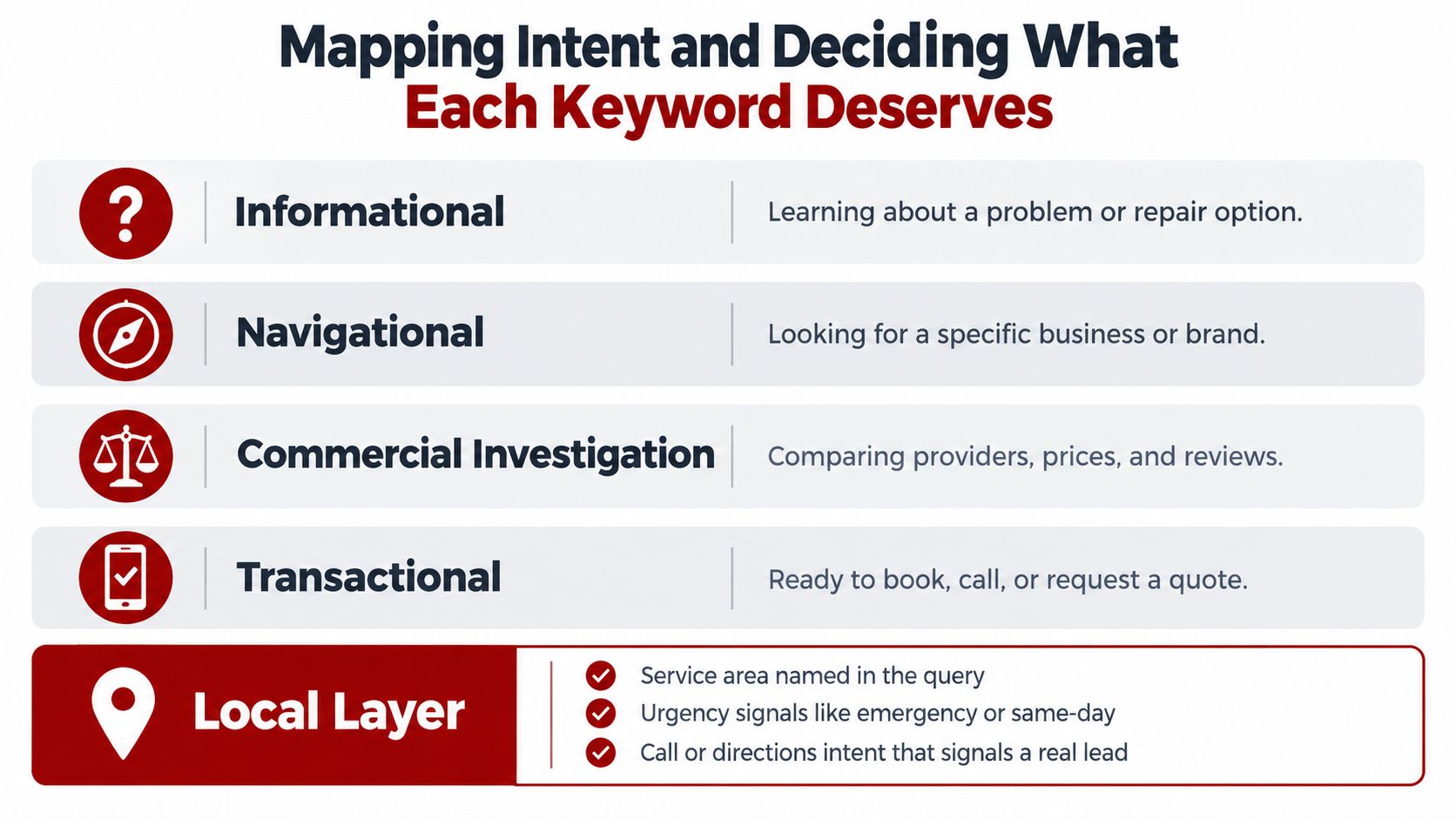
Use four primary intent categories, then add a local layer:
Informational: The searcher is learning about a problem, service, or repair option.
Navigational: The searcher wants a specific business, brand, or website.
Commercial investigation: The searcher is comparing providers, reviews, approaches, or costs.
Transactional: The searcher is ready to call, book, request a quote, or take another direct action.
The local layer changes the value of each category. “How do I stop a burst pipe?” may support an educational article, while “burst pipe repair Prescott” indicates a stronger service path. “Emergency plumber Prescott,” “24-hour plumber near me,” and “burst pipe repair Prescott” may all represent the same job to be done.
One page or several?
Create one authoritative emergency-service page when the SERP shows the same providers, page types, map results, and AI Overview coverage for the cluster. Separate pages make sense only when the customer need, service, or result pattern changes. “Water-heater replacement cost” may deserve a decision-stage resource because the searcher is evaluating a distinct question rather than only looking for emergency assistance.
Use this clustering checklist:
Read the results: Do the same page types rank for each phrase?
Compare the customer job: Is the searcher trying to solve the same problem?
Check the local signal: Do the same communities, map results, and service areas appear?
Review the conversion: Would the same call-to-action serve every query?
Inspect the AI summary: Does the Overview address the same underlying question?
Choose the smallest useful page set: Consolidate near-duplicates and separate genuine needs.
Google's featured-snippet guidance explains that systems select useful answers when enough page text is available to create a meaningful excerpt. That supports concise answers under descriptive headings, followed by practical context instead of a collection of thin pages.
For paid campaigns, the same mapping prevents a mismatch between an ad and its landing page. Silva Marketing's keyword research for Google Ads is relevant here because paid search still depends on matching the query, message, page, and conversion action.
Why AI Overviews Change How Local Keywords Are Valued
A keyword can influence a customer without sending that person directly to the ranking page. Google's AI Overviews may summarize an answer, cite sources, and give the searcher enough context to remember a business name before making a later branded search or phone call.
A Pew Research Center analysis of nearly 69,000 Google searches from about 900 U.S. adults found that users clicked a traditional result in only 8% of searches when an AI Overview appeared, compared with 15% when one did not. Only 1% clicked a source link inside the Overview. Those figures change how local marketers should interpret a keyword that produces modest direct traffic but repeatedly exposes a business as a credible answer.
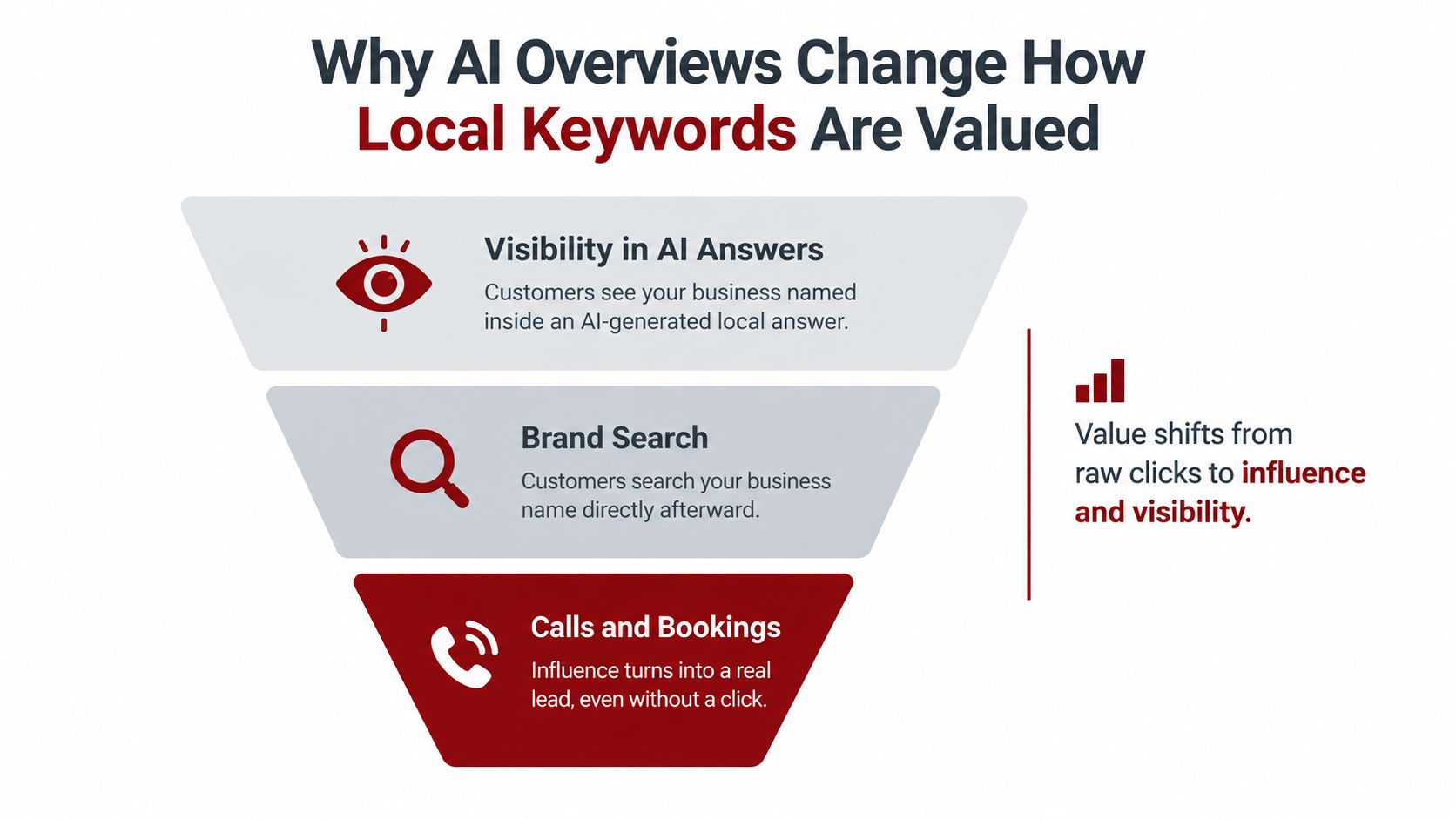
Measure influence alongside clicks
For Prescott contractors and Northern Arizona service businesses, keyword evaluation should include:
Brand mentions: Is the company named in relevant answers?
Citations: Do AI systems reference pages that explain the service accurately?
Map actions: Do searches lead to profile views, calls, or direction requests?
Assisted conversions: Does a customer interact with informational content before contacting the business?
Traditional performance: Do rankings and organic visits still support the commercial journey?
This doesn't make rankings irrelevant. It means rankings are one part of a broader visibility record. A lower-volume question about choosing a contractor, diagnosing a service problem, or comparing repair options may be more commercially valuable than a broad phrase if it consistently positions the business as a trusted local source.
Entity language becomes important here. Use clear business details, named services, genuine service areas, author expertise, useful explanations, and consistent references across the website and Business Profile. A guide to AI search readiness can provide additional context for teams adapting their content to answer-based discovery.
Silva Marketing's AI search engine optimization resource reflects the same shift. The practical objective is not to write for a machine at the expense of a customer. It is to make the business, service, local relevance, and supporting evidence easy for both audiences to understand.
Local Ranking Factors Built Into Your Keyword Decisions
Google identifies three primary local ranking factors: relevance, distance, and prominence. Keyword research becomes more useful when each phrase is tested against all three rather than treated as an isolated term.
Factor | What it means | Research and implementation action |
|---|---|---|
Relevance | How closely the Business Profile and page match the search | Describe actual services in plain language and map them to appropriate pages |
Distance | How far the business is from the searcher or referenced location | State genuine service areas and create community pages only where service is real |
Prominence | How well-known and trusted the business appears | Build reviews, relevant links, mentions, and consistent business information |
Relevance starts with service clarity. If a Business Profile says “marketing” while the website explains contractor SEO, custom websites, and Google Ads, the business should align those descriptions so Google and customers can understand the offer. The same applies to a plumber, roofer, electrician, or legal professional.
Distance isn't something a business can solve by adding every city to every paragraph. A Prescott company may serve Prescott Valley, Chino Valley, and other Quad Cities communities, but each location reference should reflect an actual service relationship. Publishing a page for a place the company doesn't serve creates a credibility problem rather than a local advantage.
Prominence grows through recognition outside the website. Google notes that links from other websites and the quantity and quality of reviews can influence how prominent a business appears. Community involvement, accurate listings, consistent business details, and legitimate customer feedback support the entity that the keyword research is meant to connect with.
Local targeting should therefore ask, “Can this business prove relevance, presence, and recognition for this query?” If the answer is weak, changing the wording alone won't fix the campaign.
Putting It All Together Into a Repeatable Research Workflow
A durable process turns keyword research into a recurring operating habit:
Collect the seed list. Start with phone language, estimates, service descriptions, customer questions, locations, and audience terms.
Expand carefully. Use Google autocomplete, People Also Ask, Search Console, competitor pages, and a keyword tool to find related language.
Validate direction. Compare up to five terms in Google Trends with consistent location and date settings. Record relative interest, seasonality, Rising queries, and local differences.
Classify intent. Label each candidate informational, navigational, commercial investigation, transactional, or local. Note the likely conversion action.
Cluster by customer need. Keep closely related variations together when the SERP, AI Overview, page type, and job to be done are the same.
Review AI visibility. Look for questions where the business could be cited, named, or associated with a useful local answer.
Check local legitimacy. Confirm relevance, distance, prominence, service-area accuracy, reviews, links, and Business Profile consistency.
Assign the page or campaign. Choose a service page, location page, educational article, comparison resource, Google Ads group, or no new asset.
Google's SEO Starter Guide supports using varied vocabulary and clear headings to help people move through content. Google also defines keyword stuffing as filling a page with keywords or numbers in an attempt to manipulate rankings, especially when terms appear unnaturally or out of context. That makes two common local mistakes easy to identify: repeating “Prescott” in every paragraph and creating a separate page for every minor phrase variation.
Use natural language instead. Explain the service, name the communities genuinely served, answer customer questions, and consolidate pages when the underlying need is identical. Google's spam-policy guidance is a useful guardrail because keyword research should improve clarity, not create a quota for exact-match repetition.
For a practical planning document, use a keyword research planner to record the phrase, intent, location, target page, conversion action, evidence of demand, and next review date. Revisit the plan when the business adds a service, expands into a legitimate service area, changes its offer, or hears new language from customers.
Silva Marketing helps Prescott and Northern Arizona businesses turn keyword research into SEO roadmaps, conversion-focused websites, Google Ads campaigns, and content plans built around qualified calls. Visit Silva Marketing to request a free consultation and discuss a practical next step without a long-term contract.
Comments