
Landing Page with Form: Build and Optimize for Local Leads

You've paid for the Google Ads click, earned the map search, or finally appeared in front of a homeowner who needs help. Then the visitor reaches your contact page, sees a generic headline, struggles through an oversized form, and leaves without calling. For a Prescott contractor, Northern Arizona home service company, or local professional firm, that lost submission can represent a valuable opportunity that never reaches your team.
Silva Marketing helps Prescott and Northern Arizona businesses turn that gap into a clearer path from click to conversation. The agency works with local service businesses, contractors, entrepreneurs, and small to midsize companies that need custom websites, search engine optimization, and Google Ads campaigns that generate more qualified calls and leads across Prescott, Prescott Valley, Chino Valley, Dewey-Humboldt, and surrounding Northern Arizona communities.
A landing page with form gives one campaign, service, and audience a focused destination. Instead of asking a visitor to move through your entire website, it presents a relevant promise, local proof, a practical next step, and a form designed to collect only the information your team can use.
Table of Contents
Why Your Current Lead Capture Strategy Might Be Leaking Calls - What makes a dedicated page different - Why generic templates underperform locally
Balancing Form Fields and Conversion Friction - Which fields earn their place - Mobile completion depends on feedback
Designing the Page Anatomy for Local Trust and Speed - What belongs above the fold - Why speed protects the conversion path
Connecting the Form to Your CRM and Tracking Systems - Build a clean submission workflow - Protect data quality after the click
Testing and Optimizing for Continuous Lead Growth - Test the message before the decoration - Use behavior evidence responsibly
Why Your Current Lead Capture Strategy Might Be Leaking Calls
A standard contact page usually has a broad job. It may link to every service, location, blog post, social profile, and company detail. That structure can work for existing customers who already know your business, but it often performs poorly for a person arriving from a service-specific ad or a local search result.
A dedicated page starts with a narrower question: What does this visitor need, and what should they do next? If someone searches for roof repair in Prescott, the page should confirm that service immediately. If a business owner wants a website redesign in Northern Arizona, the page should speak to that project rather than send them to a general navigation menu.
What makes a dedicated page different
A landing page should match the promise that earned the click. The headline, supporting copy, imagery, form, and call to action all need to point toward the same outcome. A page for emergency plumbing calls shouldn't lead with a long company history. A page for a planned remodel estimate shouldn't use the same urgent language as an after-hours dispatch page.
The distinction matters because visitors assess relevance and credibility quickly. Local buyers want to know whether you serve their area, understand their situation, and provide a legitimate way to get help. A vague template with stock photography and no clear service boundary leaves them to answer those questions alone.
Strong local signals can include:
Specific service coverage: Name Prescott and the surrounding communities you serve.
Authentic evidence: Use real team photos, project images, licenses, certifications, memberships, and accurate customer feedback.
Clear expectations: Explain what happens after submission, such as a phone call, estimate discussion, consultation, or scheduling conversation.
A visible alternative: Some visitors prefer calling, so show a legitimate business phone number alongside the form.
A focused offer: Ask for an estimate, consultation, inspection, or service request, not an ambiguous “submit” action.
Practical rule: A form is not the beginning of trust. It's the final step in a sequence that must first make the visitor feel understood and safe.
Why generic templates underperform locally
A generic template often treats location as an afterthought. It may place “Prescott” in a footer while the main message could belong to any company in any city. That weakens both the user experience and the connection between the searcher's intent and the page.
Authority-first design takes the opposite approach. It makes the local business recognizable, explains its service clearly, and removes uncertainty before asking for contact information. Faith-based values, community involvement, professional credentials, and consistent service across Northern Arizona can support that trust when they're genuine and presented with restraint.
A useful benchmark comes from a large 2026 analysis of landing pages, which found a 4.02% median conversion rate for dedicated landing pages, while the top quartile exceeded 11.45%. The same analysis reported a 2.35% median for general website pages, making purpose-built pages a useful comparison point for campaign teams evaluating lead capture performance. The 2026 landing page conversion analysis presents these figures as cross-industry benchmarks, not guarantees for a particular Prescott campaign.
The strategic shift is simple. Stop treating the form as an isolated widget on a general page. Build the page around the visitor's reason for arriving, then make the next action easy to understand and easy to complete.
Balancing Form Fields and Conversion Friction
Every field creates a decision for the visitor. Some fields help your team qualify a lead, while others merely satisfy an internal preference for collecting more data. Local service businesses need to separate those two categories before expanding a form.
A 2026 form-behavior study covering 404 landing pages with form-based conversions found a consistent decline as field count increased. One-field forms converted at 18.2%, two-field forms at 13.0%, three-field forms at 11.5%, four-field forms at 9.9%, five-field forms at 8.1%, seven-field forms at 7.6%, eight-field forms at 5.8%, and forms with nine or more fields at 4.2%. The form field conversion analysis supports a practical principle, collect the minimum information needed at the top of the funnel and qualify later.
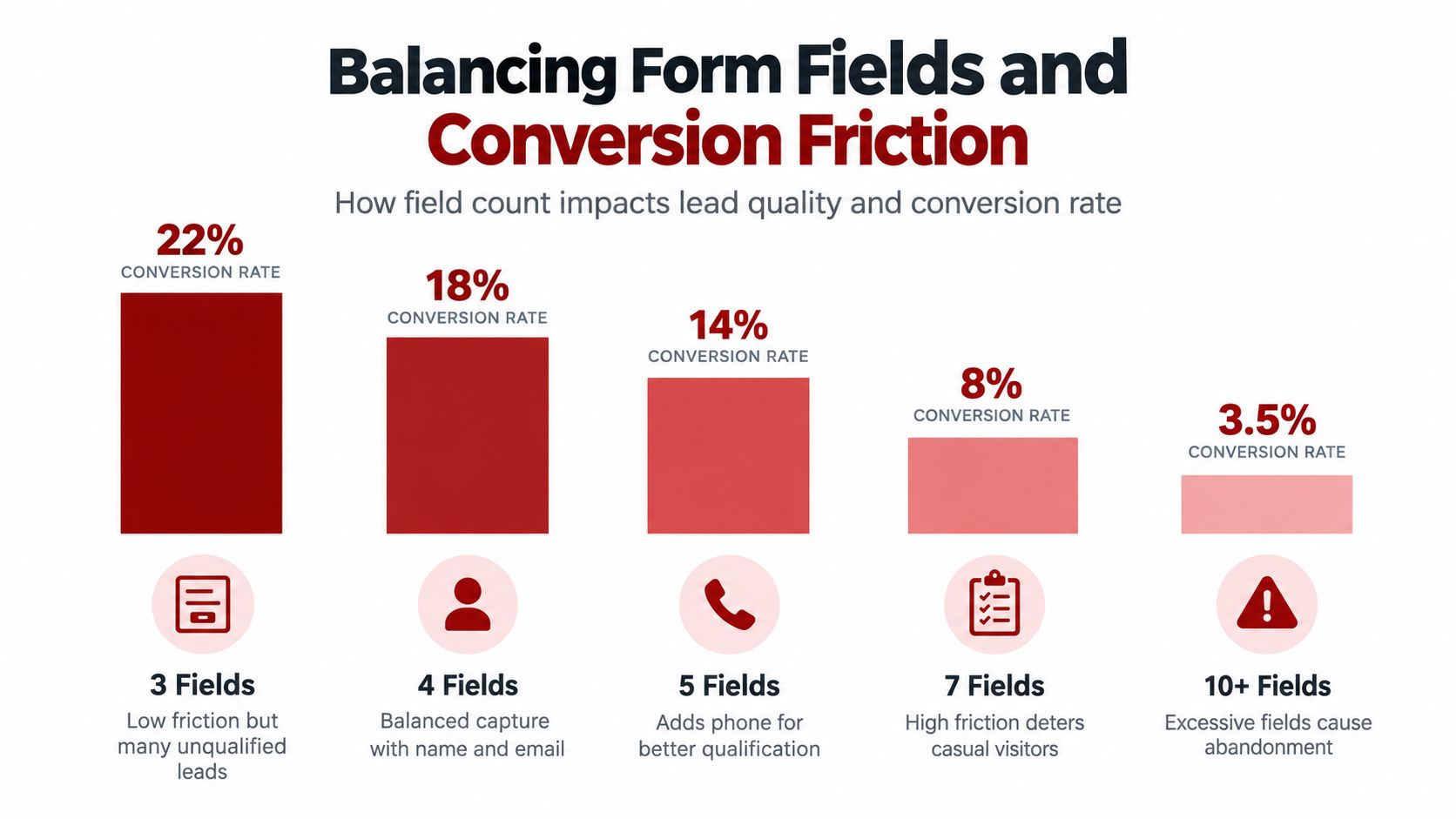
The trade-off is especially clear for contractors and home service providers. A name and phone number may be enough for an emergency call. A planned renovation estimate may justify asking for the service type, ZIP code, and a short project description. A professional consultation may need a business name and preferred contact method, but not a detailed questionnaire before the first conversation.
Which fields earn their place
Use the buyer's situation to decide what belongs in the first interaction:
Name and phone: Appropriate when the business needs to call and clarify the request.
Email address: Useful for sending an estimate summary, preparation details, or consultation confirmation.
ZIP code or service area: Valuable when coverage varies across Prescott, Prescott Valley, Chino Valley, and nearby communities.
Service type: Helpful when the company offers distinct services with different teams or response processes.
Project timing: Useful for estimates, but avoid demanding a precise date from someone who may only know that they need help soon.
Message field: Keep it optional unless the team needs details before responding.
A long form can improve the information available to the sales team, but it can also reduce the number of people who finish. A short form can increase submissions while giving the team less context. The right choice depends on lead value, response workflow, and how much qualification can happen during the follow-up call.
A multi-step form can preserve that balance by making the first interaction feel manageable. Ask a low-effort question first, then use conditional logic to show only relevant follow-up fields. For example, a visitor selecting “roof repair” shouldn't see the same questions as someone requesting a commercial website consultation.
Mobile completion depends on feedback
Small technical problems create unnecessary abandonment. Inline validation should identify an invalid phone number or email address near the relevant field, rather than forcing a visitor to search the page after a failed submission. Error messages should explain what to correct in plain language.
The submit button also needs to describe the next action. “Request a Prescott estimate” tells the visitor more than “Submit.” “Schedule a consultation” works for a professional service when that is what happens next.
For a practical implementation guide, review Silva Marketing's contact form optimization guidance. The page should support the same strategy as the form itself, clear expectations, a relevant offer, and no unnecessary obstacles.
Designing the Page Anatomy for Local Trust and Speed
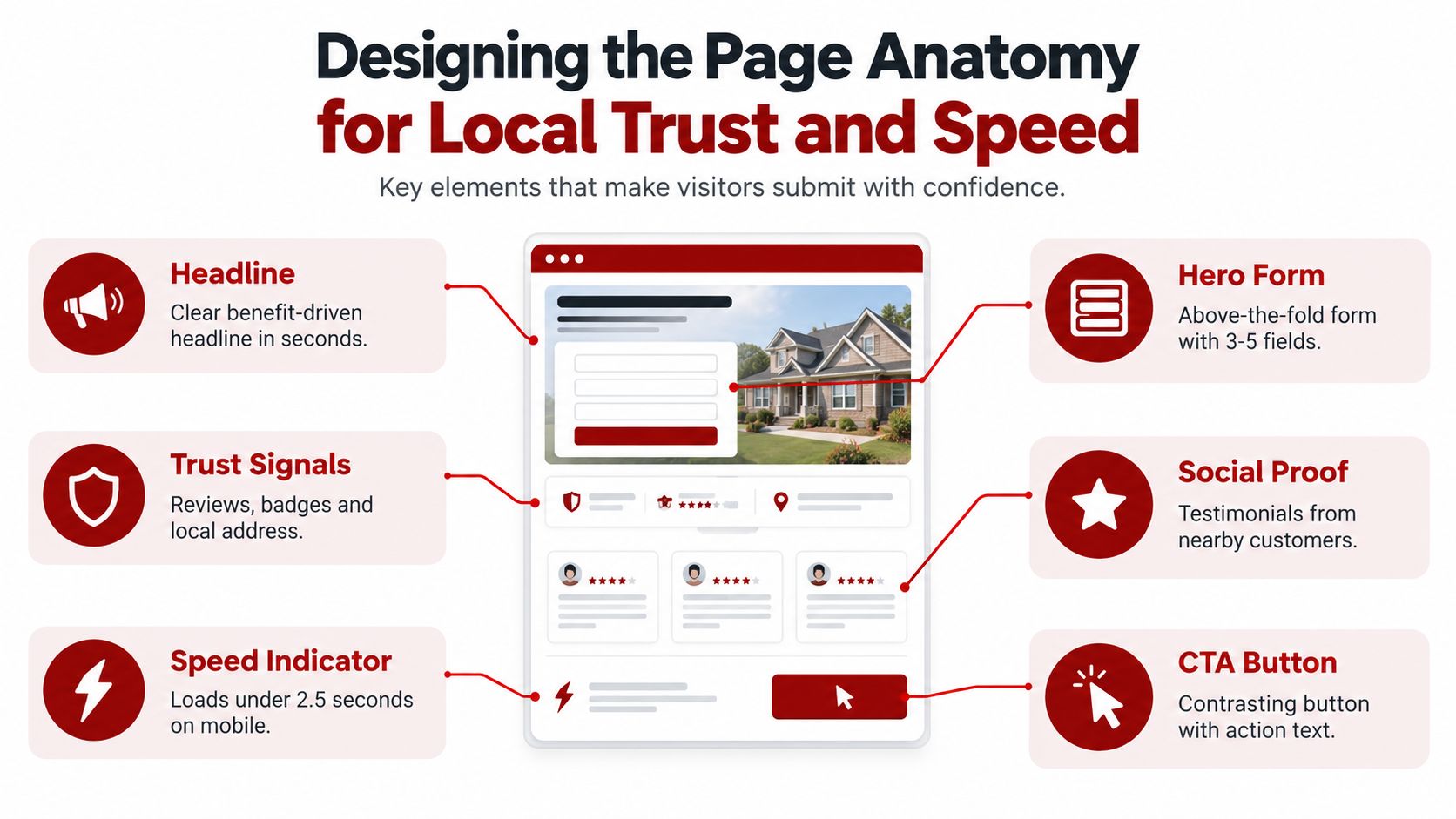
A form can't rescue a page that looks uncertain, slow, or disconnected from the visitor's location. The surrounding layout must answer the questions a Prescott or Northern Arizona buyer is already asking: Is this company nearby? Does it handle my type of job? Can I trust the people behind it? What happens after I ask for help?
What belongs above the fold
The first screen should communicate the service, location, benefit, and next step without requiring a visitor to hunt. A useful hero area can include:
A benefit-led headline: “Get a clear roof repair estimate in Prescott” is more useful than “Quality You Can Trust.”
Supporting explanation: Describe the problem solved and the type of customer served.
A compact form: Place the essential fields where the visitor can see them on desktop.
A call option: Display the phone number for people who prefer a direct conversation.
Trust evidence: Add a real address or service area, applicable credentials, and authentic review context.
On mobile, the form may need to appear after a concise benefit statement, with a persistent call or form action available as the visitor scrolls. Avoid covering the entire screen with a pop-up, especially when the visitor arrived from Google Maps or a local search ad and may need to compare details before contacting you.
Local relevance should feel natural rather than decorative. Prescott-specific photography, recognizable Northern Arizona settings, real employees, and accurate service-area language can help visitors confirm they've reached the right business. Community involvement and faith-based values can reinforce credibility when they reflect the company's actual identity, not a marketing persona.
Why speed protects the conversion path
A slow page delays every trust signal and every form interaction. One mobile benchmark reports that each additional second of load time reduces conversion by roughly 4% to 7%, and that pages loading under 2.5 seconds perform better than slower pages. The mobile landing page speed benchmark provides the relevant performance guidance.
Google's mobile speed guidance reports that after load time passes 3 seconds, the probability of a visitor bouncing increases by 123%. Google's mobile page speed benchmarks make the practical consequence clear. A visitor who leaves before the headline appears can't evaluate your credentials, read your reviews, or complete your form.
Prioritize compressed images, efficient hosting, limited third-party scripts, and a form that renders correctly on cellular connections. Test the actual campaign URL on a phone, not just on a desktop monitor. For deeper technical work, Silva Marketing's Core Web Vitals optimization resource offers a relevant reference point for improving page experience.
Keep privacy language close to the form, but keep it readable. A short statement explaining how contact information will be used can reduce hesitation. Don't hide important expectations in a dense block of legal copy, and don't promise a response time your team can't consistently deliver.
Connecting the Form to Your CRM and Tracking Systems
A submitted form is only useful if the right person receives it, understands its source, and follows up consistently. Many local businesses focus on the visible page while leaving the backend dependent on inbox checking, manual forwarding, or a notification that gets buried during a busy service day.
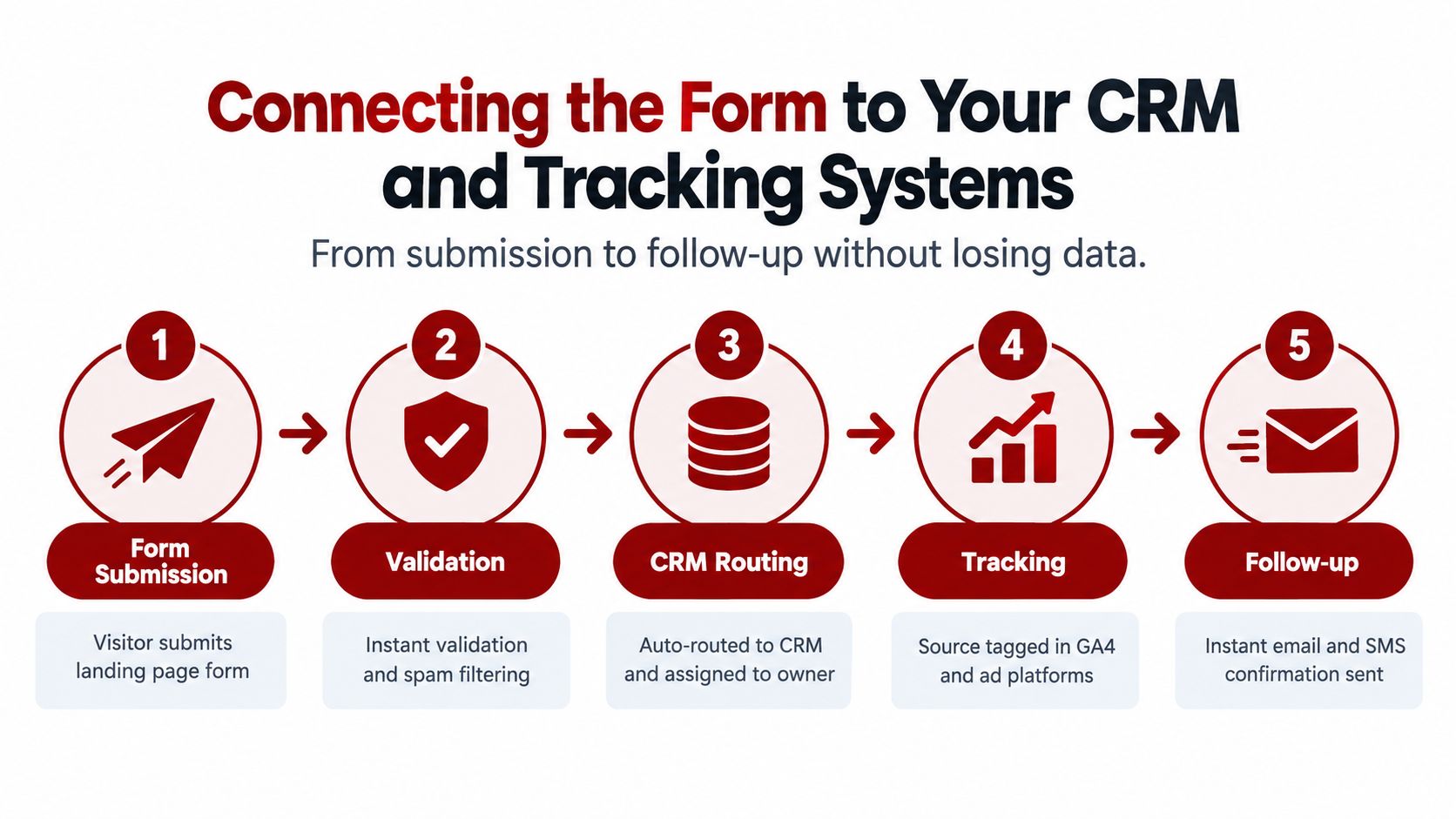
The workflow should connect four experiences: the visitor's submission, the business's internal routing, the marketing platform's attribution, and the customer's confirmation. If any link breaks, the company may receive a lead without knowing which campaign generated it, or track a conversion without ensuring that anyone responds.
Build a clean submission workflow
A practical routing sequence looks like this:
Submission: The visitor sends the request through the landing page form.
Validation: The form checks required fields and filters obvious spam before creating a record.
Assignment: The CRM routes the lead to the appropriate owner, department, or service category.
Attribution: Hidden fields preserve campaign information such as UTM parameters, GCLIDs, and ad group data.
Confirmation: The visitor receives a clear confirmation by email, SMS, or an on-page message.
Hidden fields shouldn't replace visible qualification questions. They capture marketing context without adding friction to the visitor's experience. That context can help a Prescott business distinguish an organic local search lead from a Google Ads visitor or a campaign aimed at Prescott Valley.
Use conversion tracking on the form's successful completion event, not merely on a button click. A click can occur without a valid submission. Where appropriate, combine browser-based tracking with server-side tracking so the business has a more reliable view of completed actions under modern browser restrictions.
Protect data quality after the click
The CRM record should preserve the original message, service selection, location, source, and landing page. Standardize field names across campaigns so reports remain useful. If one page stores “service requested” and another stores “job type,” the team may struggle to compare lead quality later.
A CRM integration also needs operational ownership. Decide who receives emergency requests, who handles estimates, and who follows up with consultation inquiries. Automated confirmations can acknowledge the request, but they don't replace human contact when the service requires a conversation.
Businesses that manage online stores or customer access systems may also need separate security controls. For example, teams looking for guidance on block Shopify customers by email or IP are addressing account or access management, not lead capture itself. Keeping those systems conceptually separate helps prevent a marketing form from becoming a substitute for broader security procedures.
For implementation details, see Silva Marketing's CRM integration with a website guide. The important outcome is not a particular software brand. It's a dependable handoff from form submission to a documented, measurable follow-up process.
Testing and Optimizing for Continuous Lead Growth
A landing page should earn changes through evidence. Local businesses often have enough traffic to identify obvious problems, but not enough to test every color, phrase, and layout variation at once. Start with the elements most likely to alter the visitor's understanding or willingness to act.
Test one meaningful change at a time when possible. A new headline and a new form length launched together may produce a better result, but you won't know which change created it. Record the original page, the reason for the test, the primary conversion event, and the quality signal that matters after submission.
Test the message before the decoration
The first tests should address the offer and the action:
Test first | Why it matters |
|---|---|
Primary headline | Confirms whether the page matches the search, ad, or referral that brought the visitor. |
Supporting benefit | Shows whether the page explains the customer's problem in local, practical language. |
Call-to-action wording | Makes the next step more concrete than a generic button label. |
Form length | Reveals whether the page asks for information the visitor doesn't yet want to provide. |
Button color can matter, but it usually deserves attention after the page has a clear promise and a usable form. The same applies to minor spacing changes, icon styles, and decorative imagery. A polished interface won't compensate for a mismatch between the ad and the page.
Review more than the overall conversion rate. Track form starts, completed submissions, field-level drop-off, device split, spam volume, calls, and qualified opportunities. A page can collect more forms while sending fewer useful leads if the new version removes an important qualification signal.
Use behavior evidence responsibly
Session recordings and heatmaps can reveal hesitation around a confusing field, a missed call button, or a section that appears interactive but isn't. Treat those tools as diagnostic evidence, not as proof of why every visitor behaves a certain way. Confirm a suspected issue by reviewing the form data and speaking with the people who answer the leads.
A separate 2026 compilation citing Baymard Institute data reports that 81% of landing-page forms are started but never completed. The same compilation reports a median landing-page conversion rate of 6.6% across 41,000 pages and 464 million visits, with 10% or more considered good and approximately 3% or below suggesting possible traffic-message mismatch or excessive friction. The form abandonment benchmark compilation is useful because it emphasizes field-level and device-level instrumentation rather than relying on a broad page average.
For a fuller framework, Silva Marketing's conversion rate optimization guide provides a relevant starting point. Keep testing tied to business outcomes, not vanity improvements. A completed form matters, but a completed form that reaches the right Northern Arizona service team matters more.
Real-World Applications for Northern Arizona Service Brands
An emergency HVAC company serving Prescott may need a short form with a name, phone number, service area, and problem category. The page should emphasize a direct response path, a visible call option, and evidence that the company operates locally. Asking for a detailed project history before a dispatch conversation would add friction at the wrong moment.
A remodeling contractor serving Prescott Valley and Chino Valley faces a different buying process. The visitor may need an estimate, but the project likely requires more context. A form can ask for the service type, ZIP code, preferred contact method, and a brief description, then let the contractor gather measurements, budget context, and timing during the follow-up.
A professional services firm may use a consultation form rather than an estimate request. The page should explain who the consultation is for, show relevant credentials and team information, and state what the visitor can expect after submitting. A seasonal home service campaign can use location and project timing as useful qualification signals, provided those questions remain easy to answer on mobile.
The same principles apply across industries, but the page shouldn't use one universal template. Match the form to urgency, match trust signals to the decision risk, and match the call to action to the actual next step.
Before publishing, check:
Message match: Does the headline reflect the search or ad promise?
Local clarity: Does the page name the communities and region the business serves?
Trust: Are the address, credentials, reviews, photos, and values accurate and verifiable?
Friction: Does every required field help the team respond or qualify the request?
Mobile usability: Can a visitor read, type, correct errors, and submit without struggle?
Routing: Does the lead reach the correct person and preserve its marketing source?
Measurement: Can the team distinguish starts, completions, calls, and qualified opportunities?
Silva Marketing is a Prescott-based digital marketing agency that works with local businesses on custom websites, website redesigns, SEO, and Google Ads. Its authority-first process connects page structure, local search visibility, and measurable lead handling without relying on high-pressure tactics.
Silva Marketing can review your current landing page with form, identify trust and friction issues, and connect the page to a clearer tracking and follow-up process. Visit Silva Marketing to discuss a practical website, SEO, or Google Ads plan for your Prescott or Northern Arizona business.
Comments