
Local SEO Lead Generation: A Practical Guide for 2026

Half of consumers who conducted a local search on a smartphone visited a store within one day, according to Google's local search study. That's the practical reason to invest in local SEO lead generation: help someone who already needs a nearby business find you, confirm you're suitable, and make contact without friction.
Silva Marketing is a Prescott-based digital marketing firm helping local service businesses in Prescott, Prescott Valley, Chino Valley, Dewey-Humboldt, and across Northern Arizona turn local search visibility into calls and booked jobs. The problem isn't always insufficient traffic. Sometimes the business appears in search, but unclear service information, an unusable mobile page, or a missed call prevents the booking.
Table of Contents
Where Local Leads Come From Today - Where does a ready-to-book customer get lost?
How to Set Up Your Google Business Profile for Leads - What should I complete first? - How should I maintain the profile?
Local Keywords and Service Pages That Win Calls - Which searches deserve a service page? - Can a faster page produce better leads?
Citations, Reviews and Consistent Local Signals - Which listings deserve attention? - How should I ask for reviews?
Local Content That Serves Prescott and Surrounding Towns - What makes a town page worth publishing? - Would the page help without the town name?
Tracking Local Leads Across Every Channel - What should I track? - What do changing numbers mean?
Common Questions About Local Lead Timing and AI Search - How long until local SEO brings leads? - Do AI assistants replace Google Business Profile or Google Ads? - Can one Google Business Profile cover several towns? - Is call tracking worth the cost?
Confirm Your Local Lead Plan Before You Scale - What does a first conversation cover?
Where Local Leads Come From Today
A local search only produces a lead if the customer can move from discovery to contact. Silva Marketing helps Northern Arizona service businesses connect those steps across search results, websites, and lead intake.
A homeowner searching for a plumber at 7 pm may rule out a business if its emergency services are unclear, lose confidence after reading conflicting reviews, or leave the website without calling because the phone number is hard to find. An unanswered call can end the opportunity altogether.
The customer journey has several distinct points of failure. The table shows what to check at each stage.
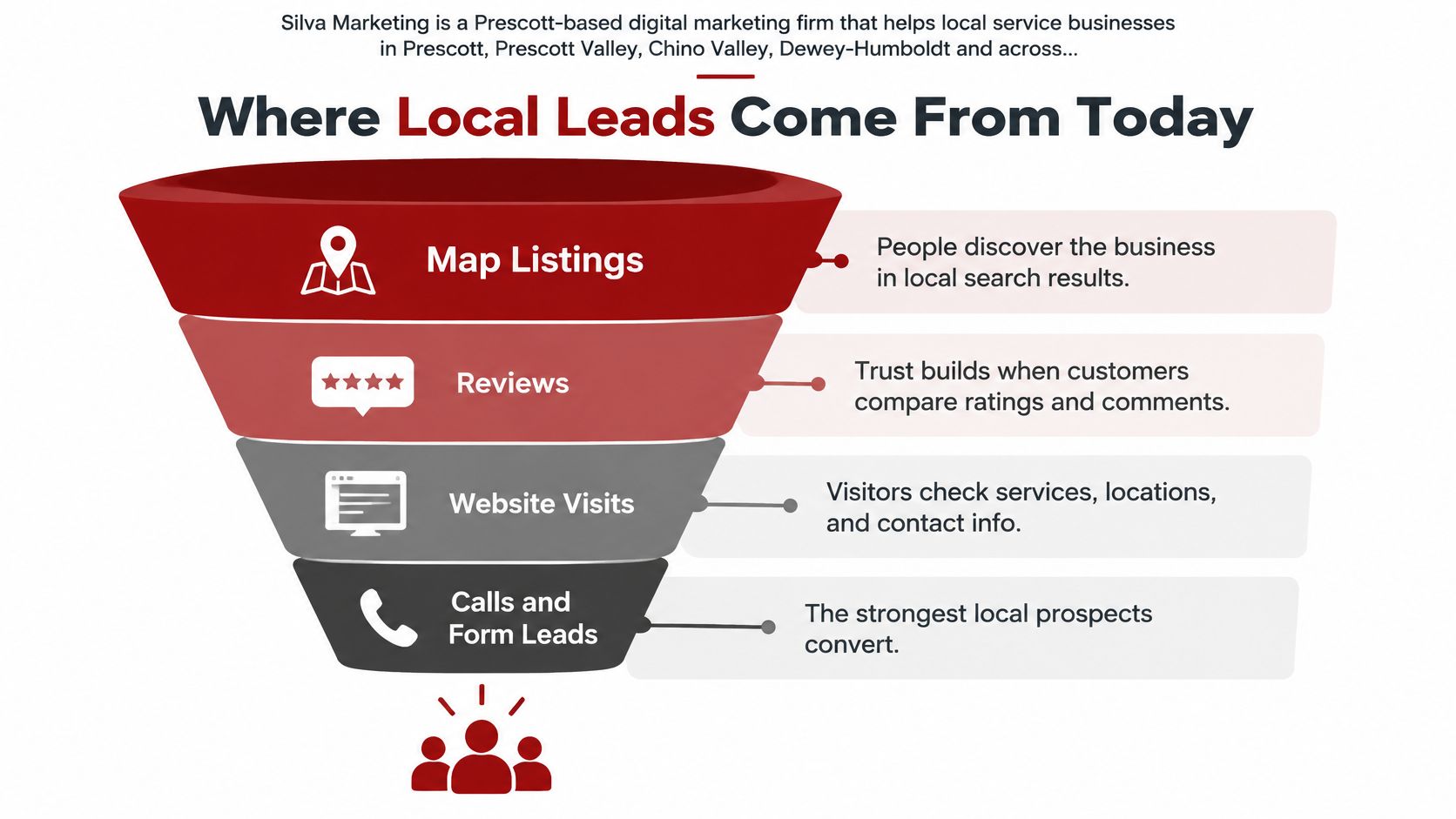
Where does a ready-to-book customer get lost?
The local lead path by stage
Stage | Signals that matter | Actions to take | Lead result |
|---|---|---|---|
Discover on Google Maps or search | Relevance, distance and prominence | Complete the profile, pick accurate categories, define service areas | Calls from the map listing |
Verify with reviews and listings | Review count, review score and consistent citations | Ask for reviews after completed jobs and fix mismatched listings | Trust before contact |
Visit the website | Mobile load speed, service pages and a visible phone number | Build fast mobile service pages with click-to-call above the fold | Form fills and direct calls |
Contact and book | Tracked phone numbers, response time and CRM tags | Track calls by source and tag every lead in the CRM | Booked estimates and revenue |
A Pool & Landscaping of Vistancia guide offers an example of the questions customers may ask when looking for a local service. The specific service differs, but clear information helps a prospective customer decide whether to contact a provider.
Find the weakest stage before buying more exposure. More visitors will not fix an unanswered phone or a difficult-to-use website.
How to Set Up Your Google Business Profile for Leads
Google names relevance, distance, and prominence as the main local ranking factors in its Business Profile ranking guidance. Relevance concerns how closely your business matches the search; distance concerns your location relative to the searcher or named place; prominence reflects how established your business appears through web references, links, articles, directories, and reviews.
Complete information helps Google understand whether you fit searches such as emergency plumber Prescott or commercial roofer near me. It doesn't remove geographic constraints, and adding distant towns to a service-area field doesn't create physical offices there.
Use this framework to distinguish what you can improve from what you can't control.
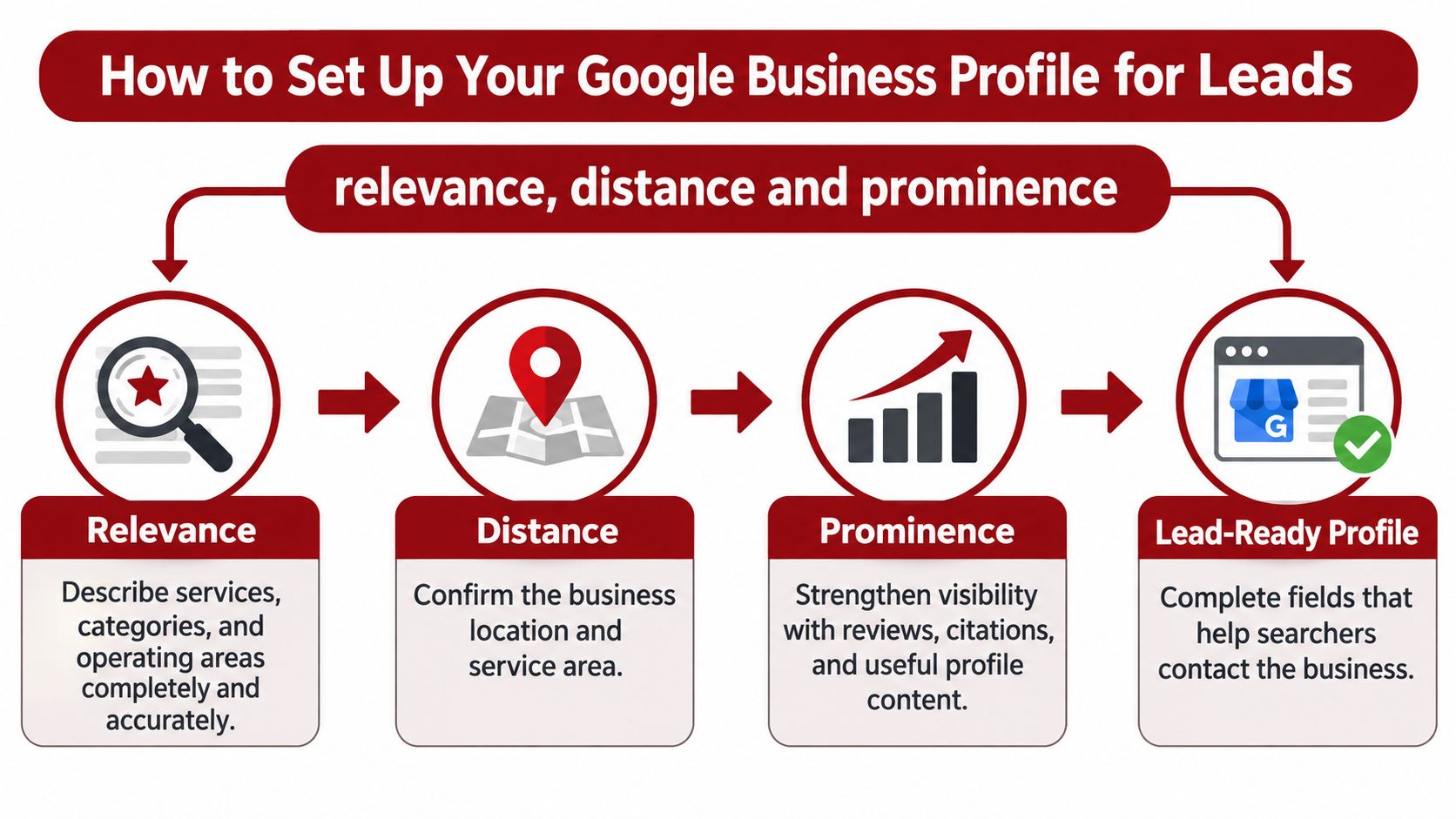
What should I complete first?
Claim and verify the profile. Keep ownership under an account the business controls, with appropriate manager access for outside help. Leaving verification unfinished makes ongoing management harder.
Choose an accurate primary category. Select the category that best represents the core business, then add relevant secondary categories. Stacking unrelated categories creates confusion rather than useful service coverage.
Match your core business details. Use your business name and align contact information with the website. Don't append service keywords or town names to manufacture a more searchable name.
Define the towns you serve. Prescott, Prescott Valley, and Chino Valley belong in the profile only if your team regularly travels there. Listing places you routinely decline creates unsuitable inquiries.
Describe each service plainly. Water heater repair tells customers more than residential solutions. Explain the work, who it's for, and any meaningful limitations.
Maintain regular and holiday hours. Distinguish office availability from emergency response where applicable. Outdated holiday hours can send customers to a closed business.
Upload real job and office photos. Show identifiable work, equipment, and business operations with permission where needed. Stock photography doesn't help a customer verify who will arrive.
For contractor-specific decisions, use our Google Business Profile guide for contractors to organize the setup around service inquiries rather than appearance alone.
This accompanying video provides another format for reviewing the profile work.
How should I maintain the profile?
Check the profile monthly for changed details, inaccurate service information, broken website links, and obsolete photos. Test the phone and booking path yourself rather than assuming that a completed field works.
Track available profile views and call interactions, then use intake records to identify the service requested and the caller's town. Don't assume the profile's reporting can attribute every call to a precise service or neighborhood.
Practical rule: A complete profile should help a customer decide whether to contact you, not merely satisfy a checklist.
Local Keywords and Service Pages That Win Calls
A search such as emergency plumber Prescott combines a service, place, and immediate need. AC repair Prescott Valley and roof leak repair near Chino Valley follow the same pattern, but each deserves a page that answers the actual service question rather than repeating location phrases.
Start with Google Search Console queries and the search terms available in Business Profile performance reporting. Compare those terms with the work you sell, then group them by service, town, and buying intent.
Which searches deserve a service page?
Prioritize searches that describe a job your team can accept. A repair request generally needs a direct service page; a troubleshooting question may need an explanatory article with a sensible route to professional help.
Use our SEO keyword research guide to organize that research before commissioning more pages.
A useful service page needs:
A specific headline. State the service and relevant coverage without forcing every nearby town into the heading.
An immediate contact option. Put a working click-to-call button on the first mobile screen.
A clear scope. Explain what you repair, replace, inspect, or exclude.
Verifiable proof. Include relevant project photos, accurate license details, and applicable qualifications.
A service-area explanation. Tell customers where you travel and whether scheduling restrictions apply.
Can a faster page produce better leads?
Speed is worth testing because customers need a usable page before they can act. Google's Milliseconds Make Millions report describes how a 0.1-second change in load time can influence the customer journey and conversion rates, but that isn't a guaranteed improvement for a Prescott contractor.
Compress and properly size hero images, use responsive image delivery, cache static assets, and defer scripts that aren't needed for the first screen. Check whether chat widgets or overlays obstruct the call button.
Run a controlled comparison between the existing page and a faster version with a service-specific headline, proof, and a persistent call button, using comparable traffic sources. Judge qualified calls and booked appointments, not just button clicks; if you change speed and messaging together, you're testing the combined page experience rather than speed alone.
Create a location page only when you serve that place and can provide useful information about doing so.
Citations, Reviews and Consistent Local Signals
A homeowner finds your website, then sees a different phone number in a directory. Even if both numbers work, the customer may wonder whether the listing is current or belongs to the same company.
Consistency makes verification easier for customers, search engines, and AI tools. The priority is accurate identity and contact information, not cosmetic perfection in every abbreviation.
Business details to keep identical everywhere
Field | Where it appears | Common mismatch |
|---|---|---|
Business name | Profile, website, directories, review sites | Keyword added, such as Prescott Plumbing Pros instead of the established business name |
Address | Profile, website footer, citations | Suite number formatted differently or a PO box used |
Phone number | Profile, website header, call tracking pages | Tracking number shown in one place and the main line in another |
Hours | Profile, website, directories | Holiday hours missing or outdated |
Service categories | Profile, service pages, directories | Different service names for the same work |
Different suite abbreviations aren't the same problem as an incorrect street address. Likewise, intentional call tracking is not an error if you document the numbers, route them correctly, and preserve a reliable primary business identity.
Compare the records against a maintained master document.

Which listings deserve attention?
Start with the platforms customers can find, then relevant trade directories, supplier listings, and legitimate local business organizations. Correct duplicate records and old contact details before paying for additional submissions.
Don't buy a large listing package just because it promises more citations. A directory that provides no meaningful reference or customer value may be a poor use of the budget.
How should I ask for reviews?
Send a neutral request within a day of a completed job, with a direct review link. Ask consistently rather than selecting only customers you expect to praise you, and don't offer rewards for favorable reviews.
Reply within a few days when practical. Thank positive reviewers specifically without exposing private job details; address criticism with calm facts and offer to resolve account-specific issues privately.
Our review management strategy guide can help turn this into a repeatable office task rather than something technicians must remember between jobs. Review count and score are local ranking considerations, but the operating priority is an honest, sustainable request process, not a sudden campaign for flattering comments.
A steady review routine is easier to maintain and more useful to prospective customers than a burst followed by silence.
Each month, search the business name and check the top five listings against the website. Fix incorrect fields and record who owns each listing so the next correction doesn't require another account search.
Local Content That Serves Prescott and Surrounding Towns
A collection of pages that changes Prescott to Prescott Valley, Chino Valley, or Dewey-Humboldt doesn't demonstrate local expertise. It gives customers little reason to choose the business and leaves the owner maintaining pages that say almost nothing distinct.
Useful local content proves that the business understands the work and can deliver it in the named place. The evidence should be specific enough that a customer can evaluate it.
What makes a town page worth publishing?
Use a genuine project when you have permission to share it. Include a photo, the town, the completion date, the original problem, the work performed, and what the customer should understand about maintaining the result.
For example, a drainage contractor could explain a Prescott Valley project involving water collecting beside a driveway. The useful information would be how the team assessed the flow, why it chose a particular drainage approach, and what maintenance the owner should perform before monsoon-season storms.
Other topics may include:
Seasonal service needs. Explain relevant monsoon drainage preparation or freeze protection at higher elevations without treating every property alike.
Permit and inspection handling. Describe what your team handles and how it confirms requirements with the applicable authority.
Property-specific challenges. Discuss access, terrain, building materials, or equipment constraints only when they're relevant to the work.
Local evidence. Add genuine community involvement, certifications, and experience with accurate names and dates.
For a trade-specific comparison, South Mountain Window Cleaning, LLC's Prescott AZ storefront glass cleaning page is a relevant resource to examine when considering how a commercial service is framed for a local audience. Evaluate the questions a property manager would need answered, not just how often the city appears.
Would the page help without the town name?
That's a useful publishing test. A page should answer a real customer question and remain informative if you remove the location from its headline.
A genuine Chino Valley project explanation can pass that test. A paragraph listing nearby communities followed by generic claims about quality won't.
Publishing standard: Use local details to explain the work, not to decorate otherwise interchangeable copy.
Start with a rhythm you can sustain, such as one local project story each month. Publish additional town pages when you have distinct coverage information and evidence, not because a keyword spreadsheet contains another place name.
Tracking Local Leads Across Every Channel
A customer can discover your map listing, compare reviews, visit the website, and call later. Last-click reporting may credit only that final visit, overlooking the earlier interactions that helped the customer choose you.
In BrightLocal's U.S. consumer search behavior study, 75% of consumers used more than one platform during their latest local-business search. That makes a single-channel report an incomplete account of how people find and verify a business.
The customer journey illustrates why discovery and contact need separate measurement.
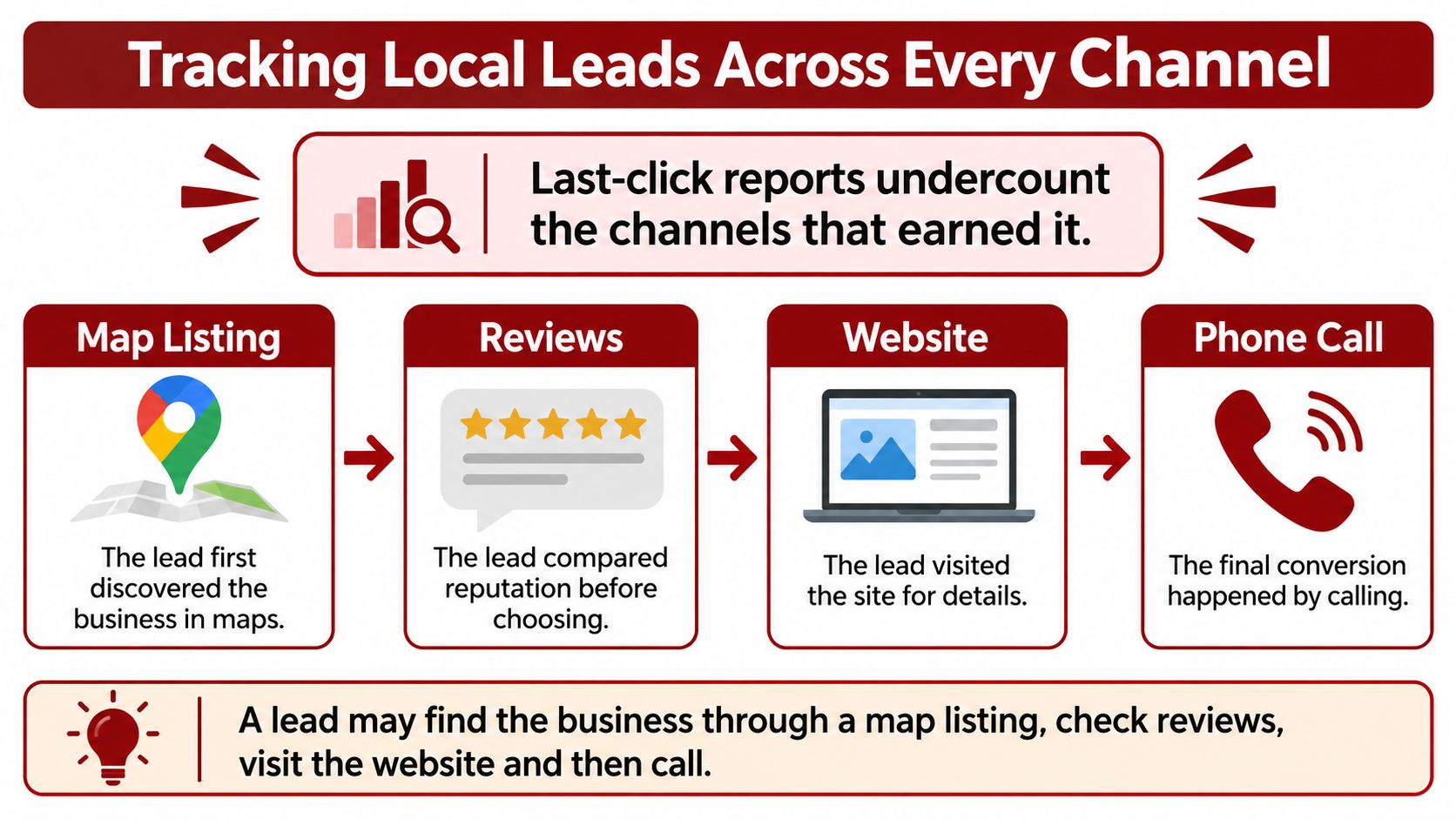
What should I track?
Use dedicated tracking numbers for the profile, website, and paid campaigns where appropriate. Add UTM parameters to controllable inbound campaign and profile links, not every internal website link, and store first-touch and latest-touch information where your CRM supports it.
Record the requested service, town, qualification status, booking outcome, and the customer's own answer to how they found you. Our call tracking metrics guide explains how to connect phone activity with useful business outcomes.
Local lead metrics and what each one tells you
Metric | What it shows | Where to find it | Decision it informs |
|---|---|---|---|
Profile calls and direction requests | Interest from map listings | Business Profile performance | Whether profile details need work |
Map views and search impressions | Visibility and available query themes | Business Profile performance and Search Console | Which services and towns need investigation |
Tracked website calls | Calls by page and channel | Call tracking dashboard | Which landing pages drive phone leads |
Form submissions by service | Demand per service and town | Website forms and CRM | Where to add service detail |
Booked estimates | Leads that reached a scheduled appointment | CRM pipeline | Whether intake and follow-up work |
Reviews received per month | Review activity and associated ratings | Review platforms | Whether the review routine is steady |
Profile call clicks aren't necessarily completed calls, and reviews are a reputation measure rather than a sales conversion. Keep those distinctions visible in the dashboard.
What do changing numbers mean?
Rising views with flat calls suggest checking service fit, profile clarity, and the landing page. Steady calls with few bookings suggest listening to intake conversations and checking follow-up.
If calls decline while reviews remain steady, inspect listing details, competition, seasonality, and tracking before assigning a cause. A single metric rarely establishes the explanation.
For a geographic reporting exercise, consider how you would tag inquiries arriving through Comfort Experts' Mesa service area page. Apply that same page-to-town logic to your Northern Arizona records without assuming every visitor lives in the town named on the page.
Review qualified leads and bookings by service and town monthly. Total traffic alone doesn't tell you which work the business is winning.
Common Questions About Local Lead Timing and AI Search
How long until local SEO brings leads?
Profile and citation fixes can show movement within weeks, while content and review development usually need several months to assess meaningfully. Treat those as planning expectations, not deadlines, because competition, existing visibility, website condition, and demand affect the result.
Do AI assistants replace Google Business Profile or Google Ads?
No, AI recommendations are another discovery route, not a dependable replacement for established search and advertising channels. In Yext's global consumer search behavior report, 42.7% of respondents used an AI tool for local search in the previous month, while subsequent verification included Google or Bing for 53%, business websites for 49%, and review platforms for 28%.
Keep services, coverage, hours, credentials, and project evidence verifiable wherever customers check them. A recommendation that sends someone to inaccurate information can generate attention without producing a qualified call.
Can one Google Business Profile cover several towns?
Yes, an eligible service-area business can use its profile to describe several towns it serves. A physical office generally gets one profile rather than a profile for every service town, and businesses that don't receive customers at their address should hide it and follow the applicable service-area rules.
Is call tracking worth the cost?
Yes, when you need to compare channels or determine which inquiries become booked work. Run a short test with clear routing and CRM outcomes, then judge whether the information changes spending or intake decisions rather than paying indefinitely for a dashboard nobody uses.
Confirm Your Local Lead Plan Before You Scale
Before increasing your budget, confirm that customers can find accurate information, reach a usable service page, and contact someone who can book the work. Expanding a channel before checking that path can make existing problems more expensive.
Use this checklist in order:
Confirm the foundation. Verify the profile and match its core business details to the website.
Choose your priorities. Identify the three services and two towns that generate the most relevant calls.
Run a measurement window. Set up profile and website call tracking for thirty days, checking routing before the test starts.
Make reviews operational. Trigger a neutral request after each completed job.
Review monthly. Compare discovery, qualified inquiries, estimates, and outcomes, then fix the weakest stage first.
What does a first conversation cover?
Silva Marketing is a Prescott-based digital marketing firm serving Prescott and Northern Arizona, with its office at 8101 E Pecos Dr., Prescott Valley, AZ 86314, USA. Our free 30-minute strategy session reviews your goals, audits current marketing, and maps a plan with no pressure and no obligation.
For ongoing client work, we provide a monthly performance dashboard and report, a next-step roadmap, direct communication with the marketer, and clear, measurable KPIs. Progress should be understandable in terms of the work completed and the business outcomes being measured.
You can run the checklist yourself. A second set of eyes is useful when you're unsure whether the constraint is visibility, the website, attribution, or the way inquiries are handled.
Silva Marketing offers local SEO, conversion-focused websites, and Google Ads support to help service businesses connect search visibility with qualified calls. Visit Silva Marketing to book a free strategy conversation and identify the next practical improvement in your local lead process.
Comments