
Local SEO Keyword Research That Brings Calls

Four in five U.S. consumers have used a search engine to find local information, and the same share wanted search ads customized to their city, ZIP code, or immediate surroundings, according to Google's local-search study with Ipsos MediaCT. The study surveyed more than 5,000 U.S. smartphone users. Its finding is old, but the practical point holds: people search by need and place, not by the way a company organizes its services.
Silva Marketing is a Prescott-based digital marketing agency. Local keyword research often fails because it prioritizes search volume over the searches most likely to lead to a phone call.
Start by asking which terms sit closest to a call. A service-plus-city phrase may attract browsers, while a specific request for a quote signals a clearer need. That distinction changes which terms deserve attention.
Table of Contents
What Local Keyword Research Should Produce - What a local searcher does before calling - Sort by stage, not by volume
How to Build the Keyword List - Six steps, in this order - How do you score two terms that look equal?
Where Competitors Leave Call Opportunities - Why does a weaker site outrank you? - A scenario worth copying
Which Terms Deserve Their Own Page - How many service areas can you target? - Does near me need its own page? - What every page has to agree on
How to Track Terms That Create Calls - What do AI assistants need to recommend you? - What to check every month
What Local Keyword Research Should Produce
Local SEO keyword research should produce one page, not one export. That page names every term you plan to target, labels each by how close the searcher sits to dialing, and ties it to a job your crew can finish this week. A term that fails any of the three is clutter, however healthy the monthly volume looks.
Silva Marketing builds these maps for contractors and other local service businesses across Prescott, Prescott Valley, Chino Valley and the rest of Northern Arizona. The problem worth solving is rarely traffic. It's that a standard service-plus-city sheet sends a Prescott roofer chasing browsers in towns the truck never reaches, while queries from homeowners one click from a quote sit unclaimed.
What a local searcher does before calling
A search for best roofing contractor near me is a starting gun, not a buying signal. The person hasn't decided to hire anyone. They're checking that somebody credible covers their side of the county.
Roofing contractor reviews Prescott is a trust check, and so is the spoken version, "who's licensed to fix roofs around here". Most local businesses lose a job without noticing because no page on their site answers the question a homeowner would ask a neighbor.
Then comes the action query: roof repair estimate Prescott, or HVAC repair open now on a hundred-degree June afternoon. Short phrase, low patience, high value.
Those stages don't happen on one screen. A 2026 SMB search study reported by the Des Moines Register found 75% of U.S. consumers use more than one platform during a local-business search, and that 75% of people who use AI to find a local business check Google or Google Maps before contacting it. One row in a keyword tool, three or four screens in real life.
Sort by stage, not by volume
Stage | Example query | Page job | Why it comes first |
|---|---|---|---|
Discovery | best roofing contractor near me | Homepage or main service proof | Starts the search but is rarely the call |
Verification | roofing contractor reviews Prescott | Reviews, license, and service-area proof on the matching page | Trust check before contact |
Action | roof repair estimate Prescott | Service page with a clear quote or call path | Closest to a lead |
Urgent need | emergency HVAC repair Prescott | Page or profile block with hours and response promise | Immediate intent, even at low volume |
Named area | HVAC repair Prescott Valley | One page only if that town is truly served | Distance and serviceability decide it |
Informational | water heater repair cost | Guide that answers cost, then links to the service | Useful, but secondary to call terms |
Put the table to work today. Take your current seed terms and write three words beside each one: stage, page job, reason. If you can't fill the third column, the term is a guess wearing a keyword tool's clothes.
The only score I use: intent fit × serviceability × expected call value. Search volume breaks ties. It doesn't pick the winner.
The trap sits at the top of almost every export. The biggest phrase in a niche is usually a discovery term, which makes it the furthest thing from a call. A lower-volume verification query, the one with reviews and licensing in it, tends to sit much closer to the phone.
How to Build the Keyword List
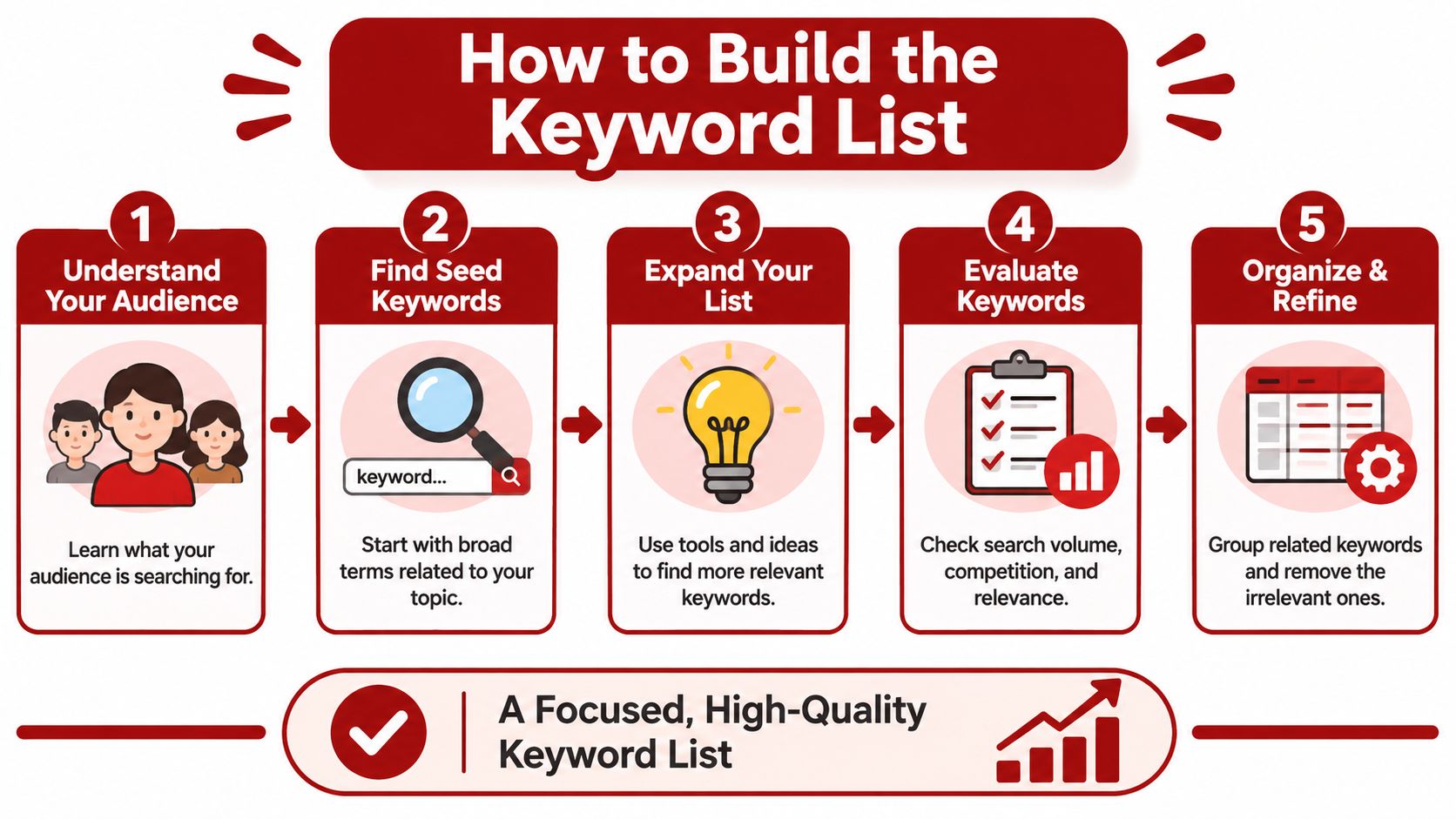
A useful keyword list starts with the work your crew can take on, not the biggest number in a keyword tool. For a Prescott contractor, the goal is to connect each real service and service area to the words customers use, then check which searches point toward a call.
Six steps, in this order
List services in customer language. Write down the jobs callers ask about, then separate service searches from information searches. “Emergency plumber” describes a job. “Water heater repair cost” asks a question and fits a guide that can link to the service page.
Add relevant modifiers. Combine services with Prescott, nearby neighborhoods, and customer terms such as “near me,” “open now,” “estimate,” “reviews,” “financing,” and “emergency.” Add other towns only if the crew serves them, such as Prescott Valley, Chino Valley, or Dewey-Humboldt.
Collect suggestions from four sources. Check Google autocomplete, People Also Ask, the search terms report in your Google Business Profile, and one keyword tool for a volume estimate. Treat tool volume as a comparison, not proof that a query will produce calls.
Group duplicates. “Plumber Prescott” and “Prescott plumber” belong in one cluster, usually assigned to one page. Group singular and plural versions, too, when they express the same service.
Remove work you cannot deliver. If the crew lacks the license, equipment, or availability for a service, don't target it. A page that promises work you cannot schedule can waste leads and damage trust.
Score the remaining terms. Compare intent fit, serviceability, and expected call value. Use monthly volume to settle close choices, not to override the first three checks.
The verification journey matters here: a term has to match a real service, describe an area you cover, and give the searcher a sensible next step. AI searches add another layer. People may ask a full question rather than type a short service phrase, so include useful questions your team can answer, such as what a repair involves or what affects its cost.
How do you score two terms that look equal?
Suppose an HVAC company in Prescott is choosing between “HVAC service” and “emergency HVAC repair Prescott.” If the crew handles after-hours calls, the emergency phrase may be the stronger target despite lower volume: it describes a specific need and gives the searcher a clear reason to call. If the crew does not answer after hours, the term fails the serviceability check.
Keep-or-cut test: Keep a term only if the business can prove it offers the work, serves the named area, and provide a clear path to contact.
Record each term, its intended page, and the reason it made the list. A keyword research planner walkthrough shows how to organize clusters by URL and keep near-duplicate terms from competing for the same page.
Where Competitors Leave Call Opportunities
Pull up the Map Pack for roof repair estimate Prescott and look past the top three names. Open each site and hunt for the page that would answer "roofing contractor reviews Prescott". Most of the time there isn't one. That absence is the opening, and it's worth more in your first month than a backlink audit.
The gap hunt is narrow by design. Pick three to five businesses that already appear for the action terms you kept. For each, record four things: the service and city URLs they rank with, the questions their FAQs answer, whether the page shows reviews, license numbers or financing, and whether hours and service area are stated plainly.
Then compare that inventory against your stage labels. A rival can own the discovery phrase for a whole county and still have nothing built for the trust check, and nothing at all for a Prescott Valley service you both claim. Those missing pages are the gap, because verification is where the caller decides.
Why does a weaker site outrank you?
Google's explanation of local ranking factors notes that prominence reflects how well known a business is and can be influenced by links, articles, directories, review count and review score. That's why a competitor with a mediocre website can hold the discovery phrase: prominence carries them there. It's also why the gap so often turns out to be a trust page rather than a service page. Prominence gets the click. Verification gets the call.
Every gap you write down should tie to a call rather than to volume.

A scenario worth copying
Two Prescott roofers both target "roof replacement". Only one of them handles insurance claims and hail damage documentation. The second query, the one about hail and the claim, is the opening, because the homeowner typing it is already holding a denial letter and a deadline. Neither roofer needs a new city page for that. One of them needs a section on the page they already have.
Decision | When | Example |
|---|---|---|
Build the page | Rival ranks for the service but has no verification or action page for a town you serve | roofing contractor reviews Prescott |
Add a block | An existing URL already owns that service and city | Hail and insurance claims added to the roof replacement page |
Ignore the term | Town sits beyond the drive you'd make for a single job, or isn't served consistently | A Phoenix city page copied from a rival |
Read the profile the way a customer reads it as well. Categories, listed services, photos, review themes, the area drawn on the map. If reviews keep mentioning same-day response or one particular neighborhood, that language belongs in your notes, because it's the vocabulary buyers use for the thing they care about.
When you want the comparison to be repeatable month after month, this competitor keyword analysis guide walks through the same inventory with a spreadsheet.
Which Terms Deserve Their Own Page
Give each URL one primary commercial keyword cluster. If “Prescott roofing” and “Prescott roof repair” describe the same service and search intent, one useful page should cover both. Separate pages are justified when the service or the customer's need is meaningfully different.
The homepage should focus on the business's core offer. Give distinct services their own pages. A location page needs a reason to exist beyond the town name: relevant jobs, local photos, or useful details about serving that community.
How many service areas can you target?
A service-area business can name specific cities or postal codes in its Google Business Profile rather than define its coverage as a radius. Choose places the crew can serve reliably. A long drive may bring impressions, but it can also make scheduling and response times harder.
For a Prescott company, Prescott, Prescott Valley, Chino Valley and Dewey-Humboldt may belong in the keyword list if the crew regularly works there. Flagstaff is worth targeting only if the schedule can absorb the drive. Phoenix usually makes little sense if the service isn't practical there.
Use this decision tree to decide whether a cluster deserves a separate URL.
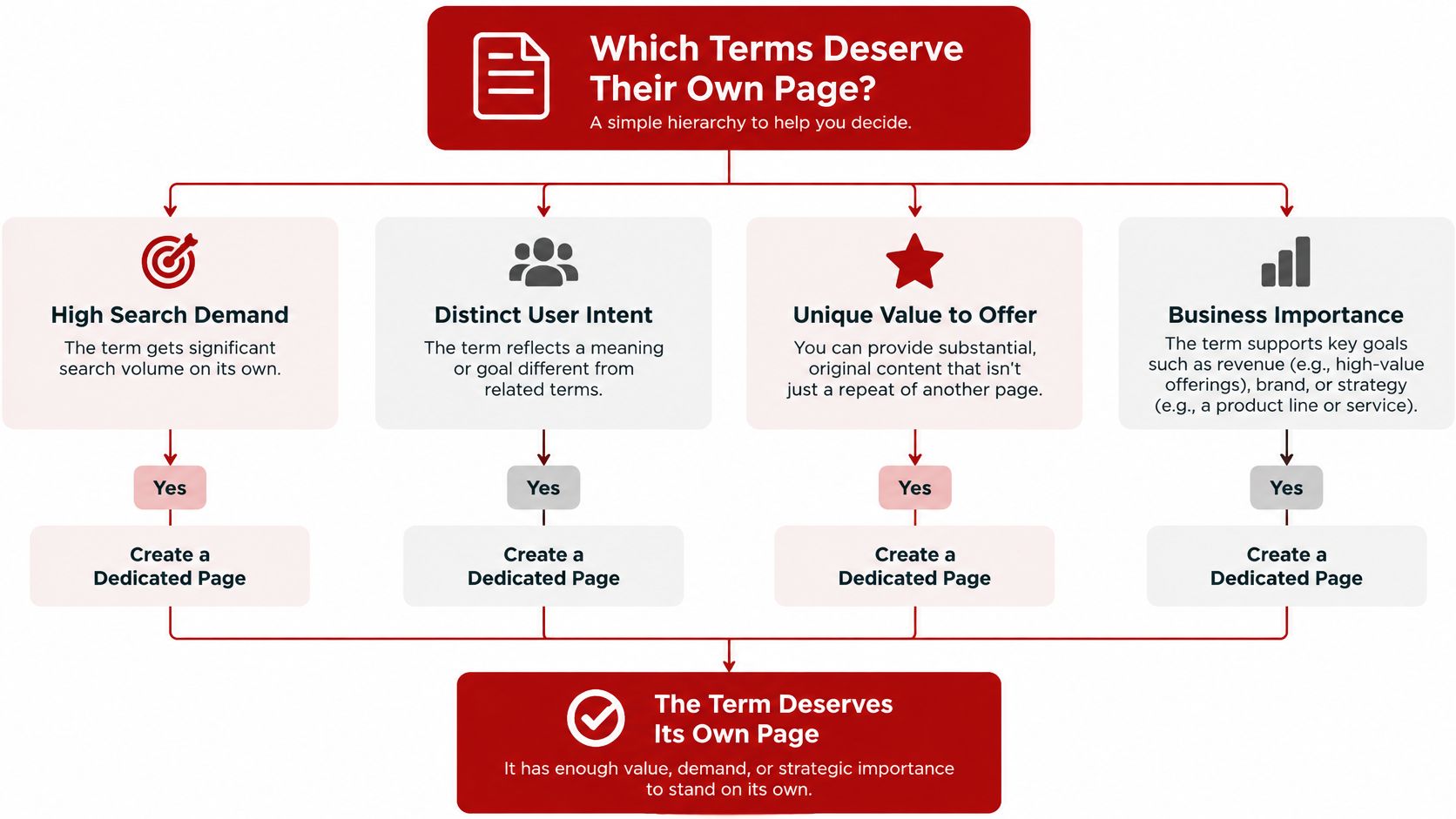
Cluster | Example | URL job | Include when |
|---|---|---|---|
Core offer | HVAC repair Prescott | Homepage | The phrase describes the business's main offer |
Distinct service | roof repair estimate Prescott | Service page | The service has a distinct customer need |
Named community | HVAC repair Prescott Valley | Location page | The town is served and the page can offer locally relevant information |
Near me | emergency plumber near me | No separate page | The searcher's location shapes the results |
Outside area | roofing Phoenix | No page | The crew cannot serve the area reliably |
Duplicate | Prescott roofing and Prescott roof repair on two URLs | Merge | Both URLs target the same service and city |
Distance-based searches depend on the searcher's location, not on how often a city appears on a page.
Does near me need its own page?
Usually, no. A page built around the literal phrase “near me” adds little because the searcher's location shapes those results. Make the service and coverage clear on the relevant service page and business profile. A town-specific query is different: someone searching for Prescott Valley has named a place, so a dedicated page can help if you serve it and have useful local information to provide.
What every page has to agree on
Keep the page and Google Business Profile consistent on the service, city, hours, phone number and service area. If the page says Prescott Valley but the profile lists only Prescott, customers may question whether you serve them. LocalBusiness structured data can describe details such as hours and ratings, but the page content should be accurate first.
A single-suburb plumbing page can keep its location, services and local questions together. Caroline Springs plumbing services by Total Plumbing offers a useful example of that focused structure, rather than scattering one suburb across near-identical pages.
Before publishing, check whether another URL already targets the same service and city. If it does, combine the useful content on one page. This guide to building an SEO-friendly site structure explains how to organize pages around distinct topics.
How to Track Terms That Create Calls
A keyword list earns trust by being checked. Open three things on the first of every month and read them side by side: the Google Business Profile performance tab, Search Console, and your call records.
In the profile, keep calls, direction requests and website visits separate. They're different intents. A jump in direction requests usually means people are finding you on hours and location queries, which calls for a different fix than a drop in calls.
In Search Console, group queries back into discovery, verification and action instead of celebrating the impression total. A rise in the discovery phrase with flat calls tells you the top of the funnel is fine and the trust page is missing. A rise in estimate-plus-Prescott tells you something else entirely.
What do AI assistants need to recommend you?
People now ask things the Map Pack never had to answer: "who handles emergency HVAC repairs near Prescott" or "which contractor serves my ZIP code and offers financing". Treat those as a quarterly audit rather than a second SEO program. If the site, the profile and third-party mentions don't state the same services, towns, specialties and proof, an assistant has nothing consistent to work with.
The behavior is moving quickly. AI use for local recommendations rose from 9% of U.S. consumers in 2025 to 52% in 2026, and 81% of consumers who receive an AI recommendation take a verification step first, per Search Engine Land's reporting on local search fragmentation. The same reporting found 23% used AI during their most recent local-business search while Google Search and Google Maps stayed central to the journey. The answer is matching facts everywhere, not abandoning the keyword map.
What to check every month
Read the dashboard with the page map beside it. A term with no page behind it is a decision you haven't made, not a data point.
Retire pages that never earn a call. A town page outside your service area with no lead in a year is dead weight, and it competes with the pages that work.
Refresh review and credential language when verification queries appear. If people start asking about licensing, the answer belongs on the page and in the profile.
Call tracking is what turns all of this from a monthly report into a decision. These call tracking metrics are the ones worth pairing with each stage, so a keyword gets judged by qualified conversations rather than clicks.
Book a Keyword Review in Prescott
Most of this you can settle yourself this week. If you can already label a discovery term, a verification term and an action term, and name the Prescott, Prescott Valley, Chino Valley and Dewey-Humboldt towns your crew serves, you have enough to draft the first page map and check it against calls next month.
If the sheet is still a pile of service-plus-city phrases, or your website and your Google Business Profile disagree about services, hours or areas, an outside look is the faster route. That's a free 30-minute call, with no pressure and no obligation. We go through your goals, compare the current site and profile against the keyword map, and sketch a plan you can run with.
When you'd rather hand the work over, our SEO consult covers in-depth keyword research, a high-quality content strategy, onsite technical SEO and competitor analysis, aimed at local visibility and qualified calls for contractors and service businesses across Northern Arizona. Silva Marketing has launched more than 500 websites and influenced more than $50 million in client revenue, and the measure at the end stays the same: whether the phone rings with a job you want.
The difference between a keyword export and a keyword plan is whether it ends in a call, and that's the work Silva Marketing does for contractors and service businesses across Prescott and Northern Arizona: mapping terms to pages, aligning the profile, and tracking what rings. If you'd like a second read on your list before you build anything, Silva Marketing offers a free 30-minute strategy call to review your current setup and map the next step. Bring the spreadsheet and we'll tell you what to keep.
Comments