
Landing Page Design Services That Convert

You're running Google Ads, showing up in local search, or sending referrals to a page that looks acceptable on a desktop screen. Yet calls are inconsistent, forms go unfinished, and you can't tell whether the problem is the traffic, the offer, or the page itself.
That's where landing page design services earn their place. Silva Marketing helps Prescott contractors, home-service companies, multi-location brands, and small to midsize service businesses turn visits into qualified calls and form submissions through strategy, copy, design, development, speed optimization, tracking, and ongoing testing. The work serves Prescott, Prescott Valley, Chino Valley, Dewey-Humboldt, and surrounding Northern Arizona communities.
A useful landing page isn't a decorative destination. It's the middle of a revenue funnel. Before hiring a landing page team, ask six practical questions: Does the offer match the visitor's intent? Is the page fast on a real phone? Can people with accessibility needs use it? Does the form capture the right information? Does every lead reach the right person quickly? Can the business connect page activity to qualified calls, booked appointments, and revenue?
Table of Contents
What Landing Page Design Services Actually Cover in Prescott - The six questions to answer before hiring
Deliverables a Real Landing Page Service Should Include - Strategy comes before decoration - Design should make the next step obvious - Development must connect the page to the business
The Build and Optimization Process Step by Step - Research and offer positioning - Wireframe, copy, and responsive design - Development, accessibility, and on-page SEO - Launch and measurement - Optimization over the following cycle
Pricing Models and What They Really Cost for Local Businesses
ROI Expectations Tied to Speed, Copy, and Response Time - Track the funnel in business language - Speed is only valuable when operations are ready
How to Choose the Right Prescott Landing Page Agency - Ask for engineering evidence - Ask how leads move after submission - Check local relevance and ownership
Common Questions About Landing Page Design Services - How long does a landing page project take? - Should I redesign the page or optimize what I have? - Who owns the landing page after the project? - How does landing page design support local SEO?
What Landing Page Design Services Actually Cover in Prescott
A landing page design service should combine offer strategy, conversion copywriting, user experience, visual design, development, technical performance, and measurement. If a provider only delivers a mockup or installs a template, you're buying one visible part of a much larger system.
For a Prescott-area business, the work starts with local intent. A person searching for HVAC repair in Prescott may need different reassurance from someone looking for roofing in Prescott Valley or plumbing in Chino Valley. Dewey-Humboldt deserves accurate service-area language too, not a paragraph where a city name has been swapped into a generic statewide template.
The six questions to answer before hiring
Who is the page for? Define the customer, service, location, urgency, and level of buying intent.
What single action matters most? Choose a call, quote request, consultation, booking, or another primary conversion.
What does the visitor need to believe? Address licensing, service quality, response expectations, coverage, financing if applicable, and local credibility.
Will the page work on mobile? Google's analysis of 900,000 mobile websites found that the average mobile page took 22 seconds to fully load, while 53% of users were likely to leave when a page took more than 3 seconds (Google's mobile site speed research).
Can the business track quality? Form fills alone don't show whether the lead was relevant, reachable, or worth pursuing.
Who owns and improves the asset? Clarify access, hosting, analytics, source files, integrations, and post-launch responsibility.
The hero section deserves particular attention because it establishes message match before the visitor decides whether to continue. A useful resource on how Polish personalizes hero sections can help teams think beyond a generic headline, but personalization should support clarity rather than add technical weight or distracting animation.
For local service businesses, a Prescott-focused partner also brings practical context. The page should reflect real service boundaries, recognizable local concerns, accurate business details, and the language customers use when they're ready to call. A national template shop can make a page look polished. A local strategist should know why a contractor page needs a clear service area, a visible phone action, credible proof, and a route from click to conversation.
Deliverables a Real Landing Page Service Should Include
A credible proposal should make the work visible before design begins. You should be able to see what happens to the offer, page structure, copy, code, tracking, and optimization after approval.
Strategy comes before decoration
The team should define the campaign, audience, service, location, traffic source, objections, and conversion action. For a Prescott roofer, that may mean separating storm-related searches from replacement-roof research. For a home-service company serving several communities, it may mean deciding whether one regional page or several city-specific pages will produce clearer relevance.
Offer framing matters because visitors don't convert on a list of capabilities. They respond to a clear answer to a practical problem. The page needs a headline that matches the ad or search intent, supporting copy that explains the value, and proof that reduces perceived risk.
Design should make the next step obvious
The visual package normally includes wireframes, responsive layouts, hero sections, trust signals, service explanations, FAQs, forms, phone links, and one dominant CTA. Good design gives important information visual priority. It doesn't bury the phone number under decorative sections or force a mobile visitor to pinch, zoom, and hunt.
Social proof should be specific and legitimate. Use real customer feedback, relevant credentials, service guarantees where they exist, and local associations or community involvement when those claims can be verified. Don't use stock photography as a substitute for trust.
Development must connect the page to the business
A functional landing page service should include lightweight front-end development, responsive behavior, form validation, CRM routing, call tracking, analytics events, and appropriate local SEO markup. The page should record separate actions such as CTA clicks, form starts, form completions, click-to-call events, and qualified outcomes.
Google classifies Core Web Vitals as “Good” when the 75th-percentile Largest Contentful Paint is 2.5 seconds or less, Interaction to Next Paint is 200 milliseconds or less, and Cumulative Layout Shift is 0.1 or less (Google's Core Web Vitals guidance). These are useful acceptance criteria, not vague promises about a “fast” website.
Post-launch work should include performance audits, controlled tests, reporting, and recommendations tied to business results. If the proposal ends at publication, it stops before the most valuable learning begins.
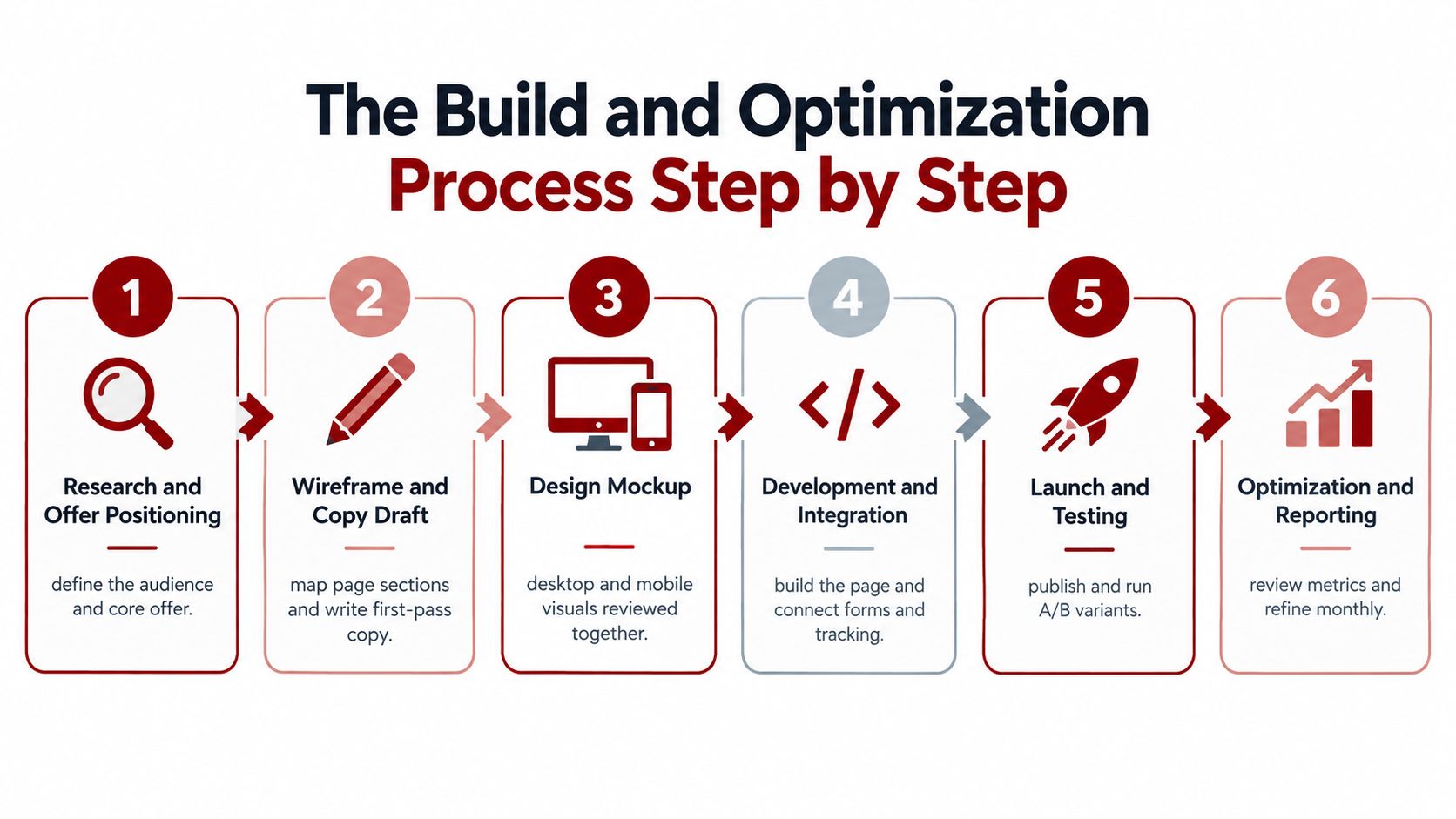
The Build and Optimization Process Step by Step
A Prescott service page can look polished and still waste paid traffic. The build should move through clear gates, with each decision tied to the next stage of the revenue funnel, from click to contact, qualified call, booked appointment, and revenue.
Research and offer positioning
Start by defining the customer, service area, traffic source, competitor language, and desired action. Review campaign data, call recordings when available, search terms, form quality, and sales objections. These inputs reveal whether the page should push calls, forms, or both.
The first checkpoint is a documented offer and a measurable conversion definition. A Prescott electrician may prioritize qualified phone calls. A commercial contractor may need a project-details form that routes directly to a sales coordinator. The choice affects the headline, CTA, form fields, tracking, and response workflow.
Wireframe, copy, and responsive design
A wireframe exposes weak logic before development makes revisions expensive. The copy should state the service, location, customer benefit, proof, process, and next step in language a busy mobile visitor can scan quickly.
Review desktop and mobile layouts together. A mobile page needs thumb-friendly controls, visible contact actions, readable fields, stable content, and sensible spacing. Shrinking a desktop layout is not responsive design. It creates friction at the point where local prospects are ready to call or submit details.
Keep the page focused on one primary action. Secondary choices should support that action rather than compete with it.
Development, accessibility, and on-page SEO
Development turns the approved structure into a working sales asset. Connect the form to the CRM, configure call tracking, preserve entered values after validation errors, display useful error messages, and document what each conversion event means. Set up local SEO markup where it supports the service and location without adding irrelevant content.
Accessibility belongs in the build, not in a final cleanup pass. WCAG 2.2 generally calls for pointer targets of at least 24 by 24 CSS pixels, subject to defined exceptions, and requires a visible keyboard-focus indicator with appropriate size and contrast (WCAG 2.2 standards). A prospect who cannot use the form cannot become a qualified lead.
For form-focused pages, use this landing page with form guide. Paid campaigns also need message match between the ad and post-click page. The guide to PPC landing page optimization provides a useful reference for that review.
Launch and measurement
Before launch, test real phones and browsers, verify form delivery, confirm call attribution, inspect analytics events, and complete a keyboard review. The dashboard should separate page views, CTA clicks, form starts, form completions, calls, qualified leads, and booked appointments.
Google's mobile research associated a 0.1-second speed improvement with a 10.1% increase in conversion rate overall, and reported a 21.6% uplift from the first form step to the submission page after the same improvement (Google's Milliseconds Make Millions report). Treat those figures as sourced findings, not a promise for every Prescott business. They show why speed belongs beside copy, form design, and lead routing.
Optimization over the following cycle
After launch, test meaningful differences rather than random color changes. Compare offer framing, headline, proof placement, form length, call-first versus form-first layouts, and traffic-specific messaging. Review page results with CRM outcomes, because more submissions can still mean fewer qualified opportunities.
A useful cycle runs long enough to produce actionable evidence, then repeats around a defined business question. Judge the work by its effect on cost per qualified lead, cost per booked appointment, response time, and revenue, not by click volume alone.
Pricing Models and What They Really Cost for Local Businesses
Pricing should follow the job, not the agency's preferred billing system. A single service-area launch, an ongoing paid-search program, and a troubled existing page need different levels of research, development, testing, and support.
Pricing Model | Typical Range | Best For | Watch For | Reporting Level |
|---|---|---|---|---|
Flat project fee | $1,500 to $6,000 | One new service or location page | Design-only delivery, limited integrations, no testing | Launch summary and baseline metrics |
Monthly retainer | $2,000 to $5,000 per month | Ongoing Google Ads testing and optimization | Unused hours, unclear ownership, vague deliverables | Monthly funnel and lead-quality reporting |
Hourly or sprint rate | $125 to $250 per hour | Redesigns, targeted experiments, and technical fixes | Scope drift and unpredictable totals | Experiment or sprint report |
A flat fee fits a Prescott contractor launching one focused page for roofing, concrete, HVAC, or another defined service. It should still state whether strategy, copy, development, CRM integration, call tracking, accessibility work, and post-launch revisions are included.
A retainer makes sense when traffic and offers change regularly. The advantage is continuity. The risk is paying for activity without a clear link to qualified calls or booked work. Require a monthly plan that names the tests, pages, reporting, and decisions the team will make.
A sprint works well when the page already has traffic and the problem is narrow. You might need to repair mobile behavior, simplify a form, improve tracking, or test a new hero section rather than rebuild the entire asset.
Low-cost proposals often exclude the parts visitors never see. Speed audits, accessibility remediation, CRM routing, call attribution, conversion copy, and split testing can disappear from the scope while the mockup remains prominent. Before comparing prices, compare the actual system each proposal delivers.
For a broader view of agency structures, review digital marketing agency pricing packages. The right question isn't “Which quote is cheapest?” It's “Which scope gives this business a reliable way to turn qualified traffic into measurable sales conversations?”
ROI Expectations Tied to Speed, Copy, and Response Time
A Prescott landing page can raise conversion rates and still fail to raise revenue. A form submission is only an opportunity. The business must reach the prospect, confirm the service fit, schedule the work, prepare a quote, and close the job.
Benchmarks provide context, not a target for every local contractor. A 2024 MarketingProfs analysis of more than 57 million conversions across more than 41,000 landing pages found a 6.6% median conversion rate across its dataset. Financial-services pages recorded 8.4%, SaaS pages recorded 3.8%, and email traffic converted at an average of 19.3% (MarketingProfs landing page conversion benchmarks). A roofing page in Prescott should not be judged against a SaaS page or an email campaign.
Track the funnel in business language
Use metrics that connect the page to booked work:
Cost per click: What does it cost to bring a visitor from Google Ads or another channel?
Landing-page conversion rate: How many visitors call, start a form, or submit it?
Lead-to-quote rate: How many inquiries fit the service and receive a real opportunity?
Quote-to-close rate: How many opportunities become customers?
Average job value: What does a closed project contribute before delivery costs?
The calculation is straightforward. Qualified traffic has value only when the page turns more visitors into contacts, routes those contacts correctly, and supports consistent follow-up. A page with fewer inquiries can outperform one with a higher conversion rate if its leads fit the service and produce more booked appointments.
Revenue rule: Optimize for qualified calls and booked appointments, not the prettiest conversion-rate chart.
Copy must also make the offer easy to understand. The same MarketingProfs benchmark analysis reported a 11.1% median conversion rate for pages written at a fifth- to seventh-grade reading level, compared with 5.3% for pages written at a college reading level. Plain language does not make a contractor look unrefined. It clarifies the service, location, proof, and next step.
Speed is only valuable when operations are ready
A fast page still loses money if its form sends leads to the wrong inbox. Clear copy fails when a call goes unanswered or a submission waits untouched. Lead routing, confirmation messages, staff ownership, call tracking, and CRM status definitions belong in the ROI model.
Set up reporting to answer operational questions: Which campaign produced the lead? Did the prospect call or submit? Was the request serviceable? How quickly did someone respond? Was an appointment booked? Which source produced revenue?
Review page performance alongside sales outcomes. The site speed optimization resource can help identify technical problems, but speed work must sit beside conversion tracking and CRM review. A better diagnostic score does not compensate for slow follow-up, broken routing, or calls that never reach a person. For local businesses in Prescott and Northern Arizona, those handoff failures can raise the cost per qualified call even when the page looks polished.
How to Choose the Right Prescott Landing Page Agency
A landing page can look polished and still produce expensive, poorly handled leads. Choose an agency that can explain the page, the handoff after a form submission or phone click, and the effect on cost per qualified call for a Prescott-area business.
Ask for engineering evidence
Request Core Web Vitals results before and after launch, preferably from field data rather than a polished lab screenshot. Ask how the team handles large hero images, third-party scripts, layout shifts, delayed interactions, and mobile form behavior. A provider should connect these technical choices to page speed and lead completion, not present performance as a decorative score.
Accessibility questions should be concrete. Ask whether the page supports keyboard navigation, visible focus states, adequate contrast, usable labels, readable error messages, and touch targets that meet WCAG guidance. WCAG 2.2 guidance on 24 by 24 CSS pixel pointer targets and focus indicators provides practical tests of whether the team has considered visitors beyond desktop users.
Technical quality remains inconsistent across the web. In 2025, only 48% of mobile websites and 56% of desktop websites achieved good Core Web Vitals, while 94.8% of the top one million homepages failed at least one WCAG accessibility test (web performance and accessibility statistics). Use those figures as a warning. A professional-looking page is not automatically fast, accessible, or ready to convert.
Ask how leads move after submission
The provider should show the path from form completion or phone click to CRM record, notification, assignment, follow-up, and sales outcome. Ask whether call tracking separates campaign calls from existing customers and whether reporting distinguishes spam, duplicates, unqualified inquiries, booked appointments, and closed work.
Case studies should report outcomes that affect revenue when clients permit disclosure. Page views and button clicks are weak evidence. Ask for qualified-lead volume, booked calls, cost per qualified lead, or revenue attribution.
Check local relevance and ownership
The page should use accurate references to Prescott, Prescott Valley, Chino Valley, Dewey-Humboldt, and other actual service areas. It should connect properly with the business's Google Business Profile and keep name, address, phone, service, and location information consistent.
Retain access to the domain, hosting, analytics, advertising accounts, CRM integrations, design files, and page content. Review ownership, cancellation, revision limits, reporting, and post-launch support in the contract. A vague handoff clause can turn a low initial fee into an expensive dependency.
Silva Marketing is a Prescott-based option for custom websites, redesigns, SEO, Google Ads, conversion-focused landing pages, and analytics setup. Its relevant fit is local service-area knowledge combined with work focused on speed, clarity, tracking, and qualified lead flow. Before comparing providers, review this guide on how to choose a web design agency.
Common Questions About Landing Page Design Services
How long does a landing page project take?
Timing depends on the number of services and locations, the condition of existing copy and assets, the required integrations, and the review process. A focused page can move quickly when the offer, brand assets, access, and decision-maker are ready. A multi-location campaign with custom copy, CRM routing, accessibility work, and testing needs more coordination.
Ask for milestones rather than a single delivery date. The proposal should identify research, wireframe approval, copy review, design, development, testing, launch, and post-launch measurement.
Should I redesign the page or optimize what I have?
Optimize an existing page when it receives relevant traffic, loads reliably, has usable tracking, and has a structure worth improving. Start over when the offer is unclear, the page attracts the wrong intent, the code prevents meaningful fixes, the form routing is broken, or the design doesn't support mobile visitors.
The decision should come from evidence, not preference. Review search terms, calls, form quality, device performance, and sales outcomes before approving a full rebuild.
Who owns the landing page after the project?
Your contract should state that clearly. Confirm ownership and access for the domain, hosting, analytics, advertising accounts, CRM connection, call-tracking configuration, copy, design files, and source code. If the provider hosts the page, ask what happens when the relationship ends.
How does landing page design support local SEO?
A landing page supports local search when it clearly explains the service, accurately identifies the location, provides useful local context, and connects with consistent business information. It doesn't replace a complete local SEO strategy or a well-maintained Google Business Profile.
Google says local ranking relies on relevance, distance, and prominence, with prominence including links, directory information, and reviews from other websites (Google's local ranking guidance). For Prescott and Northern Arizona businesses, that means a page should support legitimate local signals, including accurate service areas, relevant directories, customer reviews, and links from credible local organizations. Design helps visitors trust the business, but it can't compensate for inaccurate profile data or weak local authority.
Silva Marketing offers custom, conversion-focused landing pages for Prescott and Northern Arizona businesses, with mobile-ready design, copy, analytics, SEO, and Google Ads support connected to real lead outcomes. Visit Silva Marketing to request a free consultation and discuss whether your current page needs a focused optimization plan or a complete rebuild.
Comments